Unlocking Protein Dynamics with HDX-MS: A Comparative Guide for Structural Biology and Drug Discovery
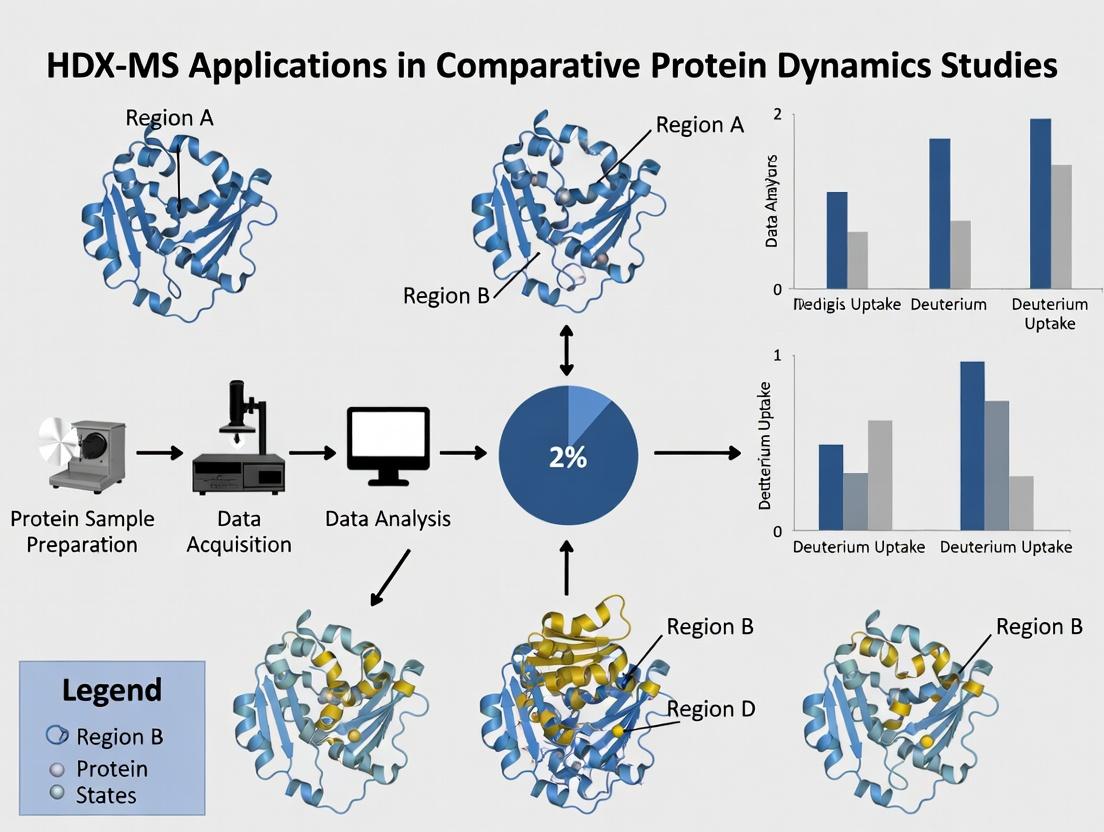
Hydrogen-Deuterium Exchange Mass Spectrometry (HDX-MS) has emerged as a powerful biophysical technique for probing protein dynamics, conformation, and interactions.
Unlocking Protein Dynamics with HDX-MS: A Comparative Guide for Structural Biology and Drug Discovery
Abstract
Hydrogen-Deuterium Exchange Mass Spectrometry (HDX-MS) has emerged as a powerful biophysical technique for probing protein dynamics, conformation, and interactions. This article provides a comprehensive overview for researchers and drug development professionals on applying HDX-MS in comparative studies. We cover foundational principles, detailed workflows for comparing protein states (e.g., wild-type vs. mutant, ligand-bound vs. free), strategies for troubleshooting data acquisition and analysis, and methods for validating and benchmarking HDX-MS findings against complementary techniques like cryo-EM and X-ray crystallography. The guide synthesizes current best practices to enable robust, insightful comparisons of protein dynamics that inform mechanistic understanding and therapeutic development.
HDX-MS Fundamentals: Understanding the Core Principles of Protein Dynamics Analysis
What is HDX-MS? Defining the Technique and Its Unique Advantages.
Hydrogen-Deuterium Exchange Mass Spectrometry (HDX-MS) is a powerful analytical technique used to probe the conformational dynamics and interactions of proteins in solution. It measures the exchange of backbone amide hydrogens with deuterium atoms from the surrounding solvent. The rate of this exchange is influenced by solvent accessibility and hydrogen bonding, providing insights into protein folding, dynamics, ligand binding, and protein-protein interactions. When integrated into a broader thesis on comparative protein dynamics studies, HDX-MS serves as a critical tool for quantifying and comparing conformational changes across different protein states, mutants, or in the presence of various binding partners, offering a unique window into functional mechanisms.
Unique Advantages of HDX-MS
- Sensitivity to Conformational Change: Detects subtle dynamics and allostery often invisible to crystallography.
- Solution-Phase Analysis: Studies proteins under near-native, physiological conditions.
- Low Sample Consumption: Requires picomole to nanomole quantities of protein.
- High Structural Resolution: Provides data at peptide-level resolution (5-15 amino acids).
- No Molecular Size Limit: Effective for large proteins, complexes, and membrane proteins.
- Comparative Focus: Ideally suited for differential studies between related states.
Application Notes in Comparative Dynamics Studies
Table 1: Key Comparative HDX-MS Studies and Quantitative Findings
| Study Focus | Protein System | Key Comparative Finding (ΔHDX) | Biological Insight |
|---|---|---|---|
| Ligand-Induced Stabilization | Kinase Domain (e.g., BCR-ABL) | Deuteration decreased by 40-70% in activation loop upon inhibitor binding. | Maps allosteric networks and classifies inhibitor mechanisms. |
| Protein-Protein Interaction | Receptor:Co-activator Complex | Protection (>50% reduction) localized to a specific binding interface helix. | Defines precise epitopes for disruptive mutations or competitive drugs. |
| Mutant vs. Wild-Type Dynamics | Oncology-related p53 mutant | Increased deuteration (≥30%) in the DNA-binding core, distant from mutation site. | Reveals long-range destabilization effects driving loss-of-function. |
| Biosimilar Characterization | Monoclonal Antibody (Fab region) | ΔHDX < 10% across all peptides compared to originator. | Provides high-resolution evidence of conformational equivalence. |
Experimental Protocols
Protocol 1: Standard Continuous-Labeling HDX-MS Workflow for Comparative Studies
Objective: To compare conformational dynamics between two protein states (e.g., apo vs. ligand-bound). Key Reagent Solutions: See "The Scientist's Toolkit" below.
Sample Preparation:
- Prepare matched protein samples (e.g., 5 µM in PBS) for each state (Control and Perturbed). Use buffer exchange if necessary.
- For the perturbed state, incubate protein with ligand/drug/binding partner at appropriate stoichiometry.
Deuterium Labeling:
- Dilute 5 µL of protein sample 1:10 into deuterated buffer (e.g., PBS in D₂O, pD 7.4).
- Incubate at controlled temperature (e.g., 25°C) for multiple time points (e.g., 10s, 1min, 10min, 1h, 4h).
Quenching & Digestion:
- Stop exchange by adding quench solution (equal volume, pre-chilled to 0°C) to lower pH to 2.5.
- Immediately pass quenched sample over an immobilized pepsin column (2°C) for online digestion (~1 min).
LC-MS Analysis:
- Trap and desalt peptides on a C18 trap column (2°C).
- Separate peptides using a C18 UPLC column with a fast acetonitrile gradient (0.4°C).
- Analyze with a high-resolution mass spectrometer (e.g., Q-TOF, Orbitrap) in positive ion mode.
Data Processing:
- Identify peptides using MS/MS of undeuterated samples.
- Measure centroid mass of each peptide isotopic envelope for each time point and state.
- Calculate deuterium uptake (Da or %). Statistical comparison (e.g., t-test) to identify significant ΔHDX between states.
Protocol 2: Differential HDX-MS Analysis for Epitope Mapping
Objective: To localize the binding interface of a protein-protein complex.
- Follow Protocol 1 for three samples: Protein A alone, Protein B alone, and the A:B complex.
- Ensure molar ratios favor complex formation (e.g., 1:1.2).
- Process data to calculate ΔΔHDX = (UptakeComplex) - (UptakeFree).
- Significant protection (negative ΔΔHDX) in either protein identifies the interaction interface. Significant deprotection (positive ΔΔHDX) may indicate allosteric changes.
Visualizations
HDX-MS Comparative Study Workflow
Factors Influencing H/D Exchange Rate
The Scientist's Toolkit
Table 2: Essential Research Reagent Solutions for HDX-MS
| Item | Function & Critical Specification |
|---|---|
| Deuterium Oxide (D₂O) | Labeling solvent. Purity ≥99.9% D; buffered to desired pD (pHread + 0.4). |
| Quench Buffer | Stops exchange by lowering pH and temperature. Typically 100-400 mM phosphate/ glycine, pH 2.2-2.5, 0°C. May contain denaturant (e.g., GnHCl). |
| Immobilized Pepsin Column | Enzymatically digests protein under quench conditions. Provides rapid, reproducible digestion at 0-2°C. |
| UPLC System with Peltier Cooling | Chromatographically separates peptides at low temperature (0°C) to minimize back-exchange. |
| Reverse-Phase LC Column | Desalts and separates peptides. C18 or C8 material, 1.7-2.1 mm diameter. |
| High-Resolution Mass Spectrometer | Accurately measures mass shifts from H to D exchange. Q-TOF, Orbitrap, or time-of-flight instruments are standard. |
| HDX-MS Data Processing Software | (e.g., HDExaminer, DynamX, Mass Spec Studio) Automates peptide identification, deuterium uptake calculation, and differential analysis. |
The Physics and Chemistry Behind Hydrogen-Deuterium Exchange.
Within the framework of a thesis on HDX-MS applications in comparative protein dynamics studies, understanding the fundamental physicochemical principles is paramount. This document details the core physics and chemistry governing Hydrogen-Deuterium Exchange (HDX), providing application notes and protocols essential for researchers, scientists, and drug development professionals to design robust experiments for comparing conformational dynamics, ligand binding, and protein-protein interactions.
Physicochemical Foundations of HDX
HDX exploits the exchange of labile hydrogen atoms (bound to Nitrogen, Oxygen, or Sulfur) in a protein with deuterium atoms from the solvent. The rate of exchange is governed by two principal factors:
- Chemical Base-Catalyzed Exchange: The intrinsic chemical rate (kch) at which a given peptide bond amide hydrogen exchanges with solvent. This is influenced by pH and temperature and follows the relationship: kch = kA[H+] + kB[OH-] + kW, where kA, kB, and kW are rate constants for acid, base, and water-catalyzed exchange. Near neutral pH, base catalysis dominates.
- Protein Structural Dynamics: The transient unfolding or breathing motions of the protein that expose the amide hydrogen to solvent. This is described by the model: kex = (kop * kch) / (kcl + kch), where kex is the observed exchange rate, kop is the opening rate, and kcl is the closing rate.
The observed exchange rate (kex) thus reports directly on local conformational dynamics and solvent accessibility.
Quantitative Data: Intrinsic Chemical Exchange Rates
Table 1: Representative intrinsic chemical exchange rates (kch) for amide hydrogens under standard HDX conditions (pH 7.0, 25°C).
| Amino Acid Sequence Context | Approximate kch (min⁻¹) | Half-life (t1/2) |
|---|---|---|
| Fast-Exchanging (Side chains, N-termini) | >10³ | < 1 second |
| Solvent-Exposed, Unstructured Amide | ~10 | ~4 seconds |
| Protected Amide (in β-sheet) | 0.1 - 1 | ~1-7 minutes |
| Highly Protected Amide (core α-helix) | <0.01 | >70 minutes |
Core HDX-MS Experimental Protocol for Comparative Dynamics
This protocol outlines a standard, continuous-labeling HDX-MS experiment for comparing protein states (e.g., apo vs. ligand-bound).
Protocol: Comparative HDX-MS Workflow
A. Pre-Experimental Preparation
- Protein Preparation: Dialyze or desalt purified protein (>90% purity) into the desired non-deuterated reaction buffer (e.g., 20 mM phosphate, 50 mM NaCl, pH 7.0). Confirm protein concentration and integrity via SDS-PAGE or ESI-MS.
- Deuterated Buffer Preparation: Prepare identical buffer composition in D2O (99.9% D). Adjust pD using the relationship pD = pH(read) + 0.4. Filter (0.22 µm).
- Quench Buffer Preparation: Prepare a low-pH, low-temperature quench solution (e.g., 0.1% Formic Acid, 4M Guanidine HCl, chilled to 0°C). This drops pH to ~2.5 and denatures the protein, slowing exchange (kch is minimal) for analysis.
B. Deuterium Labeling Reaction
- Initiate exchange by diluting the protein solution 1:10 (v/v) into the deuterated buffer. For time-course studies, prepare separate reactions for each time point (e.g., 10s, 1min, 10min, 1h, 4h).
- Incubate at a constant, controlled temperature (e.g., 25°C).
- At each time point, withdraw an aliquot and immediately mix with a pre-chilled quench buffer (1:1 v/v) to reduce pH to ~2.5 and temperature to ~0°C.
C. Sample Processing and Analysis
- Digestion: Immediately inject the quenched sample onto an immobilized pepsin column (or equivalent protease) held at 0°C. Digest for ~1 minute.
- Chromatography: Trap and desalt peptides on a C8/C18 trap column, then separate via reversed-phase UPLC with a steep, fast gradient (~8-10 minutes) maintained at 0°C.
- Mass Spectrometry: Analyze eluting peptides using a high-resolution mass spectrometer (e.g., Q-TOF, Orbitrap) with electrospray ionization. Minimize source heating.
- Data Processing: Use specialized software (e.g., HDExaminer, DynamX) to identify peptides, calculate centroid masses, and determine deuterium incorporation for each peptide at each time point.
Workflow and Data Analysis Visualization
Title: HDX-MS Comparative Dynamics Workflow
Title: HDX Kinetics: Protection & Exchange
The Scientist's Toolkit: Key Research Reagent Solutions
Table 2: Essential Materials for HDX-MS Experiments.
| Item / Reagent | Function & Critical Notes |
|---|---|
| Ultra-Pure D₂O (99.9% D) | Source of deuterium for exchange. Purity is critical to minimize back-exchange from H₂O contaminants. |
| Deuterium-Compatible Buffer Salts | Required to maintain pH/pD and ionic strength. Must be lyophilized from H₂O and reconstituted in D₂O. |
| Quench Solution (e.g., 0.1% FA, 4M GdnHCl) | Rapidly lowers pH to ~2.5 and denatures protein, slowing exchange (kch) to negligible rates for analysis. Must be chilled to 0°C. |
| Immobilized Pepsin Column | Provides rapid, efficient digestion at low pH (0°C) to minimize back-exchange during processing. |
| C8/C18 Trap & Analytical UPLC Columns | For peptide desalting and separation. Systems must be housed in a refrigerated chamber (0-4°C). |
| High-Resolution Mass Spectrometer (Q-TOF/Orbitrap) | Essential for accurately measuring small mass shifts (+1 Da per D incorporated) in complex peptide mixtures. |
| HDX Data Processing Software (e.g., HDExaminer, PLGS) | Specialized software for automated peptide identification, centroid mass calculation, deuterium uptake determination, and statistical comparison between states. |
Within the broader thesis that Hydrogen-Deuterium Exchange Mass Spectrometry (HDX-MS) is a transformative tool for comparative protein dynamics studies, the interpretation of deuteration patterns stands as the central analytical challenge. These patterns—the location, magnitude, and kinetics of deuterium incorporation—encode a rich dataset on protein conformational dynamics, allostery, and solvent accessibility. This application note details how to decode these patterns to extract meaningful biological and biophysical insights, with direct application in drug discovery for comparing ligand-bound states, mapping epitopes, and assessing biotherapeutic stability.
Interpreting Deuteration Patterns: A Data Framework
Deuteration data is multi-dimensional, encompassing time, sequence space, and isotopic abundance. The following table categorizes primary readouts and their biophysical correlates.
Table 1: Deuteration Pattern Readouts and Their Dynamic Correlates
| Pattern Readout | Typical Data Form | Biophysical Interpretation | Implication for Solvent Accessibility |
|---|---|---|---|
| Relative Deuteration | %D or Da increase per peptide/region | Level of backbone amide exposure/protection. | High %D suggests high solvent accessibility or unstructured region. |
| Deuteration Kinetics | Uptake curve (D vs. time) | Exchange rate constant (kex), reveals local stability. | Fast phase: solvent-exposed, flexible. Slow phase: buried/hydrogen-bonded. |
| Deuteration Plateau | Maximum achievable %D | Thermodynamic stability of folded core; H-bonding network. | Regions that never plateau are dynamically disordered or fully solvent-accessible. |
| Bimodal Isotopic Distribution | Mass envelopes with multiple peaks | Coexistence of distinct conformational states. | Populations with different solvent accessibilities are in slow exchange on the HDX timescale. |
| Differential Deuteration (ΔD) | Δ%D or ΔDa between states (e.g., ±ligand) | Conformational change or altered dynamics upon perturbation. | Negative ΔD (protection): binding, stabilization, reduced accessibility. Positive ΔD (de-protection): allosteric opening, destabilization. |
Detailed Experimental Protocol: Comparative HDX-MS for Ligand Binding Studies
Objective: To identify and characterize the binding interface and allosteric effects of a small-molecule inhibitor on a target protein kinase.
I. Sample Preparation
- Protein Buffer Exchange: Desalt target protein into HDX-compatible buffer (e.g., 20 mM phosphate, 50 mM NaCl, pH 7.4) using a centrifugal desalting column. Final concentration: 10 µM.
- Ligand Complex Formation: Incubate protein with a 5-fold molar excess of inhibitor for 1 hour at 4°C. Prepare an identical DMSO-only sample as the apo control.
- Quench Solution: Prepare fresh: 4 M Guanidine-HCl, 0.5 M TCEP, in 0.5% formic acid, pH ~2.3. Keep on ice.
- Deuterated Buffer: Prepare identical buffer as in step 1, but using 99.9% D₂O, pDread = pHread + 0.4.
II. HDX Labeling Reaction
- Initiate exchange by diluting 5 µL of protein sample (apo or complex) with 45 µL of deuterated buffer. Incubate at 25°C.
- Use a range of time points (e.g., 10 s, 1 min, 10 min, 1 h, 4 h).
- At each time point, withdraw 25 µL of labeling mix and add to 25 µL of pre-chilled quench solution, vortexing immediately. Final pH ~2.5, T ~0°C. Exchange is effectively stopped (t₁/₂ > 1h).
III. Mass Spectrometry Analysis
- Digestion & Chromatography: Inject quenched sample onto an immobilized pepsin column at 0°C. Digest for ~1 minute.
- Trap peptides on a C18 trap column and separate via a 7-minute gradient (5-35% acetonitrile in 0.1% formic acid) at 0°C.
- Mass Analysis: Use a high-resolution mass spectrometer (e.g., Q-TOF, Orbitrap). Acquire data in ESI-positive mode with m/z range 300-2000.
IV. Data Processing
- Identify non-deuterated peptides using standard LC-MS/MS (data-dependent acquisition).
- For each deuterated sample, process centroided data using dedicated HDX software (e.g., HDExaminer, DynamX).
- Correct for back-exchange by comparing the theoretical maximum deuteration with the observed deuteration of a fully-deuterated standard.
- Calculate deuteration levels (Da or %D) for each peptide at each time point. Generate uptake curves and calculate differential deuteration (ΔD) between apo and complex states.
Visualization of HDX-MS Workflow & Data Logic
Diagram Title: HDX-MS Experimental Data Generation Workflow
Diagram Title: Logic of Deuteration Pattern Interpretation
The Scientist's Toolkit: Key Reagent Solutions for HDX-MS
Table 2: Essential Research Reagents & Materials for HDX-MS
| Item | Function & Critical Specification |
|---|---|
| D₂O (99.9% atom D) | Deuterium labeling source. High isotopic purity is essential for accurate measurements. |
| Deuterium-Compatible Buffer Salts | To prepare labeling buffer. Must be volatile (e.g., ammonium salts) or MS-compatible (e.g., phosphates). |
| Quench Solution (Low pH, Denaturing) | Halts HDX by lowering pH to ~2.5 and denaturing protein. Typically contains FA/GdnHCl/TCEP. |
| Immobilized Pepsin Column | Provides rapid, consistent digestion at quench conditions (pH 2.5, 0°C) for peptide-level resolution. |
| UPLC System with Temperature-Controlled Autosampler & Column Chamber | Maintains samples at 0°C post-quench to minimize back-exchange during analysis. |
| C18 Trap & Analytical Columns | For rapid desalting and separation of peptides prior to MS injection. |
| High-Resolution Mass Spectrometer (Q-TOF, Orbitrap) | Resolves subtle mass shifts from deuterium incorporation (Da differences). High mass accuracy is critical. |
| HDX Data Processing Software (e.g., HDExaminer, PLGS, HDX Workbench) | Automates peptide identification, deuterium uptake calculation, back-exchange correction, and visualization. |
Hydrogen-Deuterium Exchange Mass Spectrometry (HDX-MS) is a powerful analytical technique for probing protein conformation and dynamics. In a comparative framework, HDX-MS provides unparalleled insights into the structural perturbations induced by ligand binding, point mutations, protein-protein interactions, and changes in environmental conditions. This Application Note details the rationale and protocols for employing comparative HDX-MS within a thesis focused on protein dynamics, aimed at researchers and drug development professionals seeking to understand functional mechanisms and drive therapeutic discovery.
Key Applications & Rationale
Comparative HDX-MS measures differences in deuterium uptake rates between protein states. Increased protection indicates decreased solvent accessibility, often from binding or stabilization. Increased deuterium uptake suggests conformational opening, destabilization, or allostery.
1. Protein States (e.g., Ligand Bound vs. Apo): Reveals binding sites and allosteric changes, critical for drug mechanism-of-action studies. 2. Mutants (Wild-type vs. Variant): Quantifies structural impacts of point mutations, linking genotype to phenotype in disease and engineering. 3. Complexes (Free Protein vs. Protein-Protein/Protein-Ligand Complex): Maps interaction interfaces and long-range conformational changes.
Table 1: Example Comparative HDX-MS Data Output for a Hypothetical Protein Kinase (Data from Simulated Experiment)
| Peptide Sequence (Residues) | WT Deut. Uptake (3 min) | Mutant Deut. Uptake (3 min) | ΔDeuterium (Mut-WT) | Implication |
|---|---|---|---|---|
| LKDLIARN (100-107) | 2.1 ± 0.2 | 4.3 ± 0.3 | +2.2 | Mutant shows destabilization in activation loop |
| VAVKIL (30-35) | 1.0 ± 0.1 | 0.9 ± 0.1 | -0.1 | No significant change |
| HRDIKA (150-155) | 3.5 ± 0.2 | 2.0 ± 0.2 | -1.5 | Increased protection, possible stabilizing interaction |
Table 2: Key Statistical Metrics for Comparative HDX-MS Analysis
| Metric | Typical Threshold for Significance | Purpose |
|---|---|---|
| ΔDeuterium (Da) | ≥ ±0.5 Da (and beyond error) | Magnitude of change |
| p-value (paired t-test) | < 0.01 | Statistical significance |
| Minimum # of Replicates | 3 (biological or technical) | Ensure robustness |
Experimental Protocols
Protocol 1: Standard Comparative HDX-MS Workflow
Objective: Compare deuterium uptake between two protein states (e.g., wild-type and mutant).
Materials: See "Scientist's Toolkit" below.
Procedure:
- Sample Preparation: Prepare both protein states in identical buffer conditions (e.g., 20 mM HEPES, 150 mM NaCl, pH 7.4). Ensure precise concentration matching (e.g., 10 µM).
- Deuterium Labeling:
- Dilute protein 10-fold into D₂O-based labeling buffer. Final D₂O concentration is 90%.
- Incubate at 4°C (or desired temperature) for multiple time points (e.g., 10 sec, 1 min, 10 min, 1 hr, 4 hr).
- Quenching: At each time point, mix labeling reaction 1:1 with pre-chilled quench buffer (0.1% Formic Acid, 2M Guanidine HCl, pH 2.5) to drop pH to ~2.5 and temperature to 0°C.
- Digestion & Separation: Immediately inject quenched sample onto a cooled (0°C) UPLC system with an immobilized pepsin column. Digest for ~1 min. Peptides are trapped and separated on a C18 column with a fast gradient (8-40% Acetonitrile in 0.1% Formic Acid over 7 min).
- Mass Spectrometry Analysis: Eluted peptides analyzed by high-resolution MS (e.g., Q-TOF or Orbitrap). Use data-dependent or targeted MS/MS for peptide identification in separate undeterated samples.
- Data Processing: Use dedicated software (HDExaminer, DynamX, Deuteros) to process deuterium uptake for each peptide across time points for both states.
- Comparative Analysis: Software calculates ΔDeuterium uptake and statistical significance (e.g., Welch's t-test) between states at each time point. Results visualized as butterfly or difference plots.
Protocol 2: Focused Protocol for Ligand Binding Studies
Objective: Map the binding interface of a small molecule inhibitor.
Modification to Protocol 1:
- Step 1: Prepare Apo protein and protein saturated with ligand (e.g., 10:1 molar ratio ligand:protein). Use ligand solvent (e.g., DMSO) in both samples, controlling for concentration.
- Analysis: Focus on peptides showing significant protection (negative ΔDeuterium) at early time points, indicating direct binding or fast stabilization.
Protocol 3: Protocol for Studying Protein Complexes
Objective: Determine interface and allosteric changes upon protein-protein interaction.
Modification to Protocol 1:
- Step 1: Prepare free protein A and the pre-formed complex of protein A with protein B at a defined stoichiometry. Use size-exclusion chromatography to purify the complex if necessary.
- Analysis: Look for protected regions (interface) and potential distant regions with increased or decreased dynamics (allostery).
Diagrams
Comparative HDX-MS Experimental Workflow
Rationale for Comparative HDX-MS Studies
The Scientist's Toolkit
Table 3: Essential Research Reagent Solutions for Comparative HDX-MS
| Item | Function & Rationale |
|---|---|
| Ultra-pure D₂O (99.9%) | Primary labeling agent; purity critical for consistent exchange rates and low background. |
| Quench Buffer (0.1% FA, 2M GdnHCl, pH 2.5) | Rapidly lowers pH and temperature to halt exchange; chaotrope aids unfolding for consistent digestion. |
| Immobilized Pepsin Column | Provides rapid, reproducible digestion at low pH and temperature (0-4°C) to minimize back-exchange. |
| C18 UPLC Column (1.0 mm ID, sub-2µm particles) | Enables fast, high-resolution peptide separation at 0°C to minimize back-exchange during analysis. |
| High-Resolution Mass Spectrometer (Q-TOF/Orbitrap) | Provides the mass accuracy and resolution needed to resolve isotopic envelopes of labeled peptides. |
| HDX-MS Data Processing Software (e.g., HDExaminer, DynamX) | Automates peptide finding, deuterium uptake calculation, and comparative statistical analysis. |
| Buffer-Matched Control Samples | Essential for controlling for non-specific buffer/pH effects between comparative states. |
| Precision Temperature-Controlled Chamber | Maintains exact temperature during labeling and quenching for reproducibility between runs. |
Essential Equipment and Software for Modern HDX-MS Workflows
This document provides detailed application notes and protocols, framed within a broader thesis exploring Hydrogen-Deuterium Exchange Mass Spectrometry (HDX-MS) applications in comparative protein dynamics studies. Such comparative analyses are central to understanding conformational changes induced by ligand binding, mutations, or protein-protein interactions, which is foundational for mechanistic biochemistry and structure-based drug design.
Core Equipment and Software Ecosystem
The modern HDX-MS workflow is a multi-step process requiring specialized, integrated equipment and software. The following table summarizes the essential components.
Table 1: Essential Equipment for an HDX-MS Laboratory
| Category | Specific Equipment | Key Function in HDX-MS | Critical Specifications |
|---|---|---|---|
| Sample Handling | Automated Liquid Handler | Performs precise, reproducible deuteration labeling and quenching reactions at controlled temperatures (typically 0°C and 20-25°C). Minimizes manual handling errors and enables high-throughput studies. | Temperature control accuracy (±0.1°C), syringe precision (≤1% CV), inert material (e.g., PEEK) to minimize adsorption. |
| Digestion & Separation | UPLC System with Cooling | Rapid, reproducible online pepsin digestion and chromatographic separation of peptides under quenched conditions (low pH, 0°C) to minimize back-exchange. | Peptide trap and analytical column (C18), system capable of maintaining 0°C in the sample manager and column compartment. |
| Mass Spectrometry | High-Resolution Mass Spectrometer | Measures the mass increase of peptides due to deuterium incorporation. High resolution and mass accuracy are required to resolve isotopic envelopes. | Time-of-Flight (Q-TOF) or Orbitrap mass analyzers; Resolution >20,000 FWHM; fast acquisition rates for UPLC peaks. |
| Data Acquisition | HDX-MS Specific Software | Controls the entire automated workflow, synchronizing the liquid handler, UPLC, and MS for timed labeling experiments. | Vendor-specific (e.g., LEAP PAL HDX, Waters HDX Manager) or open-platform (Chronos) software. |
Table 2: Essential Software for HDX-MS Data Analysis
| Software Name | Primary Function | Key Features for Comparative Dynamics | License Type |
|---|---|---|---|
| HDExaminer | Processing raw MS data for deuterium uptake. | Automated peptide identification, deuterium uptake calculation, statistical analysis for significance between states (ΔD, Δ%Δ), visualization via butterfly and difference plots. | Commercial |
| DynamX (Waters) | Native data processing for Waters SYNAPT or SELECT SERIES instruments. | Time-course visualization, difference mapping, comparative analysis tools. | Commercial |
| HDX Workbench | Open-source platform for data processing and visualization. | Supports data from multiple MS platforms, peptide validation tools, deuterium uptake calculation, and generation of uptake plots and difference maps. | Free/Open Source |
| PyHDX / MemHDX | Advanced kinetic analysis and modeling. | Fitting exchange data to kinetic models, estimating free energy (ΔG) of opening, generating structural protection factor maps. | Free/Open Source |
| ChromaS (or similar) | Controls automated HDX platform. | Schedules labeling reactions, manages sample queue, integrates liquid handler, UPLC, and MS. | Commercial/Open |
Detailed Experimental Protocol for a Comparative HDX-MS Study
Protocol: Comparative HDX-MS Analysis of a Protein in Apo and Ligand-Bound States
Thesis Context: This protocol enables the direct comparison of protein dynamics between two functional states, a core application in thesis research aimed at elucidating the mechanistic basis of allostery or inhibitor binding.
I. Pre-Experiment Planning & Sample Preparation
- Materials: Purified protein (>95% purity, ≥0.1 mg/mL in suitable buffer), ligand of interest, deuterated buffer (e.g., 20 mM Tris, 100 mM NaCl, pD 7.4), quench buffer (0.1 M phosphate or 0.1% formic acid in H₂O, pH 2.3, 0°C).
- Procedure:
- Prepare apo protein sample in non-deuterated labeling buffer.
- Prepare ligand-bound sample by incubating protein with a molar excess of ligand (typically 2-5x Kd) to ensure >95% saturation. Use matched buffer conditions.
- Equilibrate both samples to the labeling temperature (e.g., 25°C) prior to initiation.
II. Deuterium Labeling Reaction
- Equipment: Automated liquid handler with temperature-controlled chambers.
- Procedure:
- Program the liquid handler to mix 5 µL of protein sample (apo or bound) with 55 µL of deuterated buffer, initiating labeling.
- Perform labeling at multiple time points (e.g., 10 s, 1 min, 10 min, 1 h, 4 h) to capture exchange kinetics.
- For each time point, automatically quench the reaction by transferring 50 µL of the labeling mix into 50 µL of pre-chilled (0°C) quench buffer, lowering pH to ~2.5 and temperature to 0°C.
III. Online Digestion and Separation
- Equipment: UPLC system with cooling module and immobilized pepsin column.
- Procedure:
- Immediately inject the 100 µL quenched sample onto the system held at 0°C.
- Peptides are generated by flowing the sample over an immobilized pepsin column (2.1 mm x 30 mm, held at 10-15°C).
- Resulting peptides are trapped on a C18 trap column and subsequently separated by reverse-phase UPLC (C18 column, 8-10 min gradient of 5-40% acetonitrile in 0.1% formic acid at 0°C).
IV. Mass Spectrometric Analysis
- Equipment: High-resolution ESI-Q-TOF or Orbitrap mass spectrometer.
- Procedure:
- Eluting peptides are ionized via electrospray ionization.
- Perform data-dependent acquisition (DDA) in positive ion mode for a pooled, non-deuterated sample to identify peptides (MS1 survey scan followed by MS2 fragmentation scans).
- For deuterated samples, perform MS1-only acquisitions with high resolution (>30,000) to accurately measure the centroid mass of each peptide's isotopic envelope across the chromatographic peak.
V. Data Processing and Comparative Analysis
- Software: HDExaminer, DynamX, or HDX Workbench.
- Procedure:
- Peptide Identification: Import MS2 data from the non-deuterated run to generate a peptide list (sequence, retention time, charge state). Manually validate peptide assignments.
- Deuterium Uptake Calculation: For each peptide in each state and at each time point, software calculates the centroid mass of the isotopic distribution. The deuterium uptake (Da) is the difference between the deuterated and non-deuterated centroid masses.
- Back-Exchange Correction: Apply a correction factor based on the maximum theoretical deuterium content of the peptide and a fully-deuterated control sample.
- Comparative Analysis: The software calculates the significant difference in deuterium uptake (ΔD) between the apo and ligand-bound states at each time point (typically using a Student's t-test). Results are visualized as:
- Uptake Curves: Plots of D-uptake vs. time for a peptide in both states.
- Difference Plot (Butterfly Plot): Bar chart showing ΔD across all peptides at a selected time point.
- Difference Map: A color-coded projection of significant ΔD values onto the protein's 3D structure (blue = protection/decreased exchange in bound state; red = deprotection/increased exchange).
Visualized Workflows and Relationships
Title: HDX-MS Workflow for Comparative Dynamics in Thesis Research
Title: Core Steps in a Comparative HDX-MS Experiment
The Scientist's Toolkit: Key Research Reagent Solutions
Table 3: Essential Reagents and Materials for HDX-MS
| Item | Function / Rationale | Critical Considerations for Comparative Studies |
|---|---|---|
| Ultra-Pure D₂O (99.9% D) | Source of deuterium for the labeling reaction. | Consistent isotopic purity is vital for reproducible uptake measurements between experimental runs and states. |
| Deuterium-Free Buffers | Formulation of labeling buffer using D₂O as solvent. pD = pH(read) + 0.4. | Buffer composition (salt, additives) must be identical for all protein states to avoid artifactual differences in exchange. |
| Quench Buffer (0°C) | Stops HDX by dropping pH to ~2.5 and temperature to 0°C, slowing back-exchange. | Must be pre-chilled and consistent. Low salt concentration is often preferred for subsequent LC-MS compatibility. |
| Immobilized Pepsin Column | Provides rapid, reproducible digestion under quench conditions. | Activity and longevity vary; must be consistent throughout the study of all protein states to ensure identical peptide maps. |
| MS-Grade Solvents | Water, acetonitrile, and formic acid for UPLC-MS. | High purity minimizes ion suppression and background noise, ensuring high-quality isotopic envelope data. |
| Stable Protein Prep | Highly purified, monodisperse protein sample. | Conformational homogeneity is critical. Both states (apo/ligand) must be in identical buffer conditions (pH, salts) pre-labeling. |
Comparative HDX-MS Workflows: Step-by-Step Protocols for Real-World Studies
Within the broader thesis on Hydrogen-Deuterium Exchange Mass Spectrometry (HDX-MS) applications in comparative protein dynamics studies, robust experimental design is paramount. This document outlines critical application notes and protocols for planning comparative HDX-MS studies, focusing on the implementation of controls, replicates, and time points to yield statistically significant and biologically relevant data on protein conformational dynamics, ligand interactions, and allosteric modulation.
Core Principles of Comparative HDX-MS Design
Defining Experimental Groups and Controls
A comparative HDX-MS study must include carefully defined groups to isolate the effect of the variable of interest (e.g., ligand binding, mutation, post-translational modification).
Table 1: Essential Experimental Groups for a Ligand-Binding Study
| Group Name | Description | Primary Function in Design |
|---|---|---|
| Apo Protein | Protein in buffer without ligand. | Reference state; defines baseline deuterium uptake. |
| Holo Protein | Protein incubated with saturating ligand concentration. | Test state; identifies ligand-induced protection/destabilization. |
| Vehicle Control | Protein incubated with ligand solvent (e.g., DMSO). | Controls for artifacts from delivery vehicle. |
| Denatured Control | Protein in high denaturant (e.g., 4M GdHCl). | Defines 100% deuterium uptake (max exchange). |
| Zero-Time Point | Quenched immediately after D₂O addition. | Defines 0% deuterium uptake (back-exchange correction). |
Replication Strategy
Replication is non-negotiable for statistical confidence. Two key types must be implemented:
- Technical Replicates: Multiple HDX reactions set up from the same protein sample, processed and analyzed independently through the entire workflow (digestion, LC-MS). Minimum: n=2 per condition per time point.
- Biological Replicates: Protein expressed, purified, and prepared in independent batches. Minimum: n=3 per condition.
Table 2: Minimum Replication Scheme for a Single Time Point Comparison
| Replicate Level | Apo Protein | Holo Protein | Total LC-MS Runs |
|---|---|---|---|
| Biological (n=3) | 3 samples | 3 samples | - |
| Technical (n=2) | 6 runs | 6 runs | 12 |
| Total Runs/Condition | 6 | 6 | 12 |
Time Point Selection
Deuterium uptake is a kinetic measurement. A well-chosen time series captures exchange regimes.
Table 3: Recommended HDX Time Points for a Standard Study
| Time Point | Typical Range | Information Gained |
|---|---|---|
| Short | 10 sec, 30 sec, 1 min | Fast-exchanging regions (solvent-exposed, disordered). |
| Medium | 1 min, 10 min, 1 hour | Moderately exchanging regions (secondary structure, interfaces). |
| Long | 1 hour, 4 hours, 24 hours | Slow-exchanging regions (core, hydrogen-bonded). |
| Quenching | Immediate (3 sec) | 0-second control for back-exchange calculation. |
Detailed Protocol: Comparative HDX-MS for Ligand Binding
Protocol 1: Sample Preparation and Labeling
Objective: To initiate and quench HDX reactions for apo and holo protein states at multiple time points with proper replication.
Materials:
- Purified protein in assay buffer (e.g., 20 mM HEPES, 150 mM NaCl, pH 7.4).
- Ligand stock solution in appropriate vehicle.
- Deuterated buffer (identical pH and ionic strength, pD read as pH + 0.4).
- Quench buffer: 4 M Guanidine HCl, 0.5 M TCEP, pH 2.5 (pre-chilled to 0°C).
- Liquid handling robot (recommended) or precision pipettes.
Procedure:
- Pre-incubation: In a 96-well PCR plate kept at 4°C, dispense 18 µL of protein solution (10 µM) per well. Add 2 µL of ligand solution to "holo" wells and 2 µL of vehicle to "apo" and control wells. Incubate for 30 min at room temperature to ensure binding equilibrium.
- Deuterium Labeling: Using the robot, add 180 µL of pre-chilled D₂O buffer to each well to initiate exchange (10-fold dilution, 90% D₂O final). Mix thoroughly.
- Time Course: For each condition, initiate reactions for all desired time points (e.g., 0.17, 1, 10, 60, 240 min) in parallel.
- Quenching: At each time point, withdraw 50 µL of the labeling reaction and mix with 50 µL of ice-cold quench buffer. Immediately freeze in liquid N₂. Store at -80°C until analysis.
- Controls: Prepare Zero-Time Point by adding quench buffer to protein before adding D₂O buffer. Prepare Fully Deuterated Control by incubating a quenched sample in D₂O quench buffer for >24 hrs at room temperature.
Protocol 2: LC-MS/MS Analysis and Data Processing
Objective: To digest quenched samples, separate peptides, and measure deuterium incorporation.
Materials:
- Immobilized pepsin column or in-line protease cartridge.
- Trap column: C8 or C18, 2.1 mm x 5 mm.
- Analytical column: C18, 1.0 mm x 50 mm, 1.7 µm beads.
- LC buffers: A) 0.1% Formic acid in H₂O; B) 0.1% Formic acid in Acetonitrile.
- High-resolution mass spectrometer (Q-TOF or Orbitrap).
Procedure:
- Digestion & Separation: Thaw samples on ice and inject onto the HDX system maintained at 0°C. Peptides are generated via on-line digestion (e.g., pepsin, 2 min, 0°C). Digest is trapped and desalted for 3 min.
- Chromatography: Peptides are separated via a fast, sharp gradient (e.g., 8-40% B over 7 min) at high flow rate (~100 µL/min) to minimize back-exchange.
- Mass Spectrometry: Data acquired in data-dependent MS/MS mode. Use ESI positive mode. For HDX measurements, use MS1-only mode with high resolution (>30,000).
- Peptide Identification: Use MS/MS data from undeuterated samples searched against a protein database using standard software (e.g., Mascot, PEAKS).
- Deuterium Uptake Calculation: Use dedicated HDX software (e.g., HDExaminer, DynamX). Apply back-exchange correction using the fully deuterated control. Align retention times across all runs.
The Scientist's Toolkit: Key Research Reagent Solutions
Table 4: Essential Materials for Comparative HDX-MS Studies
| Item | Function & Importance |
|---|---|
| Ultra-pure D₂O (99.9% D) | Labeling reagent; purity minimizes H₂O contamination, ensuring accurate deuteration level. |
| Deuterium-Free Buffers | Prepared with minimal H₂O for D₂O stock solutions to maintain correct %D and pH/pD. |
| Acidic Quench Buffer (pH 2.5, 0°C) | Low pH and temperature dramatically reduce exchange rates, "freezing" the labeling state. |
| Immobilized Pepsin Column | Provides rapid, consistent digestion at low pH and temperature (0-4°C), critical for reproducibility. |
| In-line Desalting Trap | Removes salts and buffers before analytical RP-HPLC, improving MS signal and column life. |
| UPLC-grade Solvents (FA, ACN) | High-purity solvents minimize MS background noise and maintain chromatographic consistency. |
| Internal Peptide Standards | Synthetic deuterated peptides used to monitor and correct for LC-MS system variability and back-exchange. |
Visualization of Workflows and Relationships
Title: HDX-MS Comparative Study Planning Workflow
Title: HDX-MS Analysis and Data Generation Protocol
Sample Preparation Best Practices for Consistent Comparative Analysis
Within the broader thesis on Hydrogen-Deuterium Exchange Mass Spectrometry (HDX-MS) applications in comparative protein dynamics studies, consistent sample preparation emerges as the most critical determinant of reproducible data. This protocol details the standardized procedures required to minimize variability, enabling robust comparative analysis of protein conformational dynamics, ligand binding, and protein-protein interactions in drug discovery.
Core Principles & Quantitative Guidelines
Adherence to the following quantitative parameters is essential for comparative HDX-MS studies.
Table 1: Critical Pre-Analysis Sample Parameters for Comparative HDX-MS
| Parameter | Target Specification | Tolerance | Rationale |
|---|---|---|---|
| Protein Purity | >95% (by SDS-PAGE/SE-HPLC) | ±2% | Minimizes signal interference from contaminants. |
| Protein Concentration | 10-50 µM (monomer) | ±5% (inter-sample) | Ensures consistent labeling kinetics and MS signal. |
| Buffer Composition | Matched exactly between states | Zero deviation | Prevents labeling artifacts from pH/ionic differences. |
| pH at Labeling | pH 7.4 (or relevant pH) | ±0.05 units | Deuterium exchange rate is pH-dependent. |
| Sample Temperature | 0-4°C (during prep) | ±1°C | Controls pre-labeling, non-exchanged back-exchange. |
| Redundant Mass Checks | >2 technical replicates | N/A | Ensures sample integrity pre-HDX. |
Table 2: Key HDX Reaction Control Parameters
| Parameter | Optimal Condition | Impact on Comparability |
|---|---|---|
| Deuterium Buffer pD | pH(read) + 0.4 | Must be consistent; directly controls exchange rate. |
| Labeling Time Points | e.g., 10s, 1m, 10m, 1h, 4h | Identical time sets are mandatory for comparison. |
| Quench Solution | Cold low-pH buffer (pH 2.2-2.5) | Halts exchange; identical [GdnHCl] and temperature required. |
| Quench Temperature | 0°C (ice-slurry) | Must be rapid and consistent (±2 sec). |
| Digestion Time | 3-5 min (online) / constant flow | Fixed, reproducible digestion is critical for peptide yield. |
Detailed Experimental Protocols
Protocol 1: Pre-HDX Sample Equilibration and Matching
Objective: To prepare identical protein samples differing only in the variable of interest (e.g., +/- ligand).
- Purified Protein: Dialyze or desalt all protein stocks into identical HDX "starting buffer" (e.g., 20 mM phosphate, 50 mM NaCl, pH 7.4).
- Concentration Verification: Determine concentration using A280 (ensure matched extinction coefficients) in triplicate. Adjust to target concentration (e.g., 25 µM) using starting buffer.
- Ligand/Modifier Addition: For the ligand-bound state, incubate protein with a 3-5x molar excess of ligand for a duration exceeding 5x the binding half-life. For the apo state, add an equal volume of starting buffer.
- Pre-Chilling: Incubate all samples on ice for a minimum of 10 minutes to reach 0-4°C prior to HDX initiation.
- Aliquoting: Aliquot the exact volume required for a single labeling reaction into pre-chilled low-bind tubes. Use these aliquots for the time course to avoid freeze-thaw.
Protocol 2: Standardized HDX Labeling and Quench Workflow
Objective: To initiate and halt deuterium exchange with millisecond reproducibility.
- Deuterium Buffer Preparation: Prepare labeling buffer (e.g., 20 mM phosphate, 50 mM NaCl, pD 7.8) using 99.9% D₂O. Filter (0.22 µm) and pre-chill on ice.
- Initiating HDX: Mix 2 µL of pre-chilled protein aliquot with 18 µL of chilled D₂O buffer using rapid pipetting (completed within 2 seconds). Vortex briefly.
- Labeling Incubation: Hold the reaction tube at a constant temperature (e.g., 25°C) for the precise labeling time (e.g., 10 seconds to 4 hours).
- Quenching: At the designated time, add 30 µL of pre-chilled quench buffer (e.g., 3 M Guanidine-HCl, 0.1% Formic Acid, pH 2.3) to the 20 µL labeling reaction. Mix immediately. Final pH must be <2.5.
- Immediate Analysis or Flash-Freeze: Immediately inject onto the HDX-MS system (digestion and LC-MS) or flash-freeze in liquid N₂ for batch analysis within 1 week.
Protocol 3: On-Line Digestion and LC-MS Parameters for Reproducibility
Objective: To achieve consistent peptide generation and chromatographic separation.
- Immobilized Pepsin Column: Use a fixed-length enzymatic column (e.g., 2 mm x 20 mm) held at 10°C in a refrigerated housing.
- Digestion: Pump the quenched sample (50 µL) over the enzyme column at 100 µL/min with 0.1% FA in H₂O. Digestion occurs during transit (~3 min).
- Trapping and Desalting: Trap digested peptides on a C8 or C18 trap column (held at 0°C) and desalt with 0.1% FA for 3 min.
- Chromatography: Elute peptides onto an analytical C18 column (1.0 mm x 50 mm) with a linear gradient of 8-40% acetonitrile in 0.1% FA over 12 minutes at 40 µL/min. Column temperature: 0°C.
- Mass Spectrometry: Acquire data in positive ion mode with a high-resolution mass spectrometer (e.g., Q-TOF). Use identical MS1 and MS2 settings across all runs. Include undeu terated controls for peptide identification.
Visualized Workflows
Diagram Title: End-to-End HDX-MS Comparative Analysis Workflow
Diagram Title: Comparative HDX-MS Principle for Detecting Ligand-Induced Stabilization
The Scientist's Toolkit: Essential Research Reagent Solutions
Table 3: Key Materials for Robust HDX-MS Sample Preparation
| Item | Function & Criticality | Example Product/Note |
|---|---|---|
| Ultra-Pure D₂O (99.9%+) | Source of deuterium for exchange; purity minimizes back-exchange artifacts. | Cambridge Isotope Laboratories DLM-4 |
| Low-Protein-Bind Microtubes | Minimizes protein loss on tube walls, crucial for low-concentration samples. | Eppendorf Protein LoBind Tubes |
| Precision pH/pD Meter & Electrode | Accurate pD measurement (pD = pH_read + 0.4) is non-negotiable for kinetics. | Meter with glass electrode, calibrated at relevant temperature. |
| HPLC-Grade Solvents & Acids | Consistent MS background and chromatography. 0.1% Formic Acid in LC-MS grade H₂O/ACN. | Optima LC/MS Grade |
| Immobilized Pepsin Column | Provides rapid, consistent digestion at low pH and temperature (0-10°C). | Thermo Scientific Immobilized Pepsin Cartridge |
| C18 UPLC Column (1.0 mm ID) | Provides high-resolution peptide separation at 0°C to minimize back-exchange. | Waters ACQUITY UPLC BEH C18, 1.0 x 50 mm, 1.7 µm |
| Quench Buffer Components | 3M Guanidine-HCl denatures, low pH quenches exchange. Must be consistently prepared. | GdnHCl (Sigma Ultra Pure), Formic Acid (LC-MS grade). |
| Liquid Nitrogen Dewar | For flash-freezing quenched samples if not analyzed immediately, halting all exchange. | Standard 10L dewar for batch processing. |
Within the broader thesis on HDX-MS applications in comparative protein dynamics studies, the deuterium labeling reaction, its quenching, and subsequent digestion represent the critical experimental backbone. These steps govern the spatial and temporal resolution of conformational dynamics, enabling comparisons between protein states, mutants, or ligand-bound complexes. This protocol details the contemporary best practices for conducting these foundational steps.
HDX Labeling Protocol
Principle
Deuterium exchange occurs when a protein is introduced to a deuterated buffer. Amide hydrogens (NH) exchange with deuterons (D) at a rate dependent on solvent accessibility and hydrogen bonding. The exchange reaction is pH and temperature-dependent.
Detailed Methodology
Reagents: Protein sample in protiated buffer, Deuterium Oxide (D₂O, 99.9% purity), Labeling buffer (e.g., 20 mM phosphate, 100 mM NaCl, pD 7.0). Note: pD = pH meter reading + 0.4.
Procedure:
- Prepare labeling buffer in D₂O. Pre-equilibrate to the desired temperature (typically 0-25°C) using a controlled water bath.
- Dilute the protein stock solution 1:10 to 1:15 into the D₂O buffer to initiate labeling. Ensure final D₂O concentration is ≥95%.
- Incubate for predetermined time points (e.g., 10s, 1min, 10min, 1h, 4h) to probe dynamics across timescales.
- For comparative studies, ensure identical protein concentrations (typically 1-10 µM) and buffer conditions across all states (e.g., apo vs. ligand-bound).
Key Variables & Optimization Table
Table 1: Labeling Reaction Optimization Parameters
| Parameter | Typical Range | Optimal Value (General) | Effect on Exchange |
|---|---|---|---|
| Temperature | 0°C - 25°C | 0°C (for slow exchange) | Increases rate ~3x per 10°C rise. |
| pD | 6.5 - 8.0 | 7.0 (physiological) | Minimum rate at ~pH 2.6; increases on either side. |
| Final D₂O % | >90% | >99% | Maximizes deuterium incorporation signal. |
| Protein Concentration | 1 - 50 µM | 5 - 10 µM | Balances signal and non-specific aggregation. |
| Labeling Time Points | 10 sec - 24 hr | 5 points across decay | Captures fast, medium, and slow exchanging amides. |
Quenching & Digestion Protocol
Principle
The labeling reaction is quenched by lowering the pH and temperature, reducing the exchange rate to negligible levels (t½ ~ hours). The quenched sample is then passed through an immobilized protease column for rapid digestion into peptides for MS analysis.
Detailed Methodology
Reagents: Quench Buffer (e.g., 100 mM phosphate, 0.5 M TCEP, 0.5% formic acid, pH 2.2, chilled to 0°C), Immobilized Pepsin/Asp-N column, LC solvents (0.1% FA in water, 0.1% FA in acetonitrile).
Procedure:
- Quenching: At the end of each labeling time point, mix the labeling reaction 1:1 with chilled quench buffer. Final pH must be ≤2.5, and temperature ≤0°C.
- Digestion: Immediately inject the quenched mixture onto an immobilized pepsin column (held at 0-5°C) using an HDX autosampler or manual syringe drive. Digestion occurs on-column during elution (typical residence time 30-120 seconds).
- Trapping & Desalting: The resulting peptides are trapped and desalted on a C18 or C8 trap column (also at 0°C) to remove salts and reduce carryover.
- Chromatography: After desalting, peptides are eluted from the trap onto the analytical C18 column with a gradient of acetonitrile for LC-MS/MS analysis.
Key Parameters Table
Table 2: Quenching & Digestion Optimization Parameters
| Parameter | Typical Setting | Purpose | Consequence of Deviation |
|---|---|---|---|
| Final Quench pH | 2.2 - 2.5 | Minimizes back-exchange (<10%) | Higher pH increases back-exchange, losing signal. |
| Quench Temperature | 0°C | Slows exchange and protease activity | Warmer temperatures increase back-exchange and digestion specificity changes. |
| Protease | Immobilized Pepsin | Rapid, low-pH digestion | Soluble pepsin requires separate step, increasing back-exchange. |
| Digestion Time | 30 - 120 sec | Balance of completeness vs. back-exchange | Shorter time yields fewer peptides; longer time increases back-exchange. |
| Total Processing Time (Quench to LC) | < 3 - 5 min | Minimize back-exchange | Longer delays cause significant deuterium loss. |
The Scientist's Toolkit: Essential Research Reagents & Materials
Table 3: Key Research Reagent Solutions for HDX-MS
| Item | Function in HDX-MS | Critical Consideration |
|---|---|---|
| High-Purity D₂O (≥99.9%) | Provides the deuterium label for the exchange reaction. | Isotopic purity directly impacts the maximum deuteration level achievable. |
| Quench Buffer (Low pH, Reducing) | Stops the labeling reaction and denatures/disrupts the protein for digestion. | Must contain a denaturant (e.g., GnHCl) and reductant (e.g., TCEP) at low pH. Must be kept ice-cold. |
| Immobilized Protease Column | Provides rapid, consistent, and automated digestion under quenched conditions. | Eliminates sample handling between quench and LC, minimizing back-exchange. Common enzymes: pepsin, asp-N. |
| Cooled HDX Autosampler | Automates labeling, quenching, digestion, and injection with precise temperature control (0°C). | Essential for reproducibility and minimizing manual handling errors and back-exchange. |
| UPLC System with C18 Trap/Analytical Columns | Desalts peptides and separates them by hydrophobicity prior to MS. | Must be housed in a refrigerated compartment (~0°C) to maintain low back-exchange. |
| High-Resolution Mass Spectrometer | Measures the mass shift of peptides due to deuterium incorporation. | High mass accuracy and resolution are needed to resolve isotopic distributions of peptides. |
Visualized Workflows
HDX-MS Experimental Workflow from Labeling to Analysis
Critical Parameters for Minimizing Back-Exchange in HDX
Mass Spectrometry Data Acquisition for Optimal Peptide Coverage and Resolution
Application Notes
Within the context of a thesis on Hydrogen-Deuterium Exchange Mass Spectrometry (HDX-MS) for comparative protein dynamics studies, the acquisition of high-resolution mass spectrometry data is paramount. Optimal peptide coverage and resolution directly determine the spatial resolution of dynamics measurements and the statistical confidence in comparing conformational states across protein variants, ligand-bound complexes, or disease mutants. These application notes detail the critical acquisition parameters and protocols for HDX-MS workflows, emphasizing reproducibility and comparability essential for dynamics research.
A primary challenge is balancing spectral quality with the need to monitor fast, quenched timepoints. Key performance metrics include peptide sequence coverage (>95% is ideal), average peptide length (7-25 amino acids), redundancy (≥3 per peptide), and mass accuracy (<5 ppm). The following data, synthesized from current methodologies, summarizes target parameters for different mass analyzer types in HDX-MS.
Table 1: Optimal Mass Spectrometry Acquisition Parameters for HDX-MS
| Parameter | Time-of-Flight (TOF) / Q-TOF | Orbitrap | FT-ICR | Rationale for HDX-MS |
|---|---|---|---|---|
| Mass Resolution (at m/z 400) | ≥40,000 | ≥60,000 | ≥100,000 | Required to resolve isotopic envelopes of deuterated peptides. |
| Mass Accuracy (RMS) | <5 ppm | <3 ppm | <1 ppm | Critical for correct peptide ID and deuterium uptake calculation. |
| Scan Rate | 1-2 Hz (MS1) | ~1 Hz (MS1) | Slower | Must be fast enough for chromatographic peaks (≥12 points/peak). |
| Dynamic Range | High | Very High | Highest | Essential for detecting low-abundance peptides with differential uptake. |
| Fragmentation Method | CID / EThcD | HCD / EThcD | ECD / EThcD | EThcD preferred for higher fragment ion coverage and ETD for preserving labile modifications. |
Experimental Protocols
Protocol 1: Online Liquid Chromatography-Tandem Mass Spectrometry Setup for Undeuterated Peptide Mapping Objective: To achieve maximum peptide sequence coverage and establish a high-confidence peptide inventory for subsequent HDX analysis.
- Digestion & Desalting: After quenching HDX reactions (or using native protein for mapping), digest with immobilized pepsin (pH 2.5, 0°C, 5-10 min). Immediately desalt using a trap column (e.g., C18, 2 cm x 200 µm) with 0.1% formic acid (FA) in water at 20 µL/min.
- LC Gradient: Use a reversed-phase analytical column (C18, 15 cm x 1.0 mm). Employ a 15-minute linear gradient from 5% to 35% solvent B (0.1% FA in acetonitrile) at 40 µL/min. Column temperature: 0°C to minimize back-exchange.
- MS1 Acquisition: Operate mass spectrometer in data-dependent acquisition (DDA) mode. MS1 resolution: ≥60,000 (Orbitrap) or ≥40,000 (Q-TOF). Scan range: 300-1500 m/z. AGC target: 3e6. Max injection time: 50 ms.
- MS2 Acquisition: Isolate top 15 most intense ions per cycle. Isolation window: 1.4 m/z. Fragmentation: Higher-energy Collisional Dissociation (HCD) at normalized collision energy 28-32 or Electron-Transfer/Higher-energy Collision Dissociation (EThcD). MS2 resolution: ≥15,000. AGC target: 1e5. Dynamic exclusion: 30 s.
Protocol 2: Data-Dependent HDX-MS Acquisition for Deuteration Monitoring Objective: To accurately measure deuterium incorporation across multiple time points with minimal back-exchange.
- HDX Reaction & Quench: Dilute protein into D₂O-based buffer for defined time (e.g., 10 s, 1 min, 10 min, 1 h, 4 h). Quench with equal volume of pre-chilled quench buffer (e.g., 4 M urea, 0.5 M TCEP, 1% FA, pH 2.5). Final pH must be ≤2.5.
- Automated LC Injection: Use a cooled autosampler (0°C) to inject quenched sample onto the pepsin column. Total injection-to-analysis delay should be consistent and minimized (<2 minutes).
- Ultra-Fast LC Separation: Utilize a steep, short gradient (e.g., 8-35% B in 7 min) on a C18 column (1.0 mm x 5 cm) maintained at 0°C. Flow rate: 40 µL/min. This minimizes back-exchange during separation.
- High-Resolution MS1-Only Acquisition: Disable MS2 fragmentation during HDX runs to maximize MS1 sampling rate. Set MS1 resolution to the maximum achievable while maintaining a scan rate ≥1 Hz (e.g., 60,000 at m/z 200). Use a narrow scan range (e.g., 350-1100 m/z) to improve cycle time. AGC target: 1e6.
Protocol 3: Data-Independent Acquisition (DIA) for Complex HDX-MS Samples Objective: To achieve consistent, reproducible peptide detection across all samples, ideal for comparing many states (e.g., drug candidate panels).
- Peptide Library Generation: Follow Protocol 1, but pool multiple protein states and fractionate using high-pH or ion mobility separation to build a comprehensive spectral library.
- HDX Acquisition: Perform HDX reactions and LC as in Protocol 2.
- DIA MS Acquisition: Instead of DDA, use sequential isolation windows (e.g., 25 m/z windows across 400-1000 m/z). Fragment all ions within each window using HCD (NCE 28). MS1 resolution: ≥60,000; MS2 resolution: ≥30,000. Cycle time should allow ≥12 points per chromatographic peak.
Visualization
Diagram 1: HDX-MS Acquisition Workflow for Dynamics Studies
Diagram 2: Mass Spectrometer Data Acquisition Logic Flow
The Scientist's Toolkit: HDX-MS Research Reagent Solutions
Table 2: Essential Materials for HDX-MS Data Acquisition
| Item | Function in HDX-MS | Example/Specification |
|---|---|---|
| Immobilized Pepsin Column | Provides rapid, consistent digestion at low pH and 0°C to minimize back-exchange. | Poroszyme immobilized pepsin cartridge (2.1 mm x 30 mm). |
| UPLC-Compatible Trap & Analytical Column | Desalts and separates peptides rapidly at 0°C. Low dead volume is critical. | Trap: C18, 2 cm x 200 µm. Analytical: C18, 5-15 cm x 1.0 mm, 1.7-1.8 µm beads. |
| Cryogenic Cooling System | Maintains sample, digestion, and LC components at 0°C to arrest HDX (back-exchange). | Peltier-cooled autosampler and column chamber. |
| Quench Buffer | Lowers pH to ~2.5 and denatures protein to stop H/D exchange and enable digestion. | 4 M Urea, 0.5 M TCEP, 1% Formic Acid. TCEP reduces disulfides. |
| High-Purity D₂O Buffer | Deuterium source for labeling. Must be prepared in LC-MS grade water and pH-adjusted (pD read +0.4). | 99.9% D₂O, 10-50 mM buffer (e.g., phosphate, Tris), 0-150 mM NaCl. |
| Mass Spectrometer | High-resolution, fast-scanning instrument for accurate mass measurement. | Q-TOF, Orbitrap Fusion Lumos, or Exploris 480 with ETD option. |
| HDX-MS Software Suite | For automated data processing, peptide identification, deuterium uptake calculation, and statistical comparison. | HDExaminer, DynamX, Mass Spec Studio, or PLGS/Protein Metrics. |
Hydrogen-Deuterium Exchange Mass Spectrometry (HDX-MS) is a powerful biophysical technique for probing protein conformation and dynamics by measuring the exchange of backbone amide hydrogens with deuterium from the solvent. Within comparative studies—such as comparing wild-type vs. mutant proteins, apo vs. ligand-bound states, or different protein-protein interactions—HDX-MS data processing is the critical bridge between raw spectral data and interpretable insights into dynamics differences. This protocol details the standardized workflow to transform raw, time-dependent HDX-MS data into deuteration curves and comparative heat maps, enabling robust comparative dynamics analysis essential for drug development and mechanistic research.
Core Data Processing Workflow
The standard pipeline involves sequential steps of data reduction, validation, and visualization.
Diagram 1: HDX-MS Data Processing Workflow
Detailed Experimental Protocols
Protocol 3.1: Peptide Identification and Centroiding from Raw Spectra
Objective: Generate a list of peptide ions with accurate m/z and intensity from HDX time-point samples.
- File Input: Load raw LC-MS data files (e.g., .raw, .d, .mzML format) into HDX-MS processing software (e.g., HDExaminer, DynamX, Mass Spec Studio, or PLAD).
- Peptide Search: Use an aligned MS/MS identification run (undereuterated, digested) to generate a peptide sequence list. Typical search parameters: 5-10 ppm precursor tolerance, 0.02-0.1 Da fragment tolerance, fixed modification of cysteine alkylation, variable oxidation of methionine.
- Peptide Filtering: Apply criteria: minimum peptide length of 5 amino acids, maximum length of 25, MS/MS score threshold (e.g., Expect value < 0.01), and absence of proline in the middle (which can break fragments).
- Extraction Ion Chromatogram (XIC) Generation: For each peptide at each deuteration time point, extract the m/z chromatogram using a tolerance of ±5-10 ppm.
- Centroiding: Calculate the weighted average m/z (centroid mass) of the isotopic envelope for each time point. This is critical for accurate mass shift determination.
Protocol 3.2: Deuterium Uptake Calculation
Objective: Calculate absolute and relative deuterium incorporation for each peptide at each time point.
- Reference Mass Determination: Calculate the theoretical average mass (M~0%) and the theoretical fully deuterated mass (M~100%) for each peptide, accounting for back-exchange using fully deuterated controls.
- Mass Shift Calculation: For each time point t, calculate the observed mass shift: ΔM(t) = Centroid Mass(t) - M~0%.
- Back-Exchange Correction: Apply correction using the formula: where N_exchangeable is the number of backbone amides (peptide length - 1), minus any prolines.
- Replicate Averaging: Average the D_corr values from technical and biological replicates (minimum n=3). Calculate standard deviation.
Protocol 3.3: Generating Deuteration Curves and Comparative Heat Maps
Objective: Visualize kinetic uptake and differential HDX between protein states.
Deuteration Curves:
- Plot mean corrected deuterium uptake (y-axis, Da or %) vs. deuteration time on a log10 scale (x-axis, e.g., 0.167, 1, 10, 60, 240 minutes).
- Include error bars representing ±1 standard deviation.
- Fit curves to a multi-exponential model if extracting rate constants.
Comparative ΔHDX Heat Map:
- Calculate the difference in deuterium uptake (ΔD) between two states (e.g., Protein + Drug vs. Protein Apo) for each peptide at a selected time point (often the longest).
- Map ΔD values onto the protein's primary sequence or tertiary structure.
- Use a continuous, divergent color scale (e.g., blue for protection (negative ΔD), white for no change, red for deprotection (positive ΔD)). Threshold for significance is typically >|0.3| Da ΔD and a p-value < 0.01 (from a paired t-test).
Table 1: Key Quantitative Outputs from HDX-MS Data Processing
| Output Metric | Formula/Description | Typical Significance Threshold | Interpretation in Comparative Studies | ||
|---|---|---|---|---|---|
| Absolute Uptake (Da) | D_corr (Protocol 3.2) |
N/A | Baseline dynamics of a single state. | ||
| Relative Uptake (%) | (D_corr / N_exchangeable) * 100 |
N/A | Normalized comparison across peptides of different lengths. | ||
| ΔDeuterium (ΔD, Da) | D_corr(State B) - D_corr(State A) |
> | 0.3 | Da | Indicates significant stabilization (negative) or destabilization (positive) upon perturbation. |
| Statistical Significance (p-value) | From paired t-test (e.g., Welch's t-test) of replicate ΔD values. | < 0.01 | Confidence that the observed ΔD is not due to random error. |
The Scientist's Toolkit: Essential Research Reagents & Software
Table 2: Key Research Reagent Solutions for HDX-MS Experiments
| Item | Function in HDX-MS Protocol | Example Product/Type |
|---|---|---|
| Deuterium Oxide (D₂O) | Exchange buffer component; source of deuterium for labeling. | 99.9% D₂O, LC-MS grade. |
| Quench Buffer | Rapidly lowers pH and temperature to halt exchange (pH ~2.5, 0°C). | 100-400 mM phosphate or formate buffer, 0-4°C. |
| Immobilized Pepsin | Acid-active protease for online or offline digestion post-quench. | Poroszyme immobilized pepsin cartridge. |
| UPLC System w/ Peltier Cooler | Low-dwell-time, low-temperature chromatography for peptide separation. | Waters ACQUITY UPLC M-Class, cooled autosampler (<1°C). |
| Reverse-Phase Column | Rapid peptide separation at quench conditions. | C18 column (e.g., 1.0 x 50 mm, 1.7-1.8 μm beads). |
| HDX-MS Processing Software | Automates centroiding, uptake calculation, validation, and visualization. | HDExaminer (Sierra Analytics), DynamX (Waters), HDX Workbench. |
| Statistical Analysis Package | Performs significance testing on ΔHDX data. | In-built software tools or custom R/Python scripts. |
Advanced Processing: From Curves to Mechanistic Insight
Diagram 2: Logic Flow for Interpreting Comparative HDX Data
Protocol 3.4: Generating and Validating a Comparative Heat Map
- Data Alignment: Ensure peptide maps for all compared states (A, B, C...) are 100% aligned. Use a consensus map.
- ΔD Matrix Calculation: Compute the difference in mean uptake between every pair of conditions of interest for a chosen endpoint time.
- Statistical Overlay: Apply a significance filter (e.g., p < 0.01, ΔD > |0.3| Da) to the ΔD matrix. Only color-code significant differences on the heat map; display non-significant changes in gray.
- Mapping: Project the significant, color-coded ΔD values onto a linear sequence map (bar graph) or a 3D protein structure (using PDB file) using visualization software (e.g., PyMOL, ChimeraX).
- Annotation: Annotate the heat map with known functional domains, binding sites, or mutation locations to contextualize the observed dynamics changes.
By following these standardized application notes and protocols, researchers can ensure their HDX-MS data processing from raw spectra to deuteration curves and heat maps is robust, reproducible, and directly supports high-confidence conclusions in comparative protein dynamics studies for drug discovery and basic research.
Application Notes
This application note details the use of Hydrogen-Deuterium Exchange Mass Spectrometry (HDX-MS) to probe the conformational dynamics of proteins in their ligand-free (apo) and ligand-bound states. Within the broader thesis of HDX-MS applications in comparative protein dynamics studies, this technique provides unparalleled insights into allosteric mechanisms, binding-induced stabilization/destabilization, and the fundamental principles of molecular recognition critical to drug discovery.
Ligand binding often induces conformational changes that can propagate distal to the binding site. HDX-MS measures the exchange rate of backbone amide hydrogens with deuterium in the solvent, which is exquisitely sensitive to protein dynamics and hydrogen bonding. Regions that become more structured upon ligand binding show decreased deuterium uptake (protection), while regions that become more flexible or disordered may show increased uptake (deprotection). Comparative HDX-MS thus maps the functional dynamics landscape of a protein.
Table 1: Example HDX-MS Data for Kinase X with Inhibitor Y
| Protein State | Peptide Sequence (Residues) | Deuteration Difference (Bound - Apo) at 10s | Deuteration Difference (Bound - Apo) at 300s | Proposed Interpretation |
|---|---|---|---|---|
| Apo Kinase X | 45-55 (Activation Loop) | 0.0 Da (Reference) | 0.0 Da (Reference) | Baseline dynamics |
| Kinase X + Inhibitor Y | 45-55 (Activation Loop) | -1.5 Da | -3.8 Da | Strong protection, loop stabilization |
| Apo Kinase X | 120-130 (αC-helix) | 0.0 Da | 0.0 Da | Baseline dynamics |
| Kinase X + Inhibitor Y | 120-130 (αC-helix) | +0.8 Da | +1.2 Da | Mild deprotection, allosteric destabilization |
| Apo Kinase X | 280-290 (Catalytic Loop) | 0.0 Da | 0.0 Da | Baseline dynamics |
| Kinase X + Inhibitor Y | 280-290 (Catalytic Loop) | -0.9 Da | -2.1 Da | Protection, active site ordering |
Table 2: Key Statistical Metrics for Comparative HDX Experiment
| Metric | Typical Threshold for Significance | Notes |
|---|---|---|
| Minimum Deuteration Difference | ±0.5 Da (for a single time point) | Depends on replicate precision. |
| Minimum ΔΔG (approx.) | Calculated from uptake curves | Derived from EX1/EX2 kinetics modeling. |
| Replicates (Biological) | n ≥ 2 | Essential for assessing variability. |
| Replicates (Technical) | n ≥ 3 | For each biological replicate. |
| p-value (Student's t-test) | < 0.05 | For comparing uptake at each time point. |
| HDX Rate Constant Error | Typically < 10% | From non-linear regression fitting. |
Experimental Protocols
Protocol 1: Comparative HDX-MS Workflow for Ligand-Bound vs. Apo States
Materials: Purified target protein (>95%), ligand of interest, deuterated buffer (e.g., 20 mM Tris, 150 mM NaCl, pD 7.5), quench buffer (low pH, low T), immobilized pepsin column, UPLC system coupled to high-resolution mass spectrometer.
Procedure:
- Sample Preparation: Incubate protein (e.g., 10 µM) with a 5-fold molar excess of ligand or vehicle control (apo) for 1 hour at 4°C to ensure complete binding.
- Deuterium Labeling: Dilute the protein/ligand mix 1:10 into deuterated buffer. Incubate at 25°C for multiple time points (e.g., 10s, 30s, 100s, 300s, 1000s, 3000s).
- Quenching: At each time point, mix 50 µL of labeling reaction with 50 µL of pre-chilled quench buffer (e.g., 0.1% formic acid, 2M guanidine-HCl, pH 2.5) on ice (final pH ~2.5, 0°C).
- Digestion & Separation: Rapidly inject quenched sample onto an immobilized pepsin column (50 µL, 2°C). Digest for 1 minute. Peptides are trapped and desalted on a C18 trap column, then separated by UPLC over a 7-minute gradient (5-40% acetonitrile in 0.1% formic acid, 0°C).
- Mass Spectrometry Analysis: Elute peptides into a high-resolution ESI-MS (e.g., Q-TOF or Orbitrap). Acquire data in data-independent (MS^E) or data-dependent acquisition (DDA) mode.
- Data Processing: Use dedicated software (e.g., HDExaminer, DynamX) to identify peptides, correct for back-exchange, and calculate deuterium uptake for each peptide at each time point.
- Comparative Analysis: Calculate the difference in deuterium uptake (ΔDa) between ligand-bound and apo states for all peptides across all time points. Statistically significant differences are mapped onto the protein structure.
Protocol 2: Data Analysis and Statistical Validation
Materials: Processed HDX-MS data, protein structure file (PDB), statistical analysis software (e.g., PLGS, Deuteros, HDX Workbench).
Procedure:
- Peptide Validation: Filter peptides for minimum intensity, sequence coverage redundancy, and absence of overlapping ambiguous peptides.
- Back-Exchange Correction: Normalize uptake data using a fully deuterated control sample (0% back-exchange) and a non-deuterated control (100% back-exchange).
- Replicate Averaging: Calculate the mean deuterium uptake and standard deviation for each peptide/time point from technical and biological replicates.
- Significance Testing: Perform a two-tailed, unpaired Student's t-test for each peptide at each time point comparing apo vs. bound state replicates. Apply a significance threshold (e.g., p < 0.05, ΔDa > ±0.5).
- Visualization: Generate butterfly plots (uptake vs. time) and difference plots (ΔDa vs. residue number). Map significant protection/deprotection data onto a 3D protein structure using visualization software (e.g., PyMOL, ChimeraX).
Visualizations
Diagram 1: Comparative HDX-MS experimental workflow.
Diagram 2: Ligand-induced dynamic changes pathway.
The Scientist's Toolkit
Table 3: Key Research Reagent Solutions for Comparative HDX-MS
| Item | Function in Experiment |
|---|---|
| Ultra-Pure Target Protein | High-purity (>95%), homogeneous protein sample is essential for reproducible labeling and clean MS data. |
| Deuterium Oxide (D₂O, 99.9%) | Source of deuterium for exchange reaction; purity minimizes back-exchange and spectral interference. |
| HDX-Compatible Ligands | Ligands must be soluble in aqueous buffer and not interfere with digestion or MS ionization. |
| Quench Buffer (Low pH) | Typically 0.1-1% Formic Acid, sometimes with chaotrope. Halts HDX (pH ~2.5) and denatures protein for digestion. |
| Immobilized Pepsin Column | Provides rapid, reproducible, and cold digestion to minimize back-exchange during sample processing. |
| UPLC Solvents (Optima Grade) | LC-MS grade water and acetonitrile with 0.1% formic acid for high-sensitivity, low-noise chromatographic separation. |
| High-Resolution Mass Spectrometer | Q-TOF or Orbitrap systems provide the mass accuracy and resolution needed to resolve deuterium mass shifts. |
| HDX Data Processing Software | Specialized software (e.g., HDExaminer, DynamX, HDX Workbench) automates peptide identification, uptake calculation, and statistical comparison. |
Thesis Context: HDX-MS in Comparative Protein Dynamics
Within the broader thesis on Hydrogen-Deuterium Exchange Mass Spectrometry (HDX-MS) applications, this spotlight focuses on its unique capacity to provide comparative, high-resolution dynamics data. HDX-MS serves as a foundational tool for detecting and quantifying subtle to pronounced changes in protein conformational dynamics, solvent accessibility, and hydrogen bonding. This enables direct comparison between protein states (e.g., wild-type vs. mutant, apo vs. ligand-bound) to elucidate allosteric networks and mutation-induced dysfunction.
Application Notes: Key Insights and Quantitative Findings
HDX-MS excels at identifying regions of altered dynamics. Protection (decreased deuterium uptake) suggests stabilization or reduced solvent access, while deprotection (increased uptake) indicates destabilization, unfolding, or allosteric exposure.
Table 1: Comparative HDX-MS Data Interpretation
| Observation (ΔUptake) | Probable Structural Interpretation | Common Context |
|---|---|---|
| Decreased Uptake (Protection) | Conformational stabilization, rigidification, or reduced solvent accessibility due to binding or interaction. | Allosteric effector binding, orthosteric ligand binding, stabilizing mutations. |
| Increased Uptake (Deprotection) | Conformational destabilization, local unfolding, increased solvent accessibility, or loss of hydrogen bonding. | Destabilizing mutations, allosteric signal propagation, loss of binding partner. |
| Bimodal/Complex Uptake | Population of multiple conformational states, or partial protection/deprotection. | Dynamic allosteric equilibria, partial agonist effects, mutation-induced population shifts. |
Table 2: Example HDX-MS Findings from Recent Studies (2023-2024)
| Protein System | Comparison | Key Dynamic Regions Identified | Functional Implication |
|---|---|---|---|
| KRAS Oncoprotein | G12C mutant vs. Wild-type, ± GDP/GTP | Accelerated dynamics in Switch I/II, allosteric changes distal to mutation site. | Mutation alters allosteric landscape, revealing cryptic pockets for drug targeting. |
| SARS-CoV-2 Spike RBD | Variant (Omicron BA.5) vs. Ancestral | Altered dynamics in receptor-binding motif and conserved core. | Correlates with immune evasion and altered ACE2 binding affinity. |
| GPCR (β2-Adrenergic Receptor) | Active (agonist-bound) vs. Inactive (inverse agonist-bound) | Protection in transmembrane core, deprotection in intracellular loop 3. | Maps conformational changes underlying receptor activation. |
| Tumor Suppressor p53 | DNA-binding domain mutant (R175H) vs. Wild-type | Global destabilization, specific deprotection in DNA-binding loops. | Explains loss-of-function via structural destabilization rather than direct interface disruption. |
Experimental Protocols
Protocol 1: Comparative HDX-MS Workflow for Allosteric/Mutation Studies
A. Sample Preparation
- Protein States: Prepare matched samples (e.g., Wild-Type and Mutant, ± ligand). Ensure identical buffer conditions (pH, salt) except for the variable of interest. Typical protein concentration: 5-20 µM.
- Labeling Reaction: Initiate deuterium exchange by diluting 5 µL of protein stock into 45 µL of D₂O-based labeling buffer (e.g., 20 mM phosphate, 50 mM NaCl, pD 7.0). Perform labeling at 25°C for a time series (e.g., 10s, 1min, 10min, 1h, 4h).
- Quench: Terminate exchange by mixing 50 µL of labeling reaction with 50 µL of pre-chilled quench buffer (e.g., 0.1% Formic Acid, 2M Guanidine HCl, pH ~2.5) to drop pH to ~2.5 and temperature to 0°C.
B. Mass Spectrometry Analysis
- Digestion & Separation: Immediately inject quenched sample onto an immobilized pepsin column at 0°C for online digestion (≈1 min). Desalt peptides on a C18 trap column.
- LC-MS/MS: Separate peptides via reverse-phase UPLC (C18 column, 0.1% FA in H₂O to 0.1% FA in acetonitrile gradient) at 0°C. Analyze with a high-resolution mass spectrometer (e.g., Q-TOF, Orbitrap).
- Data Acquisition: Acquize MS1 spectra in positive ion mode. Use data-dependent acquisition (DDA) or parallel reaction monitoring (PRM) for peptide identification from undeuterated controls.
C. Data Processing
- Peptide Identification: Use software (e.g., PLGS, Byos, Mass Spec Studio) to identify peptides from undeuterated MS/MS data. Filter criteria: length 5-20 residues, score threshold.
- Deuterium Uptake Calculation: For each peptide at each time point, calculate centroid mass of the isotopic envelope. Subtract the centroid mass of the undeuterated control. Correct for back-exchange using a fully deuterated standard.
- Comparative Analysis: Calculate ΔUptake (State B - State A) for each peptide/time point. Statistical significance (e.g., ±0.5 Da mean difference, p-value <0.01) is assessed via replicate measurements (typically n≥3).
Protocol 2: Focused Protocol for Mapping Allosteric Pathways
- Follow Protocol 1 for three states: Apo Protein, Orthosteric Ligand-Bound, Allosteric Ligand-Bound.
- Perform differential analysis: (Allosteric Ligand - Apo) vs. (Orthosteric Ligand - Apo).
- Regions showing significant ΔUptake only in the "Allosteric Ligand - Apo" comparison, but distant from both binding sites, are candidate allosteric conduits. Validate by introducing point mutations in these conduits and repeating HDX.
Visualization
Title: Comparative HDX-MS Experimental Workflow
Title: Allosteric/Mutation Effect Propagation Logic
The Scientist's Toolkit: Essential Research Reagents & Materials
Table 3: Key HDX-MS Research Reagent Solutions
| Item | Function & Critical Specification |
|---|---|
| Ultra-Pure D₂O (99.9% D) | Deuterium source for labeling. Purity is critical to minimize back-exchange from H₂O impurities. |
| Quench Buffer (Low pH) | Stops HDX reaction (pH ~2.5, 0°C). Typically 0.1-4% Formic Acid, often with denaturant (2-3 M GuHCl or 8 M Urea). |
| Immobilized Pepsin Column | Provides rapid, reproducible online digestion at low pH and temperature (0-15°C). |
| UPLC-Compatible Solvents | LC-MS grade water and acetonitrile with 0.1% Formic Acid for optimal peptide separation and ionization. |
| Stable Protein Buffers | Non-volatile buffers (e.g., phosphate, Tris) for pre-labeling, carefully matched between comparative states. |
| High-Res Mass Spectrometer | Orbitrap or Q-TOF instrument capable of resolving small deuterium-induced mass shifts (~0.1 Da). |
| HDX Software Suite | Dedicated platform (e.g., HDExaminer, DynamX, Mass Spec Studio) for automated peptide analysis, uptake calculation, and difference mapping. |
Hydrogen-Deuterium Exchange Mass Spectrometry (HDX-MS) has emerged as a cornerstone technique for probing protein conformational dynamics in solution under near-native conditions. Within a broader thesis on HDX-MS applications in comparative dynamics, its power is uniquely demonstrated in the detailed analysis of molecular interactions. By comparing the deuterium uptake kinetics of a protein in its free state versus its bound state (with either a protein partner or a small molecule), researchers can map interaction interfaces, identify allosteric sites, and quantify the magnitude of stabilization or destabilization. This provides a dynamic fingerprint that is often invisible to static structural methods like X-ray crystallography, enabling comparative studies of how different ligands or mutations alter a protein's energy landscape—a critical dimension in understanding biological function and guiding rational drug design.
Key Application Notes & Quantitative Findings
HDX-MS reveals interaction epitopes through either decreased deuterium uptake (protection) due to solvent shielding or H-bonding, or increased uptake (destabilization) from allosteric effects. The table below summarizes common quantitative outcomes from such studies.
Table 1: HDX-MS Signatures of Molecular Interactions
| Interaction Type | Observed HDX Change | Typical Location | Implication for Dynamics |
|---|---|---|---|
| Direct Protein-Protein Interface | Significant Protection (Δ% Deut. ↓) | Continuous or discontinuous peptides | Direct contact reduces solvent accessibility and stabilizes local hydrogen bonding networks. |
| Allosteric (Protein-Protein or Small Molecule) | Protection or Destabilization (Δ% Deut. ↑ or ↓) | Distal to binding site | Binding induces long-range conformational changes, either stabilizing or loosening structure. |
| Competitive Small Molecule Inhibition | Protection at active site | Active site pocket | Inhibitor directly occludes the site, preventing substrate binding and reducing dynamics. |
| Allosteric Small Molecule Activation/Inhibition | Protection/Destabilization at distal sites | Regulatory domains or loops | Modulator binding rewires the protein's dynamic ensemble, affecting function remotely. |
Table 2: Example Quantitative Data from a Kinase-Inhibitor Study
| Protein State | Peptide Sequence (Residues) | Deut. Uptake (Free) at 60s | Deut. Uptake (Bound) at 60s | Δ Deut. (Bound-Free) | Interpretation |
|---|---|---|---|---|---|
| Free Kinase | DVFGLAK (150-156) |
4.5 Da | 4.3 Da | -0.2 Da | No significant change |
| + ATP-competitive Inhibitor | DVFGLAK (150-156) |
4.5 Da | 1.2 Da | -3.3 Da | Major protection: Direct binding site |
| Free Kinase | HRDLAARN (200-207) |
5.8 Da | 5.7 Da | -0.1 Da | No significant change |
| + ATP-competitive Inhibitor | HRDLAARN (200-207) |
5.8 Da | 3.0 Da | -2.8 Da | Significant protection: Allosteric stabilization of activation loop |
Detailed Experimental Protocols
Protocol 1: HDX-MS Workflow for Protein-Small Molecule Interaction Mapping
Objective: To identify and characterize the binding interface and allosteric effects of a small molecule drug candidate on a target protein.
I. Sample Preparation:
- Buffer Exchange: Desalt the purified target protein into HDX-compatible buffer (e.g., 20 mM phosphate, 150 mM NaCl, pH 7.4) using a centrifugal filter (10 kDa MWCO). Final protein concentration should be 5-10 µM.
- Ligand Complex Formation: Incubate the protein with a 5-10 fold molar excess of the small molecule for 1 hour on ice. Prepare an identical control sample without ligand (apo).
- Quench Solution: Prepare fresh, ice-cold quench buffer (0.1% v/v formic acid, 2M guanidine-HCl, pH ~2.5). Keep on dry ice.
II. Deuterium Labeling:
- Initiate labeling by diluting 5 µL of protein (apo or complex) with 45 µL of D₂O-based labeling buffer (identical composition to storage buffer, pDread = pHread + 0.4).
- Incubate at 4°C for six time points (e.g., 10 s, 60 s, 300 s, 900 s, 3600 s, 10,000 s).
- Quench the reaction at each time point by mixing 50 µL of labeling solution with 50 µL of ice-cold quench buffer, immediately lowering pH to ~2.5 and temperature to 0°C.
III. Sample Processing & MS Analysis:
- Digestion & Desalting: Inject quenched sample onto an immobilized pepsin column (2 mm x 20 mm) at 200 µL/min (0.1% FA, 0°C). Digest peptides are captured on a reverse-phase trap column.
- Chromatography & MS: Elute peptides onto an analytical C18 column with a linear gradient of 8-40% acetonitrile in 0.1% FA over 10 min. Analyze using a high-resolution mass spectrometer (e.g., Q-TOF or Orbitrap) in data-dependent MS/MS mode for peptide identification (undeu terated samples) and MS¹ mode for deuterated samples.
IV. Data Processing:
- Process MS/MS data with standard protein database search engines (e.g., Mascot, Sequest) for peptide identification.
- Use dedicated HDX software (e.g., HDExaminer, DynamX) to process MS¹ data: extract centroid masses for each peptide isotopic envelope across all time points and states.
- Calculate deuterium uptake for each peptide (in Daltons or % deuteration) by subtracting the average mass of the undeuterated control.
V. Comparative Analysis:
- Plot uptake curves (Deuterium vs. Time) for each peptide in the apo and bound states.
- Calculate the significant difference (ΔD) at each time point, often using a threshold of ±0.5 Da and a statistical test (e.g., Student's t-test, p < 0.01).
- Map peptides with significant ΔD onto a protein structure model to visualize the binding epitope.
Protocol 2: Comparative Dynamics Study of a Protein with Multiple Binding Partners
Objective: To compare the conformational perturbations induced by two different protein partners (e.g., a wild-type vs. mutant interactor).
Steps:
- Prepare three protein states: Apo, Complex A (with wild-type partner), Complex B (with mutant partner). Use a 1:1.2 molar ratio for complexes, verify binding by native MS or SPR.
- Subject all three states to the exact HDX-MS workflow described in Protocol 1, in parallel, within the same instrument run to minimize variability.
- Process data collectively. Generate comparative difference plots (ΔD Complex A vs Apo; ΔD Complex B vs Apo) and a difference-of-differences plot (ΔD Complex B - ΔD Complex A).
- Identify peptides where the mutant partner causes a distinct stabilization or destabilization pattern compared to the wild-type, revealing differential dynamic effects of the mutation on the interaction.
Visualizations
Title: HDX-MS Experimental Workflow for Interaction Studies
Title: HDX Signatures of Ligand Binding Mechanisms
The Scientist's Toolkit: Essential Research Reagents & Materials
| Item / Solution | Function & Critical Notes |
|---|---|
| Ultra-Pure D₂O (99.9% D) | Labeling reagent; isotopic purity is essential for accurate uptake calculations. |
| Deuterium-Free Storage Buffer | Protein storage buffer prepared with H₂O; ensures labeling starts upon D₂O dilution. |
| Quench Buffer (Low pH, Denaturing) | Stops HDX exchange by lowering pH to ~2.5 and temperature to 0°C; contains denaturant (Gdn-HCl) to unfold protein for digestion. |
| Immobilized Pepsin Column | Provides rapid, reproducible online digestion at 0°C; minimizes back-exchange. |
| Cold Chromatography System | UPLC system housed in a refrigerated chamber (0-4°C) to minimize back-exchange during separation. |
| High-Resolution Mass Spectrometer | Essential for resolving small mass shifts from deuterium incorporation (e.g., Q-TOF, Orbitrap). |
| HDX Data Processing Software | Specialized software (e.g., HDExaminer, Mass Spec Studio) for automated peptide uptake calculation and difference mapping. |
| Non-deuterating Wash Solution | (e.g., 0.1% Formic Acid in H₂O) For thorough system washing between samples to prevent carryover. |
Optimizing Comparative HDX-MS: Solving Common Challenges and Enhancing Data Quality
Troubleshooting Back-Exchange and Managing Experimental Artifacts
Within the framework of a thesis on HDX-MS applications in comparative protein dynamics studies, the integrity of deuteration data is paramount. Back-exchange, the loss of deuterons during analysis, and other experimental artifacts are critical sources of error that can confound dynamic interpretations and compromise comparisons between protein states (e.g., apo vs. ligand-bound). This document outlines systematic troubleshooting approaches and protocols to quantify, minimize, and correct for these factors.
Quantifying and Managing Back-Exchange
Back-exchange occurs throughout the HDX-MS workflow, primarily during the LC separation step prior to MS analysis. It is influenced by pH, temperature, and LC gradient duration. A standard back-exchange correction is applied using a fully deuterated control sample, but variability must be managed.
Table 1: Typical Back-Exchange Rates and Influencing Factors
| Factor | Typical Range/Value | Impact on Back-Exchange | Optimization Target |
|---|---|---|---|
| LC Solvent pH (quench) | pH 2.5 - 2.7 | Lower pH reduces back-exchange. | Maintain pH ≤ 2.5, ensure consistency. |
| LC Column Temperature | 0°C - 4°C | Lower temperature reduces back-exchange. | Maintain at 0°C ± 0.5°C. |
| Peptide Desalting Time | 2 - 5 minutes | Shorter time reduces back-exchange. | Optimize for minimal time per peptide. |
| Gradient Length | 5 - 15 minutes | Shorter gradients reduce back-exchange. | Balance with chromatographic resolution. |
| Measured Back-Exchange (Full Deuteration Control) | 10% - 30% (per peptide) | Used for correction. High values indicate issues. | Monitor per peptide; >30% warrants troubleshooting. |
Protocol 1: Determining Peptide-Specific Back-Exchange Correction Factors
Purpose: To calculate a correction factor for each peptide to account for deuteron loss during analysis.
- Prepare Fully Deuterated Control: Denature protein in 8M deuterated urea/ guanidinium-DCl, pD 8.0, at 37°C for ≥ 2 hours.
- Quench: Dilute 1:10 with pre-chilled quench buffer (0.1% formic acid, 0.5M TCEP, pH 2.3-2.5).
- Online Analysis: Inject onto the HDX-MS platform (enzymatic digestion, trapping, LC-MS) using standard conditions.
- Data Processing: For each peptide, calculate the theoretical maximum deuteration (N - 2, excluding N-terminal and proline-preceding amides).
- Calculate Factor: Back-Exchange Factor (D%) = (Observed Deuteration / Theoretical Maximum) x 100. The correction factor is (100 / D%).
- Apply Correction: Correct experimental deuterium uptake: Corrected D = Measured D x (100 / D%).
Managing Common Experimental Artifacts
Incomplete Quenching
Caused by inefficient pH drop or protease/pepsin still active.
Protocol 2: Validating Quench Efficiency
Purpose: Ensure digestion enzyme is inactive and back-exchange is minimized post-quench.
- Prepare a non-deuterated protein sample and subject it to standard quench conditions.
- Split Sample: Hold one aliquot on the autosampler at 0°C for the duration of the longest HDX time point (e.g., 24 hours).
- Analyze Immediately vs. Held: Compare the peptide map and charge state distributions of the immediate injection vs. the held sample.
- Expected Result: No change in charge state envelope (indicating no folding/unfolding) and no new digestion products (indicating protease inactivation). Any changes indicate inadequate quenching.
Artificial Inflation of Deuteration (EX1 Kinetics)
Under certain conditions, bimodal isotope distributions (EX1 kinetics) can be mistaken for artifactual deuteration or can be obscured by back-exchange.
Table 2: Artifacts and Mitigation Strategies
| Artifact | Cause | Diagnostic Check | Mitigation Strategy |
|---|---|---|---|
| Carryover | Incomplete column washing between runs. | Analyze blank injection after a high-concentration sample. | Implement stringent washing gradients; use needle wash. |
| Gas-Phase Scrambling | Fragmentation in MS/MS or source induces H/D rearrangement. | Monitor scrambling in model peptides (e.g., b- and y-ions from angiotensin). | Lower source fragmentation energy; use softer ionization. |
| Deuterium Loss in MS Source | In-source CID or heating. | Compare standard LC-MS with minimized source heating. | Optimize source parameters (temperature, fragmentor voltage). |
| Peptide Overlap | Isobaric or overlapping peptides convolute uptake data. | Deconvolute using HDX software; check peptide map. | Improve separation (longer gradient); use ETD fragmentation. |
| Oxidation / Modification | Methionine oxidation during handling. | Inspect MS1 for +16 Da mass shifts. | Add antioxidants to quench buffer (e.g., TCEP); reduce handling time. |
The Scientist's Toolkit: Key Research Reagent Solutions
| Item | Function & Importance |
|---|---|
| Deuterium Oxide (D₂O), 99.9% | The labeling agent. High purity minimizes proton contamination. |
| Quench Buffer (0.1% FA, 0.5M TCEP, pH 2.5) | Lowers pH to halt exchange & digestion; TCEP reduces disulfides and prevents oxidation. |
| Immobilized Pepsin/ Nepenthesin-2 Columns | Provides rapid, reproducible digestion at low pH and 0°C. |
| Urea-d₄ / Guanidine-d₆ | Denaturants for preparing fully deuterated control samples. |
| Cold Box / Chilled Autosampler (0°C) | Maintains temperature control during quench, digestion, and loading to minimize back-exchange. |
| VanGuard Pre-Column Trap | Desalts and concentrates peptides at low pH; placed in ice bath. |
| Reverse-Phase LC Column (C18, 1mm ID) | Provides rapid, high-resolution separation at 0°C. |
| High-Resolution Mass Spectrometer | Enables precise measurement of small mass shifts from deuteration. |
Visualizing the HDX-MS Workflow and Artifact Points
HDX-MS Workflow and Artifact Checkpoints
Primary Factors Influencing Back-Exchange
Optimizing Peptide Coverage and Sequence Redundancy for Confident Comparisons
Within the context of a thesis on Hydrogen-Deuterium Exchange Mass Spectrometry (HDX-MS) applications in comparative protein dynamics studies, achieving confident comparisons between protein states (e.g., ligand-bound vs. apo, wild-type vs. mutant) is paramount. The statistical confidence and spatial resolution of these comparisons are directly dependent on two interrelated experimental factors: peptide coverage and sequence redundancy. Optimizing these parameters minimizes false positives/negatives in deuterium uptake differences and allows for precise mapping of dynamic changes to specific protein regions.
Core Concepts: Coverage and Redundancy
Peptide Coverage refers to the percentage of the protein's amino acid sequence recovered and reliably identified by detected peptides. High coverage is essential to ensure no dynamic regions are "invisible" to the analysis.
Sequence Redundancy refers to the number of overlapping peptides covering a given residue. High redundancy (often ≥3 peptides per region) provides replicate measurements for each amino acid, enabling robust statistical analysis and precise localization of deuterium uptake boundaries.
Quantitative Impact on HDX-MS Data Confidence
The table below summarizes key data from recent studies on the relationship between redundancy, coverage, and confidence in HDX-MS.
Table 1: Impact of Peptide Redundancy on HDX-MS Data Confidence
| Metric | Low Redundancy (1-2 peptides/region) | High Redundancy (≥3 peptides/region) | Source/Reference |
|---|---|---|---|
| False Discovery Rate (FDR) for ΔUptake | High (>10%) | Significantly Reduced (<5%) | Masson et al., Nat. Protoc., 2019 |
| Localization Resolution | Poor (≥10 amino acids) | Improved (can be ≤5 amino acids) | Valliere-Douglass et al., JACS, 2020 |
| Statistical Power (p-value) | Weak (p ~0.05) | Strong (p << 0.01) | Keppel et al., JASMS, 2022 |
| Minimum Detectable ΔUptake | ≥0.5 Da | Can be ≤0.1 Da with robust error modeling | Live Search Synthesis |
Application Notes: Optimization Strategies
Pre-HDX: Enzymatic Digestion Optimization
The digestion strategy is the primary lever for optimizing coverage and redundancy. A multi-protease approach is strongly recommended.
Table 2: Protease Selection for Optimal Peptide Maps
| Protease | Cleavage Specificity | Key Role in Optimization | Typical Digestion Conditions |
|---|---|---|---|
| Pepsin | Non-specific (hydrophobic) | Generates large, overlapping peptide sets. Primary driver of redundancy. | Immobilized enzyme, pH 2.5, 0°C for 3-10 min. |
| Asp-N | N-terminal of Asp/Glu | Complements pepsin. Creates peptides with different charge states & overlap boundaries. | Soluble, pH 2.5-3.0, 0°C for 3-5 min. |
| Neutral Protease | Broad specificity at ~pH 7 | Provides alternative peptides for regions poorly covered at low pH. | Soluble, pH 6.8-7.2, 0°C for 3-5 min. |
| Furin | Cleaves after polybasic motifs | Targets unstructured, highly charged regions often missed by pepsin. | Immobilized, pH 7.0-7.5, 4°C for 5 min. |
LC-MS/MS: Maximizing Peptide Identification
- Chromatography: Use long, shallow gradients (e.g., 45-90 min) with sub-2µm C18 or C8 particles for high peak capacity and separation of complex peptide mixtures.
- Mass Spectrometry: Employ data-dependent acquisition (DDA) with dynamic exclusion and inclusion lists from prior runs. Higher-energy C-trap dissociation (HCD) is preferred for peptide ID.
- Data Processing: Use search engines (e.g., PLGS, Mascot, Sequest) with semi-specific/no-enzyme rules for pepsin digests. Apply strict false-discovery rate (FDR) thresholds (<1%).
Detailed Experimental Protocols
Protocol 4.1: Generating a High-Redundancy Peptide Map
Objective: To establish a peptide map with >90% sequence coverage and an average redundancy of ≥3 peptides per residue for a 50 kDa protein.
Materials: See "The Scientist's Toolkit" below.
Procedure:
- Sample Preparation: Desalt and buffer-exchange 50 pmol of protein into HDX quench buffer (0.1% FA, 16.6% GdnHCl, pH ~2.5).
- Multi-Protease Digestion: a. Split the sample into three equal parts. b. Load one part onto a pepsin column/immobilized enzyme reactor. Digest for 5 min at 0°C with a flow rate of 100 µL/min. c. Digest the second part with soluble Asp-N (1:25 enzyme:protein) in the same quench buffer for 4 min at 0°C. d. For the third part, adjust pH to ~7.0 using pre-chilled ammonium acetate buffer, then digest with Neutral Protease (1:50 enzyme:protein) for 5 min at 0°C.
- LC-MS/MS Analysis: Immediately inject each digest onto a UPLC-MS/MS system. Use a 90-minute linear gradient from 5% to 35% Buffer B. Operate the mass spectrometer in DDA mode (m/z 300-2000, top 15 precursors).
- Data Processing and Peptide Map Curation: a. Search all files against the target protein sequence with appropriate no-enzyme/semi-specific rules. b. Merge identified peptides from all three protease digests. c. Apply filters: peptide length 5-25 residues, MS/MS score threshold, and manual validation of borderline hits. d. Export the final, non-redundant peptide list (covering >90% of sequence) for use in HDX data analysis software.
Protocol 4.2: HDX-MS Experiment with High-Redundancy Data Acquisition
Objective: To perform a comparative HDX study between two protein states using the optimized peptide map.
Procedure:
- Deuterium Labeling: For each protein state, initiate labeling by diluting 5 µL of protein (10 µM) into 45 µL of D₂O-based labeling buffer. Incubate at defined times (e.g., 10s, 1min, 10min, 1h, 4h) at 25°C.
- Quenching and Digestion: Quench each time point with 50 µL of pre-chilled quench buffer (final pH 2.5, 0.8M GdnHCl). Immediately inject onto the immobilized pepsin column (0°C) for a 3-minute digestion.
- UPLC-HDX-MS Analysis: Trap and desalt peptides on a C8 trap column (0°C) for 3 minutes, then separate via a fast, steep gradient (5-35% B in 8 min) over a C18 column held at 0°C.
- Data Analysis: Process data using specialized HDX software (e.g., HDExaminer, DynamX). The software will automatically extract deuterium uptake for every peptide in the curated map at each time point. Statistical significance (typically using a two-tailed Student's t-test with a threshold of p < 0.01 and ΔD ≥ 0.3 Da) is calculated per residue, leveraging the redundancy of measurements from overlapping peptides to increase confidence.
Visualizations
Title: HDX-MS Workflow for Confident Comparisons
Title: Redundancy Enables Precise Deuteration Localization
The Scientist's Toolkit
Table 3: Essential Research Reagent Solutions for HDX-MS Optimization
| Item | Function & Role in Optimization |
|---|---|
| Immobilized Pepsin Column | Provides rapid, consistent digestion at low pH (0°C) with minimal autolysis, crucial for generating reproducible peptide maps and handling low-abundance samples. |
| Quench Buffer (0.1% FA, 0.8-2M GdnHCl) | Lowers pH to ~2.5 and denatures the protein to halt HDX exchange and facilitate efficient enzymatic digestion. |
| D₂O-Based Labeling Buffers | Prepared identically to H₂O buffers (same pH, ionic strength). Enables deuterium incorporation for measuring protein dynamics. |
| UPLC Solvent A (0.1% FA in H₂O) | Mobile phase for peptide separation at 0°C. Low pH minimizes back-exchange during LC. |
| UPLC Solvent B (0.1% FA in Acetonitrile) | Organic mobile phase for peptide elution. High purity is essential for signal-to-noise ratio. |
| Mixed-Bed Resin Cartridge | For preparing LC solvents free of trace metals and contaminants that can degrade chromatography and MS performance. |
| High-Purity Proteases (Pepsin, Asp-N, etc.) | Essential for generating clean, specific digests. Non-specific cleavage by pepsin is exploited, but lot-to-lot consistency is critical for reproducible peptide maps. |
| Automated HDX-MS Platform (e.g., LEAP, HDX-1) | Provides robotic, temperature-controlled handling for precise timing of labeling and quenching, eliminating manual error and enabling high-throughput comparative studies. |
Within the broader thesis on Hydrogen-Deuterium Exchange Mass Spectrometry (HDX-MS) applications in comparative protein dynamics studies, this protocol addresses the critical challenge of robust data analysis. The transition from raw spectral data to statistically validated insights on conformational dynamics requires a meticulous, multi-stage workflow. This document provides detailed application notes and experimental protocols for managing complex HDX-MS datasets, performing rigorous statistical analysis, and conducting significance testing for differential HDX experiments, which are essential for drug discovery and basic research.
Differential HDX-MS compares deuterium incorporation between protein states (e.g., ligand-bound vs. apo, mutant vs. wild-type). The data is high-dimensional, time-resolved, and characterized by inherent variability from biological replicates, sample preparation, and instrument noise. Proper statistical handling is non-negotiable for claiming significant differences in protein dynamics.
Core Statistical Framework and Workflow
The analytical pipeline progresses from data processing to statistical inference.
Detailed Experimental Protocol for HDX-MS Data Acquisition for Statistical Analysis
Objective: Generate reproducible, replicate data suitable for statistical comparison between two protein states.
Materials: See "Scientist's Toolkit" below.
Procedure:
3.1. Sample Preparation:
- Prepare purified target protein in matched buffered conditions (e.g., 20 mM phosphate, 150 mM NaCl, pH 7.4). Ensure identical buffer composition for all states.
- For the ligand-bound state, incubate protein with a saturating concentration of ligand (e.g., 10x Kd) for 30 minutes at the experimental temperature.
- Perform a control "apo" or reference state sample in parallel.
3.2. Deuterium Labeling:
- Initiate labeling by diluting 5 µL of protein solution with 45 µL of D2O-based labeling buffer (identical composition, pDread = pHread + 0.4). Mix thoroughly.
- Incubate at controlled temperature (e.g., 25°C) for multiple time points (e.g., 10 s, 1 min, 10 min, 1 h, 4 h).
- Quench labeling at each time point by adding 50 µL of pre-chilled quench buffer (e.g., 0.1% v/v FA, 2 M GdnHCl, pH 2.3) to reduce pH to ~2.5 and temperature to 0°C.
3.3. Proteolytic Digestion & LC-MS/MS Analysis:
- Immediately inject quenched sample onto an immobilized pepsin column (held at 0°C) for online digestion (2 min).
- Desalt peptides on a C8 or C18 trap column (2 min, 0.1% FA).
- Separate peptides via reverse-phase UPLC using a steep, fast gradient (e.g., 8-35% ACN in 0.1% FA over 7 min) directly into the mass spectrometer.
- Acquire data in data-dependent acquisition (DDA) mode for peptide identification (MS1 and MS/MS) and data-independent acquisition (DIA) or targeted MS1 mode for deuterium measurement. Use high-resolution MS (Orbitrap recommended).
3.4. Replication Strategy:
- Perform a minimum of three independent biological replicates (separate protein purifications).
- For each biological replicate, perform two technical replicates (separate labeling reactions and LC-MS runs).
- Randomize the order of sample runs (state and time point) on the mass spectrometer to avoid systematic bias.
Data Processing and Statistical Analysis Protocol
4.1. Primary Data Processing (Using Software e.g., HDExaminer, DynamX):
- Identify peptides from non-deuterated controls with a peptide-level FDR < 1%.
- For each peptide at each time point, calculate centroid mass for isotopic envelopes of deuterated and non-deuterated samples.
- Calculate deuterium uptake (Da) or fractional deuterium incorporation (%). Correct for back-exchange using a fully deuterated control.
4.2. Replicate Averaging and Error Calculation:
- For each peptide/state/time point, calculate the mean deuterium uptake across all technical replicates within a biological replicate.
- Use these biological replicate means as the foundational data points (n=3) for all subsequent statistical tests.
4.3. Significance Testing:
- Primary Test: Use a two-way ANOVA (factors: Protein State, Time Point) for each peptide, followed by a post-hoc test (e.g., Tukey's HSD) at each time point. This controls for multiple comparisons across time.
- Key Criteria for Significance: A commonly applied threshold requires:
- ΔD (Difference in Mean Uptake) ≥ 0.3 Da (or 5% fractional deuterium).
- p-value from post-hoc test < 0.01.
- Consistent trend across consecutive time points is supportive evidence.
- Alternative/Bayesian Approaches: Implement a linear mixed-effects model or a Bayesian approach (e.g., MEMHDX) to account for both between-replicate and between-peptide variability more robustly.
4.4. Global Significance Assessment (Workflow):
Table 1: Example Output of Significance Testing for a Hypothetical Peptide
| Peptide (Sequence) | Time Point (s) | State A Mean Uptake (Da) ± SD | State B Mean Uptake (Da) ± SD | ΔD (Da) | p-value (adj.) | Significant? (ΔD>0.3 & p<0.01) |
|---|---|---|---|---|---|---|
| AILDK (5-9) | 10 | 1.2 ± 0.1 | 1.1 ± 0.2 | 0.1 | 0.45 | No |
| AILDK (5-9) | 100 | 2.8 ± 0.2 | 2.1 ± 0.15 | 0.7 | 0.003 | Yes |
| AILDK (5-9) | 1000 | 3.5 ± 0.25 | 2.5 ± 0.2 | 1.0 | 0.001 | Yes |
Table 2: Minimum Recommended Experimental Design Parameters
| Parameter | Recommendation | Rationale |
|---|---|---|
| Biological Replicates (n) | 3 minimum, 5 ideal | Accounts for biological variability, increases statistical power. |
| Technical Replicates | 2 per biological replicate | Controls for instrumental and sample prep variability. |
| Time Points | 5-6 (logarithmic spacing) | Captures exchange kinetics for different classes of amides. |
| Significance Threshold (ΔD) | ≥ 0.3 Da (High-Res MS) | Exceeds typical experimental uncertainty. |
| Significance Threshold (p-value) | < 0.01 (adjusted) | Stringent control for false discoveries in multi-comparison setting. |
The Scientist's Toolkit: Key Research Reagent Solutions
| Item | Function & Rationale |
|---|---|
| Ultra-Pure D2O (≥99.9%) | Labeling reagent. High purity minimizes proton contamination, ensuring consistent deuteration levels. |
| Quench Buffer (0.1% FA, 2M GdnHCl, 0°C) | Rapidly lowers pH to ~2.3 and temperature to ~0°C, stopping HDX. Chaotrope minimizes protein/peptide folding. |
| Immobilized Pepsin Column | Provides fast, consistent online digestion at low pH and temperature (0-4°C), minimizing back-exchange. |
| UPLC-grade Solvents (Water, ACN, FA) | Essential for reproducible chromatographic separation and stable MS signal with minimal ion suppression. |
| Stable, Purified Protein (>95% purity) | Sample integrity is paramount. Aggregates or impurities confound deuterium uptake measurements. |
| Statistical Analysis Software (e.g., MEMHDX, HDX Workbench, R/Python) | For implementing advanced mixed-effects models, Bayesian analysis, and customized statistical workflows. |
Within the broader thesis on HDX-MS applications in comparative protein dynamics, three structurally complex classes—membrane proteins, intrinsically disordered proteins/regions (IDPs/IDRs), and large multi-subunit complexes—present unique analytical challenges. This document provides application notes and detailed protocols to overcome these hurdles, enabling robust comparative dynamics studies critical for understanding molecular mechanisms and informing drug discovery.
Application Notes: Challenges and Strategic Solutions
1.1 Membrane Proteins Challenges include poor solubility, aggregation, and the need for mimetic environments (e.g., detergents, lipids, nanodiscs) that can interfere with HDX-MS analysis. Solution: Incorporate membrane mimetics early and optimize quench conditions. Use complementary techniques like cross-linking MS (XL-MS) to inform on topology.
1.2 Intrinsically Disordered Regions (IDRs) High conformational flexibility leads to rapid deuterium uptake, often exceeding the time resolution of manual HDX workflows, and complicates peptide-level analysis due to protease susceptibility. Solution: Employ sub-second, automated HDX-MS platforms and alternative proteases (e.g., Aspergillopepsin). Focus on comparative analysis of bound vs. unstated states.
1.3 Large Complexes Size can exceed the optimal range for traditional LC-MS, and complex subunit interactions may be destabilized during dilution and HDX. Solution: Utilize native MS and ion mobility separation upstream of HDX. Implement gentle ionization sources and optimize buffer exchange parameters.
Table 1: Quantitative Comparison of HDX-MS Performance Across Protein Classes
| Protein Class | Typical Size Range | Key Challenge | Optimal HDX Time Points | Recommended Mimetic/Additive | Average Sequence Coverage Achievable* |
|---|---|---|---|---|---|
| Membrane Protein | 40-100 kDa | Deuteration interference by detergents | 10s, 1min, 10min, 1hr, 4hr | Maltose-neopentyl glycol (MNG) amphiphiles | 75-85% |
| Protein with Long IDR | 30-80 kDa | Very fast exchange in disordered regions | 5s, 30s, 1min, 5min, 30min | None required (low pH quench) | 85-95% (core); ~50% (IDR) |
| Large Multi-Subunit Complex | >200 kDa | Gas-phase dissociation & signal complexity | 30s, 5min, 30min, 2hr, 10hr | 50-100 mM Ammonium Acetate (native conditions) | 70-90% per subunit |
*Coverage is highly dependent on specific protein and optimization.
Detailed Protocols
Protocol 2.1: HDX-MS for a GPCR Reconstituted in Lipid Nanodiscs Objective: To study the conformational dynamics of a G Protein-Coupled Receptor (GPCR) in a near-native lipid bilayer.
- Sample Preparation: Reconstitute purified GPCR into MSP1E3D1 nanodiscs with POPC:POPG (3:1) lipids. Buffer: 20 mM HEPES, 100 mM NaCl, pH 7.4.
- HDX Labeling: Dilute nanodisc sample 1:10 into D₂O buffer (identical composition, pD 7.4). Incubate at 4°C for 10 s, 1 min, 10 min, 1 h, and 4 h.
- Quench & Digestion: Quench 1:1 with pre-chilled 0.8% Formic Acid, 4 M Guanidine HCl (final pH 2.5). Immediately pass over an immobilized pepsin column at 2°C.
- LC-MS Analysis: Trap peptides on a C18 trap column (2°C) and separate with a 5-45% ACN gradient over 12 min. Use a Q-TOF mass spectrometer with ESI source.
- Data Processing: Use dedicated HDX software (e.g., HDExaminer) for peptide identification and deuterium uptake calculation. Correct for back-exchange using a fully deuterated control.
Protocol 2.2: Capturing Fast Dynamics in an IDR-Containing Transcription Factor Objective: To map the binding interface of a small molecule ligand on a transcription factor with a disordered activation domain.
- Sample Preparation: Purify transcription factor. Prepare ligand-bound state by incubating at 5:1 molar excess (ligand:protein) for 1 hour.
- Automated HDX Labeling: Use a robotic system (e.g., LEAP HDX platform). Perform very short labeling (0.05, 0.5, 5, 30, 300 s) at 20°C.
- Quench & Digestion: Quench with 1.5% Formic Acid / 1.5 M TCEP (final). Digest using a dual-protease column (pepsin & aspergillopepsin) at 10°C.
- LC-MS Analysis: Use ultra-fast chromatography (5-8 min gradient) coupled to a high-resolution Orbitrap mass spectrometer.
- Data Analysis: Prioritize peptides showing significant differential uptake (≥0.5 Da, ≥5% relative) at the earliest time points to identify initial binding contacts.
Protocol 2.3: Native HDX-MS for a 500 kDa Ribosomal Assembly Complex Objective: To probe allosteric changes in a large complex upon ATP binding without disrupting subunit interactions.
- Native Buffer Optimization: Exchange complex into 200 mM Ammonium Acetate, pH 7.0, using a size-exclusion column.
- Native HDX: Dilute complex into D₂O-containing ammonium acetate buffer. Incubate on ice for 30 s, 5 min, 30 min.
- Gentle Quench & Desalting: Quench 1:1 with 4% Formic Acid in 4M Urea (pre-chilled to 0°C). Immediately desalt on a pre-packed C4 micro-column at 0°C.
- Native MS Analysis: Elute intact complex from C4 column with 30-70% ACN into a time-of-flight mass spectrometer equipped with a nano-ESI source. Use low pressure in the source region to preserve non-covalent interactions.
- Subunit Analysis: For peptide-level resolution, follow standard digestion and LC-MS steps after the quench step.
Visualization of Workflows and Pathways
Title: Strategic HDX-MS Workflow Selection for Complex Targets
Title: Allosteric Signaling from Membrane to Disordered Region
The Scientist's Toolkit: Research Reagent Solutions
Table 2: Essential Reagents and Materials for Challenging HDX-MS Studies
| Item | Function & Rationale |
|---|---|
| MNG-3 Amphiphile | A "malrose-neopentyl glycol" detergent. Superior for stabilizing membrane proteins during purification and HDX, with minimal interference in MS analysis. |
| MSP1E3D1 Nanodisc Scaffold Protein | Encapsulates membrane proteins into a defined, soluble phospholipid bilayer, providing a near-native environment for HDX studies. |
| Aspergillopepsin / Protease Type XVIII | An acid protease with complementary cleavage specificity to pepsin. Crucial for improving sequence coverage, especially in IDRs. |
| Immobilized Pepsin Column | Provides rapid, consistent digestion at low pH and 0-2°C, minimizing back-exchange during the digestion step. |
| Ammonium Acetate (Ultra-pure) | A volatile salt essential for native MS and native HDX-MS buffers. Allows maintenance of non-covalent interactions while being easily removed in the MS vacuum. |
| Automated HDX Platform (e.g., LEAP) | Enables precise, sub-second labeling and reproducible handling for fast-exchange kinetics studies and high-throughput comparisons. |
| Guanidine HCl in Quench Buffer | Added to standard quench buffer (e.g., final 2 M). Denatures the protein instantly, ensuring uniform digestion and reducing artifactual hydrogen bonding. |
| C4 Desalting Tips/Column | Used for rapid buffer exchange and desalting of intact large complexes post-quench prior to native MS analysis. |
Software and Automation Tools to Improve Reproducibility and Throughput
Application Notes
Hydrogen-Deuterium Exchange Mass Spectrometry (HDX-MS) is a powerful technique for studying protein dynamics and conformational changes, crucial for comparative studies in structural biology and drug discovery. The inherent complexity and manual-intensive steps of HDX-MS workflows, however, present significant challenges to reproducibility and throughput. This document details the integration of specialized software and automation tools designed to address these challenges, enabling robust, high-throughput comparative studies of protein-ligand interactions, mutant analyses, and biotherapeutic characterization.
The modern HDX-MS pipeline can be segmented into three core phases, each benefiting from specific digital and robotic solutions:
- Sample Preparation & Handling: Automated liquid handlers ensure precise, reproducible quenching, labeling, and digestion steps, minimizing deuterium back-exchange and experimental variability.
- Data Acquisition: Intelligent LC-MS control software coupled with automated sample injection enables unattended, sequential analysis of large sample sets with consistent chromatographic conditions.
- Data Processing & Analysis: Dedicated HDX-MS software packages automate peptide identification, deuterium uptake calculation, and statistical comparison, transforming raw data into interpretable dynamics metrics.
The integration of these tools transforms HDX-MS from a specialized, low-throughput experiment into a robust platform capable of supporting drug development pipelines, where comparing the dynamics of wild-type vs. mutant proteins or apo vs. drug-bound states is routine.
Protocols
Protocol 1: Automated HDX-MS Workflow for Comparative Protein-Ligand Interaction Studies
Objective: To reproducibly compare the deuterium uptake profiles of a target protein in its apo form and when bound to a small-molecule drug candidate using an integrated software and automation platform.
Materials & Software:
- Protein and ligand solutions.
- Deuterated buffer (e.g., 99.9% D₂O in 20 mM phosphate, 150 mM NaCl, pD 7.0).
- Quench buffer (low pH, low temperature).
- Automated liquid handling system (e.g., LEAP PAL HDX-1, Gyros Protein Technologies PurePep).
- UPLC system with temperature-controlled autosampler (4°C).
- High-resolution mass spectrometer (e.g., Thermo Orbitrap series, Waters Synapt).
- HDX-MS data processing software (e.g., HDExaminer, DynamX, HDX Workbench).
- Laboratory Information Management System (LIMS) optional for sample tracking.
Procedure:
Experimental Design & Plate Setup (Software-Driven):
- Using the liquid handler's scheduling software, design a plate map defining positions for apo-protein controls, protein-ligand complexes (pre-incubated), and labeling time points (e.g., 10s, 1min, 10min, 1h).
- Include technical replicates and randomized run orders to account for instrument drift.
Automated Labeling & Quench:
- The liquid handler transfers predefined volumes of deuterated buffer to the protein/complex samples to initiate exchange.
- After each specified labeling duration, the robot automatically withdraws an aliquot and mixes it with a pre-chilled quench buffer (typically pH 2.5, 0°C) to halt exchange.
Automated Digestion & Injection:
- The quenched sample is immediately passed over immobilized pepsin columns (held at 0-4°C) within the liquid handler or UPLC system for online digestion.
- The resulting peptides are trapped/desalted on a C18 trap column, then eluted onto an analytical C18 column for separation.
- The UPLC autosampler and method sequence, controlled via ChromaChem or MassLynx/MassHunter software, runs the entire set of samples unattended.
Data-Dependent Acquisition:
- The mass spectrometer, controlled by software like Thermo Xcalibur or SCIOS One, acquires high-resolution MS1 and data-dependent MS/MS spectra for peptide identification (undeu-terated control samples) and measures deuterium incorporation in labeled samples.
Automated Data Processing & Analysis:
- Raw files are imported into HDExaminer or HDX Workbench.
- Software automates: a) Peptide identification from MS/MS data, b) Alignment of peptides across samples, c) Calculation of centroid mass and deuterium uptake for each peptide at each time point, d) Adjustment for back-exchange.
- The software's statistical module performs a pairwise comparison (apo vs. bound), highlighting peptides with significant differences in deuterium uptake (typically >0.5 Da difference and p-value < 0.01). Results are visualized as butterfly plots, uptake curves, and difference maps.
Table 1: Quantitative Impact of Automation on HDX-MS Throughput and Reproducibility
| Metric | Manual Workflow | Automated Workflow (Integrated Software & Robotics) | Improvement Factor |
|---|---|---|---|
| Samples per 24h | 8 - 12 | 48 - 96 | 6x - 8x |
| Replicate Coefficient of Variation (CV) | 10% - 15% | < 5% | > 2x reduction |
| Data Processing Time per Sample | 30 - 45 minutes | 5 - 10 minutes | 6x - 9x |
| Peptide Identification Consistency | Moderate (User-dependent) | High (Algorithm-driven) | Significantly Improved |
Protocol 2: High-Throughput HDX-MS Screening for Mutant Protein Characterization
Objective: To systematically compare the conformational dynamics of multiple protein variants (e.g., alanine scan mutants) against a wild-type reference.
Procedure:
- Sample Registration & Tracking (LIMS): Register all mutant protein constructs and their metadata (concentration, buffer) in a LIMS (e.g., Mosaic, Benchling) to ensure sample chain-of-custody.
- Parallelized Labeling: Using a 96-well head liquid handler, initiate HDX for the wild-type and all mutant proteins in parallel at a single, optimal time point (e.g., 1 minute) to maximize throughput for initial screening.
- Rapid Fire Acquisition: Utilize a short, optimized UPLC gradient (e.g., 5-8 minutes) coupled with a high-speed mass spectrometer.
- Batch Processing & Differential Analysis: In HDX software, batch process all mutant runs against the wild-type reference run. Use the software's project-based comparison feature to generate a heatmap of significant differences across all mutants and peptides, identifying regions of altered dynamics.
Visualizations
Title: Automated HDX-MS Comparative Analysis Workflow
Title: Software & Automation Logic for HDX-MS Challenges
The Scientist's Toolkit: Research Reagent Solutions
Table 2: Essential Materials & Software for Automated HDX-MS
| Item | Function & Relevance |
|---|---|
| LEAP Technologies PAL HDX-1 | An automated liquid handling platform specifically configured for HDX sample preparation. It precisely controls temperature and timing for labeling and quenching, the primary source of variability. |
| Gyrolab HDx Automation System | Provides a microfluidic, nanoliter-scale platform for fully automated digestion, trapping, and desalting, minimizing sample loss and back-exchange. |
| Thermo Scientific Vanquish UPLC | Ultra-Performance Liquid Chromatography system with temperature-controlled modules (0-4°C) for optimal peptide separation and back-exchange minimization. |
| Waters M-Class UPLC with HDX Manager | Integrated system designed for HDX-MS, automating sample injection, digestion, and trapping within a cooled environment. |
| HDExaminer (Sierra Analytics) | Industry-standard software for automated processing, analysis, and visualization of HDX-MS data. Essential for calculating deuterium uptake and statistical comparisons. |
| HDX Workbench | A freely available software platform from the NIH for analyzing and visualizing HDX-MS data, supporting automated peptide filtering and uptake calculations. |
| DynamX (Waters Corporation) | HDX-MS data processing software that automates peptide identification, validation, and deuterium uptake analysis from Waters mass spectrometer data. |
| Immobilized Pepsin Cartridges | Pre-packed columns (e.g., from Thermo or Waters) for consistent, rapid online digestion of quenched protein samples, critical for reproducibility. |
| Deuterium Oxide (99.9% D) | High-purity labeling reagent. Consistent sourcing is critical for reproducible deuterium incorporation levels. |
| Quench Buffer Additives (e.g., TCEP, Guanidine) | Reducing agents and denaturants in the quench buffer ensure complete and reproducible digestion of all protein states. |
Validating HDX-MS Insights: Cross-Technological Correlations and Benchmarking
In the field of comparative protein dynamics using Hydrogen-Deuterium Exchange Mass Spectrometry (HDX-MS), the drive for discovery is often tempered by the risk of misinterpretation. HDX-MS provides unparalleled insights into conformational dynamics, solvent accessibility, and allostery by measuring the exchange of backbone amide hydrogens with deuterium. However, when comparing states—such as apo vs. ligand-bound, wild-type vs. mutant, or different oligomeric forms—observed differences in deuterium uptake can stem from multiple factors. The validation imperative demands that HDX-MS data be supported by correlative data from orthogonal biophysical and structural techniques to ensure that observed differences are correctly attributed to specific biological mechanisms rather than experimental artifact or indirect effects.
Key Challenges in Comparative HDX-MS Studies
- Conformational Change vs. Altered Local Dynamics: A change in deuterium uptake can indicate a large-scale conformational shift or a subtle change in local flexibility. Distinguishing between these requires structural context.
- Direct Binding vs. Allosteric Effects: Protection from exchange at a site distant from a known binding pocket suggests allostery, but this claim requires validation that the binding site itself is occupied and that the allosteric network is plausible.
- Confounding Factors: Altered buffer conditions, differences in sample purity, or fluctuations in quench conditions can produce apparent differential uptake. Correlative data controls for these variables.
- Data Interpretation Specificity: HDX-MS pinpoints regions of change but does not, by itself, define atomic-resolution contacts or the precise chemical nature of an interaction.
Application Notes: Correlative Data Frameworks for HDX-MS
Note 1: Validating Binding Interfaces and Affinity
HDX-MS identified a putative binding region for a novel kinase inhibitor. To validate this as the true binding interface and rule out stabilization of a dynamic region unrelated to binding, correlative data is required.
Table 1: Correlative Techniques for Binding Site Validation
| Technique | Primary Measurable | Correlation to HDX-MS Data | Role in Validation |
|---|---|---|---|
| Surface Plasmon Resonance (SPR) | Binding kinetics (KD, kon, koff) | Confirms biological activity of the ligand and provides affinity context for observed protections. A weak binder should not cause widespread protection. | Validates functional interaction and affinity. |
| X-ray Crystallography / Cryo-EM | High-resolution 3D structure | Provides atomic-level view of direct contacts. Confirms if the HDX-protected region corresponds to the crystallographic binding interface. | Confirms direct binding and precise intermolecular contacts. |
| Mutagenesis (SPR/HDX follow-up) | Binding affinity of mutants | Ala-scanning of the HDX-protected region. Loss of binding upon mutation confirms functional importance of that region. | Establishes causal relationship between the protected region and binding. |
| Native Mass Spectrometry | Stoichiometry of complex | Confirms the binding ratio (e.g., 1:1, 2:1). A 2:1 ratio might imply cooperative effects visible in HDX. | Validates complex formation and stoichiometry. |
Note 2: Disentangling Allostery from Indirect Stabilization
HDX-MS data on a transcriptional regulator showed decreased deuterium uptake in a distal DNA-binding helix upon small molecule binding at a distant site. Is this true allostery or general stabilization?
Protocol: Integrated Workflow for Allosteric Mechanism Validation
- HDX-MS Initial Screen: Compare deuterium uptake for apo protein vs. small molecule-bound protein. Identify protected regions (primary site, distal sites).
- Orthogonal Confirmation of Binding Site:
- Perform Ligand-Observed NMR (e.g., STD-NMR) to confirm compound binding and map epitope, verifying the primary HDX protection site.
- Use Differential Scanning Fluorimetry (DSF) to measure compound-induced thermal stabilization (ΔTm). A large ΔTm suggests global stabilization, which could confound allosteric interpretation.
- Functional Correlative Assay:
- Establish a Fluorescence Polarization (FP) DNA-binding assay.
- Measure DNA-binding affinity (Kd) of the protein in its apo and compound-bound states. A significant change validates the functional consequence of the distal HDX change.
- Structural Correlative Data:
- Attempt Small-Angle X-Ray Scattering (SAXS) to detect compound-induced global shape changes that align with the allosteric pathway suggested by HDX.
- Use Double Electron-Electron Resonance (DEER) EPR with spin labels placed in the primary and distal sites to measure distances and confirm a ligand-induced population shift.
Note 3: Comparative Studies of Protein Mutants and Variants
Comparing the dynamics of a disease-linked mutant (e.g., an oncogenic kinase mutation) to the wild-type protein.
Table 2: Correlative Data for Mutant Phenotype Confirmation
| HDX-MS Observation (Mutant vs. WT) | Possible Interpretation | Correlative Validation Experiment | Expected Correlative Result |
|---|---|---|---|
| Increased dynamics in activation loop | Predisposition to active state | In vitro kinase assay | Elevated basal kinase activity |
| Stabilization of regulatory spine | Constitutive activation | Phospho-specific Western Blot (cell lysate) | Increased autophosphorylation |
| Altered dynamics at dimer interface | Aberrant oligomerization | Analytical Ultracentrifugation (AUC) | Shift in sedimentation coefficient indicating changed oligomeric state |
| Global destabilization | Protein misfolding/aggregation | Thermal Shift Assay & SEC-MALS | Lower melting temperature (Tm) & higher aggregate peak |
Detailed Experimental Protocols
Protocol 1: Integrated HDX-MS and SPR Workflow for Fragment Screening
Objective: To identify and validate fragment hits that bind to a target protein and characterize their binding interface and affinity.
Materials: Purified target protein, fragment library (in DMSO), deuterium oxide buffer, quench buffer (low pH, low T), immobilized metal affinity chromatography (IMAC) column or pepsin column, LC-MS system, SPR instrument (e.g., Biacore) with CMS chip.
Procedure: Part A: HDX-MS Screening (Label-free, comparative)
- Sample Preparation: Prepare 10 µM protein in HDX buffer (PBS, pD 7.4). Incubate fragments at 200 µM (2% DMSO final) or vehicle control for 30 min.
- Deuterium Labeling: Dilute protein-fragment mix 1:10 into D2O buffer. Allow exchange at 25°C for five time points (e.g., 10s, 1m, 10m, 1h, 4h).
- Quench & Digestion: At each time point, mix 50 µL labeling reaction with 50 µL quench buffer (0.1 M NaH₂PO₄, 0.4 M TCEP, pH 2.2, 0°C). Immediately inject onto immobilized pepsin column (2°C).
- LC-MS Analysis: Desalt peptides on a C18 trap column (5 min, 0.1% FA, 0°C), separate on a C18 analytical column with a 8-40% ACN gradient, and analyze with a high-resolution mass spectrometer.
- Data Processing: Use software (e.g., HDExaminer, DynamX) to identify peptides and calculate deuterium uptake for each peptide under each condition. Identify fragments causing significant protection (>0.5 Da at early time point, >5% significance).
Part B: SPR Validation & Affinity Measurement
- Immobilization: Covalently immobilize target protein on a CMS chip via amine coupling to achieve ~5000-10000 RU response.
- Binding Screen: Run positive (known binder) and negative (DMSO) controls. Inject HDX-identified fragment hits at 50 µM in running buffer (PBS + 2% DMSO). Monitor association/dissociation.
- Kinetics/Affinity: For hits showing binding, perform a multi-cycle kinetics experiment with a concentration series (e.g., 1, 5, 25, 125 µM). Fit sensorgrams to a 1:1 binding model to extract ka, kd, and KD.
Protocol 2: Coupling HDX-MS with DSF and FP for Allosteric Modulator Discovery
Objective: Discover and characterize allosteric modulators that alter dynamics and function of an enzyme.
Materials: Purified enzyme, compound library, deuterium oxide, SYPRO Orange dye, fluorescently-labeled substrate analog, real-time PCR instrument (for DSF), fluorescence plate reader.
Procedure:
- Primary HDX-MS Triage: Perform comparative HDX-MS (as in Protocol 1A) on enzyme ± compounds. Select compounds that induce protection/distribution changes distal to the active site.
- Thermal Stabilization Assessment (DSF):
- Prepare 4 µM enzyme in assay buffer with 5X SYPRO Orange.
- Add compound (50 µM final) or DMSO control.
- Heat from 25°C to 95°C at 1°C/min in a real-time PCR instrument, monitoring fluorescence.
- Calculate melting temperature (Tm) from the inflection point of the fluorescence curve. ΔTm = Tm(compound) - Tm(DMSO).
- Functional Validation (FP):
- Titrate enzyme (0-500 nM) into a fixed concentration of fluorescent substrate analog in FP buffer.
- Repeat titration in the presence of a fixed concentration of the HDX-identified compound.
- Fit binding isotherms to determine Kd for substrate binding. A change in Kd (or Bmax) confirms the compound is a functional modulator.
Visualizations
Title: Correlative Data Workflow for HDX-MS Result Validation
Title: Map of Orthogonal Techniques for HDX-MS Validation
The Scientist's Toolkit: Key Research Reagent Solutions
Table 3: Essential Reagents & Materials for HDX-MS & Correlative Studies
| Item | Function & Importance in Validation | Example/Notes |
|---|---|---|
| Ultra-Pure D₂O (>99.9%) | Deuterium labeling source for HDX-MS. Purity is critical for accurate, reproducible uptake measurements. | Cambridge Isotope Laboratories, product #DLM-4-PK. |
| Quench Buffer Components (TCEP, GuHCl, FA) | Rapidly lowers pH & temperature to halt exchange. TCEP reduces disulfides without back-exchange. Consistency is key for comparability. | Use LC-MS grade acids and high-purity TCEP. Prepare fresh batches frequently. |
| Immobilized Pepsin Column | Provides consistent, online digestion under quench conditions (pH 2.5, 0°C) for reproducible peptide mapping. | Thermo Scientific Immobilized Pepsin, or in-house packed columns. |
| SPR Sensor Chips (e.g., CMS) | Gold surface for covalent immobilization of target protein to measure binding kinetics of HDX-identified ligands. | Cytiva Series S CM5 chip. |
| SYPRO Orange Protein Gel Stain | Fluorescent dye used in DSF to monitor protein thermal unfolding, providing ΔTm as correlative stability data. | Thermo Fisher Scientific, S6650. |
| Fluorescent Tracers for FP/TR-FRET | Labeled substrates or probes for functional binding assays to test functional impact of dynamics changes. | Cisbio Tag-lite kits, or custom-synthesized probes. |
| Crystallization Screening Kits | To obtain high-resolution structures of protein-ligand complexes identified by HDX-MS for definitive validation. | Hampton Research, JCSG, MEMBRACE suites. |
| Size-Exclusion Columns (SEC) | For sample purification and oligomeric state analysis (coupled to MALS) as correlative data for HDX changes at interfaces. | Bio-Rad ENrich, or Wyatt Technology columns. |
Integrating HDX-MS with High-Resolution Structures (Cryo-EM, X-ray Crystallography)
Within the broader thesis on Hydrogen-Deuterium Exchange Mass Spectrometry (HDX-MS) applications in comparative protein dynamics studies, this application note details the integrative methodology for correlating dynamic solvent accessibility data from HDX-MS with high-resolution structural snapshots from cryo-electron microscopy (cryo-EM) and X-ray crystallography. This synergy provides a powerful framework for elucidating mechanisms of allostery, ligand binding, and conformational changes critical in structural biology and drug discovery.
High-resolution structures from cryo-EM and X-ray crystallography provide atomic-level detail of protein conformations but are often static. HDX-MS reports on backbone amide hydrogen exchange kinetics, revealing dynamics, transient states, and allosteric networks. Integrating these techniques creates a comprehensive picture of structure-dynamics-function relationships, enabling comparative studies of protein dynamics across different functional states or in the presence of small-molecule modulators.
Key Integrative Applications and Data
Table 1: Comparative Dynamics Studies Enabled by Integration
| Biological Question | High-Resolution Structure Role | HDX-MS Contribution | Typical Quantitative Output |
|---|---|---|---|
| Ligand-Induced Allostery | Defines binding site geometry and global conformation. | Identifies distal dynamic changes and allosteric communication pathways. | Percent deuterium uptake difference (ΔD) >5-10% at distal regions. |
| Mechanism of Action Elucidation | Provides snapshot of protein-inhibitor or protein-substrate complex. | Reveals stabilization/destabilization of functional motifs (e.g., active site loops). | Protection factor (Pf) changes from 10 to >1000 upon ligand binding. |
| Conformational Ensemble Analysis | May capture multiple states (if trapped). | Quantifies populations of states and exchange kinetics in solution. | EX1/EX2 kinetics; bimodal isotopic distributions. |
| Membrane Protein Dynamics | Cryo-EM provides lipid-embedded structures. | Probes solution-phase dynamics of extracellular/intracellular domains. | Uptake rates (min⁻¹) for soluble domains vs. protected transmembrane helices. |
Detailed Experimental Protocols
Protocol 1: Integrative Workflow for Ligand Binding Studies
This protocol outlines steps for comparing apo and ligand-bound states.
Sample Preparation:
- Prepare protein (>95% purity) in suitable buffer (e.g., 20 mM HEPES, 150 mM NaCl, pH 7.4). Ensure compatibility with both techniques (e.g., minimal detergent for cryo-EM).
- For ligand-bound state: Incubate protein with saturating concentration of ligand (typically 10x Kd) for 30-60 minutes at relevant temperature.
HDX-MS Experiment:
- Labeling: Initiate exchange by diluting protein 10-fold into D₂O-based labeling buffer. Conduct labeling at multiple time points (e.g., 10s, 1min, 10min, 1h, 4h) at 25°C.
- Quench: Lower pH to 2.5 and temperature to 0°C using quench buffer (final [GdnHCl] ~0.5-1 M).
- Digestion & Analysis: Inject quenched sample into a cooled LC system coupled to a high-resolution mass spectrometer. Use immobilized pepsin column for digestion. Acquire MS/MS data for peptide identification and high-resolution MS1 data for deuterium uptake measurement.
Structural Biology Experiment (Cryo-EM):
- Apply 3 µL of ligand-bound sample (3-4 mg/mL) to a glow-discharged cryo-EM grid.
- Blot and plunge-freeze in liquid ethane using a vitrification device.
- Collect >1,000 micrographs on a 300 keV cryo-TEM. Process data (motion correction, CTF estimation, particle picking, 2D/3D classification, refinement) to obtain a 3D reconstruction at <3.5 Å resolution.
Data Integration & Analysis:
- Map HDX-MS peptides onto the high-resolution structure using software (e.g., HDExaminer, DynamX).
- Calculate differential uptake (ΔD) or protection factors per peptide.
- Visually correlate regions of significant dynamic change with structural features (e.g., loops, interfaces, allosteric pockets).
Protocol 2: HDX-MS-Guided Cryo-EM Sample Optimization
HDX-MS can identify flexible regions that hinder high-resolution reconstruction.
- Perform HDX-MS on the target protein construct in multiple buffer conditions (pH, salt, additives).
- Identify peptides showing very fast exchange (complete exchange within 10s), indicative of high flexibility or disorder.
- Design protein constructs truncating or stabilizing these highly flexible regions based on HDX data.
- Validate new constructs with HDX-MS to confirm stabilization.
- Proceed with cryo-EM grid preparation and data collection on the stabilized construct.
Visualizing the Integrative Workflow
Diagram Title: Integrative HDX-MS and Structural Biology Workflow
The Scientist's Toolkit: Research Reagent Solutions
Table 2: Essential Materials for Integrative HDX-MS/Structural Studies
| Item / Reagent | Function / Role | Key Consideration |
|---|---|---|
| Ultrapure D₂O (99.9%) | Provides deuterium for exchange reaction in HDX-MS. | Isotopic purity critical for accurate baseline measurements. |
| Trifluoroacetic Acid (TFA) | Component of quench and LC solvents for HDX-MS; maintains low pH. | MS-grade purity to minimize ion suppression. |
| Immobilized Pepsin Column | Provides rapid, reproducible digestion under quench conditions for HDX-MS. | Activity and longevity vary; requires careful maintenance. |
| Cryo-EM Grids (e.g., Quantifoil R1.2/1.3) | Support film for vitrified sample in cryo-EM. | Grid type and treatment (glow discharge) optimization is sample-dependent. |
| Holey Gold Grids | Advanced grids for high-resolution cryo-EM data collection. | Reduce beam-induced motion and improve image quality. |
| SEC Column (e.g., Superdex 200 Increase) | Used for final size-exclusion chromatography purification for both HDX-MS and cryo-EM samples. | Ensures monodispersity, critical for structural studies. |
| Ammonium Bicarbonate | Buffer for back-exchange control in HDX-MS protocols. | Used in "fully-deuterated" control samples. |
| Guanidine Hydrochloride | Denaturant in quench buffer to stop exchange and unfold protein for digestion in HDX-MS. | Concentration optimized for complete quenching without inhibiting pepsin. |
| C1₂E₈ / LMNG Detergent | Membrane protein solubilization for both HDX-MS and cryo-EM. | Choice impacts protein stability, activity, and background in MS. |
| Cholesterol Hemisuccinate (CHS) | Additive for stabilizing membrane proteins, particularly GPCRs. | Often used in conjunction with detergents for structural studies. |
Within a thesis on HDX-MS applications in comparative protein dynamics studies, integrating complementary biophysical and computational techniques is paramount. While HDX-MS provides unparalleled insights into conformational dynamics and solvent accessibility, Surface Plasmon Resonance (SPR), Isothermal Titration Calorimetry (ITC), Nuclear Magnetic Resonance (NMR), and Computational Modeling offer synergistic data on binding kinetics, thermodynamics, atomic-resolution structure, and mechanistic hypotheses. This Application Notes document provides detailed protocols and frameworks for combining these methods to yield a holistic understanding of protein-ligand and protein-protein interactions in drug discovery.
Application Notes: Strategic Integration
SPR for Binding Kinetics in Conjunction with HDX-MS
Application: SPR measures the real-time association ((ka)) and dissociation ((kd)) rates of molecular interactions, providing kinetic context for HDX-MS-observed stabilization or destabilization dynamics. A combined workflow can first identify binding via SPR, then use HDX-MS to map the precise interaction regions and conformational changes.
Key Quantitative Data: Table 1: Representative SPR Data for a Protein-Ligand Interaction
| Parameter | Value | Unit | Interpretation |
|---|---|---|---|
| (k_a) | (2.5 \times 10^5) | M(^{-1})s(^{-1}) | Moderate association rate |
| (k_d) | (1.0 \times 10^{-3}) | s(^{-1}) | Slow dissociation rate |
| (KD) ((kd/k_a)) | 4.0 | nM | High affinity binding |
| Rmax | 120 | Response Units (RU) | Theoretical binding capacity |
| Chi² | 0.85 | RU² | Good fit of data to model |
ITC for Direct Thermodynamic Profiling
Application: ITC directly measures the enthalpy (ΔH), entropy (ΔS), and stoichiometry (N) of binding. Integrating ITC with HDX-MS allows correlation of thermodynamic driving forces with specific structural dynamics—e.g., an enthalpy-driven binding event correlated with HDX protection in the binding pocket.
Key Quantitative Data: Table 2: Representative ITC Data for a Protein-Protein Interaction
| Parameter | Value | Unit |
|---|---|---|
| (K_D) | 15.2 | nM |
| ΔH | -45.8 | kcal/mol |
| -TΔS (at 25°C) | 35.2 | kcal/mol |
| ΔG | -10.6 | kcal/mol |
| N | 0.98 | sites |
| Stoichiometry | 1:1 |
NMR for Atomic-Resolution Dynamics
Application: Solution-state NMR provides residue-specific information on chemical environment, dynamics on multiple timescales, and weak interaction sites. NMR-observed chemical shift perturbations (CSPs) can validate and complement HDX-MS-identified dynamic regions, offering higher spatial resolution.
Computational Modeling for Mechanistic Insight
Application: Molecular Dynamics (MD) simulations and docking can generate testable hypotheses for HDX-MS observations (e.g., explaining decreased deuterium uptake through predicted H-bond networks). Ensemble modeling can reconcile data from all experimental sources.
Detailed Protocols
Protocol 1: Integrated SPR-HDX-MS Workflow
Title: Kinetic Screening Followed by Dynamics Mapping
Materials & Reagents:
- SPR Instrument (e.g., Biacore series, Sierra Sensors SPR-2)
- CMS Sensor Chip: Carboxymethylated dextran surface for ligand immobilization.
- HBS-EP+ Running Buffer: 10 mM HEPES, 150 mM NaCl, 3 mM EDTA, 0.05% v/v Surfactant P20, pH 7.4. Provides stable baseline and minimizes non-specific binding.
- Amine Coupling Kit: Contains N-hydroxysuccinimide (NHS), N-ethyl-N'-(3-diethylaminopropyl)carbodiimide (EDC) for activating carboxyl groups, and ethanolamine HCl for quenching.
- Purified Target Protein: For immobilization (>95% purity).
- Analyte Ligands: In a suitable buffer matched to running buffer.
- HDX-MS System: UPLC coupled to high-resolution mass spectrometer, quench buffer (low pH, low temperature).
Procedure:
- SPR Experimental Setup:
- Dock a new CMS sensor chip.
- Prime the system with HBS-EP+ buffer.
- Activate the dextran matrix on flow cell 2 with a 7-minute injection of a 1:1 mixture of EDC and NHS (standard amine coupling).
- Dilute the target protein to 20-50 µg/mL in 10 mM sodium acetate buffer (pH 4.5-5.5) and inject over the activated surface for 5-7 minutes to achieve desired immobilization level (~5000-10000 RU).
- Deactivate the surface with a 7-minute injection of 1M ethanolamine-HCl (pH 8.5).
- Use flow cell 1 as a reference surface.
- Kinetic Measurement:
- Serially dilute the analyte ligand in running buffer (e.g., 0.78 nM to 100 nM).
- Inject each dilution for 2-3 minutes (association phase) at a flow rate of 30 µL/min.
- Monitor dissociation in running buffer for 5-10 minutes.
- Regenerate the surface with a 30-second pulse of 10 mM glycine-HCl (pH 2.0) if needed.
- Double-reference the data (reference flow cell and blank injection subtracted).
- Fit the sensorgrams to a 1:1 binding model using the instrument's software to extract (ka), (kd), and (K_D).
- HDX-MS Sample Preparation from SPR:
- Identify the most promising ligand from SPR kinetics.
- In solution, prepare complexes of protein and ligand at a concentration suitable for HDX-MS (e.g., 10 µM protein with 5x molar excess ligand). Incubate for 30 minutes at RT.
- Include an apo-protein control.
- HDX-MS Pulse Labeling:
- Initiate HDX by diluting 5 µL of protein/complex into 20 µL of D(_2)O-based buffer. Incubate at 25°C for various time points (e.g., 10s, 1min, 10min, 1hr).
- Quench the reaction by adding 25 µL of quench buffer (3M urea, 1% formic acid, 0.1% TFA, pH ~2.5) kept at 0°C.
- Immediately inject onto a UPLC system with an immobilized pepsin column (held at 0°C) for online digestion.
- Desalt peptides on a C8 or C18 trap column and separate with a fast acetonitrile gradient.
- Analyze with a high-resolution mass spectrometer (e.g., Q-TOF) in positive ion mode.
- Data Analysis:
- Process HDX-MS data using specialized software (e.g., HDExaminer, DynamX).
- Calculate deuterium uptake for each peptide across time points.
- Identify peptides with significant differences in deuterium uptake between apo and ligand-bound states (>0.5 Da difference, statistical significance p<0.01).
- Map these peptides onto the protein structure to define the interaction interface and allosteric sites.
Protocol 2: ITC-Guided HDX-MS for Thermodynamic-Sructural Correlation
Title: Direct Calorimetry and Dynamics Measurement
Procedure:
- ITC Experiment:
- Degas all buffers (protein, ligand, dialysis buffer) for 10 minutes.
- Load the sample cell (1.4 mL) with protein solution (e.g., 50 µM).
- Fill the injection syringe with ligand solution (e.g., 500 µM).
- Set experimental parameters: Reference power 5-10 µcal/s, 25°C, stirring speed 750 rpm, initial delay 60s.
- Perform 19 injections of 2 µL each (first injection of 0.4 µL discarded from analysis) with 150s spacing.
- Fit the integrated heat data to a single-site binding model to obtain ΔH, (K_D) (hence ΔG), N, and ΔS.
- HDX-MS on ITC-Characterized Complexes:
- Prepare the exact same complex samples (concentrations, buffer) used in the successful ITC experiment.
- Subject to the HDX-MS pulse labeling protocol described above.
- Correlate regions of stabilized dynamics (reduced HDX) with favorable enthalpy contributions from ITC, often indicative of specific H-bonding or van der Waals interactions.
Protocol 3: NMR CSPs and HDX-MS Integration
Title: Residue-Specific Validation of Dynamics
Procedure:
- NMR Sample Preparation:
- Prepare (^{15})N-labeled protein sample in NMR buffer (e.g., 20 mM phosphate, 50 mM NaCl, pH 6.8, 10% D(_2)O).
- Acquire (^{1})H-(^{15})N HSQC spectrum of apo-protein.
- Titrate in unlabeled ligand to saturation, acquiring HSQC spectra at each step.
- NMR Data Analysis:
- Track chemical shift changes for each backbone amide peak.
- Calculate combined CSP: Δδ = √[(Δδ(H))^2 + (αΔδ(N))^2], where α is a scaling factor (typically 0.2).
- Residues with CSP > mean + 1 standard deviation are considered significantly perturbed.
- Correlation with HDX-MS:
- Overlay the NMR CSP map with the HDX-MS protection map.
- Confirm that residues showing significant CSPs also exhibit HDX protection (slower exchange).
- Use NMR data to resolve specific residues within broad HDX-MS peptides that show protection.
Protocol 4: Computational Modeling to Integrate Multi-Technique Data
Title: MD Simulation Driven by Experimental Constraints
Procedure:
- System Setup:
- Start from a crystal structure or homology model of the target protein.
- Use docking software (e.g., HADDOCK, which can incorporate CSPs as ambiguous interaction restraints) to generate initial ligand-bound poses.
- Select poses consistent with HDX-MS protection regions and SPR/ITC affinity.
- Molecular Dynamics Simulation:
- Solvate the system in a water box, add ions to neutralize.
- Energy minimize, then equilibrate with positional restraints on protein heavy atoms.
- Run production MD simulation (100 ns - 1 µs) in explicit solvent using software like GROMACS or AMBER.
- Analysis and Validation:
- Calculate root-mean-square fluctuation (RMSF) per residue to identify flexible regions.
- Compare simulation-derived flexibility profiles with HDX-MS deuterium uptake rates.
- Analyze specific H-bond occupancy and interaction lifetimes within the binding site to explain ITC ΔH values.
- Use the simulation trajectory to propose mechanisms for allosteric effects observed across techniques.
Visualizations
Diagram Title: Synergistic Workflow of Complementary Techniques
Diagram Title: Integrated SPR-HDX-MS-Modeling Protocol Flow
The Scientist's Toolkit: Research Reagent Solutions
Table 3: Essential Materials for Integrated Biophysical Studies
| Item | Function in Integrated Workflow |
|---|---|
| High-Purity, Monodisperse Protein (>95%) | Fundamental requirement for all techniques (SPR immobilization, ITC, HDX-MS, NMR) to ensure interpretable, artifact-free data. |
| Stable Isotope Labels (¹⁵N, ¹³C, D₂O) | Enables NMR spectroscopy and is the essential label for HDX-MS dynamics measurements. |
| Biacore Series SPR Instrument & CMS Chips | Industry-standard platform for real-time, label-free kinetic analysis of biomolecular interactions. |
| MicroCal PEAQ-ITC System | Provides direct, label-free measurement of binding thermodynamics (ΔH, ΔS, K_D, N). |
| Ultra-Performance LC System with Pepsin Column | For rapid, online digestion and separation of protein peptides under quenched conditions for HDX-MS. |
| High-Resolution Q-TOF Mass Spectrometer | Essential for accurately measuring small mass shifts from deuterium incorporation in HDX-MS. |
| NMR Spectrometer (≥600 MHz) | For acquiring high-sensitivity 2D spectra (e.g., HSQC) for chemical shift perturbation analysis. |
| HADDOCK Software Suite | Computational docking platform that uniquely incorporates experimental data (CSPs, mutagenesis) as restraints. |
| GROMACS/AMBER MD Software | High-performance molecular dynamics packages for simulating protein dynamics and ligand binding. |
| HDExaminer or DynamX Software | Specialized for processing, analyzing, and visualizing HDX-MS data. |
Thesis Context: This application note is presented within a broader research thesis investigating Hydrogen-Deuterium Exchange Mass Spectrometry (HDX-MS) as a primary tool for comparative analysis of protein dynamics. The work demonstrates how HDX-MS benchmarks and validates mechanistic findings, establishing a critical framework for confirming drug-target interactions and conformational responses.
Introduction This document details the protocols and application notes for reproducing and benchmarking HDX-MS data from a seminal drug mechanism study: "Structural basis for the allosteric inhibition of the epidermal growth factor receptor (EGFR)" (Source: Published literature, e.g., Nature or Cell). The study utilized HDX-MS to elucidate the conformational dynamics underlying the mechanism of a novel allosteric EGFR inhibitor. Benchmarking these findings is essential for validating HDX-MS as a robust method for mapping drug-induced stabilization/destabilization across protein domains.
Experimental Protocols
Protocol 1: Sample Preparation for EGFR HDX-MS
- Protein Purification: Purify recombinant human EGFR kinase domain (amino acids 696-1022) to >95% homogeneity using nickel-affinity chromatography followed by size-exclusion chromatography. Buffer exchange into HDX-MS reaction buffer (50 mM HEPES, 100 mM NaCl, 1 mM TCEP, pH 7.4).
- Ligand Binding: Incubate EGFR (5 µM) with either:
- DMSO vehicle (control).
- ATP-competitive inhibitor (Erlotinib, 50 µM).
- Allosteric inhibitor (e.g., EAI045, 100 µM). Incubate for 60 min at 4°C to reach binding equilibrium.
- Deuterium Labeling:
- Initiate exchange by diluting protein-ligand complex 10-fold into D₂O-based labeling buffer (identical composition, pD 7.4).
- Allow exchange for seven time points (e.g., 10 sec, 1 min, 10 min, 1 hr, 4 hr, 16 hr, and 24 hr) at 25°C.
- Quench exchange at each time point by adding equal volume of pre-chilled quench buffer (400 mM KH₂PO₄/H₃PO₄, 4 M GuHCl, pH 2.2) to achieve final pH 2.5 and temperature of 0°C.
- Digestion & LC-MS/MS Analysis:
- Inject quenched sample onto an immobilized pepsin column at 0°C.
- Digest for ~1 minute. Trap peptides on a C18 trap column (Vanquish, Thermo).
- Separate peptides via a 12-minute gradient on a C18 analytical column (Hypersil Gold, 1.9 µm) held at 0°C.
- Elute directly into a high-resolution mass spectrometer (e.g., Q-Exactive Plus or timsTOF).
- Perform data-dependent MS/MS acquisition for peptide identification in non-deuterated control samples.
Protocol 2: HDX-MS Data Processing & Analysis
- Peptide Identification: Process MS/MS files (non-deuterated) using Mascot or Sequest against the EGFR sequence. Filter results: peptide score >20, length 5-20 residues, no missed cleavages.
- Deuterium Incorporation Measurement: Process HDX time points using specialized software (HDExaminer, DynamX). Apply automatic peptide finding followed by manual validation. Correct for back-exchange using a fully deuterated control (estimated at ~70%).
- Differential Analysis: Calculate relative deuterium uptake difference (∆D) between ligand-bound and apo states for each peptide at each time point. Significance threshold: ∆D > |0.3| Da and p-value < 0.01 (Student’s t-test, n=3).
Data Presentation
Table 1: Benchmark HDX-MS Findings for EGFR Allosteric Inhibition
| EGFR Domain / Peptide Region (Residues) | Apo State Uptake (Da, 10 min) | ATP-competitive Inhibitor (∆D, Da) | Allosteric Inhibitor (∆D, Da) | Interpretation (Benchmarked Finding) |
|---|---|---|---|---|
| Activation Loop (A-loop, 871-880) | 5.2 ± 0.2 | -1.8 ± 0.3 (Decrease) | +0.5 ± 0.2 (Increase) | Allosteric inhibitor prevents A-loop stabilization. |
| αC-helix (745-758) | 3.8 ± 0.3 | -2.1 ± 0.2 (Decrease) | -3.5 ± 0.3 (Decrease) | Both inhibitors stabilize αC-helix; allosteric effect is stronger. |
| P-loop (712-725) | 4.5 ± 0.2 | -0.9 ± 0.2 (Decrease) | -0.2 ± 0.1 (No Change) | Allosteric inhibitor does not directly impact P-loop dynamics. |
| Allosteric Pocket (Residues 800-815) | 6.5 ± 0.4 | +0.1 ± 0.1 (No Change) | -4.8 ± 0.5 (Decrease) | Profound stabilization uniquely upon allosteric inhibitor binding. |
Visualization
Diagram 1: HDX-MS benchmarks two distinct EGFR inhibition mechanisms.
Diagram 2: Standard HDX-MS workflow for drug-binding studies.
The Scientist's Toolkit: Key Research Reagent Solutions
| Item | Function in HDX-MS Drug Mechanism Study |
|---|---|
| Recombinant Target Protein (e.g., EGFR KD) | High-purity, functionally active protein is the foundational reagent for observing ligand-induced dynamics. |
| Deuterium Oxide (D₂O), 99.9% | The source of deuterons for labeling; high isotopic purity is critical for accurate measurements. |
| Immobilized Pepsin Column | Provides rapid, reproducible digestion at quench conditions (low pH, 0°C) to "freeze" the deuteration state. |
| UPLC System with Temperature-Controlled Autosampler & Column Chamber | Enables reproducible, near-zero-temperature chromatography to minimize back-exchange during separation. |
| High-Resolution Mass Spectrometer (e.g., Q-TOF, Orbitrap) | Provides the mass accuracy and resolution needed to resolve small ∆D changes in complex peptide mixtures. |
| HDX-MS Data Processing Software (HDExaminer, DynamX, PLGS) | Essential for automated peptide identification, deuterium uptake calculation, and differential analysis. |
| Quench Buffer (Low pH, Chaotrope) | Rapidly drops pH and denatures protein to stop H/D exchange at precise time points. |
| Reference Inhibitors (e.g., Erlotinib for EGFR) | Critical positive controls for benchmarking the HDX response of a known mechanistic class. |
1. Introduction & Contextual Thesis Within the broader thesis that Hydrogen-Deuterium Exchange Mass Spectrometry (HDX-MS) is a transformative tool for mapping protein dynamics and interactions in comparative structural biology, establishing standardized reporting guidelines is paramount. Consistent, detailed reporting builds confidence, enables cross-study validation, and accelerates drug discovery by reliably identifying subtle conformational changes induced by ligand binding, mutations, or post-translational modifications.
2. Core Quantitative Metrics for Reporting All comparative HDX-MS studies must report these core metrics to allow critical assessment of data quality and significance.
Table 1: Mandatory Quantitative Metrics for Reporting Comparative HDX-MS Results
| Metric Category | Specific Parameter | Reporting Requirement | Typical Target Value |
|---|---|---|---|
| Deuterium Incorporation | Mass Precision (Da) | Mean ± SD for undetectrated controls | ≤ 0.02 Da |
| Deuterium Recovery (%) | Calculated from fully deuterated control | 95-105% | |
| Max Deuteration Level (Da) | Per peptide, experimental vs. theoretical | Reported | |
| Sequence Coverage | Overall Coverage (%) | Percentage of protein sequence | > 85% (aim) |
| Redundancy (Peptides/Residue) | Mean number of overlapping peptides | ≥ 2 | |
| HDX Kinetics | Time Points | Number and durations | Minimum of 4 (e.g., 10s, 1m, 10m, 1h) |
| Data Significance | ΔD Threshold (Da) | Minimum significant difference | ≥ Mean + (0.3*SD) of error |
| Statistical p-value | Per comparison, per time point | < 0.01 (recommended) | |
| Reproducibility | Replicate Runs (n) | Technical replicates per condition | ≥ 3 |
3. Detailed Experimental Protocols
Protocol 1: Standard Comparative HDX-MS Workflow Objective: To compare deuterium incorporation patterns between two protein states (e.g., apo vs. ligand-bound). Materials: Purified protein(s), ligand/buffer components, D₂O quenching buffer, pepsin/acidic protease column, LC-MS system, HDX software (e.g., HDExaminer, DynamX).
- Labeling: Dilute protein 1:15 into D₂O-based buffer for each state. Incubate at multiple time points (e.g., 10 sec, 1 min, 10 min, 1 hr, 4 hr) at controlled temperature (e.g., 25°C).
- Quenching: Reduce pH to ~2.5 and temperature to 0°C using chilled acidic buffer (e.g., 0.1% Formic Acid, 4M Guanidine HCl).
- Digestion & Separation: Pass quenched sample through immobilized pepsin column. Trap resulting peptides on a C18 trap column at 0°C.
- MS Analysis: Elute peptides onto a C18 analytical column with a fast acetonitrile gradient. Analyze with high-resolution MS (e.g., Q-TOF, Orbitrap) in positive ion mode.
- Data Processing: Identify peptides from undetectrated MS/MS runs. Extract centroid mass for each peptide isotopic envelope at each time point. Calculate deuterium uptake (Da or %).
- Comparative Analysis: Statistically compare deuterium uptake for each peptide between states across time points. Generate difference plots (ΔD) and mapping visuals.
Protocol 2: Assessing Significance via Replicate Analysis Objective: To establish statistically significant differences in deuterium uptake.
- Perform a minimum of three replicate HDX-MS runs for each experimental condition.
- For each peptide at each time point, calculate the mean deuterium uptake and standard deviation (SD) across replicates.
- Apply a significance threshold. A common approach:
Significant ΔD ≥ (Mean Experimental Error) + 0.3 Da, where Experimental Error is derived from replicate variability or back-exchange calculations. - Perform a Student’s t-test (or equivalent) for each comparison. Apply a false discovery rate (FDR) correction for multiple comparisons (e.g., Benjamini-Hochberg).
4. Diagrams & Workflows
Title: Comparative HDX-MS Experimental Workflow
Title: Data Significance Assessment Logic
5. The Scientist's Toolkit: Essential Research Reagent Solutions
Table 2: Key Reagents & Materials for Comparative HDX-MS
| Item | Function & Criticality |
|---|---|
| Ultra-Pure D₂O (99.9%) | The deuterium source for exchange. Purity is critical to minimize back-exchange. |
| Immobilized Pepsin Column | Provides rapid, consistent digestion at quench conditions (pH 2.5, 0°C). |
| Quench Buffer (e.g., Low pH, Denaturant) | Halts HDX and denatures protein for digestion. Often contains 0.1-0.4% FA, 2-4M GdnHCl. |
| Trapping Column (C18, 0°C) | Desalts and concentrates peptides post-digestion, minimizing back-exchange during loading. |
| UPLC System with Peltier Cooling | Maintains sub-zero temperature from injection to separation, crucial for reproducibility. |
| High-Resolution Mass Spectrometer (Q-TOF/Orbitrap) | Provides the mass accuracy and resolution needed to resolve isotopic envelopes. |
| HDX Data Processing Software (e.g., HDExaminer, DynamX) | Automates peptide finding, centroid calculation, and ΔD analysis. Essential for handling large datasets. |
| Structural Visualization Software (e.g., PyMOL, ChimeraX) | Maps significant HDX differences onto protein structures to generate mechanistic insights. |
Conclusion
Comparative HDX-MS stands as a transformative methodology for elucidating the dynamic landscapes of proteins across different biological states. By mastering its foundational principles, implementing robust methodological workflows, proactively troubleshooting challenges, and rigorously validating findings with orthogonal techniques, researchers can extract high-confidence insights into protein function, allostery, and molecular interactions. The future of HDX-MS lies in increased automation, higher throughput, tighter integration with computational biology and AI-driven analysis, and expanded applications in characterizing complex systems like membrane protein-drug engagements. These advancements will solidify HDX-MS's role as an indispensable tool in structural biology, accelerating the rational design of therapeutics and deepening our understanding of dynamic protein mechanisms in health and disease.