Dynamic Light Scattering (DLS): The Essential Guide to Assessing Membrane Protein Homogeneity for Drug Discovery
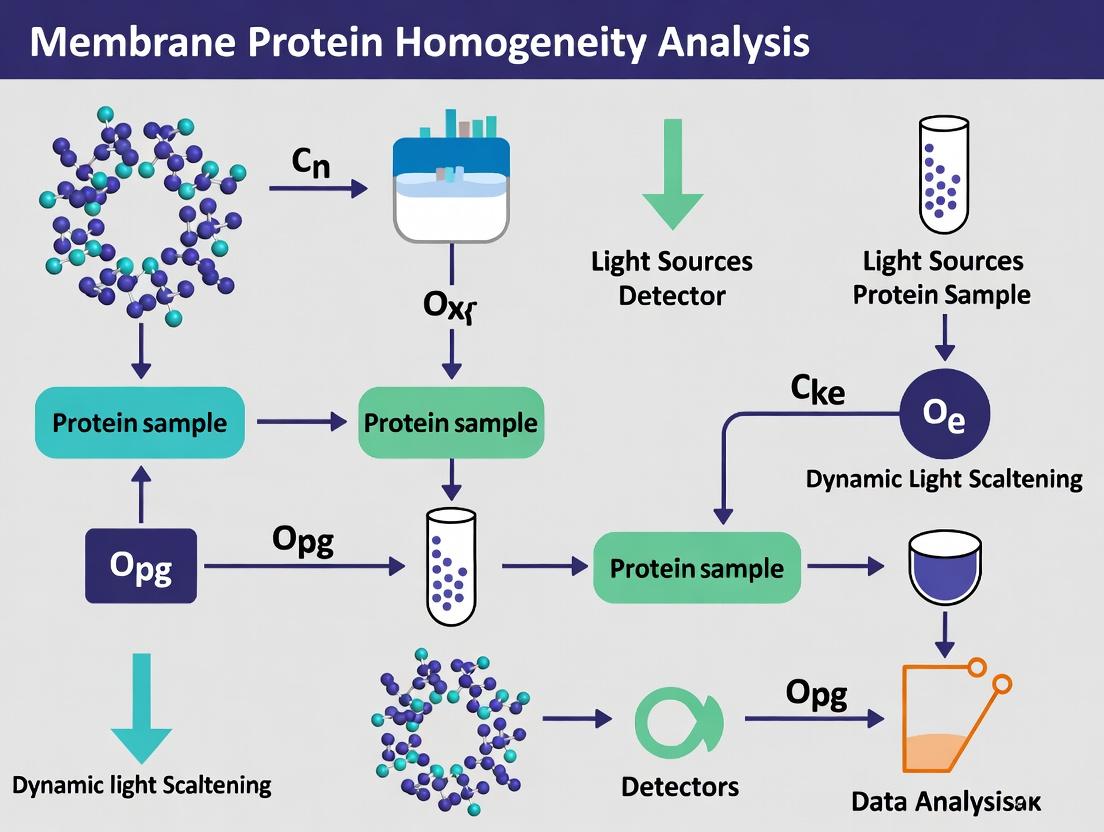
This comprehensive guide explores the critical role of Dynamic Light Scattering (DLS) in characterizing membrane protein homogeneity, a pivotal factor in structural biology and therapeutic development.
Dynamic Light Scattering (DLS): The Essential Guide to Assessing Membrane Protein Homogeneity for Drug Discovery
Abstract
This comprehensive guide explores the critical role of Dynamic Light Scattering (DLS) in characterizing membrane protein homogeneity, a pivotal factor in structural biology and therapeutic development. We first establish the fundamental principles of DLS and its unique advantages for analyzing challenging membrane protein samples in solution. The article then details a robust methodological workflow for sample preparation, measurement, and data interpretation specific to detergent-solubilized proteins, lipid nanodiscs, and other mimetic systems. Practical troubleshooting strategies are provided to address common pitfalls such as aggregation, viscosity effects, and signal contamination. Finally, we validate DLS by comparing its capabilities with complementary techniques like Size Exclusion Chromatography-Multi-Angle Light Scattering (SEC-MALS) and Native Mass Spectrometry, positioning DLS as an indispensable, rapid, and non-destructive tool for quality control in the pipeline of membrane protein-based drug development.
Understanding DLS Fundamentals: Why Light Scattering is Crucial for Membrane Protein Analysis
Structural biology and rational drug design are predicated on the analysis of well-defined, homogeneous samples. For membrane proteins—which constitute over 60% of drug targets—achieving monodispersity is uniquely challenging due to their amphipathic nature and instability in aqueous environments. Dynamic Light Scattering (DLS) has emerged as the gold-standard, orthogonal technique for quantifying sample homogeneity and size distribution in solution prior to costly and time-intensive downstream analyses such as cryo-Electron Microscopy (cryo-EM), X-ray crystallography, and surface plasmon resonance (SPR). This Application Note details protocols and data interpretation for employing DLS as a critical gatekeeper in the membrane protein research pipeline.
Application Notes: Quantitative Impact of Sample Polydispersity
Table 1: Impact of Sample Heterogeneity on Key Downstream Assays
| Assay/Technique | Key Metric Affected | Polydisperse Sample Result | Monodisperse Sample Requirement | Typical Acceptable PDI (DLS) |
|---|---|---|---|---|
| Cryo-EM | High-Resolution 3D Reconstruction | Blurred/noisy maps, multiple conformations, class averaging failure | Sharp, high-resolution density maps | ≤ 0.1 |
| X-ray Crystallography | Crystal Formation & Diffraction Quality | Micro-crystals, twinned crystals, no diffraction | Single, well-ordered crystals | ≤ 0.15 |
| SPR/BLI (Binding Kinetics) | Kinetic Constants (ka, kd) | Multi-phasic sensorgrams, inaccurate KD | Clean, fittable 1:1 binding curves | ≤ 0.2 |
| NMR Spectroscopy | Spectral Resolution & Assignment | Broadened peaks, signal overlap, impossible assignment | Sharp, well-dispersed resonances | ≤ 0.1 |
| Activity Assays (e.g., ATPase) | Specific Activity (μmol/min/mg) | Irreproducible, low apparent activity due to aggregates/inactive species | Reproducible, high specific activity | ≤ 0.2 |
Table 2: DLS Size and Polydispersity Index (PDI) Interpretation Guide
| Z-Average (d.nm) | PDI | Peak Analysis (Intensity) | Interpretation & Recommendation |
|---|---|---|---|
| Expected ± 10% | < 0.05 | Single, narrow peak | Excellent monodispersity. Proceed to structural studies. |
| Expected ± 10% | 0.05 - 0.1 | Single, slightly broad peak | Near-monodisperse. Acceptable for most high-res work. |
| Expected ± 10% | 0.1 - 0.2 | Main peak >90% of intensity | Moderately polydisperse. Use with caution for kinetics; optimize for structure. |
| Variable | > 0.2 | Multiple or very broad peaks | Highly polydisperse. Contains aggregates/oligomers. REQUIRES further purification. |
| >> Expected | N/A | Large aggregate peak present | Significant aggregation. Sample is unreliable for quantitative analysis. |
Experimental Protocols
Protocol 1: Routine DLS Quality Control for Membrane Protein Preparations
Objective: To rapidly assess the monodispersity and hydrodynamic radius (Rh) of a purified membrane protein sample (e.g., a GPCR in detergent micelles or nanodiscs).
Materials: See "The Scientist's Toolkit" below.
Procedure:
- Sample Preparation: Centrifuge the protein sample at 18,000 x g for 10 minutes at 4°C to remove any large dust or aggregates.
- Instrument Setup: Power on the DLS instrument and equilibrate the detection chamber at the desired temperature (typically 4°C or 20°C). Select the appropriate laser wavelength and detector angle (commonly 173° for back-scatter detection).
- Loading: Pipette 12-35 μL (volume dependent on cuvette type) of the supernatant from step 1 into a clean, low-volume quartz cuvette or disposable microcuvette. Avoid introducing bubbles.
- Measurement: Place the cuvette in the instrument. Set measurement parameters: 5-10 runs per measurement, each run duration of 10-30 seconds. Perform a minimum of 3 consecutive measurements.
- Data Analysis:
- The software will report the Z-Average (d.nm) and the Polydispersity Index (PDI).
- Examine the size distribution by intensity plot. A monodisperse sample shows a single, sharp peak.
- Check the correlation function decay. A single, smooth exponential decay indicates homogeneity.
- Decision Point: Refer to Table 2. If PDI > 0.2, proceed to Protocol 2 for optimization.
Protocol 2: SEC-DLS for Identifying and Resolving Heterogeneity
Objective: To couple Size-Exclusion Chromatography (SEC) with in-line DLS detection to identify the specific elution volumes containing monodisperse protein and separate it from aggregates or degraded species.
Procedure:
- System Configuration: Connect the outlet of an HPLC-grade SEC column (e.g., Superdex 200 Increase) directly to an in-line DLS flow cell. Configure the system so that UV (280 nm), static light scattering (SLS), and DLS data are collected simultaneously.
- Calibration: Equilibrate the SEC column with the desired buffer (containing detergent/lipids). Inject a blank buffer sample.
- Sample Injection: Concentrate the protein sample to > 2 mg/mL. Inject 50-100 μL onto the column at a low, controlled flow rate (e.g., 0.5 mL/min).
- Data Collection: Monitor the UV chromatogram. The in-line DLS will provide a Rh and PDI value for every time point (elution volume) across the chromatogram.
- Analysis:
- Overlay the UV trace with the PDI trace. The most monodisperse sample corresponds to the peak center where PDI is at its minimum.
- The DLS radius across the peak should be constant. An increasing Rh at the leading edge indicates aggregation; a decreasing Rh at the trailing edge suggests degradation or stoichiometry issues.
- Fractionation: Collect narrow-fraction slices across the UV peak. Re-analyze key fractions (especially those with lowest in-line PDI) using static DLS (Protocol 1) for confirmation before pooling for downstream use.
Visualizations
Title: DLS-Driven Workflow for Membrane Protein Sample Qualification
Title: Consequences of Sample Heterogeneity in Key Assays
The Scientist's Toolkit
| Research Reagent / Material | Function in Homogeneity Assessment |
|---|---|
| High-Sensitivity DLS Instrument | Measures time-dependent fluctuations in scattered light to calculate hydrodynamic radius (Rh) and Polydispersity Index (PDI). Essential for quantitative QC. |
| Disposable Micro Cuvettes (Low-Volume) | Minimizes sample requirement (12-35 μL), reduces contamination risk, and is ideal for precious membrane protein samples. |
| SEC Columns (e.g., Superdex Increase series) | Separates monomeric protein from higher-order aggregates and degraded species. Critical for purification prior to DLS. |
| In-Line DLS / MALS Detector | Couples with SEC to provide real-time, size-based characterization across the entire elution profile, identifying optimal monodisperse fractions. |
| Detergent/Lipid Screen Kits | Systematic arrays of amphiphiles (e.g., detergents, SMA copolymers, nanodisc scaffolds) to identify optimal solubilization conditions for monodispersity. |
| Stabilizing Additives | Small molecules, lipids, or salts that enhance protein stability, reduce aggregation, and promote a single, homogeneous conformational state. |
| Bench-top Microcentrifuge | For high-speed clarification of samples immediately before DLS analysis to remove dust and large aggregates that can skew results. |
| Buffer Exchange Consumables | Spin concentrators and desalting columns for rapid buffer optimization, which is crucial for maintaining membrane protein monodispersity. |
Within the context of membrane protein homogeneity research, accurate characterization of monodispersity, oligomeric state, and aggregation propensity is critical for functional studies and drug development. Dynamic Light Scattering (DLS) serves as a pivotal, non-invasive technique to assess these parameters in near-native conditions by determining the Hydrodynamic Radius (Rh). This application note details the core principle of DLS, focusing on the quantification of Brownian motion to calculate Rh, and provides validated protocols for membrane protein analysis.
Core Principle: From Brownian Motion to Rh
The fundamental operating principle of DLS is the analysis of temporal fluctuations in scattered light intensity caused by the Brownian motion of particles in solution. Larger particles move more slowly, causing the intensity to fluctuate more slowly than for smaller, faster-moving particles.
- Measurement: A laser illuminates the sample, and a detector at a fixed angle (commonly 173° for backscatter) records the scattered light intensity over time.
- Autocorrelation Analysis: The raw intensity trace is processed via an autocorrelation function, G(τ), which compares the signal with itself at different time delays (τ). It quantifies how quickly the signal loses its similarity over time.
- Decay Constant (Γ): The decay rate of the autocorrelation function is related to the diffusion coefficient (D). For a monodisperse sample: G(τ) ∝ exp(-Γτ), where Γ = D q².
- Scattering Vector (q): q = (4πn/λ₀) sin(θ/2), where n is solvent refractive index, λ₀ is laser wavelength, and θ is scattering angle.
- Stokes-Einstein Equation: Finally, the translational diffusion coefficient (D) is related to the Hydrodynamic Radius (Rh) via the Stokes-Einstein equation: Rh = kT / (6πηD) where k is Boltzmann's constant, T is absolute temperature, and η is solvent viscosity.
This derived Rh represents the radius of a hard sphere that diffuses at the same rate as the measured particle, incorporating the solvation shell and protein conformation.
Table 1: Key Physical Constants and Parameters in DLS Analysis
| Parameter | Symbol | Typical Value / Range | Units | Notes |
|---|---|---|---|---|
| Boltzmann Constant | k | 1.380649 x 10⁻²³ | J/K | Fixed constant |
| Measurement Temperature | T | 293.15 (20°C) | K | Commonly used for proteins |
| Water Viscosity (20°C) | η | 1.002 | mPa·s (cP) | Solvent-dependent; critical for accuracy |
| Laser Wavelength | λ₀ | 632.8 (He-Ne) or 830 | nm | Instrument-dependent |
| Scattering Angle | θ | 173° (Backscatter) | degrees | Minimizes multiple scattering |
| Refractive Index (Water) | n | 1.333 | - | Solvent-dependent |
Table 2: Example DLS Output for Model Membrane Proteins
| Protein / Sample | Measured Rh (nm) | Polydispersity Index (PDI) | Inferred Oligomeric State | Estimated MW (kDa) |
|---|---|---|---|---|
| Detergent Micelle (Blank) | 4.5 ± 0.3 | 0.05 | - | - |
| GPCR in LMNG Micelle | 6.2 ± 0.5 | 0.15 | Monomer + Micelle | ~120 |
| Ion Channel (Tetrameric) | 8.8 ± 0.6 | 0.08 | Tetramer + Micelle | ~350 |
| Aggregated Sample | 42.5 ± 15.2 | 0.35 | Large Aggregates | >1000 |
Experimental Protocols
Protocol 1: Basic DLS Measurement for Membrane Protein Homogeneity Assessment
Objective: To determine the hydrodynamic radius and size distribution of a membrane protein in detergent solution. Materials: See "The Scientist's Toolkit" below.
Procedure:
- Sample Preparation:
- Clarify the membrane protein solution in detergent (e.g., LMNG, DDM) by centrifugation at 20,000 x g for 15 minutes at 4°C to remove dust and large aggregates.
- Use the matching detergent buffer as the blank for background measurement.
- Instrument Setup:
- Power on the DLS instrument and allow the laser to stabilize for 15-30 minutes.
- Set the temperature to the desired value (typically 20°C) and allow the sample chamber to equilibrate.
- Set measurement angle to 173° (NIBS backscatter geometry).
- Set measurement duration to 10-15 automatic runs of 10 seconds each.
- Measurement:
- Rinse the cuvette thoroughly with filtered, deionized water and acetone. Dry under a stream of clean, filtered air.
- Load 35-40 µL of the clarified sample into a clean, low-volume quartz cuvette. Avoid introducing bubbles.
- Place the cuvette in the instrument and start the measurement.
- Repeat for the detergent buffer blank.
- Data Analysis:
- Software will generate the intensity autocorrelation function. Ensure the decay is smooth and reaches baseline.
- Analyze the data using the "Cumulants" method to obtain the Z-Average Size (Rh) and the Polydispersity Index (PDI). A PDI < 0.1 is considered monodisperse.
- For polydisperse samples, use an appropriate size distribution algorithm (e.g., NNLS, CONTIN) to resolve multiple populations.
- Interpretation:
- Subtract the micelle size (from the blank) from the protein-micelle complex size with caution, as the interaction is non-arithmetic. Focus on the relative change and distribution width (PDI).
Protocol 2: Stability Assessment via Temperature-Dependent DLS
Objective: To monitor the thermal stability and aggregation onset of a membrane protein. Procedure:
- Prepare the sample as in Protocol 1.
- In the instrument software, set a temperature ramp program (e.g., from 10°C to 50°C in 2°C increments).
- At each temperature, allow a 2-minute equilibration time before performing a measurement (5 runs x 10 seconds).
- Plot Rh and % Intensity of the main peak versus temperature. A sharp increase in Rh and the appearance of a large-sized population indicate aggregation and denaturation.
Diagrams
DLS Measurement and Analysis Workflow
DLS Role in Membrane Protein Research Thesis
The Scientist's Toolkit: Research Reagent Solutions
Table 3: Essential Materials for DLS of Membrane Proteins
| Item | Function / Rationale | Example Brands/Types |
|---|---|---|
| Ultra-pure Water | Prevents spurious scattering from particulates in buffers. | Milli-Q (18.2 MΩ·cm) |
| 0.02 µm Syringe Filters | Final filtration of all buffers to remove dust and nanoparticles. | Anotop (inorganic membrane) |
| Low-Volume Quartz Cuvettes | High optical clarity, minimal sample volume (~12-40 µL). | Hellma 105.250-QS |
| Mild Detergents | Solubilize membrane proteins while maintaining stability. | DDM, LMNG, CHS, OG |
| Size Exclusion Buffers | Optimal post-SEC buffer for monodisperse sample analysis. | HEPES or Tris with salt & detergent |
| Protein Standards | Validation of instrument performance and size calibration. | Bovine Serum Albumin (Rh ~3.5 nm), Latex Nanospheres |
| Precision Pipettes & Tips | Accurate, reproducible sample loading; low protein adsorption tips recommended. | - |
Within the context of a thesis on Dynamic Light Scattering (DLS) for membrane protein homogeneity research, interpreting core DLS outputs is critical. Proper understanding of intensity, volume, and number distributions, alongside the Polydispersity Index (PDI) and Z-average size, determines accurate assessment of sample monodispersity—a prerequisite for successful structural biology and drug development workflows.
Intensity, Volume, and Number Distributions
DLS measures fluctuations in scattered light intensity to derive a hydrodynamic diameter (dH). The primary result is an intensity-weighted size distribution. This can be mathematically transformed into volume and number distributions, each providing a different perspective on the sample population.
Table 1: Comparison of DLS Size Distribution Types
| Distribution Type | Basis of Weighting | Sensitivity to Large Particles | Primary Use in Analysis |
|---|---|---|---|
| Intensity | Scattered light intensity (proportional to d6) | Very High. A few large particles dominate the signal. | Primary raw data. Identifies presence of aggregates. |
| Volume | Particle volume (proportional to d3) | Moderate. Recalculates intensity into volume occupied. | Intuitive view of sample composition by volume. |
| Number | Number of particles | Low. Recalculates volume into particle count. | Estimates the most frequent particle size by count. Misleading if large particles present. |
For membrane proteins in detergent or lipid systems, the intensity distribution is paramount for detecting large, problematic aggregates, while the volume distribution may better represent the proportion of monomeric protein versus proteomicelles/liponanoparticles.
Polydispersity Index (PDI)
The Polydispersity Index (PDI), derived from the Cumulants analysis, quantifies the breadth of the size distribution. It is the square of the standard deviation (σ) divided by the square of the mean diameter (μ2): PDI = (σ/μ)2.
Table 2: Interpreting the Polydispersity Index (PDI)
| PDI Range | Sample Monodispersity | Implication for Membrane Protein Samples |
|---|---|---|
| 0.00 – 0.05 | Highly monodisperse | Ideal, near-homogeneous preparation (rare for membrane proteins). |
| 0.05 – 0.10 | Near monodisperse | Excellent, suitable for most biophysical and structural studies. |
| 0.10 – 0.20 | Moderately polydisperse | May be acceptable for some applications; may indicate minor aggregation or sample heterogeneity. |
| > 0.20 | Very polydisperse | Significant heterogeneity or aggregation. Requires further optimization of purification or solubilization. |
A PDI > 0.3 suggests a very broad distribution, and the Z-average result may be unreliable.
Z-Average Size
The Z-average size (or Z-average diameter, dz) is the intensity-weighted mean hydrodynamic size derived from the Cumulants analysis. It is not a direct measure of the peak position in the intensity distribution but a statistical mean. It is most reliable for monodisperse samples (PDI < 0.1).
Experimental Protocols for DLS Analysis of Membrane Proteins
Protocol 1: Sample Preparation and Measurement for Detergent-Solubilized Membrane Proteins
Objective: Obtain a reliable DLS measurement of a purified membrane protein in detergent micelles.
Materials & Reagents:
- Purified membrane protein in chosen detergent (e.g., DDM, LMNG).
- Matching gel filtration or dialysis buffer containing detergent at Critical Micelle Concentration (CMC).
- Clarification filters (0.02 μm or 0.1 μm, compatible with detergent).
- Low-volume disposable or quartz cuvettes.
Procedure:
- Buffer Match: Centrifuge or filter the protein buffer (with detergent) to remove dust. Use this as the optical blank.
- Sample Clarification: Centrifuge the protein sample at >15,000 x g for 10-15 minutes at 4°C immediately before loading. Alternatively, filter using a low-protein-binding 0.02 μm filter.
- Loading: Pipette 30-50 μL of clarified sample into a clean, low-volume cuvette. Avoid introducing bubbles.
- Instrument Setup: Set instrument temperature to 4°C or 10°C (commonly used for membrane protein stability). Allow equilibration for 2 minutes.
- Measurement: Perform 10-15 sequential measurements of 10 seconds each. Use an appropriate angle (commonly 173° for backscatter detection in modern instruments).
- Data Analysis: Inspect the correlation function for a clean decay. Analyze data using the Cumulants method for Z-average and PDI. Use a non-negative least squares (NNLS) or similar algorithm to generate the intensity size distribution.
Protocol 2: Assessing Stability via Thermal Ramp DLS
Objective: Monitor membrane protein aggregation onset as a function of temperature.
Procedure:
- Prepare sample as in Protocol 1.
- Set starting temperature (e.g., 10°C) and final temperature (e.g., 40°C) with a slow ramp rate (e.g., 0.5°C/min).
- Program the instrument to take a measurement (e.g., 3 measurements of 10 seconds each) at every 1°C interval.
- Plot Z-average size and PDI versus temperature. The point where a sharp, irreversible increase in size and PDI occurs indicates aggregation onset.
DLS Data Interpretation Workflow for Membrane Proteins
Title: DLS Data Analysis Decision Pathway
The Scientist's Toolkit: Key Research Reagent Solutions for Membrane Protein DLS
Table 3: Essential Materials for DLS of Membrane Proteins
| Item | Function & Importance in DLS Context |
|---|---|
| Mild Detergents (e.g., DDM, LMNG, OG) | Solubilize membrane proteins while maintaining native conformation. Choice critically affects micelle size and sample homogeneity. |
| Size-Exclusion Chromatography (SEC) Buffer | Provides matched, clean buffer for blanks and sample dilution. Must contain detergent at ≥CMC to prevent protein aggregation. |
| Low-Protein-Binding Clarification Filters (0.02 μm) | Removes dust and large aggregates prior to measurement without adsorbing protein, crucial for accurate data. |
| High-Quality, Low-Volume Disposable Cuvettes | Minimizes sample volume requirement (12-50 μL) and reduces potential for dust contamination. |
| Stable Cell Lines & Affinity Tags | Enables overexpression and purification of sufficient quantities of functional membrane protein for DLS analysis. |
| Lipid Mimetics (Nanodiscs, Amphipols) | Alternative solubilization strategies that can provide a more native-like lipid environment, assessed by DLS for size and homogeneity. |
Application Notes
Membrane proteins (MPs) represent a critical class of drug targets but present unique analytical challenges due to their hydrophobic domains requiring stabilization in mimetic environments. Dynamic light scattering (DLS) is a pivotal, non-invasive tool for assessing the homogeneity, oligomeric state, and stability of MPs in these diverse systems, informing downstream structural and functional studies.
Key Metrics for DLS Analysis of Membrane Protein Preparations The following table summarizes typical DLS-derived parameters and their implications for MPs in different mimetics.
| Mimetic System | Typical Hydrodynamic Radius (Rₕ) Range | Polydispersity Index (PDI) Target | Key Stability Indicator (DLS) | Common Aggregation Sign |
|---|---|---|---|---|
| Detergent Micelles | 4-10 nm (MP + detergent belt) | <0.25 | Stable Rₕ over time & temperature. | Peak > 100 nm; rising PDI. |
| Proteoliposomes | 50-200 nm (vesicle size dominant) | Variable (vesicle dispersion) | Consistent vesicle size profile. | Very large (>1 µm) particle peak. |
| Nanodiscs (MSP1D1) | 6.5-8.5 nm (disc height ~5 nm) | <0.2 | Monodisperse peak; minimal larger aggregates. | Secondary peak at >15 nm. |
| Amphipols/SMA Polymers | 8-12 nm (MP + polymer) | <0.25 | Stable, monodisperse population post-purification. | Increase in Rₕ and PDI. |
Experimental Protocols
Protocol 1: DLS Sample Preparation and Measurement for Membrane Proteins Objective: To obtain a reliable assessment of particle size distribution and sample homogeneity.
- Sample Buffer Exchange: Use size-exclusion chromatography (SEC) or dialysis to equilibrate the MP sample into a clear, particle-free buffer (e.g., 20 mM HEPES, 150 mM NaCl, 0.01% detergent). Filter buffer through a 0.1 µm membrane.
- Clarification: Centrifuge the MP sample at 18,000 x g for 10 minutes at 4°C to pellet large aggregates.
- Loading: Carefully pipette the supernatant into a clean, low-volume quartz cuvette (e.g., 12 µL microcuvette). Avoid introducing bubbles.
- Instrument Setup: Equilibrate the DLS instrument to the desired temperature (e.g., 20°C). Set measurement parameters: 3-5 measurements per sample, 10-20 seconds per run.
- Data Acquisition: Run measurements. Inspect the correlation function decay; a smooth, single decay indicates monodispersity.
- Analysis: Use the instrument's software to calculate intensity-based size distributions, Rₕ, and PDI. Report the mean Rₕ from the dominant peak and the associated PDI.
Protocol 2: Assessing Thermal Stability of a MP in Nanodiscs via DLS Objective: To determine the thermal unfolding/aggregation temperature (Tₐgg) of a MP embedded in Nanodiscs.
- Prepare the MP-Nanodisc sample as in Protocol 1, steps 1-3.
- Temperature Ramp Programming: Set the DLS instrument to perform measurements at a series of increasing temperatures (e.g., 20°C to 80°C in 2°C increments). Allow a 1-2 minute equilibration at each temperature.
- Automated Monitoring: Configure the software to record the Rₕ and scattering intensity (or derived count rate) at each step.
- Data Analysis: Plot Rₕ and scattering intensity vs. temperature. The Tₐgg is identified as the temperature at which a sharp increase in Rₕ and scattering intensity occurs, indicating protein unfolding and aggregation.
- Validation: Post-ramp, cool the sample to the starting temperature and re-measure. Irreversible aggregation is confirmed if the Rₕ does not return to its original value.
Protocol 3: Detergent Screening for MP Solubilization using DLS Objective: To identify the optimal detergent for yielding monodisperse, non-aggregated MP.
- Solubilization: Solubilize identical aliquots of membrane material containing the target MP in a panel of detergents (e.g., DDM, LMNG, OG, Fos-Choline-12) at 2x the critical micelle concentration (CMC).
- Purification: Perform an initial affinity purification step for each condition.
- DLS Measurement: Analyze each eluted fraction following Protocol 1.
- Evaluation: Compare the PDI and the asymmetry of the size distribution peak. The condition yielding the smallest PDI and a symmetric, monomodal peak is the leading candidate for further optimization.
Mandatory Visualization
DLS Screening Workflow for Membrane Protein Mimetics
DLS Principle for Membrane Protein Analysis
The Scientist's Toolkit: Research Reagent Solutions
| Reagent/Material | Function in MP/DLS Analysis |
|---|---|
| n-Dodecyl-β-D-Maltoside (DDM) | Mild, non-ionic detergent; forms large micelles ideal for solubilizing and stabilizing many MPs during purification and initial DLS analysis. |
| Lauryl Maltose Neopentyl Glycol (LMNG) | Diglucosyl detergent with superior stability properties compared to DDM, often yields monodisperse MPs with lower aggregation propensity. |
| Membrane Scaffold Protein (MSP) | Engineered apolipoprotein A-I variant used to form Nanodiscs of defined diameter, providing a native-like lipid bilayer environment for MPs. |
| Bio-Beads SM-2 | Hydrophobic polystyrene beads used to remove detergents for reconstitution into proteoliposomes or Nanodiscs. |
| Size-Exclusion Chromatography (SEC) Column | Critical final purification step to isolate monodisperse MP populations and exchange into ideal buffer for DLS measurement. |
| Low-Volume Quartz Cuvette | Specialized cell for holding small volume (e.g., 12 µL) samples, minimizing protein consumption during DLS measurements. |
| 0.1 µm Syringe Filter | For filtering buffers to remove dust and particulate matter that would interfere with DLS measurements. |
Dynamic Light Scattering (DLS) is a critical analytical technique in the broader thesis of membrane protein homogeneity research. Its utility stems from its ability to assess size, monodispersity, and aggregation state of proteins in solution rapidly and with minimal material. For membrane proteins, which are notoriously difficult to solubilize, purify, and stabilize, DLS provides a solution-state analysis that is non-destructive and requires only microgram quantities of precious sample. This application note details the protocols and quantitative advantages of DLS in this challenging field.
The following table summarizes the core quantitative benefits of DLS compared to other biophysical techniques commonly used for membrane protein characterization.
Table 1: Comparative Analysis of Techniques for Membrane Protein Size/Homogeneity Assessment
| Technique | Typical Sample Volume | Measurement Time | Key Output for Homogeneity | State of Analysis |
|---|---|---|---|---|
| Dynamic Light Scattering (DLS) | 2-12 µL | 1-5 minutes | Hydrodynamic radius (Rh), Polydispersity Index (PDI), Aggregation percentage | Solution-state (native-like buffer) |
| Size Exclusion Chromatography (SEC) | 50-100 µL | 15-30 minutes | Elution profile, Apparent molecular weight | Solution-state (requires column interaction) |
| Analytical Ultracentrifugation (AUC) | 300-400 µL | Several hours to days | Sedimentation coefficient, Molecular mass distribution | Solution-state (high resolution) |
| Native PAGE | 10-20 µL (per lane) | 2-4 hours | Electrophoretic mobility, Band sharpness | Semi-native gel matrix |
| Electron Microscopy (EM) | 3-5 µL (grid prep) | Days to weeks | Direct visualization, 2D class averages | Vacuum (often stained/frozen) |
Detailed Protocols
Protocol 1: Rapid Assessment of Membrane Protein Homogeneity Post-Purification
Objective: To determine the monodispersity and hydrodynamic radius of a purified membrane protein in detergent micelles or nanodiscs immediately after size-exclusion chromatography (SEC).
Materials:
- Purified membrane protein sample (e.g., in 20 mM Tris, 150 mM NaCl, 0.05% DDM).
- Compatible DLS instrument (e.g., Malvern Panalytical Zetasizer Ultra, Wyatt DynaPro Plate Reader).
- Low-volume, disposable microcuvettes (e.g., 12 µL quartz cuvettes) or 384-well plates.
- Bench-top centrifuge with a rotor for 1.5 mL tubes (pre-cooled to 4°C).
- 0.02 µm or 0.1 µm syringe filters.
Procedure:
- Sample Clarification: Centrifuge the protein sample (typically 50-100 µL) at 14,000 x g for 10 minutes at 4°C to remove any large aggregates or dust. Alternatively, filter the sample using a compatible syringe filter.
- Instrument Equilibration: Turn on the DLS instrument and allow the laser to stabilize for at least 15 minutes. Set the measurement temperature (e.g., 4°C or 20°C).
- Loading: Pipette 10-12 µL of the clarified supernatant into a clean, disposable microcuvette. Ensure no air bubbles are present. For plate readers, load a minimum of 30 µL per well.
- Measurement Setup:
- Select the appropriate material (protein/water) and solvent (buffer) refractive indices.
- Set the equilibration time to 60 seconds.
- Configure measurement parameters: 10-15 acquisitions of 5-10 seconds each.
- Data Acquisition: Run the measurement. The instrument will auto-attenuate and optimize the detection.
- Analysis:
- Inspect the correlation function decay. A smooth, single-phase decay suggests monodispersity.
- Analyze the size distribution plot (intensity-weighted). A single, sharp peak indicates a homogeneous preparation.
- Record the Z-Average Hydrodynamic Radius (Rh) and the Polydispersity Index (PDI). A PDI < 0.2 is generally considered acceptable for monodisperse membrane protein samples.
- Note the percentage of intensity in potential aggregate populations.
Protocol 2: Stability and Aggregation Kinetics Screening Under Different Buffer Conditions
Objective: To monitor the time-dependent aggregation of a membrane protein in response to detergent exchange, lipid addition, or temperature stress.
Materials:
- As in Protocol 1, plus:
- A library of candidate buffers/detergents/lipids.
- Temperature-controlled multi-well plate reader or autosampler.
Procedure:
- Sample Preparation: In a 96- or 384-well plate, set up 50 µL reactions of the membrane protein (at 0.5-1 mg/mL) in different conditions (e.g., varying pH, salt, detergent type, lipid:protein ratio).
- Initial Time Point: Immediately after mixing, perform a DLS measurement on each well using Protocol 1 as a guide.
- Incubation & Monitoring: Incubate the plate at the desired stress temperature (e.g., 25°C). Program the instrument to automatically measure each well at defined intervals (e.g., 0, 1, 2, 4, 8, 24 hours).
- Data Analysis:
- Plot the Z-Average Rh and PDI for each condition over time.
- Identify conditions that show the smallest increase in Rh and PDI, indicating superior stability.
- Calculate the apparent aggregation rate constant from the growth of the aggregate population intensity.
Visualizations
Diagram Title: DLS Workflow in Membrane Protein Research Pipeline
Diagram Title: Core Principle of DLS Measurement
The Scientist's Toolkit: Key Research Reagent Solutions
Table 2: Essential Materials for DLS Analysis of Membrane Proteins
| Item | Function & Rationale |
|---|---|
| Mild Detergents (e.g., DDM, LMNG, OG) | Solubilize and stabilize membrane proteins by mimicking the lipid bilayer, forming protein-detergent micelles for solution-state analysis. Critical for preventing non-specific aggregation. |
| Lipids & Nanodisc Scaffold Proteins (e.g., MSPs) | For reconstituting membrane proteins into native-like lipid bilayers (Nanodiscs), providing a more physiologically relevant environment than detergent micelles for DLS assessment. |
| Size-Exclusion Chromatography (SEC) Buffers | High-salt, buffered solutions used during final protein purification to maintain solubility and separate monodisperse protein from aggregates prior to DLS. |
| Low-Binding, Low-Volume Microcuvettes (Quartz) | Minimize sample adhesion and required loading volume (as low as 2 µL), maximizing the amount of protein available for other experiments. |
| 0.02 µm or 0.1 µm Syringe Filters | Pre-filter buffers and samples to remove dust and particulate contaminants, which are major sources of interference and noise in DLS measurements. |
| High-Purity Buffers & Salts | To minimize scattering background from buffer impurities. Tris, HEPES, and phosphate buffers are commonly used with appropriate salts (NaCl, KCl). |
| Glycerol or Sucrose | Used as stabilizing additives in storage buffers to reduce protein aggregation over time. DLS can quickly screen the effectiveness of such stabilizers. |
A Step-by-Step DLS Protocol for Reliable Membrane Protein Characterization
Within the framework of research on membrane protein homogeneity using Dynamic Light Scattering (DLS), obtaining reliable and interpretable data is paramount. A significant portion of experimental artifacts in DLS arises from improper sample preparation and characterization prior to measurement. This application note details a critical pre-measurement checklist focusing on three pillars: achieving optimal sample clarification, ensuring rigorous buffer matching, and identifying the ideal concentration range for membrane protein studies. Adherence to these protocols is essential for distinguishing true monodisperse populations from aggregates, detergent micelles, or buffer contaminants, thereby providing meaningful data for downstream structural and functional analyses.
Pre-Measurement Checklist Protocols
Sample Clarification Protocol
Objective: To remove dust, large aggregates, and other particulate contaminants that can dominate the DLS scattering signal and obscure the hydrodynamic radius (Rh) of the target membrane protein.
Detailed Methodology:
- Centrifugation: Immediately prior to DLS measurement, centrifuge the membrane protein sample in a benchtop microcentrifuge at high speed (typically 14,000 - 16,000 x g) for 10-15 minutes at the temperature matching the intended measurement condition (e.g., 4°C or 25°C).
- Supernatant Handling: Carefully pipette the top 70-80% of the supernatant into a new, clean tube. Avoid disturbing the pellet, which contains the removed aggregates and particles.
- Filtration (Optional but Recommended): For critical measurements or samples prone to fibrils, filter the supernatant using a syringe-driven, low-protein-binding membrane filter. Pore sizes of 0.1 µm or 0.22 µm are standard. Pre-wet the filter with buffer to minimize sample loss.
- Direct Loading: Load the clarified supernatant directly into a meticulously cleaned DLS cuvette. Avoid pipetting from the bottom of the tube.
Buffer Matching & Background Measurement Protocol
Objective: To characterize and subtract the scattering contribution of the buffer components (detergents, salts, lipids, etc.) from the sample signal, which is critical for accurate size distribution analysis.
Detailed Methodology:
- Preparation of Matched Buffer: Prepare the exact buffer used for the final purification and storage of the membrane protein. This includes the same batch of detergent at the Critical Micelle Concentration (CMC) or above, salts, chelators, and stabilizing agents.
- Buffer Clarification: Subject the matched buffer to the identical clarification protocol (centrifugation, filtration) as the sample.
- DLS Measurement: Load the clarified buffer into the DLS cuvette and perform a minimum of three consecutive measurements. Record the intensity, size, and % polydispersity of the buffer alone.
- Acceptance Criteria: A well-prepared buffer should yield a very low scattering intensity (kilo counts per second, kcps) and show no significant peaks in the size distribution plot relevant to the protein size range (e.g., 1-10 nm for detergent micelles may be acceptable, but peaks >100 nm indicate contamination).
- Subtraction: Use the instrument software to subtract the buffer's correlation function or intensity distribution from the sample's data during processing.
Determining Optimal Concentration Range Protocol
Objective: To identify the protein concentration range that minimizes intermolecular interactions (attractive or repulsive) and provides an accurate measurement of the native hydrodynamic size.
Detailed Methodology:
- Serial Dilution: Prepare a series of dilutions of the clarified membrane protein sample using the clarified, matched buffer. A typical series might span 0.1, 0.25, 0.5, 1.0, and 2.0 mg/mL.
- DLS Measurement Series: Measure each concentration in triplicate under identical temperature and instrument settings.
- Data Analysis: Plot the apparent hydrodynamic radius (Rh) and the derived count rate (or intensity) as a function of protein concentration.
- Interpretation: The optimal concentration is within the plateau region where Rh remains constant, indicating the absence of concentration-dependent aggregation or repulsion. A linear increase in intensity with concentration confirms sample stability and lack of large aggregates.
Data Presentation: Quantitative Guidelines
Table 1: Optimal Concentration Ranges & Buffer Signals for Common Membrane Protein Systems
| Membrane Protein System | Recommended Detergent | Typical CMC (mM) | Optimal DLS Conc. Range (mg/mL) | Acceptable Buffer Signal (Rh & PdI) |
|---|---|---|---|---|
| GPCRs (e.g., β2AR) | n-Dodecyl-β-D-Maltopyranoside (DDM) | 0.17 | 0.5 - 1.5 | Micelle: 3-5 nm, PdI < 0.2 |
| Ion Channels (e.g., KcsA) | Decyl Maltose Neopentyl Glycol (DMNG) | 1.6 | 0.2 - 1.0 | Micelle: ~4 nm, PdI < 0.25 |
| Transporters (e.g., LeuT) | Lauryl Maltose Neopentyl Glycol (LMNG) | 0.02 | 0.3 - 1.2 | Micelle: 5-7 nm, PdI < 0.3 |
| Membrane Enzyme (Cytochrome P450) | Triton X-100 | 0.24 | 0.4 - 1.0 | Micelle: ~6 nm, PdI < 0.3 |
Table 2: Pre-Measurement Checklist Decision Matrix Based on DLS Outcomes
| Observed Issue (in Sample) | Potential Root Cause | Corrective Action from Checklist |
|---|---|---|
| High count rate, large Rh peak (>100 nm) | Insufficient clarification; dust/aggregates | Repeat Protocol 2.1 more rigorously; filter sample. |
| Persistent peak at 3-10 nm after subtraction | Incomplete buffer matching; detergent mismatch | Re-prepare buffer exactly; ensure detergent CMC is met (Protocol 2.2). |
| Rh decreases with dilution | Attractive interactions/aggregation at high conc. | Use concentration from lower, stable plateau (Protocol 2.3). |
| Rh increases with dilution | Repulsive interactions at high conc. | Use concentration from middle of stable range (Protocol 2.3). |
| High polydispersity index (PdI > 0.3) | Sample heterogeneity, residual aggregates | Re-visit all three protocols; may indicate inherent sample instability. |
Experimental Workflow Visualization
Diagram Title: Pre-DLS Membrane Protein Sample Preparation Workflow
The Scientist's Toolkit
Table 3: Essential Research Reagent Solutions for Membrane Protein DLS
| Item | Function & Rationale |
|---|---|
| Low-Protein-Binding Filters (0.1/0.22 µm) | For final sample and buffer clarification; minimizes sample loss and adsorbs contaminants. |
| High-Purity Detergents (DDM, LMNG, CHS) | To solubilize and stabilize membrane proteins; batch consistency is critical for buffer matching. |
| Disposable, Pre-Cleaned DLS Cuvettes | Eliminates cross-contamination and reduces scattering from cuvette imperfections. |
| Buffer Components (Hepes/Tris, NaCl, Glycerol, Imidazole) | For precise buffer matching; use high-purity grades to minimize particulate background. |
| Concentration/Dialysis Devices (e.g., Amicon Ultra) | For gentle concentration and buffer exchange of delicate membrane protein samples. |
| Dynamic Light Scattering Instrument | Core instrument for measuring hydrodynamic radius, polydispersity, and aggregation state. |
Within a thesis investigating membrane protein homogeneity via Dynamic Light Scattering (DLS), meticulous instrument configuration is paramount. The colloidal stability of membrane proteins in detergent micelles or nanodiscs is exquisitely sensitive to environmental and measurement conditions. This protocol details the optimization of three critical parameters—temperature control, number of runs, and acquisition time—to obtain statistically robust, reproducible size distributions, enabling accurate assessment of monodispersity versus aggregation.
Core Parameters and Quantitative Guidelines
The following table summarizes optimized parameters for typical membrane protein samples (e.g., GPCRs, ion channels) in solution.
Table 1: Recommended DLS Parameters for Membrane Protein Homogeneity Analysis
| Parameter | Recommended Value / Range | Rationale & Impact on Data Quality |
|---|---|---|
| Equilibration Time | 120-300 seconds | Essential for thermal uniformity post-sample loading, preventing convection currents that distort correlation functions. |
| Measurement Temperature | 4°C or 20°C ± 0.1°C | Lower temps (4°C) slow degradation/aggregation; 20°C is standard. Precise control (±0.1°C) is mandatory for reproducible diffusion coefficients. |
| Number of Runs per Measurement | 10-20 runs | Increases statistical certainty. For polydisperse samples, ≥15 runs are advised to improve averaging of intensity fluctuations. |
| Duration per Run (Acquisition Time) | 10-30 seconds | Shorter times (10s) for stable, monodisperse samples; longer times (30s) for large, slow-moving aggregates or dilute samples to improve signal-to-noise. |
| Total Measurement Duration | ~3-10 minutes | Product of runs × duration per run. Ensures collection of sufficient photons for a reliable intensity autocorrelation function. |
| Attenuator / ND Filter Setting | Automated or adjusted to obtain 100-300 kcps | Prevents detector saturation or under-counting, ensuring measurements are in the linear response range of the APD/PMT. |
Experimental Protocols
Protocol 1: Systematic Optimization of Temperature
Objective: Determine the optimal thermal stability window for a membrane protein sample.
- Sample Prep: Purify membrane protein in desired amphiphile (e.g., DDM, LMNG, SMALPs). Clarify via centrifugation (100,000 x g, 10 min, 4°C).
- Instrument Setup: Pre-cool/pre-heat the DLS instrument's cuvette chamber. Set acquisition to 10 runs of 10 seconds each as a preliminary scan.
- Temperature Ramp: Program a step-gradient: 4°C, 10°C, 15°C, 20°C, 25°C, 30°C.
- At Each Temperature: Equilibrate for 180 seconds. Perform measurement. Record Z-Average diameter (d.nm), Polydispersity Index (PdI), and peak intensity (%) from the size distribution.
- Analysis: Plot d.nm and PdI vs. Temperature. The optimal temperature is identified as the range where d.nm and PdI are minimal and stable.
Protocol 2: Determining Optimal Number of Runs & Acquisition Time
Objective: Establish parameters that yield a stable, repeatable correlation function with minimal artifacts.
- Baseline Measurement: Using a temperature from Protocol 1, set instrument to 20 runs of 20 seconds each. Perform triplicate measurements on the same sample.
- Vary Runs: Fix acquisition time at 15 seconds. Perform measurements with run counts of 5, 10, 15, and 20. Record the standard deviation of the Z-Average from three repeat measurements at each run count.
- Vary Acquisition Time: Fix run count at 15. Perform measurements with acquisition times of 5, 10, 20, and 30 seconds. Monitor the fit residual (difference between measured and fitted correlation function) as an indicator of data quality.
- Optimization Criteria: Select the lowest run count and shortest acquisition time that yield a Z-Average standard deviation < 2% and a smooth, low-magnitude fit residual.
Visualization of Experimental Workflow
Diagram 1: DLS Parameter Optimization Workflow for Membrane Proteins
The Scientist's Toolkit: Research Reagent Solutions
Table 2: Essential Materials for Membrane Protein DLS Analysis
| Item | Function & Importance |
|---|---|
| Size-Exclusion Chromatography (SEC) Buffer | Matches final sample buffer. Must contain detergent/amphiphile above its CMC to maintain protein solubility and prevent nonspecific aggregation. |
| Disposable Micro Cuvettes (e.g., UVette) | Low-volume, sterile cuvettes minimize sample consumption (50-70 µL) and prevent cross-contamination. |
| 0.02 µm or 0.1 µm Syringe Filters (Anotop) | For final sample filtration immediately before loading. Removes dust and large aggregates; critical for reducing spurious scattering. |
| Monodisperse Latex Nanosphere Standards | Used for instrument performance validation and alignment verification (e.g., 60 nm standard). |
| Detergent/Lipid Screening Kits | Commercial kits (e.g., from Anatrace) facilitate rapid screening of amphiphiles for optimal protein stability and monodispersity. |
| Bench-top Ultracentrifuge | Essential for high-speed clarification (100,000-150,000 x g) to pellet large aggregates prior to DLS measurement. |
Data Acquisition Best Practices for Detergent-Solubilized Proteins and Lipid-Based Systems
Within the broader thesis on Dynamic Light Scattering (DLS) for membrane protein homogeneity research, acquiring high-quality data from detergent-solubilized proteins and reconstituted lipid-based systems presents unique challenges. These samples are inherently complex, prone to aggregation, and sensitive to environmental conditions. This document outlines application notes and protocols to ensure robust and reproducible DLS data acquisition, crucial for assessing monodispersity and stability—key parameters in structural biology and drug development.
Application Notes
Critical Parameters for Sample Preparation
The quality of DLS data is dictated by sample preparation. For membrane proteins, the choice of solubilizing agent and buffer is paramount.
- Detergent Selection: The detergent must maintain protein solubility without forming large micelles that interfere with hydrodynamic radius (Rh) measurement. Critical micelle concentration (CMC) and aggregation number are key factors.
- Lipid System Reconstitution: For nanodiscs, liposomes, or bicelles, the lipid-to-protein ratio and the method of reconstitution significantly impact size distribution.
- Buffer Compatibility: Buffer components must not contribute significant scattering. Avoid volatile salts and include reducing agents if necessary to prevent oxidation.
- Clarification: Absolute requirement for filtration (0.1 µm or 0.02 µm for small particles) or ultracentrifugation to remove dust and large aggregates.
Instrument Calibration & Validation
Regular calibration using a known standard (e.g., monodisperse polystyrene beads) is non-negotiable. Validate instrument performance and measurement settings before analyzing precious protein samples.
Data Acquisition Settings
Optimize measurement parameters to capture an accurate representation of the sample.
- Temperature Equilibration: Allow ample time (typically 5-15 minutes) for the sample and cell holder to reach thermal equilibrium. Membrane proteins are highly temperature-sensitive.
- Measurement Duration & Number of Runs: Sufficiently long acquisition times are needed to achieve a stable correlation function, especially for polydisperse or slowly moving particles.
- Angle of Detection: For larger complexes (>10 nm) or aggregates, multi-angle DLS can provide more robust size distributions.
Table 1: Summary of Key Quantitative Parameters for DLS Data Acquisition
| Parameter | Recommended Value/Range | Rationale |
|---|---|---|
| Sample Concentration | 0.1 - 1.0 mg/mL (protein) | Minimizes intermolecular interference (multiple scattering) and protein consumption. |
| Temperature Stability | ± 0.1 °C | Essential for stable diffusion coefficients; use a precision Peltier controller. |
| Equilibration Time | ≥ 5 minutes | Ensures thermal homogeneity and reduces convective flow. |
| Number of Measurements | 10 - 15 consecutive runs | Provides statistical basis for intensity/volume distribution analysis. |
| Duration per Run | 10 - 30 seconds (per run) | Balances signal-to-noise with total measurement time. |
| Filter Size | 0.1 µm (100 nm) or 0.02 µm (20 nm) | Removes large aggregates without depleting the sample of interest. |
Detailed Protocols
Protocol 1: DLS Analysis of a Detergent-Solubilized Membrane Protein
This protocol details the steps for assessing the monodispersity of a GPCR solubilized in n-Dodecyl-β-D-maltopyranoside (DDM).
Materials:
- Purified membrane protein in DDM-containing buffer (e.g., 20 mM HEPES pH 7.5, 150 mM NaCl, 0.03% DDM).
- DLS instrument with temperature control.
- Disposable or quartz cuvettes (low volume, e.g., 12 µL or 45 µL).
- 0.1 µm syringe filters (preferably non-adsorptive, e.g., PTFE).
- 1 mL syringes.
Method:
- Sample Clarification: Centrifuge the protein sample at 18,000 x g for 10 minutes at 4°C. Carefully aspirate the supernatant, avoiding the pellet. Alternatively, pass the sample through a 0.1 µm syringe filter directly into a clean microcentrifuge tube.
- Cuvette Preparation: Meticulously clean the cuvette with filtered ethanol and water, then dry with filtered air/argon. Handle only by the top edges.
- Sample Loading: Pipette the clarified supernatant into the cuvette, avoiding bubble formation. Seal the cuvette with a cap or sealing film.
- Instrument Setup: Place the cuvette in the thermally controlled sample holder. Set the instrument temperature to the desired value (e.g., 4°C or 20°C).
- Parameter Definition: In the software, set the following:
- Refractive Index & Viscosity: Set to values for water or your specific buffer.
- Measurement Angle: 90° or 173° (backscatter), depending on instrument.
- Number of Runs: 12.
- Duration per Run: 15 seconds.
- Equilibration: Allow the sample to equilibrate at the set temperature for 10 minutes.
- Data Acquisition: Initiate the measurement series. Visually inspect the correlation function decay for smoothness and stability.
- Data Analysis: Analyze the combined data from all runs. Report the Z-Average (mean hydrodynamic diameter, Dh), the Polydispersity Index (PDI), and the intensity/volume size distribution plot.
Protocol 2: DLS Analysis of Membrane Proteins Reconstituted into Lipid Nanodiscs
This protocol focuses on verifying the size and homogeneity of a membrane protein embedded in a nanodisc system (MSP1D1 and POPC lipids).
Materials:
- Reconstituted nanodisc sample containing the target membrane protein.
- DLS instrument with temperature control.
- Disposable or quartz cuvettes.
- 0.02 µm syringe filters (Anotop or similar).
- Size exclusion chromatography (SEC) buffer (e.g., 20 mM Tris pH 7.5, 150 mM NaCl).
Method:
- Post-SEC Sample Handling: Collect the peak fraction from size exclusion chromatography, which isolates monodisperse nanodiscs. Use immediately or store on ice.
- Ultra-Filtration: Pass the SEC fraction through a 0.02 µm syringe filter to remove any potential large aggregates or fibrils formed post-purification.
- Cuvette Loading & Setup: Load the filtered sample into a clean cuvette as described in Protocol 1.
- Temperature Setting: Set the instrument to 20°C (or the temperature relevant to your assay).
- Extended Measurement: Due to the smaller size and lower scattering intensity, increase the number of runs to 15-20 and/or the duration per run to 20-30 seconds.
- Acquisition & Analysis: Perform the measurement and analyze the data. The primary peak should correspond to the expected size of the empty or protein-loaded nanodisc (e.g., ~10-12 nm diameter for MSP1D1). A PDI < 0.2 indicates a monodisperse preparation.
Table 2: The Scientist's Toolkit: Essential Research Reagents & Materials
| Item | Function/Application | Critical Notes |
|---|---|---|
| n-Dodecyl-β-D-maltoside (DDM) | Mild, non-ionic detergent for solubilizing and stabilizing membrane proteins. | High-purity grade; use above its CMC (~0.17 mM). Micelle size (~5 nm Rh) must be accounted for in DLS. |
| MSP1D1 (Membrane Scaffold Protein) | Forms a lipid bilayer disc (nanodisc) of controlled size for embedding membrane proteins. | Allows for study in a near-native lipid environment without large detergent micelles. |
| 1-palmitoyl-2-oleoyl-glycero-3-phosphocholine (POPC) | A common phospholipid used to form the bilayer in nanodiscs and liposomes. | Synthetic and homogeneous, ensuring reproducible reconstitution. |
| CHAPS Detergent | Zwitterionic detergent useful for solubilizing some membrane proteins, with a smaller micelle size than DDM. | Lower aggregation number; useful when smaller micellar background is needed. |
| Bio-Beads SM-2 | Hydrophobic resin used for detergent removal during membrane protein reconstitution into lipids. | Enables gentle, step-wise detergent depletion to form proteoliposomes or nanodiscs. |
| 0.02 µm Anotop Syringe Filter | For ultimate sample clarification, removing very small aggregates and fibrils. | Essential for high-resolution DLS on nanoparticles like nanodiscs; minimizes background scattering. |
| Precision Quartz Cuvette (e.g., 45 µL) | Provides optimal optical clarity and minimal sample volume requirement for high-concentration proteins. | Requires meticulous cleaning but offers the best signal-to-noise for dilute or weak scatterers. |
Workflow & Relationship Diagrams
DLS Workflow for Membrane Protein Homogeneity Assessment
Hierarchy of Critical DLS Quality Factors
Within the broader thesis on utilizing Dynamic Light Scattering (DLS) for membrane protein homogeneity research, accurate report interpretation is paramount. Membrane proteins, purified in detergents or amphiphilic polymers, present a complex analytical landscape where the desired monodisperse sample coexists with potential aggregates and micellar backgrounds. This application note details the protocol and analytical framework for deconvoluting these populations from a standard DLS intensity distribution report, a critical step in assessing sample quality for downstream structural or functional studies.
Key Population Signatures in DLS Data
DLS measures fluctuations in scattered light intensity to derive a size distribution based on hydrodynamic radius (Rh). The following table summarizes the characteristic signatures of the three key populations in membrane protein samples.
Table 1: Characteristic DLS Signatures for Membrane Protein Samples
| Population | Hydrodynamic Radius (Rh) Typical Range | Polydispersity Index (PDI) / Peak Width | Intensity Contribution Notes | Indicative Interpretation |
|---|---|---|---|---|
| Monodisperse Protein | 3-10 nm (varies with protein & detergent belt) | Low (<0.1); Symmetric, narrow peak. | Dominant peak in clean preps. Intensity ∝ (Size)^6, so even minor large species can overshadow it. | Ideal, homogeneous sample suitable for crystallization, cryo-EM, or binding assays. |
| Protein Aggregates | >20 nm, often >100 nm (can be micron-scale). | High; Very broad peak, often tailing. | Contributes disproportionately to scattered intensity due to large size. Small mass fraction can appear as major peak. | Sample degradation, instability, or inappropriate buffer/detergent conditions. |
| Micellar Background | Detergent-specific: 2-5 nm (e.g., DDM ~3.5 nm). | Low to moderate; Can be narrow. | Always present. Must be characterized independently (buffer + detergent blank). | The baseline solvation environment. Its size and stability are prerequisite for protein stability. |
Protocol: Stepwise DLS Analysis for Membrane Protein Homogeneity
A. Experimental Protocol for Sample and Data Acquisition
- Instrument Calibration: Perform daily calibration using a standard latex nanosphere of known size (e.g., 60 nm ± 3 nm).
- Buffer Exchange & Clarification:
- Dialyze or desalt the purified membrane protein into the final analysis buffer (including detergent/amphipol).
- Centrifuge sample at ≥ 16,000 x g for 10-15 minutes at 4°C to remove dust and large aggregates.
- Carefully pipette the supernatant, avoiding the pellet.
- Blank Measurement:
- Load filtered (0.02 µm) analysis buffer (including detergent at the Critical Micelle Concentration or above) into a clean, particle-free cuvette.
- Acquire data at the same temperature as the sample (typically 4°C or 20°C). Perform minimum 3-5 consecutive runs. This defines the micellar background.
- Sample Measurement:
- Load clarified supernatant into a clean cuvette.
- Acquire data at identical instrumental settings (laser power, attenuation, duration) as the blank. Perform minimum 5-10 consecutive runs.
- Repeat for at least two different protein concentrations (e.g., 0.5 mg/mL and 1.0 mg/mL) to assess concentration-dependent aggregation.
- Data Quality Check: Accept runs only if the measured baseline and correlation function decay meet instrument software quality thresholds.
B. Analytical Protocol for Report Interpretation
- Examine Correlation Function: A smooth, single exponential decay suggests monodispersity. A non-linear fit or multi-component decay in the cumulants analysis indicates polydispersity.
- Overlay Intensity Distributions: Visually compare the sample distribution with the buffer+detergent blank distribution.
- Identify Populations: Using Table 1 as a guide:
- Assign any peak matching the blank Rh (± 0.5 nm) as the micellar background.
- Identify the main, narrow peak larger than the micelle peak as the target monodisperse protein.
- Identify any broader peaks at significantly larger Rh values as aggregates.
- Assess Relative Intensity: Note that the intensity-weighted distribution over-represents large particles. Use volume-weighted or number-weighted distributions (from multi-angle or advanced analysis) with extreme caution, as they amplify noise for membrane proteins.
- Check Concentration Dependence: The Rh of the monodisperse peak should be constant. An increase in the aggregate peak intensity or Rh with concentration indicates reversible self-association.
The Scientist's Toolkit: Research Reagent Solutions
Table 2: Essential Materials for DLS of Membrane Proteins
| Item | Function & Importance |
|---|---|
| High-Purity Detergents (e.g., DDM, LMNG, OG) | Maintains membrane protein solubility and native conformation. Critical for defining micellar background. |
| Amphipols (e.g., A8-35, SMA copolymer) | Alternative to detergents; often yield smaller, more homogeneous particle sizes for clearer DLS interpretation. |
| Size Exclusion Chromatography (SEC) Columns | Essential pre-DLS step to isolate monodisperse protein from aggregates and exchange into optimal buffer. |
| Anapore or Similar Syringe Filters (0.02 µm) | For absolute filtration of buffers to eliminate dust, the most common DLS artifact. |
| Ultra-Clear, Disposable Micro Cuvettes | Minimize scattering from the cuvette itself and prevent cross-contamination between samples. |
| Latex Size Standard (e.g., 60 nm NIST-traceable) | Validates instrument performance and alignment daily. |
| Benchtop Ultracentrifuge | Required for definitive clarification of samples to remove large aggregates before DLS analysis. |
Visualizing the DLS Decision Pathway for Membrane Proteins
Diagram Title: DLS Report Interpretation Decision Tree
Diagram Title: Pre-DLS Sample Preparation Workflow
This application note details a case study for monitoring the stability of a purified G protein-coupled receptor (GPCR) reconstituted into Nanodiscs. The work is situated within a broader thesis on applying Dynamic Light Scattering (DLS) as a core, non-invasive tool for assessing membrane protein homogeneity, oligomerization state, and temporal stability in native-like lipid environments. For drug development, ensuring a monodisperse, stable GPCR sample is critical for high-resolution structural studies, fragment screening, and understanding pharmacology.
A model GPCR (β2-adrenergic receptor, β2AR) was purified and incorporated into Nanodiscs using membrane scaffold protein (MSP). Stability and homogeneity were monitored over 28 days at 4°C using DLS and size-exclusion chromatography (SEC).
Table 1: DLS Hydrodynamic Radius (Rh) and Polydispersity Index (PDI) Over Time
| Time Point (Days) | Mean Rh (nm) | PDI (%) | % Intensity of Main Peak | Observations |
|---|---|---|---|---|
| 0 (Post-Purification) | 6.8 ± 0.2 | 12 | 95 | Monodisperse preparation. |
| 7 | 6.9 ± 0.3 | 15 | 92 | Minor increase in baseline. |
| 14 | 7.1 ± 0.4 | 18 | 88 | Small population (~5% intensity) at ~50 nm appears. |
| 21 | 7.5 ± 0.5 | 22 | 80 | Main peak broadening; aggregate peak at 50 nm increases to ~12%. |
| 28 | 8.2 ± 1.1 | 30 | 65 | Significant aggregation; multiple populations detected. |
Table 2: Complementary SEC and Activity Data
| Assay | Day 0 | Day 28 | Change |
|---|---|---|---|
| SEC Retention Time (min) | 17.2 | 16.8 (broadened) | Indicates larger hydrodynamic volume. |
| Ligand Binding (Kd, nM) | 2.1 ± 0.3 | 5.8 ± 1.2 | ~3-fold decrease in affinity. |
| Functional Response (EC50) | 100% | 62% | Significant loss of signaling potency. |
Detailed Experimental Protocols
Protocol: GPCR Reconstitution into Nanodiscs
Objective: Incorporate purified β2AR into POPC/POPG lipid Nanodiscs using MSP1E3D1. Materials: See "Scientist's Toolkit" below. Steps:
- Lipid Preparation: Dissolve POPC and POPG (3:1 molar ratio) in chloroform. Dry under nitrogen gas to form a thin film, then desiccate overnight. Rehydrate in reconstitution buffer (20 mM HEPES, 100 mM NaCl, 0.01% LMNG, pH 7.5) to 10 mM total lipid by vortexing and brief sonication until clear.
- Pre-Reconstitution Mix: Combine purified β2AR (in LMNG/CHS), MSP1E3D1, and lipid at a molar ratio of 1:3:100 (GPCR:MSP:lipid). Incubate on ice for 30 min.
- Initiation of Self-Assembly: Add pre-washed Bio-Beads SM-2 (80 mg/mL of solution) to the mixture to remove detergent. Incubate at 4°C with gentle agitation for 4 hours.
- Nanodisc Isolation: Remove Bio-Beads. Pass the mixture over a Ni-NTA column to capture His-tagged MSP (and associated Nanodiscs). Wash with 10 column volumes of buffer (20 mM HEPES, 100 mM NaCl, 50 mM imidazole, pH 7.5). Elute with buffer containing 300 mM imidazole.
- Purification: Concentrate the eluate and inject onto a Superdex 200 Increase 10/300 GL column pre-equilibrated with formulation buffer (20 mM HEPES, 100 mM NaCl, pH 7.5). Collect the peak corresponding to monomeric Nanodiscs (~1.2 mL elution volume).
Protocol: Temporal Stability Monitoring via DLS
Objective: Assess hydrodynamic size and homogeneity of β2AR-Nanodiscs weekly. Instrument: Malvern Zetasizer Ultra. Steps:
- Sample Preparation: Centrifuge 50 µL of the Nanodisc sample at 15,000 x g for 10 min at 4°C to remove any large particulates. Carefully pipette 35 µL of the supernatant into a low-volume quartz cuvette.
- Instrument Setup: Equilibrate sample holder to 20°C. Set measurement parameters: material RI 1.45, absorption 0.001, dispersant (buffer) RI 1.33, viscosity 1.0 cP.
- Measurement: Perform a minimum of 12 sub-runs per measurement. Use the "High Resolution" analysis mode for monomodal samples and "General Purpose" for later time points with potential aggregates.
- Data Analysis: Use the ZS Xplorer software. Report the Z-average diameter (converted to Rh) and the Polydispersity Index (PDI) from the cumulants analysis. Examine the size distribution by intensity plot for multimodal populations.
Diagrams
GPCR in Nanodisc Stability Assessment Workflow
Key GPCR Signaling Pathway for Functional Validation
The Scientist's Toolkit: Essential Research Reagents & Materials
Table 3: Key Reagent Solutions for GPCR-Nanodisc Experiments
| Item | Function/Benefit | Example/Notes |
|---|---|---|
| Membrane Scaffold Protein (MSP) | Forms the protein-lipid belt that encircles the Nanodisc, defining its diameter. | MSP1E3D1 (~13 nm disc diameter). Available with His-tag for purification. |
| Lipids (e.g., POPC/POPG) | Provide the native-like lipid bilayer environment for the GPCR. | Often used at specific ratios to mimic mammalian membrane charge. |
| Bio-Beads SM-2 | Hydrophobic absorbent beads used for detergent removal, initiating Nanodisc self-assembly. | Must be pre-washed and used at optimal mg/mL ratio. |
| Size-Exclusion Chromatography (SEC) Column | Critical final polishing step to isolate monodisperse, correctly assembled GPCR-Nanodiscs. | Superdex 200 Increase provides excellent resolution for 100-500 kDa complexes. |
| DLS Instrument | Measures hydrodynamic radius (Rh) and Polydispersity Index (PDI) to assess sample homogeneity and aggregation state. | Malvern Zetasizer series; requires low-volume, clean samples. |
| Stabilizing Ligands | Binds the GPCR active/inactive state, enhancing stability during and after reconstitution. | e.g., Alprenolol (inverse agonist) for β2AR. Included in all buffers. |
| SEC Formulation Buffer | Long-term storage buffer for Nanodisc samples. Typically low salt, near-neutral pH, with reducing agents. | 20 mM HEPES, 100 mM NaCl, 0.5 mM TCEP, pH 7.5. Filtered (0.22 µm). |
Solving Common DLS Challenges: A Troubleshooting Guide for Membrane Protein Scientists
Within the context of a thesis on Dynamic Light Scattering (DLS) for membrane protein homogeneity research, the presence of aggregates presents a significant challenge. Non-monomeric species skew DLS size distributions, leading to inaccurate hydrodynamic radius (Rh) calculations and misinterpretations of oligomeric state or sample stability. This document provides application notes and protocols for diagnosing aggregates via DLS and implementing three core strategies to minimize them: filtration, centrifugation, and the use of solution additives.
Diagnosing Aggregates with DLS
A primary strength of DLS is its ability to detect trace amounts of large particles. The intensity of scattered light is proportional to the sixth power of the particle diameter (I ∝ d⁶). Consequently, a small number of aggregates can dominate the signal.
Key Diagnostic Indicators from DLS Data:
- Polydispersity Index (PdI): Values >0.2 indicate a polydisperse sample likely containing aggregates.
- Size Distribution by Intensity: A peak or significant "tail" at sizes significantly larger than the expected monomeric size.
- Size Distribution by Number/Volume: While intensity-weighted data is most sensitive, comparing it to number- or volume-weighted distributions can reveal the true proportion of aggregates.
Table 1: DLS Data Interpretation for Aggregate Diagnosis
| DLS Parameter | Monodisperse Sample | Sample with Aggregates | Interpretation |
|---|---|---|---|
| Polydispersity Index (PdI) | < 0.1 | > 0.2 (often >>0.3) | High PdI suggests a broad size distribution. |
| Peak Rh (Intensity) | Single, sharp peak at expected size. | Multiple peaks, or a dominant peak at >> expected size. | Aggregates scatter light more intensely. |
| % Intensity (Main Peak) | > 95% | Can be < 70% if aggregates are present. | Significant signal fraction from larger particles. |
| Correlation Function Fit | Single, clean exponential decay. | Multi-exponential or poor fit. | Indicates multiple diffusion coefficients. |
Core Strategies for Aggregate Minimization
Filtration
Filtration is a rapid, physical method to remove pre-existing aggregates and particulates from a protein solution.
Protocol 1.1: Syringe-Driven Ultrafiltration for Membrane Protein Samples
- Objective: To clarify a membrane protein detergent solution (e.g., in DDM, LMNG) by removing aggregates > 100 kDa.
- Materials:
- Protein sample in suitable detergent buffer.
- 1 mL or 3 mL syringe (gas-tight recommended).
- 0.1 µm or 0.22 µm low protein-binding, surfactant-resistant PVDF syringe filter.
- Microcentrifuge tubes (low-adhesion).
- Procedure:
- Pre-wet the syringe filter by passing through ~0.5 mL of sample buffer or detergent-containing buffer. Discard the flow-through.
- Load the protein sample into the syringe, attach the filter, and expel air.
- Gently and steadily push the plunger to filter the sample into a clean collection tube. Do not apply excessive force.
- For small volumes (< 50 µL), consider diluting the sample with buffer to prevent excessive loss on the filter membrane, provided the final concentration is suitable for DLS.
- Proceed immediately to DLS measurement or combine with a centrifugation step.
- Considerations: Filter pore size must be larger than the protein-detergent complex to avoid monomer removal. Centrifugation is often preferred for very precious samples to minimize adsorptive losses on the filter.
Centrifugation
High-speed centrifugation is the gold-standard for clarifying membrane protein samples prior to DLS, as it minimizes sample loss and effectively pellets large, dense aggregates.
Protocol 2.1: High-Speed Micro-Centrifugation Prior to DLS
- Objective: To pellet aggregates from a 50-100 µL membrane protein sample immediately before loading into a DLS cuvette.
- Materials:
- Membrane protein sample in detergent buffer.
- Bench-top microcentrifuge capable of ≥ 100,000 × g (with fixed-angle or angle-head rotor).
- 1.5 mL polycarbonate or polypropylene microcentrifuge tubes (compatible with high g-force).
- Piper and fine pipette tips.
- Procedure:
- Transfer the protein sample (typically 50-100 µL) to a clean, compatible microcentrifuge tube.
- Centrifuge at 100,000 × g for 10 minutes at 4°C (or the optimal temperature for protein stability).
- Carefully remove the tube from the rotor, avoiding disturbance of the pellet (which may not be visible).
- Gently pipette the top ~80-90% of the supernatant into a new tube or directly into a clean, pre-rinsed DLS cuvette. Avoid touching the bottom or sides of the tube where the pellet resides.
- Proceed with DLS measurement promptly.
- Considerations: This step is critical immediately before DLS analysis. For temperature-sensitive proteins, perform all steps in a cold room or using pre-chilled equipment.
Additive Strategies
Chemical additives can stabilize the native monomeric state by inhibiting protein-protein interactions that lead to aggregation.
Table 2: Common Additives for Membrane Protein Stabilization
| Additive Category | Example Compounds | Typical Working Concentration | Proposed Mechanism of Action |
|---|---|---|---|
| Detergents / Amphiphiles | DDM, LMNG, CHS | 0.01-1.0% (w/v or CMC-based) | Solubilize hydrophobic surfaces, mimic lipid environment. |
| Lipids / Cholesterol | POPC, DOPC, Cholesterol | 0.01-0.1% (w/v) | Provide native-like hydrophobic boundary, stabilize structure. |
| Osmolytes / Stabilizers | Glycerol, Betaine, Sucrose | 5-20% (v/v or w/v) | Preferentially exclude from protein surface, favor compact state. |
| Reducing Agents | DTT, TCEP, β-ME | 0.5-5 mM | Break spurious intermolecular disulfide bonds. |
| Salts / Ions | NaCl, MgCl₂, Histidine | 50-500 mM | Modulate electrostatic interactions; specific ions can be critical for function. |
Protocol 3.1: Systematic Additive Screening via DLS
- Objective: To identify additives that minimize the aggregate peak and maximize the monomeric peak intensity for a target membrane protein.
- Materials:
- Purified membrane protein stock.
- Additive stock solutions (see Table 2).
- Gel filtration or dialysis buffer (detergent-containing).
- DLS plate reader or cuvette-based instrument.
- Procedure:
- Prepare a master buffer containing the primary detergent at its CMC.
- From this, create 10-12 different additive buffers by supplementing with single additives or combinations (e.g., Buffer + 10% glycerol, Buffer + 0.05% CHS, Buffer + 150 mM NaCl).
- Dilute or exchange the purified protein stock into each additive buffer using a small-scale desalting column or dialysis. Keep final protein concentration constant.
- Centrifuge all samples at 100,000 × g for 10 min (Protocol 2.1).
- Load supernatants and measure each sample by DLS in triplicate.
- Compare the % Intensity of the monomeric peak and the PdI across conditions.
- Data Analysis: The optimal condition yields the highest monomer peak intensity, lowest PdI, and minimal signal in the aggregate size range.
The Scientist's Toolkit
Table 3: Essential Research Reagent Solutions for Membrane Protein DLS
| Item | Function / Rationale | Key Considerations |
|---|---|---|
| Low-Protein Binding Tips & Tubes | Minimizes adsorptive loss of precious membrane protein samples. | Essential for handling µg quantities. |
| High-Grade Detergents (e.g., DDM, LMNG) | Maintains protein solubilization and prevents non-specific aggregation. | Use high-purity, store appropriately, monitor CMC. |
| Compatible Syringe Filters (0.1/0.22 µm PVDF) | Physically removes large aggregates prior to analysis. | Must be surfactant-resistant; pre-wet to avoid detergent loss. |
| Polycarbonate Centrifuge Tubes | Withstand ultracentrifugation forces without introducing particles. | More rigid and cleaner than standard polypropylene tubes. |
| TCEP (Tris(2-carboxyethyl)phosphine) | Irreversible reducing agent; prevents disulfide-mediated aggregation. | More stable than DTT, effective at a wider pH range. |
| Glycerol (Molecular Biology Grade) | Common stabilizing osmolyte; reduces freezing point for storage. | High viscosity can affect DLS diffusion coefficients; note in analysis. |
| Size Exclusion Chromatography (SEC) Buffer | Provides optimized, aggregate-free sample for downstream DLS. | Should match DLS buffer exactly to avoid artifacts from buffer mismatch. |
Visualizations
Title: Workflow for Diagnosing and Treating Aggregates in DLS Analysis
Title: Aggregation Pathways and Additive Action
Managing Viscosity Effects from Glycerol, Detergents, and Lipids in the Buffer
Within a broader thesis on utilizing Dynamic Light Scattering (DLS) to assess membrane protein homogeneity for structural biology and drug discovery, managing solution viscosity is a critical, often overlooked, factor. Membrane protein samples require additives like glycerol for stability, detergents for solubilization, and lipids for native-like environments. These components significantly increase buffer viscosity, which directly impacts the diffusion coefficient (D) measured by DLS. An unadjusted viscosity value leads to the miscalculation of hydrodynamic radius (Rₕ), resulting in inaccurate size distribution profiles and erroneous conclusions about sample monodispersity. These application notes provide protocols and data to correctly account for viscosity effects, ensuring accurate DLS analysis in membrane protein research.
The Impact of Buffer Components on Viscosity: Quantitative Data
Table 1: Viscosity Contributions of Common Buffer Additives at 20°C
| Additive | Typical Concentration in Membrane Protein Buffers | Relative Viscosity (η/η₀) vs. Pure Water | Key Consideration for DLS |
|---|---|---|---|
| Glycerol | 10% (v/v) | ~1.3 | Cryoprotectant; significantly increases η. |
| Glycerol | 20% (v/v) | ~1.8 | Common storage concentration; major effect. |
| n-Dodecyl-β-D-Maltoside (DDM) | 0.03% (w/v) (≈0.5x CMC) | ~1.01 | Minimal impact at low []. |
| DDM | 0.2% (w/v) (≈3x CMC) | ~1.05-1.10 | Micelles contribute to viscosity. |
| Fos-Choline-12 (FC-12) | 0.1% (w/v) (≈2x CMC) | ~1.03-1.07 | Similar to DDM. |
| CHAPS | 0.5% (w/v) (≈1x CMC) | ~1.02-1.04 | Lower viscosity impact than maltosides. |
| Lipids (POPC) | 0.1 mg/mL | ~1.01 | Minimal as monomers; vesicles/bilayers affect scattering. |
| Lipids (POPC:POPG 3:1) | 1.0 mg/mL (as vesicles) | ~1.02-1.05 | Vesicle suspension increases η and complicates analysis. |
η₀ is the viscosity of pure water at the same temperature. Data compiled from literature and vendor specifications.
Table 2: Effect of Viscosity Miscalculation on Derived Hydrodynamic Radius (Rₕ)
| Actual Sample Viscosity (cP) | Viscosity Used in Software (cP) | Calculated Rₕ Error | Consequence for Homogeneity Assessment |
|---|---|---|---|
| 1.50 (20% glycerol) | 1.00 (water) | Rₕ underestimated by ~33% | Aggregates may appear smaller; false positive for monodispersity. |
| 1.10 (detergent micelles) | 1.00 (water) | Rₕ underestimated by ~9% | Small oligomers may be missed. |
| 1.80 (high glycerol/detergent) | 1.00 (water) | Rₕ underestimated by ~44% | Severe misinterpretation of oligomeric state. |
Experimental Protocols
Protocol 1: Empirical Measurement of Buffer Viscosity for DLS Calibration
Principle: Use a calibrated capillary viscometer to determine the absolute viscosity of the exact buffer blank (containing glycerol, detergent, lipids) at the DLS measurement temperature.
Materials:
- Ostwald or Ubbelohde capillary viscometer (size appropriate for aqueous buffers).
- Temperature-controlled water bath (±0.1°C).
- Analytical balance.
- Buffer blank (identical composition to sample buffer without protein).
- High-purity water or standard viscosity fluid for calibration.
Procedure:
- Clean and Dry: Thoroughly clean the viscometer with solvent and dry it.
- Water Calibration: Place the viscometer in the water bath set to your DLS measurement temperature (e.g., 20°C). Pipette a defined volume of pure water into the reservoir. Measure the time (t₀) for the meniscus to pass between the two etched marks. Repeat in triplicate.
- Buffer Measurement: Repeat step 2 with your prepared buffer blank (η). Ensure temperature equilibrium.
- Calculation: Calculate the kinematic viscosity (ν) using the viscometer constant (C) if known: ν = C * t. The relative viscosity is η/η₀ ≈ t/t₀ (for similar densities). Use the known viscosity of water at the measurement temperature (η₀ = 1.002 cP at 20°C) to calculate absolute viscosity: ηsample = (tsample / twater) * ηwater.
- DLS Input: Enter the measured η_sample value (in cP or mPa·s) into the viscosity parameter of the DLS software before analyzing your protein sample.
Protocol 2: DLS Measurement of Membrane Protein Homogeneity with Corrected Viscosity
Principle: Perform DLS analysis using a high-sensitivity instrument with the empirically determined buffer viscosity to obtain accurate Rₕ distributions.
Materials:
- DLS instrument (e.g., Malvern Zetasizer, Wyatt DynaPro).
- Ultrafiltration spin columns (MWCO appropriate for your protein).
- 0.02 µm filtered buffer (for cleaning cuvettes).
- Disposable or quartz cuvettes (low volume, e.g., 12 µL).
Procedure:
- Sample Preparation: Clarify the membrane protein sample by centrifugation at >16,000 x g for 10 minutes at 4°C to remove large aggregates. For batch-mode systems, consider ultrafiltration to exchange into the final buffer if needed.
- Buffer Blank Measurement: Load the filtered buffer blank (with additives) into a clean cuvette. Perform a DLS measurement (5-10 runs, 10 seconds each) to confirm the absence of particulate contamination and establish the baseline.
- Software Setup: In the DLS software, create a new material. Input the measured buffer viscosity (from Protocol 1), the buffer refractive index (estimate: 1.34-1.36 for aqueous buffers; measure if possible), and the protein’s refractive index increment (dn/dc) (use 0.185 mL/g for proteins as default).
- Protein Sample Measurement: Load the clarified protein sample into a clean cuvette. Measure at the same temperature as the viscosity measurement. Use an appropriate number of acquisitions (e.g., 10-15) with automatic duration.
- Data Analysis: Analyze the correlation function using the software's "Multiple Narrow Modes" or "Regularization" algorithm for size distribution. The primary peak corresponds to the monomeric/oligomeric protein-detergent complex (PDC). Note the polydispersity index (PdI) or % polydispersity. A PdI <0.2 (or a single major peak comprising >85% of mass) is generally indicative of a homogeneous preparation suitable for structural studies.
- Control Experiment: Perform a parallel measurement using the software's default "water" viscosity setting. Compare the resulting Rₕ and distribution profiles to demonstrate the error introduced by viscosity neglect.
Visualizing the Workflow and Impact
Title: Correcting Viscosity for Accurate DLS
Title: How Viscosity Skews DLS Results
The Scientist's Toolkit: Research Reagent Solutions
Table 3: Essential Materials for Managing Viscosity in DLS
| Item | Function & Relevance |
|---|---|
| Capillary Viscometer | Gold-standard for measuring absolute viscosity of buffer blanks. Essential for accuracy. |
| Temperature-Controlled Bath (±0.1°C) | Viscosity is highly temperature-dependent. Precise control during viscosity measurement and DLS is mandatory. |
| High-Quality Disposable DLS Cuvettes | Minimize dust contamination, which can be misinterpreted as aggregates, especially in viscous solutions. |
| 0.02 µm Syringe Filters | For filtering buffers and detergent/lipid stocks to remove particulates before DLS. |
| Stable Detergents (e.g., DDM, LMNG) | To maintain protein solubility with minimal interference; choice affects micelle size and buffer viscosity. |
| Glycerol, Spectral Grade | High-purity stabilizer; allows precise concentration preparation for consistent viscosity. |
| DLS Software with Custom Material Settings | Must allow manual input of solvent viscosity, refractive index, and protein dn/dc value. |
| Refractometer | For measuring buffer refractive index, another critical parameter for intensity-based DLS size calculations. |
In the context of Dynamic Light Scattering (DLS) for membrane protein homogeneity research, sample integrity is paramount. Dust and particulate contamination are primary sources of error, leading to artifactual scattering, polydispersity index (PDI) inflation, and incorrect hydrodynamic radius (Rh) determinations. These contaminants can originate from unclean cuvettes, sample preparation environments, or the sample buffer itself. This application note details stringent protocols for cuvette cleaning and sample handling to ensure reliable, reproducible DLS data in the study of membrane protein oligomerization and stability.
Table 1: Common Contaminant Sizes and Their Effect on DLS Measurements
| Contaminant Type | Approximate Size Range (nm) | Potential Impact on Membrane Protein DLS Data (Typical Rh 3-20 nm) |
|---|---|---|
| Buffer Dust / Airborne Particles | 500 - 10,000 | Dominates scattering intensity, obscures protein signal. |
| Filter Debris (from shedding) | 100 - 1000 | Introduces large, polydisperse populations. |
| Protein Aggregates | > 1000 | Indistinguishable from large particulate contamination. |
| Micellar Debris (from detergents) | 3 - 10 | Can interfere with or mimic protein monomer signal. |
Table 2: Efficacy of Cleaning Methods on Signal-to-Noise Ratio (SNR)
| Cuvette Cleaning Protocol | Baseline Count Rate (kcps) Post-Clean* | Resulting SNR for 0.5 mg/mL Membrane Protein Sample | Recommended For |
|---|---|---|---|
| Rinse with Filtered Solvent | 50 - 200 | Low (< 10) | Quick check, low-sensitivity work. |
| Acid Bath (e.g., 10% HNO₃) | 20 - 100 | Moderate (10-50) | General high-sensitivity use. |
| Strong Oxidizer (e.g., Hellmanex III) | 10 - 50 | High (50-200) | Critical membrane protein work. |
| Plasma Cleaning | < 10 | Very High (>200) | Highest sensitivity, label-free studies. |
*Typical values for a clean buffer blank. Lower baselines are better.
Experimental Protocols
Protocol 1: Rigorous Cuvette Cleaning for High-Sensitivity DLS
This protocol is designed for quartz or glass cuvettes used in membrane protein studies.
Materials Required:
- High-purity water (e.g., 18.2 MΩ·cm, filtered through 0.1 µm filter).
- Laboratory-grade acetone or ethanol.
- Specialized cuvette cleaning solution (e.g., 2% Hellmanex III or Contrad 70).
- 10% (v/v) nitric acid solution (for stubborn inorganic contaminants).
- Compressed, filtered air or nitrogen gas (0.1 µm inlet filter).
- Lint-free, particle-free wipes (e.g., Texwipe style).
- Ultrasonic bath (optional, but highly recommended).
Methodology:
- Initial Rinse: Immediately after use, rinse the cuvette 3-5 times with copious amounts of filtered, high-purity water to remove bulk sample.
- Solvent Wash: Rinse 3 times with filtered acetone or ethanol to dissolve organic residues and promote rapid drying.
- Detergent Bath: Immerse the cuvette in a 2% solution of a specialized cleaning detergent (e.g., Hellmanex III) for 30-60 minutes. Use an ultrasonic bath for 15 minutes if available.
- High-Purity Rinse: Rinse the cuvette at least 10 times with filtered, high-purity water to remove all traces of detergent. Perform a final rinse by filling the cuvette completely.
- Acid Rinse (If Necessary): For persistent contamination, soak in 10% nitric acid for 15 minutes, followed by exhaustive rinsing with high-purity water (>20 rinses).
- Drying: Invert the cuvette on a clean, lint-free wipe in a laminar flow hood. Allow to air-dry completely. Alternatively, use a gentle stream of filtered air or nitrogen to dry the interior.
- Storage: Store in a closed container or sealed plastic bag in a clean, dust-free environment. Inspect visually under a bright light before use.
Protocol 2: Sample Preparation and Handling for Membrane Protein DLS
This protocol minimizes contamination during sample preparation.
Materials Required:
- All buffers: Filtered through 0.02 µm or 0.1 µm syringe filters (Anotop or similar) immediately before use.
- Low-protein-binding microcentrifuge tubes (e.g., Eppendorf LoBind).
- Membrane protein sample in a compatible detergent/buffer (e.g., DDM, LMNG).
- Ultracentrifuge or microcentrifuge with temperature control.
- Cleanroom or laminar flow hood (Class II or better).
Methodology:
- Environment: Perform all sample preparation steps in a laminar flow hood to minimize airborne particle introduction.
- Buffer Clarification: Filter all buffers (including detergent stocks) through a 0.02 µm filter directly into a clean, low-binding container.
- Sample Clarification: Prior to DLS measurement, centrifuge the membrane protein sample at high speed (e.g., >100,000 x g for 10-15 minutes at 4°C) to pellet any large aggregates or insoluble material.
- Cuvette Loading: Carefully pipette the top 80% of the supernatant from the centrifuged sample into the meticulously cleaned cuvette. Avoid touching the pipette tip to the cuvette walls.
- Capping: Securely cap the cuvette with its lid or a Parafilm seal to prevent evaporation and dust ingress during measurement.
- Measurement: Place the cuvette in the instrument pre-equilibrated to the desired temperature (typically 4°C or 20°C for membrane proteins). Allow 2-5 minutes for temperature equilibration before starting the measurement.
Visualization of Workflows
Title: Optimal DLS Workflow for Membrane Proteins
Title: DLS Contamination Sources and Effects
The Scientist's Toolkit: Research Reagent Solutions
Table 3: Essential Materials for Contamination-Free DLS
| Item | Function & Rationale |
|---|---|
| Hellmanex III or Contrad 70 | Alkaline, highly effective surfactant concentrate for cleaning optical components. Removes organic films and particles from cuvettes. |
| 0.02 µm Anotop Inorganic Membrane Syringe Filters | Provides final, ultra-fine filtration of buffers and sample solvents to remove sub-100 nm particulates that can mimic small proteins/aggregates. |
| Ultra-Pure Water System (0.1 µm final filter) | Produces 18.2 MΩ·cm water with minimal particulates, essential for all rinsing steps and buffer preparation. |
| Low-Protein-Binding Tubes (e.g., LoBind) | Minimizes protein adsorption to tube walls, preventing loss of sample and reducing aggregate formation from surface denaturation. |
| Precision Quartz or Glass Cuvettes (e.g., 12 µL micro) | High-quality, certified clean cuvettes with defined path lengths ensure optimal light scattering with minimal intrinsic defect scattering. |
| Laminar Flow Hood (Class II Biosafety Cabinet or Clean Bench) | Provides a ISO 5 (Class 100) particulate-free environment for cuvette drying and sample preparation, eliminating airborne dust. |
| Compressed Gas Filter (0.1 µm) | Attaches to regulated nitrogen or air lines to provide particle-free drying of cuvettes post-cleaning. |
| Lint-Free, Low-Linting Wipes (e.g., TX1009) | For safe handling and drying of cuvettes without introducing fibrous contaminants. |
Optimizing Protein Concentration to Avoid Inter-Particle Interactions and Signal Saturation
Application Notes
This protocol details the optimization of membrane protein concentration for Dynamic Light Scattering (DLS) analysis. Proper concentration selection is critical for accurate size and homogeneity assessment, as it mitigates inter-particle interactions that distort diffusion coefficients and prevents signal saturation that can obscure the presence of large aggregates or small impurities. This is a foundational step within a broader thesis on utilizing DLS for evaluating the homogeneity and monodispersity of membrane proteins, which are essential for structural studies and drug discovery.
Rationale and Key Considerations
- Inter-Particle Interactions: At high concentrations (>1-2 mg/mL for many membrane proteins), electrostatic and hydrophobic interactions, as well as crowding effects, can artificially increase the apparent hydrodynamic radius (Rh). This leads to misinterpretation of oligomeric state or aggregation level.
- Signal Saturation and Multiple Scattering: Excessive concentration leads to high scattering intensity, which can saturate the detector, and increases the likelihood of multiple scattering events, where light is scattered by more than one particle before reaching the detector. Both effects corrupt data, rendering it unusable.
- Signal-to-Noise vs. Dilution: Excessively low concentrations result in poor signal-to-noise ratios, making it difficult to detect low-abundance large aggregates or small contaminants, which are critical indicators of sample quality.
Quantitative Guidance for Membrane Proteins
Table 1: Recommended Concentration Ranges for DLS of Membrane Proteins
| Detergent/Amphipol System | Suggested Starting Concentration | Optimal Range for Analysis | Critical Upper Limit (Approx.) |
|---|---|---|---|
| n-Dodecyl-β-D-Maltoside (DDM) | 0.5 mg/mL | 0.1 – 0.8 mg/mL | 1.5 mg/mL |
| Lauryl Maltose Neopentyl Glycol (LMNG) | 0.4 mg/mL | 0.05 – 0.6 mg/mL | 1.2 mg/mL |
| Fos-Choline-12 (FC-12) | 0.3 mg/mL | 0.05 – 0.5 mg/mL | 1.0 mg/mL |
| Amphipols (e.g., A8-35) | 0.6 mg/mL | 0.2 – 1.0 mg/mL | 2.0 mg/mL |
| Styrene Maleic Acid (SMA) Copolymer | 0.4 mg/mL | 0.1 – 0.7 mg/mL | 1.2 mg/mL |
Note: These values are system-dependent. The presence of lipids, protein isoelectric point (pI), and buffer ionic strength significantly influence ideal concentration.
Table 2: Diagnostic DLS Parameters and Their Interpretation
| Parameter | Optimal Value/Range | Indication of High Concentration Issues |
|---|---|---|
| Peak Intensity (%) of Main Species | > 85% (for monodisperse sample) | Broadening of peak, decrease in % intensity. |
| Polydispersity Index (PDI) / %Polydispersity | < 0.1 / < 15% | Significant increase (>0.15 / >20%). |
| Baseline of Correlation Function | Flat, close to zero | Noisy, unstable, or non-zero baseline. |
| Count Rate (kcps) | Manufacturer recommended range (e.g., 100-500) | Saturation warnings or non-linear increase with concentration. |
| Z-Average (d.nm) | Stable across a 2-3 fold dilution series | Decreases systematically with dilution. |
Detailed Experimental Protocols
Protocol 1: Initial Concentration Scouting and Optimization
Objective: To identify the optimal protein concentration for DLS analysis that avoids inter-particle interactions and detector saturation.
Materials: See "The Scientist's Toolkit" below. Procedure:
- Sample Preparation: Prepare a stock solution of the purified membrane protein in its solubilization buffer (detergent/amphipol). Determine accurate concentration using UV280 absorbance (consider detergent correction) or a compatible assay (e.g., BCA).
- Serial Dilution: Perform a 2-fold serial dilution in the identical buffer to create a series of 5-6 samples spanning a range (e.g., from 2.0 mg/mL to 0.0625 mg/mL). Use buffer for dilution, not water, to maintain constant detergent concentration above the CMC.
- DLS Measurement:
- Equilibrate instrument at the desired temperature (typically 4°C or 20°C).
- Clean the cuvette thoroughly. Load the sample with the mid-range concentration first.
- Set measurement parameters: 3-10 runs per measurement, automatic duration.
- Record the count rate (kcps), correlation function, and derived size distribution for each sample.
- Rinse cuvette meticulously between samples with buffer and validate cleanliness with a buffer blank.
- Data Analysis:
- Plot the Z-Average Rh and PDI versus protein concentration.
- The optimal concentration is within the plateau region where Rh and PDI are constant, indicating the absence of concentration-dependent interactions.
- The count rate should be within the linear range of the detector (consult manual) and the correlation function baseline should be flat.
Protocol 2: Validation via Dilution Series for Interaction Assessment
Objective: To confirm the absence of inter-particle interactions at the chosen working concentration. Procedure:
- Prepare three samples from the optimal concentration identified in Protocol 1: the original (1x), a 1:1.5 dilution (0.67x), and a 1:2 dilution (0.5x). All in identical buffer.
- Measure each sample in triplicate on the DLS instrument.
- Acceptance Criterion: The calculated hydrodynamic radius (Rh) of the main peak should vary by less than ±5% across the dilution series. A consistent decrease in Rh with dilution indicates the presence of attractive interactions at the higher concentration.
Protocol 3: Aggregate Detection and Signal Saturation Check
Objective: To ensure the selected concentration allows for detection of aggregates and avoids signal saturation. Procedure:
- At the optimal concentration, collect high-quality data (minimum 10 measurements).
- Analyze the intensity-size distribution. Note the percentage of intensity in the main peak versus larger aggregate populations.
- Saturation Check: Observe the measured count rate. If the instrument software issues a saturation warning, or if the count rate is at the maximum of the manufacturer's recommended range, further dilution is required even if Rh is stable.
- Sensitivity Check: Dilute a sample spiked with a known large aggregate (e.g., a stressed sample) to demonstrate that the protocol can detect low levels (<5% intensity) of large species.
Visualizations
Title: DLS Protein Concentration Optimization Workflow
Title: Impact of Protein Concentration on DLS Data Quality
The Scientist's Toolkit
Table 3: Essential Research Reagent Solutions for DLS of Membrane Proteins
| Item | Function & Rationale |
|---|---|
| High-Purity Detergent/Amphipol Stocks | To maintain protein solubility and monodispersity during dilution. Must be at >2x CMC in final sample to prevent delipidation or aggregation. |
| Match Buffer | Exact formulation used for protein purification and storage. Used for all dilutions to prevent changes in ionic strength, pH, or detergent concentration. |
| UV-Transparent Cuvettes (e.g., Disposable microcuvettes, Quartz cuvettes) | High-quality, clean cuvettes with appropriate path length to minimize dust interference and background scattering. |
| 0.02 μm or 0.1 μm Syringe Filters | For filtering buffers immediately before use to remove particulate contaminants that confound DLS measurements. |
| Size Exclusion Chromatography (SEC) Standards | Monodisperse proteins (e.g., BSA, Thyroglobulin) for periodic calibration and validation of instrument performance and data analysis settings. |
| Concentration Determination Kit (e.g., BCA, UV spectrometer) | To accurately measure protein concentration before DLS, correcting for detergent absorbance at 280nm if using UV. |
| DLS Instrument Software | For data acquisition and advanced analysis (e.g., CONTIN, NNLS algorithms) to deconvolute size distributions and calculate PDI. |
1. Introduction Within the broader thesis on Dynamic Light Scattering (DLS) for membrane protein homogeneity research, a primary challenge is the deconvolution of scattering data from complex, heterogeneous solutions. Purified membrane proteins are inherently solubilized in mixed systems containing protein-detergent complexes (PDCs), empty detergent micelles, and often residual lipids or lipid-detergent mixed micelles. Accurate DLS analysis is critical for assessing monodispersity, oligomeric state, and stability—key parameters for downstream structural and functional studies. This Application Note provides protocols and frameworks for interpreting DLS data from such multicomponent systems.
2. Key Research Reagent Solutions
| Reagent/Material | Function in the Experiment |
|---|---|
| Membrane Protein (e.g., GPCR, Ion Channel) | The target macromolecule, typically stabilized in a detergent belt. |
| Detergent (e.g., DDM, LMNG, OG) | Solubilizes and stabilizes the membrane protein, forming PDCs and empty micelles. |
| Size-Exclusion Chromatography (SEC) Column | Separates PDCs from empty micelles and lipid complexes based on hydrodynamic size. |
| Multi-Angle Light Scattering (MALS) Detector | Coupled with SEC, provides absolute molecular weight independent of shape. |
| Analytical Ultracentrifugation (AUC) | Measures sedimentation velocity to resolve and quantify multiple species in a mixture. |
| DLS Instrument with High-Sensitivity Detector | Measures intensity fluctuations to derive hydrodynamic radius (Rh) distributions. |
| Density Gradient Ultracentrifugation Media | Enables separation of particles based on buoyant density (e.g., separating protein-loaded vs. empty nanodiscs). |
| Reference Buffer (Pre-Filtered) | Matched buffer for background subtraction and control measurements. |
3. Quantitative Data Summary Table 1: Typical Hydrodynamic Radii (Rh) of Common Components in a Membrane Protein Sample.
| Component | Approximate Rh Range (nm) | Polydispersity Index (PDI) Typical Range | Notes |
|---|---|---|---|
| Empty Detergent Micelle (DDM) | 3.5 - 4.5 | 0.05 - 0.15 | Dominant background signal. Size is detergent-specific. |
| Membrane Protein PDC (Monomer) | 5.0 - 7.5 | 0.1 - 0.2 | Size depends on protein and detergent belt. |
| Lipid-Detergent Mixed Micelle | 4.0 - 10.0+ | 0.2 - 0.4 | Highly variable based on lipid:detergent ratio. |
| Protein Oligomer/Aggregate | >8.0 | >0.3 | Indicates instability or non-native assembly. |
| Lipid Nanodisc (e.g., MSP1D1) | 5.0 - 6.5 (belt) | 0.05 - 0.15 | Provides a near-native lipid bilayer environment. |
Table 2: Comparison of Techniques for Deconvoluting Complex Mixtures.
| Technique | Resolves PDC from Micelle? | Measures Absolute Mass? | Sample Consumption | Throughput |
|---|---|---|---|---|
| DLS (Batch Mode) | No (Population Average) | No | Low (µL) | High |
| SEC-DLS | Yes (if peaks resolved) | No | Medium (mg) | Medium |
| SEC-MALS | Yes | Yes | Medium (mg) | Medium |
| Analytical Ultracentrifugation (SV-AUC) | Yes | No (but provides S value) | Low (µg) | Low |
4. Experimental Protocols
Protocol 1: SEC-MALS-DLS for Direct Deconvolution Objective: To separate and characterize individual components in a membrane protein preparation.
- Sample Preparation: Concentrate the membrane protein sample (e.g., in 0.05% DDM) to ~5 mg/mL. Centrifuge at 20,000 x g for 10 minutes at 4°C to remove large aggregates.
- System Equilibration: Equilibrate a suitable SEC column (e.g., Superose 6 Increase 5/150) with >5 column volumes of filtered (0.1 µm) buffer containing the critical micelle concentration (CMC) of detergent.
- Instrument Setup: Connect the SEC system in series to a UV detector, a MALS detector (e.g., DAWN HELEOS II), and a DLS detector (e.g., WyattQELS or integrated DynaPro).
- Injection & Run: Inject 50 µL of prepared sample. Set flow rate to 0.3 mL/min. Monitor UV (280 nm), light scattering (90°), and differential refractive index (dRI).
- Data Analysis: Use software (e.g., ASTRA) to calculate absolute molar mass from MALS/dRI for each eluting peak. Correlate DLS Rh measurements directly to each resolved peak, distinguishing PDCs (higher mass, larger Rh) from empty micelles (lower mass, smaller Rh).
Protocol 2: Complementary Sedimentation Velocity AUC Analysis Objective: To quantify the proportion of protein-detergent complexes and empty micelles in a mixture.
- Sample & Reference: Prepare sample (~400 µL, A280 ~0.5-1.0) and exact matched buffer reference. Use buffer with D2O if necessary to improve contrast.
- Cell Assembly: Load sample and reference into dual-sector AUC cells with charcoal-filled Epon centerpieces and quartz windows.
- Centrifugation: Run in an AUC (e.g., Beckman Optima AUC) at 50,000 rpm, 20°C. Scan continuously at 280 nm and 250 nm every 5 minutes for 12-16 hours.
- Data Modeling: Analyze data using SEDFIT or Ultrascan. Model the data with a continuous c(s) distribution model. Identify sedimenting boundaries: empty micelles (~1-2 S), PDCs (~3-6 S), and aggregates (>6 S). Integrate under peaks to determine relative populations.
5. Visualization of Workflows
Title: SEC-MALS-DLS Workflow for Deconvolution
Title: DLS Data Modeling with Auxiliary Constraints
Beyond DLS: Validating Homogeneity with Complementary Analytical Techniques
Thesis Context: In membrane protein research, establishing sample homogeneity—the state of monodispersity free from aggregates, oligomeric heterogeneity, and detergent micelle variability—is a critical, non-trivial prerequisite for functional and structural studies. Within this broader thesis, Dynamic Light Scattering (DLS) serves as a primary, rapid screen for polydispersity. However, its limitation in resolving complex mixtures is addressed by the gold-standard synergy with Size-Exclusion Chromatography coupled to Multi-Angle Light Scattering (SEC-MALS), providing absolute, fraction-by-fraction determination of size and molar mass.
Introduction The characterization of membrane proteins in solution requires meticulous analysis of their hydrodynamic size and absolute molecular weight to confirm homogeneity. DLS offers a fast, in-situ measurement of the hydrodynamic radius (Rₕ) and a polydispersity index (PdI). However, for heterogeneous samples, DLS provides only an intensity-weighted average, obscuring populations like small aggregates or free detergent micelles. SEC-MALS separates species by hydrodynamic volume online with a chromatographic column, then employs static light scattering (LS) and refractive index (RI) detection to determine the absolute molar mass (Mw) and root-mean-square radius (Rᵣ, or "radius of gyration") for each eluting fraction independently of column calibration. Their synergy is definitive: DLS guides sample preparation and initial quality control, while SEC-MALS delivers unambiguous, quantitative characterization of the purified sample.
Data Summary: Comparative Outputs of DLS and SEC-MALS
Table 1: Key Parameters from DLS and SEC-MALS Analyses
| Parameter | Dynamic Light Scattering (DLS) | SEC-Multi-Angle Light Scattering (SEC-MALS) |
|---|---|---|
| Primary Output | Intensity-weighted hydrodynamic radius (Rₕ). Polydispersity Index (PdI). | Absolute molar mass (Mw, Da or kDa). Root-mean-square radius (Rᵣ, nm). |
| Sample State | Batch measurement in cuvette. | Measurement post-separation by SEC. |
| Resolution of Mixtures | Low. Provides average for the ensemble. | High. Resolves and characterizes co-eluting or adjacent species. |
| Key Metrics for Homogeneity | PdI < 0.1 indicates a monodisperse sample. Rₕ distribution peak width. | Constant Mw across the peak apex. Mw matches theoretical mass of protein-detergent complex (PDC). Low Rᵣ polydispersity. |
| Typical Data for a Monodisperse Membrane Protein (e.g., a GPCR in DDM) | Rₕ: ~5.5 nm (PDC). PdI: 0.08. | Peak Mw: ~120 kDa (Theoretical PDC: 118 kDa). Rᵣ: ~4.8 nm. |
Protocol 1: Dynamic Light Scattering for Pre-SEC Screening
Objective: To rapidly assess the aggregation state and approximate size of a purified membrane protein sample prior to SEC-MALS.
Materials (Research Reagent Solutions Toolkit):
- Purified Membrane Protein: In preferred detergent (e.g., DDM, LMNG, CHS) at >0.5 mg/mL.
- DLS-Compatible Buffer: Filtered (0.1 µm) storage or assay buffer matching the SEC-MALS mobile phase.
- Disposable Microcuvettes: Low-volume, UV-transparent cuvettes (e.g., 12 µL, 45 µL).
- 0.1 µm Syringe Filter: For buffer clarification.
- Tabletop Centrifuge: For sample clarification (e.g., 14,000 x g, 10 min, 4°C).
Methodology:
- Buffer Preparation: Clarify at least 1 mL of the running buffer by filtration through a 0.1 µm syringe filter.
- Sample Preparation: Centrifuge the protein sample (typically 50 µL) at 14,000 x g for 10 minutes at 4°C to sediment any large aggregates or particles.
- Loading: Carefully pipette the supernatant into a clean, disposable microcuvette, avoiding the introduction of bubbles. Use buffer as a reference.
- Instrument Setup: Equilibrate the DLS instrument at the desired temperature (typically 4°C or 20°C). Set measurement parameters: laser wavelength, scattering angle (typically 173° for backscatter), and acquisition time (5-10 measurements of 10 seconds each).
- Data Acquisition: Run the measurement. The instrument will correlate intensity fluctuations to generate an autocorrelation function.
- Data Analysis: Fit the autocorrelation function using the instrument software (e.g., using the Cumulants method for PdI and Rₕ, or a non-negative least squares (NNLS) algorithm for size distribution). A monodisperse, homogeneous sample suitable for SEC-MALS will show a single, narrow peak in the size distribution and a PdI < 0.15 (ideally < 0.1).
Protocol 2: SEC-MALS for Absolute Molar Mass and Size Determination
Objective: To separate and definitively characterize the molar mass and size of the membrane protein-detergent complex (PDC) and any contaminating species.
Materials (Research Reagent Solutions Toolkit):
- SEC Column: Size-exclusion column (e.g., Superdex 200 Increase, 150-600 kDa separation range).
- HPLC/UPLC System: With autosampler and temperature-controlled column compartment.
- MALS Detector: 18-angle or miniDAWN style detector.
- Refractive Index (RI) Detector: Essential for concentration determination.
- Optional UV/Vis Detector: For monitoring protein-specific absorbance.
- SEC Buffer: Filtered (0.1 µm) and thoroughly degassed buffer containing detergent above its CMC (e.g., 20 mM HEPES, 150 mM NaCl, 0.05% DDM, pH 7.5).
- Protein Sample: 50-100 µg of protein in a volume ≤ 100 µL, pre-filtered (0.1 µm spin filter) or centrifuged.
Methodology:
- System Equilibration: Flush the entire SEC-MALS system (pump, injector, column, detectors) with at least 2 column volumes (CV) of filtered, degassed running buffer until the LS and RI baselines are stable.
- Detector Normalization & Calibration: Perform normalization of the MALS detectors using a monodisperse protein standard (e.g., Bovine Serum Albumin) of known molar mass and low polydispersity. Calibrate the RI detector's response (dn/dc) using the known dn/dc value for the protein-detergent complex (typically ~0.185 mL/g for proteins, adjusted for detergent contribution).
- Sample Injection & Separation: Load the clarified protein sample onto the autosampler or injection loop. Inject the sample onto the column. Run isocratic elution at a low, controlled flow rate (e.g., 0.5 mL/min for a 7.8 mm ID column) at constant temperature (e.g., 4°C).
- Data Collection: The system simultaneously collects data from UV, all MALS angles, and the RI detector across the entire chromatogram.
- Data Analysis (Astra or Equivalent Software):
- Chromatogram Alignment: Align the data from all detectors based on known elution volume offsets.
- Baseline Subtraction: Define baselines for LS and RI signals.
- Peak Selection: Define the slice-by-slice data across the protein peak of interest.
- Molar Mass Calculation: For each data slice, the software uses the LS signal (proportional to Mw * c) and the RI signal (proportional to c) to calculate the absolute weight-average molar mass (Mw) according to the equation: LS = (dn/dc)² * Mw * c * Constant. The Rᵣ is calculated from the angular dependence of the scattered light.
- Homogeneity Assessment: A homogeneous sample will show a constant Mw across the center of the peak (typically ±5%). The measured Mw is compared to the theoretical mass of the PDC.
Visualization
Diagram Title: DLS and SEC-MALS Synergistic Workflow for Membrane Proteins
Diagram Title: SEC-MALS Process Flow for Absolute Characterization
Within the broader thesis on Dynamic Light Scattering (DLS) for assessing membrane protein homogeneity, AUC and Native MS emerge as critical orthogonal techniques. DLS provides a rapid, low-sample consumption assessment of hydrodynamic size and aggregation state in near-native conditions. However, for precise quantification of oligomeric distributions, ligand binding stoichiometry, and conformational changes, researchers must turn to AUC or Native MS. This application note provides a decision framework and detailed protocols for their complementary use.
Table 1: Comparative Analysis of AUC, Native MS, and DLS for Membrane Protein Characterization
| Parameter | Analytical Ultracentrifugation (AUC) | Native Mass Spectrometry (Native MS) | Dynamic Light Scattering (DLS) |
|---|---|---|---|
| Primary Measurement | Sedimentation coefficient (s), buoyant molar mass | Mass-to-charge ratio (m/z), intact mass | Hydrodynamic radius (Rh) |
| Sample State | Solution-phase, near-physiological conditions | Gas-phase after gentle desolvation | Solution-phase, native or formulated buffer |
| Key Outputs | Oligomeric distribution, binding constants, shape (f/f0) | Oligomeric state, ligand binding, post-translational modifications | Size distribution, aggregation propensity, polydispersity index (PDI) |
| Sample Consumption | ~300-400 µL (typically) | ≤ 5 µL | 2-50 µL |
| Typical Run Time | 12-24 hours | Minutes per sample | 2-5 minutes |
| Mass Range | ~1 kDa to >10 MDa | ~10 kDa to >1 MDa (instrument dependent) | ~0.3 nm to 10 µm (size) |
| Ligand Binding | Yes (Kd from sedimentation velocity/equilibrium) | Yes (stoichiometry & Kd via titrations) | Indirect (via size/shift changes) |
| Buffer Compatibility | High; tolerates diverse detergents, lipids, and salts | Moderate; requires volatile buffers (e.g., ammonium acetate) | Very High; any buffer, no filtration needed. |
| Primary Strengths | Absolute, label-free quantification in solution; robust with detergents. | Extreme mass precision; resolves mixed populations and small ligands. | Rapid, high-throughput homogeneity and stability screening. |
Decision Framework: AUC vs. Native MS
The choice between AUC and Native MS depends on the specific research question, sample properties, and desired information.
Use Analytical Ultracentrifugation (AUC) when:
- Quantifying heterogeneous mixtures (e.g., monomer-dimer-tetramer equilibrium) with high resolution and accuracy.
- Measuring association/dissociation constants in solution under true thermodynamic equilibrium.
- Characterizing membrane proteins in complex detergents or nanodiscs where buffer volatility is problematic.
- Determining conformational shape via the frictional ratio (f/f0).
- Validation requires an absolute, label-free, and matrix-free method.
Use Native Mass Spectrometry (Native MS) when:
- Ultra-high mass accuracy (<0.01%) is required to confirm identity, PTMs, or small ligand binding.
- The sample is heterogeneous in mass but compositionally defined (e.g., glycosylation variants).
- Ligand binding stoichiometry needs to be directly visualized on the intact complex.
- Sample quantity is extremely limited (low picomole amounts).
- Rapid screening of buffer conditions or complex stability is needed.
Detailed Experimental Protocols
Protocol 1: Sedimentation Velocity AUC for Membrane Protein Oligomerization
Research Reagent Solutions & Materials:
| Item | Function |
|---|---|
| Beckman ProteomeLab XL-I/XL-A | Analytical ultracentrifuge with UV/Vis and interference optics. |
| Two-Channel Centerpiece (e.g., charcoal-filled Epon) | Holds sample and reference buffer during centrifugation. |
| AUC-Compatible Detergent (e.g., DDM, LMNG) | Maintains membrane protein solubility and monodispersity. |
| Buffer-matched Dialysis System | Ensures precise chemical equilibrium between sample and reference. |
| SEDNTERP Software | Calculates buffer density (ρ) and viscosity (η), and partial specific volume (v-bar). |
| SEDFIT Software | Models sedimentation data using c(s) or c(s, f/f0) distributions. |
Methodology:
- Sample Preparation: Dialyze the membrane protein (in detergent/lipid) exhaustively against a reference buffer (e.g., 20 mM Tris, 150 mM NaCl, 0.05% DDM, pH 7.5). Use the final dialysate as the reference solution.
- Loading: Load ~400 µL of reference buffer in the reference channel and ~380 µL of sample (A280 ~0.5-1.0) in the sample channel of a cleaned two-channel centerpiece. Assemble the cell housing with quartz windows.
- Centrifugation: Install rotor (An-50 Ti) in centrifuge, equilibrate to 20°C. Run sedimentation velocity at 50,000 rpm. Collect interference scans every 5 minutes for 8-12 hours or UV scans (280 nm) continuously.
- Data Analysis in SEDFIT: Load the data set. Model with a continuous c(s) distribution. Input precise values for buffer ρ, η, and protein v-bar (calculated in SEDNTERP). For membrane proteins, use the protein-detergent complex v-bar. Fit the data to obtain a resolution of 100-150 s. The resulting c(s) plot directly displays the distribution of sedimenting species (e.g., monomer, dimer).
Protocol 2: Native MS for Intact Membrane Protein Complexes
Research Reagent Solutions & Materials:
| Item | Function |
|---|---|
| Q-TOF or Orbitrap Mass Spectrometer | Equipped with a nano-electrospray ionization (nESI) source. |
| Gold-coated Nano-ESI Capillaries | Provides stable spray for sensitive, low-flow infusion. |
| Volatile MS Buffer (e.g., 200 mM ammonium acetate, pH 7.5) | Enables gentle desolvation and preserves non-covalent interactions. |
| Online Desalting Column (e.g., size exclusion) | Optional for rapid buffer exchange immediately prior to infusion. |
| Detergent Removal System (e.g., P-2000 for nanodiscs, or mild detergent) | Critical for membrane protein analysis; nanodiscs or amphipols are preferred. |
| Mass Lynx/Tune Software | Instrument control and initial data acquisition. |
Methodology:
- Buffer Exchange: Exchange the membrane protein (in nanodiscs or a very mild volatile detergent like GDN) into 200 mM aqueous ammonium acetate, pH 7.5, using multiple cycles of centrifugal concentration/dilution or a micro-spin SEC column.
- Sample Loading: Load 2-5 µL of sample at ~5-10 µM concentration into a gold-coated borosilicate nano-ESI capillary.
- Instrument Setup: Apply a low nano-ESI voltage (0.9-1.2 kV) to the capillary. Set source and cone voltages to minimal levels (e.g., 40-100 V) to preserve non-covalent interactions. Use a trap/collision cell pressure of argon gas to gently remove residual solvent and detergent molecules.
- Data Acquisition & Deconvolution: Acquire spectra over an appropriate m/z range (e.g., 2000-12000). Sum spectra from a stable spray period. Use a maximum entropy (MaxEnt) or UniDec deconvolution algorithm to transform the m/z spectrum to a zero-charge mass spectrum, revealing the masses of intact complexes, lipids, and bound ligands.
Integrated Workflow with DLS
Integrated Biophysics Decision Workflow
For comprehensive membrane protein characterization, DLS, AUC, and Native MS form a powerful, complementary triad. DLS serves as the primary, rapid screening tool for homogeneity. Subsequently, AUC provides a rigorous solution-phase quantification of interactions and distributions, while Native MS offers unmatched mass precision for compositional analysis. The choice between AUC and Native MS is not mutually exclusive but guided by the specific biological question, driving a more complete and confident structural understanding in drug development.
This Application Note provides a comparative analysis of four key biophysical techniques used to assess the size, homogeneity, and oligomeric state of membrane proteins, with a specific focus on validating the use of Dynamic Light Scattering (DLS) within a broader thesis on membrane protein homogeneity. Understanding the strengths and limitations of each method is critical for selecting the appropriate tool during protein purification, formulation, and stability studies in drug development.
| Parameter | Dynamic Light Scattering (DLS) | Size Exclusion Chromatography with UV (SEC-UV) | Nanoparticle Tracking Analysis (NTA) | Time-Resolved Small-Angle Neutron Scattering (TR-SANS) |
|---|---|---|---|---|
| Primary Measure | Hydrodynamic radius (Rh) | Apparent molecular weight / Stokes radius | Particle concentration & size distribution | Real-space structure & dynamics |
| Size Range | ~0.3 nm – 10 μm | ~1 kDa – 10 MDa (column-dependent) | ~30 nm – 2 μm | ~1 – 100 nm |
| Concentration | 0.1 mg/mL – 100 mg/mL | 0.01 – 5 mg/mL (injected) | 106 – 109 particles/mL | 1 – 10 mg/mL |
| Key Strength | Fast, low-volume, minimal sample prep, measures in native buffers. | Separates species, provides purity assessment. | Direct visualization & counting, excellent for polydisperse samples. | Probes internal structure & detailed dynamics in solution. |
| Key Limitation | Poor resolution in polydisperse samples; biased toward larger sizes. | Potential for sample-column interactions; dilution of sample. | Lower size limit ~30 nm; sensitive to sample cleanliness. | Requires neutron source, deuterated solvents, complex data analysis. |
| Information on Oligomeric State | Indirect, via size calculation. | Yes, based on elution volume calibration. | Indirect, via size calculation. | Direct, via contrast matching and shape determination. |
| Throughput | High | Medium | Low-Medium | Very Low |
Detailed Experimental Protocols
Protocol 1: Dynamic Light Scattering (DLS) for Membrane Protein Homogeneity
Objective: Determine the hydrodynamic radius and assess the monodispersity of a purified detergent-solubilized membrane protein sample.
Materials:
- DLS instrument (e.g., Malvern Zetasizer, Wyatt DynaPro).
- Purified membrane protein in detergent-containing buffer (e.g., 0.05% DDM).
- Low-protein-binding filters (0.02 μm or 0.1 μm, Anotop syringe filters).
- Disposable micro cuvettes (e.g., ZEN0040).
- Buffer matching the sample (for blank measurement).
Procedure:
- Sample Preparation: Clarify the protein sample by centrifugation at 15,000 x g for 10 minutes at 4°C. Filter the supernatant using a 0.02 μm or 0.1 μm syringe filter.
- Instrument Setup: Equilibrate the instrument at the desired temperature (e.g., 4°C or 20°C). Perform a quality check using a standard (e.g., 60 nm polystyrene beads).
- Measurement: Load 12-20 μL of filtered sample into a micro cuvette. Insert into the instrument. Set measurement parameters: 10-15 acquisitions, duration automatic.
- Data Analysis: Use instrument software to obtain the intensity-weighted size distribution and the polydispersity index (PdI). A PdI <0.1 indicates a highly monodisperse sample. The derived count rate (kcps) provides a relative measure of sample clarity and aggregation.
Protocol 2: SEC-UV Coupled Analysis
Objective: Separate and analyze membrane protein oligomers and assess sample purity and homogeneity.
Materials:
- HPLC or FPLC system with UV detector (280 nm).
- SEC column suitable for membrane proteins (e.g., Superdex 200 Increase, TSKgel).
- Mobile phase: Buffer matching protein storage conditions (e.g., 20 mM HEPES, 150 mM NaCl, 0.05% DDM).
- Sample filter (0.1 μm).
Procedure:
- Column Equilibration: Connect the SEC column to the system. Equilibrate with at least 2 column volumes (CV) of filtered (0.22 μm) mobile phase at a constant flow rate (e.g., 0.5 mL/min).
- Sample Preparation: Centrifuge and filter the protein sample (0.1 μm). Adjust concentration to 1-5 mg/mL. Load a precise volume (typically 50-100 μL).
- Run: Initiate the isocratic run, monitoring UV absorbance at 280 nm. Collect elution fractions if needed for further analysis.
- Data Analysis: Plot the chromatogram. Compare elution volumes to a calibration curve of protein standards run under identical conditions. Peak symmetry and width indicate homogeneity.
Visualization: Technique Selection Workflow
Title: Decision Workflow for Technique Selection
The Scientist's Toolkit: Key Reagent Solutions
| Item | Function / Rationale |
|---|---|
| n-Dodecyl-β-D-Maltoside (DDM) | A mild, non-ionic detergent for solubilizing and stabilizing membrane proteins without denaturation. |
| Amphipols (e.g., A8-35) | Amphipathic polymers used to replace detergents, providing enhanced stability for solution-based studies. |
| Size Exclusion Columns | Specialized columns (e.g., Superdex) with matrices optimized for separation of macromolecules in specific buffers. |
| Polystyrene Nanosphere Standards | Calibration particles of known size for validating DLS and NTA instrument performance. |
| Deuterated Detergents & Buffers | Essential for TR-SANS experiments to modulate contrast and highlight specific components of the protein complex. |
| UV-Compatible SEC Buffers | Buffers with low UV absorbance at 280 nm to enable accurate protein concentration monitoring during SEC. |
In the study of membrane protein homogeneity—a critical factor for structural biology and drug discovery—Dynamic Light Scattering (DLS) has emerged as an indispensable primary screening tool. This application note details a robust Quality Control (QC) pipeline where DLS is integrated as a rapid, non-invasive first-pass assessment of sample monodispersity and size, followed by orthogonal techniques for validation. This workflow is essential for ensuring the integrity of membrane protein samples (e.g., GPCRs, ion channels, transporters) prior to resource-intensive downstream processes like cryo-EM, crystallography, or biophysical assays.
The Integrated QC Pipeline: Workflow Diagram
Diagram Title: Membrane Protein QC Pipeline Workflow
DLS as the Primary Screen: Protocol & Data Interpretation
Detailed DLS Measurement Protocol for Membrane Proteins
Objective: To rapidly assess the hydrodynamic radius (Rh) and size distribution of a membrane protein sample in detergent micelles or nanodiscs.
Materials & Key Reagent Solutions:
- Purified membrane protein in desired buffer/detergent.
- DLS Instrument: e.g., Malvern Zetasizer Ultra, Wyatt DynaPro NanoStar.
- Disposable Microcuvettes: Low-volume, UV-transparent (e.g., BrandTech BRAND µ-Cuvette).
- 0.02 µm or 0.1 µm Filter: For final buffer clarification (e.g., Whatman Anotop 10 Syringe Filter).
- Bench-top Centrifuge: For sample pre-clearing (e.g., Eppendorf 5424 R).
Procedure:
- Buffer Preparation & Clarification: Filter at least 1 mL of matching protein buffer through a 0.02 µm filter. Use this as the blank.
- Sample Preparation: Centrifuge protein sample (typically 20-50 µL at >13,000 x g for 10 min at 4°C) to remove large aggregates and dust.
- Loading: Carefully pipette 12-15 µL of the supernatant into a clean microcuvette, avoiding introduction of bubbles.
- Instrument Setup:
- Set temperature to desired value (typically 4°C or 20°C).
- Set number of measurements to 10-15 runs per sample.
- Configure software for membrane protein analysis (use "Protein Analysis" or "Biomacromolecule" preset).
- Measurement: Run blank measurement first, then load protein sample. Ensure the measured count rate is within the instrument's optimal range.
- Data Analysis:
- Examine the correlation function decay for a single smooth phase.
- Analyze the size distribution by intensity. A primary peak with >85% of the intensity is indicative of a monodisperse sample.
- Record the Z-Average (d.nm) and Polydispersity Index (PdI).
DLS Data Interpretation Table
| Parameter | Ideal Result (Monodisperse) | Acceptable Range | Caution / Failure Indicator |
|---|---|---|---|
| PdI | < 0.1 | 0.1 - 0.2 | > 0.2 (Highly polydisperse) |
| Peak Ratio by Intensity | Single dominant peak (>90%) | Single main peak (>80%) | Multiple peaks of comparable intensity |
| Correlation Function Fit | Single exponential decay | Good fit to single exponential | Poor fit, multiple decay phases |
| Z-Average Rh | Consistent with expected size (protein + micelle/nanodisc) | Within ±15% of expected size | Varies significantly between repeats |
Orthogonal Validation Suite: Protocols
Following a positive DLS screen, these validation techniques confirm homogeneity.
Analytical Size-Exclusion Chromatography (aSEC)
Protocol: Use a high-resolution column (e.g., Superdex 200 Increase 3.2/300). Run filtered buffer, then load 2-5 µg of protein in a ≤ 25 µL volume. Monitor at 280 nm (protein) and 260 nm (detergent/lipid). A symmetric, single peak with a consistent A280/A260 ratio confirms homogeneity and proper complex formation.
Native Mass Spectrometry (nMS)
Protocol: Desalt sample into volatile ammonium acetate buffer (e.g., 200 mM, pH 7.0) using micro-spin columns. Introduce via nano-electrospray source (static or static-coupled) on a high-mass-range instrument (e.g., Thermo Q-Exactive UHMR). Identify the mass of the intact protein-detergent complex or nanodisc assembly.
Negative Stain Electron Microscopy (nsEM)
Protocol: Apply 3-5 µL of sample (0.01-0.05 mg/mL) to a glow-discharged carbon-coated grid, stain with 2% uranyl acetate. Image 50-100 particles. Classify particles using RELION or CryoSPARC. A single, dominant 2D class represents homogeneity.
Decision Logic for Orthogonal Method Selection
Diagram Title: Orthogonal Validation Selection Logic
The Scientist's Toolkit: Key Research Reagent Solutions
| Item / Reagent | Function in Membrane Protein Homogeneity QC | Example Product/Brand |
|---|---|---|
| High-Purity Detergents | Solubilizes membrane proteins while maintaining stability and monodispersity. Critical for DLS sample prep. | n-Dodecyl-β-D-maltoside (DDM), Glyco-diosgenin (GDN) |
| Size-Exclusion Columns | Separates protein complexes based on hydrodynamic size. Used for aSEC validation and final purification. | Cytiva Superdex 200 Increase, Bio-Rad ENrich SEC 650 |
| Ammonium Acetate | Volatile salt buffer for native mass spectrometry, allowing for gentle desalting and intact complex analysis. | Sigma-Aldrich, ≥99.0% purity, MS grade |
| Uranyl Acetate | Negative stain for EM visualization, providing contrast to assess particle uniformity and shape. | Electron Microscopy Sciences, 2% aqueous solution |
| Buffer Clarification Filters | Removes sub-micron particulates and aggregates that cause artifacts in DLS and SEC measurements. | Whatman Anotop 10 (0.02 µm), Millipore Millex |
| Stabilizing Lipids/Nanodisc Scaffolds | Provides a native-like lipid bilayer environment (Nanodiscs) for stability studies and DLS analysis. | MSP1D1 scaffold protein, POPC lipids |
Within the critical field of membrane protein research, establishing sample homogeneity is a prerequisite for high-resolution structural determination via X-ray crystallography or single-particle cryo-electron microscopy (cryo-EM). Dynamic Light Scattering (DLS) serves as a frontline, non-invasive analytical tool to quantify hydrodynamic size, size distribution (polydispersity), and aggregation state in solution. This application note presents benchmark case studies where DLS metrics directly correlated with successful structural biology outcomes, providing a practical framework for quality control in membrane protein preparation.
The following table summarizes key published experiments where DLS parameters predicted downstream success.
Table 1: Correlation of DLS Metrics with Structural Biology Outcomes
| Membrane Protein Target (Organism) | Structural Method | Key DLS Metric (Hydrodynamic Radius, Rₕ / PDI) | Outcome Correlation | Reference (Example) |
|---|---|---|---|---|
| GPCR: β2-Adrenergic Receptor (Human) | X-ray Crystallography | Monodisperse peak: Rₕ ~ 4.5 nm, PDI < 0.1 | Led to high-resolution (<2.0 Å) crystal structures. Aggregated samples (PDI > 0.2) failed to crystallize. | Kobilka et al., Nature (2007) |
| Ion Channel: TRPV1 (Rat) | Cryo-EM | Monodisperse: Rₕ ~ 10 nm, PDI < 0.15. | Enabled 3D classification and ~3.4 Å reconstruction. Polydisperse samples yielded poor 2D class averages. | Liao et al., Nature (2013) |
| ABC Transporter: MsbA (E. coli) | X-ray Crystallography | Detergent-screened: Optimal condition showed single peak (Rₕ ~ 7 nm, PDI ~ 0.08). | Successful crystallization in lipidic cubic phase. Broader distributions correlated with micro-crystal formation. | Ward et al., PNAS (2007) |
| Membrane Enzyme: γ-Secretase (Human) | Cryo-EM | Complex integrity: Monodisperse Rₕ ~ 6.5 nm confirmed four-component assembly. | Was essential for achieving sub-4 Å resolution maps of the intact complex. | Bai et al., Nature (2015) |
| Viral Fusion Protein: HIV-1 Env (HIV-1) | Cryo-EM | Trimer stability: DLS confirmed homogeneous trimer (Rₕ ~ 8 nm) vs. aggregated post-incubation. | Only monodisperse trimers yielded high-resolution reconstructions for vaccine design. | Lee et al., Cell (2016) |
Detailed Experimental Protocols
Protocol 1: DLS Quality Control for Membrane Protein Crystallography
This protocol is adapted from best practices for GPCR and transporter crystallography.
1. Sample Preparation:
- Buffer Exchange: Use size-exclusion chromatography (SEC) as the final purification step into crystallization buffer (e.g., 20 mM HEPES pH 7.5, 100 mM NaCl, 0.1% (w/v) lauryl maltose neopentyl glycol (LMNG), 0.01% cholesterol hemisuccinate (CHS)).
- Concentration: Concentrate protein to 5-20 mg/mL using a 100 kDa molecular weight cutoff concentrator. Avoid over-concentration.
- Clarification: Centrifuge sample at 16,000 x g for 10 minutes at 4°C immediately before DLS analysis to remove any particulate matter.
2. DLS Measurement:
- Instrument Setup: Equilibrate instrument at 4°C or 20°C per protein stability.
- Loading: Load 35-50 µL of clarified supernatant into a low-volume, quartz cuvette. Avoid introducing bubbles.
- Data Acquisition: Perform a minimum of 10-15 measurements, each 10 seconds in duration.
- Analysis: Use intensity-based size distribution analysis. The correlation function should decay smoothly. Fit data using cumulants analysis to obtain Z-Average (Rₕ) and Polydispersity Index (PDI).
3. Success Criteria for Crystallography Trials:
- Primary peak corresponds to expected oligomeric state (e.g., monomer, dimer).
- PDI < 0.2 (ideally < 0.1) indicates sufficient monodispersity.
- Aggregation or secondary peaks comprising >10% of intensity suggest need for further optimization of detergent, lipid, or buffer conditions.
Protocol 2: DLS Assessment for Cryo-EM Grid Preparation
This protocol emphasizes complex stability and particle integrity for cryo-EM.
1. Sample Homogeneity Check:
- Follow steps in Protocol 1 for preparation and measurement.
- Critical Step: Perform DLS analysis immediately before grid freezing (<30 minutes).
- Stability Assay: Monitor Rₕ and PDI of the sample over 1-2 hours at the grid-freezing temperature (e.g., 4°C) to assess complex stability in solution.
2. Data Interpretation for Cryo-EM:
- A single, narrow peak in the intensity distribution is critical.
- PDI < 0.15 is strongly recommended for efficient particle picking and 2D classification.
- The measured Rₕ should be consistent with the theoretical size of the protein-detergent/lipid complex. Significant deviation suggests conformational instability or unwanted oligomerization.
Visualizations
Title: DLS-Guided Workflow for Membrane Protein Structural Biology
Title: From DLS Signal to Key Homogeneity Metrics
The Scientist's Toolkit: Essential Research Reagents & Materials
Table 2: Key Reagents for Membrane Protein Homogeneity and DLS Analysis
| Item | Function & Relevance to DLS/Structural Success |
|---|---|
| Lauryl Maltose Neopentyl Glycol (LMNG) | A popular, mild detergent for membrane protein solubilization. Provides stability and monodispersity, crucial for obtaining good DLS profiles. |
| Cholesterol Hemisuccinate (CHS) | A cholesterol analog often added to detergents to stabilize mammalian membrane proteins (especially GPCRs), improving homogeneity. |
| Glyco-diosgenin (GDN) | A detergent suitable for stabilizing large complexes like ion channels for cryo-EM, often yielding favorable DLS metrics. |
| Size-Exclusion Chromatography (SEC) Column (e.g., Superdex 200 Increase) | Essential final purification step to isolate monodisperse protein populations before DLS analysis and grid freezing/crystallization. |
| Amicon Ultra Centrifugal Filters (100 kDa MWCO) | For gentle concentration of membrane protein samples to the required mg/mL levels for DLS and structural studies. |
| High-Quality, Low-Volume Quartz Cuvettes | Essential for accurate DLS measurements with minimal sample consumption and low scatter background. |
| Lipid Mixtures (e.g., POPC, POPG) | For native nanodisc reconstitution or supplementation, often used to improve stability and homogeneity reflected in DLS. |
| SEC Buffer Additives (e.g., TCEP, NaCl) | Reducing agents and salts to maintain protein stability and prevent aggregation during and after purification. |
Conclusion
Dynamic Light Scattering stands as an indispensable, first-line analytical tool in the membrane protein researcher's arsenal, providing a rapid, non-invasive assessment of sample homogeneity that is critical for downstream success. By mastering its foundational principles, adhering to robust methodological protocols, and skillfully troubleshooting common artifacts, scientists can obtain reliable insights into the oligomeric state and stability of these challenging targets. While DLS offers unparalleled speed and ease of use, its true power is realized when integrated into a complementary analytical workflow with techniques like SEC-MALS for absolute validation. As the demand for high-resolution structures of membrane proteins in drug discovery continues to surge, the role of DLS in ensuring sample quality—from initial solubilization and purification to final formulation for structural or functional assays—will only grow in importance. Embracing this holistic approach to characterization is key to accelerating the development of novel therapeutics targeting this vital class of proteins.