CMA Activation: The Compensatory Lifeline When Macroautophagy Fails in Disease
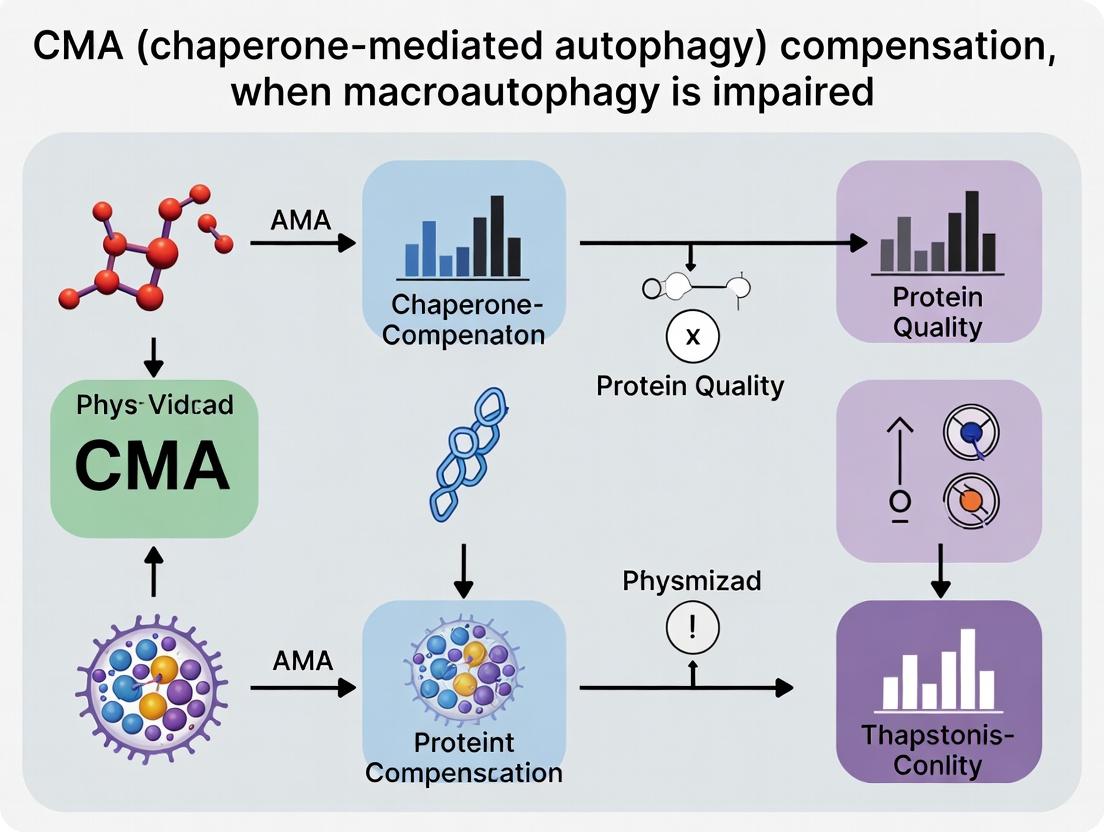
This article explores the critical compensatory role of Chaperone-Mediated Autophagy (CMA) in cellular proteostasis when macroautophagy is impaired or overwhelmed.
CMA Activation: The Compensatory Lifeline When Macroautophagy Fails in Disease
Abstract
This article explores the critical compensatory role of Chaperone-Mediated Autophagy (CMA) in cellular proteostasis when macroautophagy is impaired or overwhelmed. Targeting researchers and drug developers, it provides a comprehensive overview of the molecular crosstalk between autophagy pathways, detailing experimental methodologies to induce and measure CMA upregulation. The content analyzes common challenges in studying CMA compensation, offers optimization strategies for robust assays, and validates findings through comparative analysis with other compensatory mechanisms like proteasomal degradation. We conclude by synthesizing the therapeutic implications of modulating CMA as a novel strategy for treating neurodegenerative diseases, cancer, and age-related disorders linked to autophagy dysfunction.
Understanding the Cellular Crosstalk: How CMA Steps Up When Macroautophagy Falters
Technical Support Center
Troubleshooting Guides & FAQs
Q1: In my CMA reporter cell line (e.g., KFERQ-PA-mCherry-1), I observe low basal CMA activity even under serum starvation. What are the primary causes and solutions? A: Low basal signal can result from:
- Lysosomal pH imbalance: CMA substrates are degraded in lysosomes with a luminal pH of ~4.5-5.0. Use Lysosensor Blue or LysoTracker Red to confirm pH. Treat cells with 200 nM Bafilomycin A1 for 4-6 hours as a control; signal should accumulate.
- LAMP2A downregulation: Check LAMP2A levels by western blot. Prolonged confluence (>72 hours) can reduce LAMP2A. Re-plate cells at lower density and assay 24-48 hours later.
- Insufficient stress induction: Serum starvation for 10-16 hours is standard. Positive control: Treat with 10 µM H₂O₂ for 2 hours prior to fixation.
Q2: When inhibiting macroautophagy with 3-MA or siRNA against ATG5/7, I do not see the expected compensatory upregulation of CMA. What could be wrong? A: Compensatory CMA activation requires sustained, not acute, macroautophagy impairment.
- Temporal Check: Compensatory CMA upregulation typically manifests after 24-48 hours of sustained macroautophagy blockade. Perform a time-course experiment.
- Specificity of Inhibitors: 3-MA can have off-target effects. Confirm results using a genetic model (e.g., ATG5/7 KO cells). Measure CMA activity via:
- LAMP2A Levels: Western blot for LAMP2A. A 1.5 to 3-fold increase is typical upon compensation.
- Lysosomal Binding Assay: Isolate lysosomes and assess binding of radiolabeled GAPDH (a CMA substrate). Expect a 2-3 fold increase in substrate binding under compensatory conditions.
Q3: My isolated lysosomes for the in vitro CMA assay have low purity or poor activity. How can I optimize the protocol? A: Key steps for high-quality lysosomes:
- Use Mechanical Homogenization: Avoid detergents. Use a ball-bearing homogenizer (e.g., Isobiotec) with a 10-12 µm clearance for >90% cell breakage.
- Include Protease Inhibitors: Use 1 µg/mL each of Pepstatin A and Leupeptin in all buffers to preserve lysosomal integrity.
- Perform a Density Gradient: Use a discontinuous Percoll gradient (e.g., 19% and 30%) for purification. Assess purity by measuring the enrichment of the lysosomal marker Cathepsin D versus the cytosolic marker LDH.
Table 1: Expected Quantitative Enrichment in Lysosomal Fractions
| Marker | Homogenate Specific Activity | Purified Lysosome Specific Activity | Enrichment (Fold) |
|---|---|---|---|
| Cathepsin D (Lysosomal) | 1.0 (reference) | 18.0 - 25.0 | 18-25x |
| LDH (Cytosolic) | 1.0 (reference) | 0.8 - 1.5 | <1.5x |
| LAMP2A (CMA Receptor) | 1.0 (reference) | 20.0 - 30.0 | 20-30x |
Detailed Experimental Protocol: Assessing CMA Compensation
Title: Protocol for Measuring CMA Flux Upon Macroautophagy Inhibition
Objective: To quantitatively measure the increase in CMA activity in response to chronic macroautophagy impairment.
Materials:
- Cell Line: Stable cell line expressing KFERQ-PA-mCherry-1 (CMA reporter).
- Inhibitors: 10 mM 3-Methyladenine (3-MA) in PBS, or siRNA targeting ATG5/ATG7.
- Antibodies: Anti-LAMP2A (Ab18528), Anti-GAPDH, Anti-LC3-II, Anti-p62.
- Lysosome Isolation Kit (e.g., Lysosome Enrichment Kit, Thermo Scientific).
Procedure:
- Induction of Macroautophagy Impairment:
- Plate cells at 60% confluence.
- Group 1 (Acute): Treat with 10 mM 3-MA for 6 hours.
- Group 2 (Chronic): Treat with 10 mM 3-MA for 48 hours, refreshing media + inhibitor at 24 hours.
- Control: Treat with vehicle (PBS) for 48 hours.
- For genetic inhibition, transfert with siRNA 72 hours prior to assay.
CMA Activity Measurement (Imaging):
- Serum starve all groups for the final 16 hours of treatment.
- Fix cells with 4% PFA for 15 min.
- Image using a confocal microscope. CMA activity is reported as the ratio of punctate (lysosomal) mCherry signal to diffuse (cytosolic) signal. Analyze ≥50 cells per condition.
Biochemical Validation:
- Harvest cells and isolate lysosomes using the enrichment kit.
- Perform Western blot on lysosomal fractions for LAMP2A and total lysates for LC3-II/p62 (to confirm macroautophagy inhibition).
- Quantify band intensity. Normalize LAMP2A levels to the lysosomal control protein (Cathepsin D).
The Scientist's Toolkit: Research Reagent Solutions
Table 2: Essential Reagents for CMA/Macroautophagy Compensation Studies
| Item | Function in Experiment | Example Product/Catalog # |
|---|---|---|
| CMA Reporter Plasmid | Visualizes CMA flux in live cells via lysosomal accumulation of fluorescent-tagged CMA substrate (KFERQ motif). | KFERQ-PA-mCherry-1 (Addgene #125918) |
| LAMP2A Antibody | Critical for detecting changes in levels of the CMA receptor, a hallmark of compensatory upregulation. | Abcam ab18528 |
| Lysosome Isolation Kit | Provides pure lysosomal fractions for in vitro binding/degradation assays to quantify CMA activity biochemically. | Thermo Scientific 89839 |
| Bafilomycin A1 | V-ATPase inhibitor used as a control to block lysosomal degradation and cause accumulation of CMA substrates. | Sigma-Aldrich B1793 |
| ATG5/ATG7 siRNA | Genetic tool for specific, chronic inhibition of macroautophagy to induce compensatory CMA without pharmacological side-effects. | Dharmacon SMARTpool |
| Percoll | Used for high-purity density gradient centrifugation during lysosome isolation. | Cytiva 17-0891-01 |
Diagrams
Title: Signaling in CMA Compensation After Macroautophagy Block
Title: Workflow to Measure CMA Compensation
Troubleshooting Guides & FAQs
FAQ 1: My LC3-II immunoblot shows a strong signal, but my tandem mRFP-GFP-LC3 assay shows mostly yellow puncta (autophagosomes). Does this mean macroautophagy is induced?
- Answer: Not necessarily. A strong LC3-II signal or prevalent yellow puncta can indicate either induction of autophagy or an impairment in autophagosome-lysosome fusion/degradation (i.e., blocked flux). You must perform a flux assay.
- Troubleshooting Protocol: Bafilomycin A1 (BafA1) Flux Assay:
- Seed cells in duplicate or triplicate.
- Treat cells with your experimental stressor/condition.
- 2-4 hours before harvesting, add BafA1 (a V-ATPase inhibitor that prevents lysosomal acidification and degradation) to one set of samples. The other set serves as an untreated control.
- Harvest cells and perform LC3 immunoblot.
- Interpretation: Compare LC3-II levels +/- BafA1.
- Healthy Flux: LC3-II is low in untreated cells but increases significantly with BafA1. The stressor induces functional autophagy.
- Impaired Flux: LC3-II is already high in untreated cells and does not increase further with BafA1. The stressor blocks a late step (fusion/degradation).
FAQ 2: I suspect CMA is compensating in my macroautophagy-impaired model. What are the key validation markers?
- Answer: Do not rely on a single marker. Use a multi-pronged approach:
- LAMP2A Immunoblot & Immunofluorescence: Monitor protein levels and puncta formation. Increased LAMP2A is a primary indicator of CMA activation.
- CMA Reporter Assay (KFERQ-PA-mCherry1): Transfert cells with this construct. Under CMA-active conditions, the cytosolic mCherry signal decreases as it is translocated into lysosomes. Use lysosomal protease inhibitors (e.g., E64d/Pepstatin A) to confirm lysosomal delivery.
- Colocalization Analysis: Co-stain for LAMP2A and a known CMA substrate (e.g., GAPDH, RNASE A) under stress conditions.
FAQ 3: My experimental drug is supposed to induce autophagy, but my p62 levels are going down. Is this proof of increased degradation?
- Answer: A decrease in p62 can indicate increased autophagic degradation, but it can also result from altered transcription or proteasomal clearance. You must correlate p62 turnover with LC3 flux data.
- Troubleshooting Protocol: Integrated p62/SQSTM1 Degradation Assay:
- Perform the BafA1 flux assay as described above.
- Probe the same immunoblot membrane for p62.
- Interpretation:
- Autophagic Degradation Confirmed: p62 levels decrease with your drug. This decrease is prevented by co-treatment with BafA1.
- Alternative Clearance Suspected: p62 decreases, but BafA1 does not block this decrease. Investigate proteasome inhibition (e.g., MG132) as a control.
Key Experimental Protocols
Protocol 1: Assessing Macroautophagy Flux via Immunoblot
- Objective: Quantitatively distinguish between autophagy induction and impaired flux.
- Materials: Cells, treatment reagents, Bafilomycin A1 (100 nM typical working concentration), lysis buffer (with protease inhibitors), antibodies for LC3 and p62.
- Method:
- Plate cells in 6-well plates. Perform treatments in biological triplicate.
- For the last 4 hours of treatment, add BafA1 or vehicle control (DMSO) to the appropriate wells.
- Lyse cells in RIPA buffer. Measure protein concentration.
- Load equal protein amounts (20-40 µg) for SDS-PAGE and immunoblotting.
- Probe sequentially for LC3, p62, and a loading control (e.g., GAPDH, Actin).
- Densitometry: Calculate the fold-change in LC3-II (BafA1-treated vs. untreated) for each condition.
Protocol 2: Validating CMA Activation
- Objective: Confirm compensatory CMA upregulation.
- Materials: CMA reporter (KFERQ-PA-mCherry1), LAMP2A antibody, lysosomal inhibitors (E64d 10 µg/mL + Pepstatin A 10 µg/mL).
- Method:
- Transcriptional Upregulation: Perform qPCR for LAMP2 and HSC70 mRNA. Normalize to housekeeping genes.
- Protein Level & Translocation: a. Transfect with KFERQ-PA-mCherry1 plasmid for 24h. b. Treat cells with your stress condition +/- lysosomal inhibitors for 12-16h. c. Image live cells or fixed preparations. Quantify the ratio of cytosolic (diffuse) vs. lysosomal (punctate) mCherry signal. d. In parallel, run lysates for LAMP2A and HSC70 immunoblot.
- Functional Assay: Isolate lysosomes from control and treated cells. Perform an in vitro translocation assay with radiolabeled CMA substrate (e.g., ¹⁴C-GAPDH).
Research Reagent Solutions Toolkit
| Reagent/Tool | Function & Application |
|---|---|
| Bafilomycin A1 | V-ATPase inhibitor. Blocks autophagosome-lysosome fusion & acidification. Gold standard for flux assays. |
| Chloroquine | Lysosomotropic agent. Raises lysosomal pH, inhibiting degradation. Alternative for in vivo flux studies. |
| Tandem mRFP-GFP-LC3 | pH-sensitive reporter. GFP quenched in acidic lysosome, mRFP stable. Yellow puncta (RFP+GFP+)=autophagosomes; Red-only puncta (RFP+)=autolysosomes. |
| KFERQ-PA-mCherry1 | CMA-specific reporter. The PA (photoactivatable) variant allows pulse-chase studies of CMA substrate translocation. |
| LAMP2A Antibody | Key marker for CMA-active lysosomes. Monitor protein levels by WB and puncta formation by IF. |
| p62/SQSTM1 Antibody | Selective autophagy substrate/adapter. Turnover indicates autophagic degradation. Must be used with flux inhibitors. |
| E64d & Pepstatin A | Lysosomal protease inhibitors. Used to "trap" and confirm lysosomal delivery of CMA substrates. |
| CONA (Cyto-ID) | Dye-based autophagy kit for flow cytometry/high-content screening. Measures autophagic vacuoles. Use with caution and validate by blot. |
Table 1: Common Stressors and Their Documented Effects on Autophagy Flux and CMA Compensation
| Pathological Condition / Stressor | Effect on Macroautophagy Flux | Evidence of CMA Compensation | Key Citations (Examples) |
|---|---|---|---|
| Proteotoxic Stress (e.g., Proteasome Inhibition - MG132) | Often impairs late-stage flux; LC3-II accumulates. | Strong. LAMP2A upregulation & increased substrate translocation. | (Cuervo et al., 2004; Kaushik & Cuervo, 2018) |
| Mitochondrial Dysfunction (e.g., Rotenone/Parkinson's models) | Can impair mitophagy, leading to general flux blockade. | Yes. Observed in PD models; CMA degrades soluble mitochondrial proteins. | (Lynch-Day et al., 2012) |
| Oxidative Stress (H₂O₂, menadione) | Acute stress can induce flux; chronic stress may impair it. | Major compensatory pathway. CMA activated by oxidized proteins. | (Kiffin et al., 2004) |
| ER Stress (Tunicamycin, Thapsigargin) | Can activate UPR-induced autophagy but may also overwhelm system. | Documented. CMA degrades misfolded ER proteins via ER-phagy/CMA crosstalk. | (Smith et al., 2011) |
| Aging | Universally impaired autophagic flux. | CMA activity declines with age, but relative contribution may increase as macroautophagy fails. | (Cuervo & Dice, 2000) |
| Lysosomal Storage Disorders (e.g., NPC1 deficiency) | Severe impairment in fusion/clearance. | CMA machinery often functional initially, may be recruited. | (Sarkar et al., 2013) |
Visualizations
Title: Macroautophagy Flux Pathway and Impairment Triggering CMA
Title: Stepwise Experimental Validation of CMA Compensation
Technical Support Center
Troubleshooting Guides & FAQs
Q1: In our model of impaired macroautophagy, we see no increase in LAMP2A protein levels despite evidence of CMA activation. What could be wrong? A1: This discrepancy often points to a post-translational issue. First, verify that your LAMP2A antibody is specific for the CMA-specific LAMP2A isoform, not total LAMP2. Second, assess LAMP2A stability at the lysosomal membrane. Increased lysosomal recruitment and multimerization of LAMP2A, not just total protein, drives CMA activation. Perform a lysosomal isolation followed by blue native PAGE to check for LAMP2A multimers. Third, check for excessive lysosomal turnover; CMA activation can lead to subsequent lysosomal dysfunction under prolonged stress.
Q2: Our ChIP assays fail to show TFEB binding to the LAMP2 promoter under CMA-inducing conditions, contradicting published literature. A2: Common issues include suboptimal cross-linking and antibody specificity.
- Protocol Fix: Use a double cross-linking method (1.5 mM EGS for 45 min, then 1% formaldehyde for 15 min) to better preserve TFEB-DNA interactions. Quench with 125 mM glycine.
- Control: Always run a positive control using a known TFEB target gene primer set (e.g., CLEAR network gene). Ensure your CMA-inducing stimulus (e.g., prolonged serum starvation >12h, oxidative stress with 200 µM H₂O₂) is strong enough to trigger nuclear translocation of TFEB. Confirm TFEB nuclear translocation via immunofluorescence prior to ChIP.
Q3: How do we specifically measure CMA activity, not just marker levels? A3: Use the validated KFERQ-PA-mCherry-EGFP reporter assay.
- Detailed Protocol:
- Transfect cells with the KFERQ-PA-mCherry-EGFP construct (Addgene #125965).
- Induce CMA (e.g., serum starvation for 12-16 hours).
- Fix cells and image via confocal microscopy.
- Quantification: CMA activity is reported by the ratio of red-only puncta (mCherry signal in lysosomes after EGFP quenching) to total red puncta (both mCherry+EGFP and mCherry-only). A minimum of 50 cells per condition should be analyzed.
- Troubleshooting: High basal yellow signal (overlap) suggests poor lysosomal delivery; optimize starvation time. Low signal may require transfection optimization or stronger CMA induction.
Q4: Hsc70 co-immunoprecipitation with lysosomal membranes is inconsistent. A4: The lysosomal pool of Hsc70 is critical for substrate translocation.
- Protocol Fix: Isolate intact lysosomes via density gradient centrifugation (Metrizamide or Percoll). Perform the IP from the purified lysosomal fraction, not whole-cell lysate. Use a mild, non-ionic detergent (0.2% Digitonin) for membrane solubilization to preserve complexes. Include ATP (1 mM) in all lysis and wash buffers to maintain Hsc70 binding conformation.
Q5: When modeling macroautophagy impairment (e.g., ATG5/7 KO), what are the optimal time points to assess compensatory CMA activation? A5: CMA compensation is time-dependent. See the table below for a standard kinetic analysis framework.
| Time Post-Macroautophagy Inhibition | Expected Key CMA Event | Recommended Assay |
|---|---|---|
| Early (6-24h) | Transcriptional upregulation of LAMP2A | qRT-PCR for LAMP2A mRNA; Nuclear translocation of TFEB/TFE3 (IF/WB). |
| Mid (24-48h) | Increase in LAMP2A lysosomal protein & multimerization | Lysosomal fractionation + Western Blot; BN-PAGE for multimers. |
| Late (48-72h+) | Sustained increase in functional CMA activity | KFERQ reporter assay; Degradation of long-lived proteins (³H-Leucine assay). |
The Scientist's Toolkit: Research Reagent Solutions
| Item | Function & Application |
|---|---|
| KFERQ-PA-mCherry-EGFP Plasmid | Dual-fluorescence reporter for quantifying CMA flux in live cells. |
| TFEB/TFE3 Nuclear Localization Antibody | Immunofluorescence/Western Blot to assess the transcriptional switch. |
| LAMP2A (Clone EPR17755) Antibody | Specific antibody for the CMA-critical LAMP2A isoform. |
| Lysosome Isolation Kit (e.g., from Sigma) | For purifying intact lysosomes to analyze membrane-associated CMA components. |
| Concanamycin A / Bafilomycin A1 | V-ATPase inhibitors used to block lysosomal acidification, control for degradation steps. |
| Digitonin | Mild detergent for solubilizing lysosomal membrane protein complexes in IP. |
| Recombinant Hsc70 Protein | Positive control for binding assays and in vitro reconstitution of CMA translocation. |
Experimental Protocols
Protocol 1: Lysosomal Isolation and LAMP2A Multimerization Analysis
- Homogenize: Wash cells (two 15cm plates per condition) in ice-cold PBS, scrape in Homogenization Buffer (250 mM sucrose, 10 mM HEPES, pH 7.4, 1 mM EDTA, plus protease inhibitors). Pass through a 22-gauge needle 15 times.
- Clear Lysate: Centrifuge at 1,000 x g for 10 min (4°C). Collect supernatant.
- Density Gradient: Layer supernatant onto a discontinuous 27% Percoll gradient. Ultracentrifuge at 95,000 x g for 35 min (4°C).
- Collect Lysosomes: Harvest the dense, lower band containing lysosomes.
- BN-PAGE: Solubilize lysosomal pellet in NativePAGE sample buffer containing 1% digitonin. Load onto a NativePAGE 3-12% Bis-Tris gel. Run and process for Western Blot with anti-LAMP2A.
Protocol 2: CMA Activity Assay Using Radioactive Labeling of Long-Lived Proteins
- Labeling: Incubate cells with ³H-Leucine (0.5 µCi/mL) in complete medium for 48h.
- Chase: Wash and incubate in complete medium for 20h to degrade short-lived proteins.
- CMA Induction: Replace medium with CMA-inducing medium (e.g., serum-free) with or without 10 mM NH₄Cl (lysosomal inhibitor). Include a "No Inhibition" control and a "NH₄Cl + Concanamycin A" (CMA+Macroautophagy inhibition) set.
- Degradation Measurement: Collect media after 6-8h. Precipitate proteins with TCA (final 10%). Measure ³H-Leucine in the TCA-soluble (degraded) fraction via scintillation counting. CMA-specific degradation = (Degradation in Test) - (Degradation with NH₄Cl).
Diagrams
Diagram 1: CMA Activation Pathways in Macroautophagy Impairment
Diagram 2: Workflow for Validating Compensatory CMA
Technical Support Center: Troubleshooting Chaperone-Mediated Autophagy (CMA) Induction Studies
Frequently Asked Questions (FAQs)
Q1: My model of macroautophagy impairment (e.g., ATG5/7 KO) shows no compensatory increase in CMA activity. What could be wrong? A1: Common issues include:
- Insufficient Stress Duration: Macroautophagy impairment may require prolonged stress (nutrient deprivation >12h, oxidative stress) to trigger CMA compensation. Verify the time course.
- LAMP2A Saturation: Basal CMA may already be high. Measure LAMP2A levels and multimerization on lysosomal membranes. A lack of increase in the multimeric form (required for translocation) can limit activity despite increased transcription.
- Off-target Cell Stress: The method of macroautophagy inhibition (e.g., cytotoxicity from certain inhibitors) may globally impair lysosomal function. Use genetic knockout/knockdown models and confirm lysosomal health (pH, cathepsin activity).
Q2: When inducing oxidative stress to activate Nrf2, I see Keap1 degradation but no consistent increase in CMA substrates. Why? A2: This suggests dissociation between Nrf2 signaling and CMA execution.
- Check HSC70 and Co-chaperones: Nrf2 upregulates the CMA receptor LAMP2A, but substrate translocation requires HSC70 and its lysosomal-membrane co-chaperones. Measure their levels. Oxidative stress can also damage HSC70.
- Substrate Verification: Ensure your readout (e.g., KFERQ-Dendra reporter, endogenous protein degradation assays) is specific. Use CMA inhibitors (e.g., LAMP2A siRNA) as a control.
- Competition with Proteasome: Nrf2 also upregulates proteasome subunits. Inhibit the proteasome to see if CMA substrate accumulation increases.
Q3: Hypoxia (HIF-1α stabilization) in my system leads to lysosomal expansion but not CMA activation. Is this expected? A3: Potentially. HIF-1α primarily induces lysosomal biogenesis and macroautophagy. Direct CMA induction via HIF-1α is less documented.
- Measure Specific Components: Check if HIF-1α activation specifically upregulates LAMP2A transcription (via HREs) or just general lysosomal genes (TFEB target genes). Use ChIP to confirm HIF-1α binding to the LAMP2A promoter.
- Ambient Oxygen Levels: Ensure hypoxia is severe and sustained enough (typically <1% O2 for 16-24h) to trigger compensatory mechanisms.
Q4: How do I distinguish the individual contribution of TFEB vs. TFE3 in driving CMA during macroautophagy blockade? A4:
- Individual Knockouts: Use specific siRNA/shRNA. Redundancy is common; double knockdown may be necessary to see a phenotype.
- Nuclear Translocation Assays: Perform fractionation or immunofluorescence for each transcription factor separately under experimental conditions.
- Target Gene Profiling: Use qPCR panels for canonical TFEB/TFE3 targets (e.g., CLEAR network genes) versus known CMA-specific genes (LAMP2A). Their overlap and specificity can indicate the primary driver.
Troubleshooting Guides
Issue: Inconsistent LAMP2A Multimerization on Lysosomes
| Possible Cause | Diagnostic Test | Solution |
|---|---|---|
| Lysosomal pH Disruption | Measure lysosomal pH (Lysosensor dyes). | Use Bafilomycin A1 as a control; optimize treatment doses to avoid excessive alkalization. |
| ROS Damage to Lysosomal Membrane | Measure lipid peroxidation (e.g., BODIPY 581/591 C11). | Titrate pro-oxidants (e.g., paraquat, H2O2) or add membrane-protectant (e.g., α-tocopherol). |
| Insufficient GlcNAc-1-phosphotransferase activity | Check phosphorylation of lysosomal hydrolases. | This is genetic; confirm cell line background. |
Issue: High Background in KFERQ-Dendra2 CMA Reporter Assay
| Possible Cause | Diagnostic Test | Solution |
|---|---|---|
| Photoconversion Inefficiency | Check photoconversion efficiency using a region-of-interest control. | Optimize laser power and exposure time for complete photoconversion. |
| Non-specific Lysosomal Trapping | Co-treat with Bafilomycin A1 (blocks fusion/degradation). | Subtract the Bafilomycin-insensitive signal from total lysosomal signal. |
| Reporter Overexpression | Use stable, low-expression clones. | Titrate transfection reagents; use inducible promoters or clone low-expressing cell lines. |
Experimental Protocols
Protocol 1: Measuring CMA Activity Using a KFERQ-Dendra2 Reporter
- Seed Cells: Plate cells expressing the photoconvertible KFERQ-Dendra2 reporter.
- Induce CMA: Apply experimental condition (e.g., serum starvation, oxidative stress) for 6-24h.
- Photoconversion: At assay time, use a 405nm laser to photoconvert Dendra2 from green to red in a defined cytoplasmic region.
- Inhibit New Synthesis: Immediately add cycloheximide (10µg/mL) to the medium.
- Monitor Translocation: Image cells over 2-4h using live-cell microscopy. Track the loss of red fluorescence in the cytoplasm and its appearance in puncta (lysosomes).
- Quantify: Calculate the ratio of red puncta intensity/total cellular red intensity over time.
Protocol 2: Assessing LAMP2A Multimeric State by BN-PAGE
- Isolate Lysosomes: Use density gradient centrifugation to purify lysosomes from treated/control cells.
- Solubilize Membrane Proteins: Lyse lysosomal pellet in 1% digitonin buffer (milder than SDS, preserves complexes).
- Blue Native PAGE: Load samples on a 4-16% BN-PAGE gel. Run at 4°C with cathode buffer (containing Coomassie G-250).
- Transfer & Immunoblot: Transfer to PVDF membrane using semi-dry transfer.
- Detect LAMP2A: Probe with anti-LAMP2A antibody. Multimers will appear as higher molecular weight bands (≥700 kDa).
Protocol 3: TFEB/TFE3 Nuclear Translocation Assay
- Cell Treatment & Fixation: Treat cells, then fix with 4% PFA for 15 min.
- Permeabilization & Blocking: Permeabilize with 0.1% Triton X-100, block with 5% BSA.
- Immunostaining: Incubate with primary antibodies against TFEB and TFE3 (specific) overnight at 4°C, then with fluorophore-conjugated secondary antibodies.
- Counterstain: Stain nuclei with DAPI.
- Imaging & Quantification: Acquire high-resolution confocal images. Use image analysis software (e.g., ImageJ) to calculate the nuclear/cytoplasmic fluorescence intensity ratio for each transcription factor.
Pathway Diagrams
The Scientist's Toolkit: Research Reagent Solutions
| Reagent/Material | Function in CMA Research | Key Consideration |
|---|---|---|
| KFERQ-Dendra2 / -PAmCherry1 Plasmid | Photoconvertible CMA reporter. Allows kinetic tracking of substrate uptake into lysosomes. | Use low-expression clones; validate KFERQ motif mutation as negative control. |
| LAMP2A-Specific Antibodies | Immunoblot, immunofluorescence to quantify receptor levels and localization. | Must distinguish LAMP2A from LAMP2B/C isoforms (C-terminal epitope recommended). |
| Digitonin | Mild detergent for lysosomal membrane protein solubilization in BN-PAGE. | Critical for preserving LAMP2A multimeric complexes; purity is essential. |
| Concanamycin A / Bafilomycin A1 | V-ATPase inhibitors. Block lysosomal acidification and substrate degradation. | Used in CMA flux assays to distinguish translocation from degradation. |
| siRNA Pools vs. Individual | For knockdown of KEAP1, HIF1A, TFEB, TFE3. | Use individual siRNAs to assess redundancy; pools for robust knockdown. |
| Cycloheximide | Protein synthesis inhibitor. Used in degradation chase assays. | Short-term use only (2-8h) to avoid pleiotropic stress effects. |
| N-Acetyl-Leu-Leu-Norleu-al (ALLN) | Calpain inhibitor. Can prevent degradation of CMA components. | Useful for stabilizing proteins but may confound degradation assays. |
| Purified HSC70 Protein | Positive control for in vitro CMA substrate binding/translocation assays. | Verify ATPase activity for functional assays. |
Technical Support Center: CMA Compensation Research in Macroautophagy-Impaired Models
Troubleshooting Guides & FAQs
FAQ 1: How do I confirm successful genetic or pharmacological impairment of macroautophagy in my cellular model before assessing CMA activity?
- Answer: A multi-assay validation is required. Relying on a single marker (like LC3-II) is insufficient.
- Key Validation Experiments:
- LC3 Turnover Assay: Compare LC3-II levels in the presence vs. absence of lysosomal protease inhibitors (e.g., Bafilomycin A1 or chloroquine). Impaired macroautophagy will show a blunted increase in LC3-II accumulation upon inhibition.
- SQSTM1/p62 Degradation Assay: Monitor steady-state levels of p62 via immunoblot. Functional macroautophagy degrades p62; impairment leads to its accumulation. However, p62 is also a CMA substrate, so interpret with other data.
- Long-lived Protein Degradation Assay: The gold-standard functional assay. Measure the degradation of radiolabeled (e.g., [14C]-valine) long-lived proteins. A significant reduction indicates impaired bulk autophagy.
- Key Validation Experiments:
FAQ 2: My CMA reporter (e.g., KFERQ-Dendra) shows increased fluorescence in a macroautophagy-impaired model. Does this definitively prove CMA compensation?
- Answer: Increased fluorescence suggests increased CMA substrate delivery, but not necessarily functional lysosomal degradation. You must distinguish between substrate uptake and completion of degradation.
- Troubleshooting Steps:
- Inhibit Lysosomal Degradation: Treat cells with a lysosome inhibitor (e.g., Bafilomycin A1). If fluorescence increases further, it confirms that the reporter is being delivered to lysosomes but its degradation is now blocked, supporting active CMA flux.
- Assess Lysosomal LAMP2A Levels: Perform immunoblot for LAMP2A, the CMA receptor. Compensatory CMA is often accompanied by an increase in LAMP2A protein levels.
- Monitor CMA Transcriptional Program: Check mRNA levels of LAMP2A and other CMA components regulated by the MEF2D/TFEB axis, which is a known compensatory pathway.
- Troubleshooting Steps:
FAQ 3: When studying CMA in vivo (e.g., in neurodegeneration models like tauopathy or metabolic disease models), what are the best tissues to analyze, and how do I handle tissue-specific variability?
- Answer: CMA activity is tissue and context-dependent.
- Tissue Recommendations:
- Neurodegeneration: Brain regions specifically affected (e.g., hippocampus, cortex). Use microdissection.
- Metabolic Disease: Liver, pancreatic beta-cells, skeletal muscle, and adipose tissue.
- Handling Variability: Always include an internal loading control specific to the organelle. For CMA lysosomal assays, normalize to total lysosomal mass (e.g., Cathepsin D activity or LAMP1 levels).
- Tissue Recommendations:
FAQ 4: What are the critical controls for isolating "clean" lysosomes for the in vitro CMA translocation assay?
- Answer: Contamination with other organelles is the major pitfall.
- Essential Controls for Lysosomal Purity:
- Marker Profiling: Perform immunoblots on your lysosomal fraction against markers for mitochondria (VDAC1), endoplasmic reticulum (Calnexin), peroxisomes (Catalase), and cytosol (GAPDH). These should be absent or minimal.
- Protease Protection Assay: Treat intact lysosomes with proteinase K. The luminal CMA substrate (e.g., GAPDH) should be protected unless detergents are added to lyse the membrane.
- Latency Check: Confirm that your lysosomal preparation is intact by measuring hexosaminidase activity in the presence and absence of a detergent (e.g., Triton X-100). A high degree of latency (>70%) indicates intact organelles.
- Essential Controls for Lysosomal Purity:
Experimental Protocols
Protocol 1: In Vitro CMA Translocation Assay
- Purpose: To directly measure the ability of isolated lysosomes to take up CMA substrates.
- Methodology:
- Lysosome Isolation: From liver or cultured cells, using discontinuous metrizamide density gradient centrifugation.
- CMA Substrate Preparation: Isolate and radiolabel (³²P or ¹⁴C) GAPDH (a canonical CMA substrate) from rat liver cytosol.
- Incubation: Incubate intact lysosomes (10-50 µg protein) with the radiolabeled substrate (2-5 µg) and an ATP-regenerating system in reaction buffer (10 mM HEPES, 0.3 M sucrose, 100 mM KCl, 2 mM MgCl2, 2.5 mM ATP, pH 7.8) for 20 min at 37°C.
- Degradation Arrest: Stop the reaction by chilling on ice.
- Separation & Quantification: Re-isolate lysosomes via centrifugation. Measure the radioactivity associated with the lysosomal pellet (translocated/imported substrate) vs. the supernatant using a scintillation counter.
- Normalization: Express results as % of substrate translocated per µg of lysosomal protein. Include controls with lysosomes pre-treated with proteinase K (to degrade surface LAMP2A) to confirm CMA specificity.
Protocol 2: Measuring CMA Activity Using the Photoconvertible Reporter KFERQ-Dendra
- Purpose: To dynamically monitor CMA flux in living cells.
- Methodology:
- Transfection: Transfect cells with the KFERQ-Dendra2 construct.
- Photoconversion: Select a region of interest and photoconvert the Dendra2 signal from green to red using 405 nm laser light.
- Time-Lapse Imaging: Monitor the red (photoconverted) signal over time (e.g., 0, 4, 8, 12, 24 hours). CMA-mediated delivery to lysosomes results in the quenching of the red fluorescent signal.
- Quantification: Calculate the half-life (t½) of the red fluorescent signal. A shorter t½ indicates higher CMA activity. Always co-treat with a lysosomal inhibitor in a parallel experiment to confirm that signal loss is due to lysosomal degradation.
- Normalization: Account for photobleaching by imaging non-photoconverted cells under identical conditions.
Research Reagent Solutions
| Reagent/Catalog # | Vendor (Example) | Function in CMA/Macroautophagy Research |
|---|---|---|
| Bafilomycin A1 (SML1661) | Sigma-Aldrich | V-ATPase inhibitor. Blocks lysosomal acidification and degradation, used in flux assays for both macroautophagy and CMA. |
| Chloroquine diphosphate (C6628) | Sigma-Aldrich | Lysosomotropic agent that raises lysosomal pH, inhibiting degradation. Used in vivo and in vitro. |
| Anti-LC3B antibody (#3868) | Cell Signaling Tech | Marker for autophagosomes. Used in immunoblot to assess LC3-I to LC3-II conversion. |
| Anti-SQSTM1/p62 antibody (ab109012) | Abcam | Selective autophagy substrate. Accumulates when macroautophagy is impaired. |
| Anti-LAMP2A antibody (ab18528) | Abcam | Primary receptor for CMA. Key marker for CMA lysosomes; levels often increase during compensation. |
| KFERQ-Dendra2 (Addgene #121918) | Addgene | Photoconvertible CMA reporter. Allows live-cell imaging and quantification of CMA flux. |
| Leupeptin (L9783) | Sigma-Aldrich | Lysosomal protease inhibitor. Used in combination assays to block substrate degradation. |
| 3-Methyladenine (3-MA, M9281) | Sigma-Aldrich | Class III PI3K inhibitor. Commonly used to pharmacologically inhibit early stages of macroautophagy. |
Table 1: Key Metrics in CMA Upregulation Following Macroautophagy Inhibition
| Experimental Model | Macroautophagy Impairment Method | CMA Activity Increase (%)* | LAMP2A Protein Increase (Fold) | Key Reference (Example) |
|---|---|---|---|---|
| Mouse Liver (in vivo) | ATG7 Knockout | ~250% | 3.5 - 4.0 | Kaushik & Cuervo, 2018 |
| Mouse Brain (Neurons) | ATG5 Conditional KO | ~180% | 2.8 | |
| Cellular Model (MEFs) | ATG5 CRISPR/Cas9 KO | ~200% | 3.2 | |
| Cellular Model (HeLa) | Bafilomycin A1 (100nM, 24h) | ~150% | 2.0 |
Measured via in vitro translocation assay or reporter half-life. *Hypothetical data based on field consensus.
Table 2: Troubleshooting Common Assay Results
| Observed Result | Potential Cause | Recommended Action |
|---|---|---|
| High basal p62 in control cells | Constitutive autophagy may be low; p62 may be aggregated. | Use serum/amino acid starvation to induce autophagy in controls. Filter cell lysates before blotting. |
| No change in KFERQ-Dendra signal | CMA may not be active or reporter is mislocalized. | Treat with a known CMA inducer (e.g., serum starvation >6h) as a positive control. Verify reporter expression. |
| High lysosomal contamination in isolation | Gradient centrifugation was not optimal. | Adjust homogenization force, and optimize density gradient concentrations and centrifugation times for your tissue/cell type. |
Pathway & Workflow Diagrams
Diagram Title: Signaling Pathway for CMA Compensation Post-Macroautophagy Block
Diagram Title: Workflow for Validating CMA Compensation
Experimental Toolbox: Inducing, Measuring, and Modulating CMA Activity in Research Models
Troubleshooting & FAQs for Macroautophagy Inhibition Experiments
This technical support content is framed within the thesis research context: "Investigating CMA Compensation When Macroautophagy is Impaired."
FAQ Section
Q1: In my ATG5 knockout cell line, I observe an initial increase in CMA flux via the LAMP-2A reporter, but this compensation diminishes after 72 hours. What could explain this loss of compensation?
A: This is a common observation. Prolonged, complete genetic inhibition of macroautophagy creates significant proteostatic stress. The initial CMA upregulation is an adaptive response. The subsequent decline may be due to:
- Overwhelming of CMA capacity: The substrate load may exceed CMA's degradative throughput.
- Secondary dysfunction: Chronic accumulation of autophagic cargo (e.g., damaged mitochondria, protein aggregates) can lead to cellular toxicity and compromise lysosomal health, indirectly impairing CMA.
- Depletion of essential CMA components: Check LAMP-2A multimerization status and levels of Hsc70. The system may be degraded or transcriptionally downregulated under prolonged stress. Troubleshooting Step: Perform a time-course experiment measuring CMA activity (see Protocol A) alongside markers of lysosomal function (e.g., cathepsin activity, lysosomal pH). This will help correlate CMA dynamics with overall lysosomal health.
Q2: When using Chloroquine (CQ) to inhibit autophagy, I see conflicting results: some CMA markers increase while others decrease. How should I interpret this pharmacologically?
A: Chloroquine and other lysosomotropic agents (e.g., Bafilomycin A1) are broad lysosomal inhibitors. They not only block autophagosome-lysosome fusion/degradation but also directly impair lysosomal function by raising luminal pH. This has a dual effect:
- Indirect CMA Induction: Macroautophagy blockade signals for CMA upregulation.
- Direct CMA Inhibition: The elevated lysosomal pH disrupts the translocation of substrates across the lysosomal membrane via CMA. Your results likely reflect this balance. The initial signaling for CMA (increased LAMP-2A transcription) may be "on," while the actual mechanistic flux is impaired. Recommendation: Use CQ for short-term experiments (6-24h) to emphasize the signaling response. For cleaner long-term CMA flux studies, genetic models (ATG KOs) are preferred, possibly supplemented with a lysosomal pH buffer to maintain function.
Q3: My ATG7 knockout mouse model shows strong CMA compensation in liver, but not in brain tissue. Is this tissue-specific variability expected?
A: Yes, significant tissue specificity is a critical factor. Basal and inducible levels of macroautophagy and CMA vary greatly between tissues. Liver and kidney typically exhibit high CMA capacity, while brain has more limited CMA activity. The reliance on different proteostatic pathways is tissue-dependent. Troubleshooting Step: Always include a positive control tissue (like liver) when characterizing a new ATG knockout model. For brain studies, consider more sensitive CMA flux assays (e.g., using the KFERQ-PS-Dendra2 reporter virus) and examine alternative compensatory pathways like the ubiquitin-proteasome system.
Q4: What are the key validation controls to confirm that observed CMA activity changes are directly due to macroautophagy inhibition and not off-target effects?
A: Essential controls include:
- Rescue/Restoration: Re-introduce the deleted ATG gene (e.g., ATG5) in the KO model. CMA compensation should attenuate.
- CMA-Specific Inhibition: In your inhibited model (KO or drug-treated), use CMA-specific tools (e.g., knockdown of LAMP2A or HSPA8) to confirm that the observed phenotype (e.g., protein aggregate accumulation, cell viability loss) is specifically due to the compensatory CMA activity.
- Multiple Inhibition Methods: Correlate findings across at least two distinct inhibition methods (e.g., ATG5 KO + Bafilomycin A1 treatment). Consistent trends strengthen the conclusion.
Experimental Protocols
Protocol A: Measuring CMA Activity Using the KFERQ-Dendra2 Photoconversion Assay
Objective: Quantify CMA flux in live cells following macroautophagy inhibition. Principle: The Dendra2 fluorescent protein is fused to a canonical CMA-targeting motif (KFERQ). Under basal conditions, it distributes throughout the cell (green). Upon photoconversion with 405nm light, a region-of-interest (ROI) turns red. The rate of red fluorescence loss in the photoconverted ROI, specifically in lysosomal-rich perinuclear regions, corresponds to CMA-mediated degradation.
Method:
- Seed cells (WT and ATG KO) expressing the KFERQ-Dendra2 construct in glass-bottom dishes.
- Serum-starve (6-24h) to induce CMA. Include controls with serum.
- Photoconversion: Using a confocal microscope, select a cytoplasmic ROI excluding the nucleus. Apply a 405nm laser pulse to fully convert Dendra2 from green to red.
- Time-lapse Imaging: Immediately acquire red channel images every 30 minutes for 6-12 hours under maintained starvation conditions.
- Image Analysis:
- Quantify mean red fluorescence intensity in the photoconverted ROI over time.
- Normalize intensity to the initial post-conversion time point (T=0).
- Plot normalized intensity vs. time. The slope represents the rate of CMA-dependent degradation.
- Compare degradation rates between WT and macroautophagy-inhibited cells.
Protocol B: Validating Lysosomal Activity Under Lysosomotropic Agent Treatment
Objective: Assess the direct impact of Chloroquine (CQ) on lysosomal function alongside CMA markers. Method:
- Treat cells with a standard dose of CQ (e.g., 50-100 µM) or vehicle for 4, 12, and 24 hours.
- LysoTracker Staining: Incubate live cells with LysoTracker Deep Red (50 nM) for 30 min. Image. Increased signal can indicate lysosomal volume expansion, not necessarily activity.
- Magic Red Cathepsin B Assay: Incubate live cells with Magic Red substrate according to manufacturer protocol. Image. A direct measure of lysosomal protease activity. Signal will decrease if CQ is effectively inhibiting lysosomal acidification.
- Immunoblotting: In parallel samples, harvest protein and probe for:
- LAMP-2A (CMA component)
- LC3-II (accumulates with CQ treatment, confirming macroautophagy blockade)
- p62/SQSTM1 (should increase)
- TFEB (may show nuclear translocation as a stress response)
- Correlation: Compare the time course of LAMP-2A increase with the decrease in Magic Red signal to dissect induction from functional impairment.
Table 1: Common Models for Macroautophagy Inhibition and Their Impact on CMA
| Inhibition Method | Target/Mechanism | Key Experimental Readout for CMA Compensation | Typical Timeframe for CMA Induction | Major Caveats for CMA Studies |
|---|---|---|---|---|
| ATG5 or ATG7 KO (Genetic) | Conjugation systems for LC3/autophagosome formation | ↑ LAMP-2A protein levels; ↑ KFERQ-Dendra2 degradation rate; ↑ LAMP-2A multimers | Detectable by 24h, peaks 48-72h | Chronic model; secondary cellular stress may eventually impair lysosomes/CMA. |
| siRNA/shRNA vs. ATGs | Transient knockdown of essential ATG genes | ↑ Transcriptional activation of LAMP2A (mRNA); ↑ CMA substrate binding | 48-96 hours post-transfection | Incomplete inhibition; variable efficiency. |
| Chloroquine (CQ) | Lysosomotropic agent; raises lysosomal pH | Initial ↑ in LAMP-2A mRNA/protein; but ↓ actual CMA flux in long-term assays. | Signaling onset: 4-12h. Functional flux is impaired. | Directly inhibits lysosomal function, confounding CMA flux measurements. |
| Bafilomycin A1 | V-ATPase inhibitor; blocks lysosomal acidification & fusion | Similar to CQ. Useful for short-term, acute fusion blockade studies. | Signaling onset: 2-6h. | More potent and specific lysosomal acidification inhibitor than CQ. |
Table 2: Troubleshooting Common Pitfalls
| Observed Problem | Potential Causes | Suggested Solutions |
|---|---|---|
| No CMA increase in ATG KO cells. | 1. Insufficient metabolic stress (e.g., serum present).2. Tissue/cell type with low CMA capacity.3. Compensatory upregulation of other ATG genes. | 1. Induce CMA via serum/AA starvation (6-24h).2. Use liver-derived cells or validate model in high-CMA tissue.3. Perform RNA-seq to check for alternative pathway activation. |
| High cell death in long-term CQ experiments. | Combined proteotoxic stress from dual autophagy/lysosomal inhibition. | 1. Reduce CQ concentration.2. Shorten treatment window (<24h).3. Use genetic inhibition for chronic studies. |
| Variable CMA reporter results. | 1. Photoconversion damage during live imaging.2. Overexpression artifacts from reporter. | 1. Optimize laser power/duration for minimal phototoxicity.2. Use clonal, stable cell lines with moderate expression; validate with endogenous markers (LAMP-2A immunoblot). |
The Scientist's Toolkit: Key Research Reagents
| Reagent Category | Specific Example(s) | Function in Macroautophagy Inhibition/CMA Studies |
|---|---|---|
| Genetic Tools | ATG5, ATG7, ATG12 CRISPR/Cas9 KO kits; shRNA plasmids targeting ATGs. | To create stable, complete genetic ablation of macroautophagy, inducing compensatory CMA. |
| Pharmacological Inhibitors | Chloroquine diphosphate, Bafilomycin A1, Hydroxychloroquine sulfate. | Acute, reversible inhibition of autophagic flux and lysosomal function. Critical for time-course studies. |
| CMA Reporters | KFERQ-PS-Dendra2 plasmid, KFERQ-mCherry-EGFP (CMA-Rosella) construct. | Live-cell, quantitative measurement of CMA flux via fluorescence loss (Dendra2) or lysosomal delivery (Rosella). |
| CMA Functional Antibodies | Anti-LAMP-2A (clone GL2A7), Anti-HSC70, Anti-LAMP-1. | To monitor CMA component levels, multimerization (via native gels), and lysosomal localization. |
| Lysosomal Function Probes | LysoTracker dyes, Magic Red Cathepsin B/L assay kits, pHrodo dextran. | To assess lysosomal abundance, protease activity, and pH—critical for interpreting CMA data in pharmacological models. |
| Key Assay Kits | Commercially available ELISA for p62, LC3-II; CellTiter-Glo viability assay. | To confirm macroautophagy inhibition (↑p62, ↑LC3-II) and monitor associated cellular stress. |
Pathway & Workflow Diagrams
Title: Compensatory CMA Pathway Upon Macroautophagy Impairment
Title: KFERQ-Dendra2 CMA Flux Assay Workflow
Troubleshooting Guides & FAQs
Q1: In the KFERQ-binding assay, I observe high non-specific binding of my substrate protein to control beads (non-antibody coated). What could be the cause and how can I reduce it?
A: High non-specific binding is often due to electrostatic interactions or incomplete blocking. Ensure you are using a stringent binding/wash buffer (e.g., 50 mM Tris-HCl, 150 mM NaCl, 0.1% Tween-20, pH 7.5). Increase the concentration of a neutral detergent (0.2% Tween-20) and include 1% BSA in the wash buffer. Pre-clear the lysate with control beads for 30 minutes before incubating with antibody-coated beads. Verify that your substrate protein does not contain tags (e.g., His-tag) that may bind nonspecifically to certain resin materials.
Q2: During the lysosomal translocation assay, my isolated lysosomes appear fragile and lyse during the protease protection step. How can I improve lysosomal integrity?
A: Lysosomal fragility is common. Use a gentle osmotic shock method for isolation instead of mechanical homogenization. Maintain all solutions and centrifuge rotors at 4°C. Include 1 mM dithiothreitol (DTT) and a protease inhibitor cocktail without EDTA in all buffers. Sucrose concentration is critical; ensure the purification gradient uses 25% (w/w) sucrose for the lysosomal band. After isolation, keep lysosomes in a high-sucrose (0.25 M) stabilization buffer. Always validate integrity by measuring latent hexosaminidase activity before proceeding.
Q3: My LAMP2A stability assay shows inconsistent degradation kinetics between experimental replicates when macroautophagy is inhibited. What are key variables to control?
A: In the context of macroautophagy impairment, CMA flux can be highly dynamic. Key variables are:
- Inhibition Specificity: Use multiple methods to inhibit macroautophagy (e.g., ATG5/7 CRISPR KO alongside lysosomal inhibitors like Bafilomycin A1) to confirm findings are not off-target effects.
- Serum Starvation Time: Titrate starvation times (2-10 hours) as CMA activation timing may shift when macroautophagy is compromised.
- Cycloheximide Chase Concentration: Use a higher concentration (50 µg/mL) to fully arrest translation, as compensatory CMA upregulation may increase substrate turnover.
- Lysosomal Load: Monitor LAMP2A multimerization via non-reducing gels, as increased CMA demand can lead to faster LAMP2A assembly/disassembly cycles.
Q4: When measuring compensatory CMA upregulation, my positive control (e.g., HSC70 overexpression) works, but my experimental condition (macroautophagy inhibition) does not show increased CMA activity. Why?
A: Compensatory CMA may not be immediate. Consider:
- Time Course: Perform a time-course experiment (e.g., measure CMA activity at 12, 24, 48, and 72 hours post-macroautophagy inhibition).
- Cell State: CMA compensation is often stress-specific. Induce a mild oxidative stress (e.g., 100 µM H₂O₂ for 1 hour) alongside macroautophagy inhibition to trigger the cross-talk.
- Substrate Specificity: Test multiple known CMA substrates (e.g., GAPDH, RNASE A) as compensation might favor specific substrates.
- Lysosomal Function: Verify that macroautophagy inhibition (especially using lysosomal agents) hasn't broadly impaired lysosomal pH or function, which would block CMA.
Experimental Protocols
Protocol 1: LAMP2A Turnover and Multimerization Assay
Purpose: To assess the stability and oligomeric status of LAMP2A at the lysosomal membrane, a key indicator of CMA activity.
- Treat cells (control vs. macroautophagy-impaired, e.g., ATG5 KO) with 50 µg/mL cycloheximide to block new protein synthesis.
- Harvest cells at 0, 2, 4, 8, and 12 hours post-treatment.
- Isolate lysosomes using a discontinuous iodixanol gradient centrifugation protocol.
- Solubilize lysosomal membranes in 1% digitonin buffer for 30 min on ice.
- For stability: Analyze total LAMP2A levels by SDS-PAGE (reducing conditions) and immunoblot with anti-LAMP2A antibody (specific to the C-terminal tail, avoiding cross-reaction with LAMP2B/C).
- For multimerization: Resolve lysosomal proteins by SDS-PAGE under non-reducing conditions (omit β-mercaptoethanol/DTT in sample buffer). LAMP2A monomers (~96 kDa) and multimers (>200 kDa) will be visible.
Protocol 2: In Vitro KFERQ-Binding Assay
Purpose: To quantify the binding of substrate proteins to the CMA receptor complex.
- Generate lysates from control and treated cells in HEPES-KOH lysis buffer (pH 7.5).
- Incubate 500 µg of lysate with protein A/G beads pre-coated with anti-HSC70 antibody or isotype control IgG for 4 hours at 4°C.
- Wash beads 5 times with wash buffer (50 mM Tris, 150 mM NaCl, 0.2% Tween-20).
- Elute bound proteins with 2X Laemmli buffer at 95°C for 5 min.
- Analyze eluates by immunoblot for your protein of interest (e.g., GAPDH) and HSC70 (loading control).
- Quantification: Express the signal of the substrate co-immunoprecipitated with HSC70 as a percentage of the total substrate in the input lysate.
Protocol 3: Lysosomal Translocation/Protease Protection Assay
Purpose: To confirm the physical translocation of a substrate into the lysosomal lumen.
- Isolate intact lysosomes from cells (e.g., via sucrose gradient).
- Split the lysosomal preparation into three equal aliquots:
- Aliquot 1 (Total): Solubilize in 1% Triton X-100.
- Aliquot 2 (Protected): Leave intact in isotonic sucrose buffer.
- Aliquot 3 (Degraded): Leave intact.
- Add Proteinase K (100 µg/mL) to Aliquot 2 and 3. Incubate all three aliquots on ice for 30 min.
- Stop the reaction by adding 5 mM PMSF.
- Add 1% Triton X-100 to Aliquot 2 and 3 to solubilize.
- Detect your substrate protein by immunoblot. True translocation is indicated by signal loss in Aliquot 3 (Degraded) but protection in Aliquot 2, compared to Aliquot 1.
Table 1: Typical CMA Activity Readouts in Macroautophagy-Impaired Models
| Cell Model / Intervention | LAMP2A Protein Level (Fold Change) | LAMP2A Multimerization | KFERQ-Binding Activity (% of Control) | Lysosomal Translocation Efficiency | Reference Key Findings |
|---|---|---|---|---|---|
| ATG5 Knockout MEFs | ↑ 2.5 - 3.5 | Increased high-MW complexes | ↑ 180-220% | ↑ 2.0-fold for GAPDH | Compensatory CMA flux peaks at 24-48h post-confluence |
| Bafilomycin A1 (24h) | ↑ 1.8 - 2.2 | Moderately Increased | ↑ 150% | ↑ 1.7-fold for RNASE A | Acute lysosomal pH block triggers rapid LAMP2A upregulation |
| ATG7 Knockout Neurons | ↑ 3.0 - 4.0 | Significantly Increased | ↑ 250% | ↑ 2.5-fold for MEF2D | CMA compensation is critical for neuronal survival |
| 3-MA (10mM, 12h) | or ↑ 1.5 | Slightly Increased | Early-phase macroautophagy inhibition may not be sufficient |
Table 2: Troubleshooting Common Assay Failures
| Symptom | Possible Cause | Recommended Solution |
|---|---|---|
| No LAMP2A multimers on non-reducing gel | Over-reduction by sample buffer | Ensure NO DTT/β-ME is in the sample buffer. Use fresh Iodoacetamide (15mM) in lysis buffer to alkylate free thiols. |
| Low signal in protease protection assay | Lysosomes lysed during isolation | Verify isolation buffers are at correct osmolarity. Use a protease inhibitor cocktail that does not inhibit Proteinase K (avoid PMSF until step 4). |
| High background in KFERQ-IP | Antibody leaching from beads | Use a crosslinking agent (e.g., DSS) to covalently crosslink antibody to beads before the IP step. |
| No increase in CMA activity upon macroautophagy block | Cell type specificity | Not all cell types robustly upregulate CMA. Validate using primary mouse liver cells or fibroblasts as a positive control system. |
Diagrams
Diagram 1: CMA Pathway and Macroautophagy Crosstalk
Title: CMA Activation Upon Macroautophagy Inhibition
Diagram 2: Experimental Workflow for CMA Assays
Title: Integrated CMA Activity Assay Workflow
The Scientist's Toolkit: Research Reagent Solutions
| Item / Reagent | Function in CMA Assays | Key Consideration for Macroautophagy Compensation Studies |
|---|---|---|
| LAMP2A C-Terminal Antibody (e.g., ab18528) | Specifically detects LAMP2A isoform without cross-reacting with LAMP2B/C for immunoblot and immunofluorescence. | Validate that macroautophagy impairment does not alter LAMP2B/C levels, which could affect assay specificity. |
| HSC70 Antibody (Co-IP Grade) | Immunoprecipitation of the CMA recognition complex for KFERQ-binding assays. | Use for Co-IP, not just blotting. Ensure it does not disrupt HSC70-substrate interaction. |
| Recombinant KFERQ-Positive Substrate (e.g., RNASE A, GAPDH) | Positive control substrate for binding and translocation assays. | Confirm your cellular model expresses the substrate endogenously when testing compensation. |
| Lysosome Isolation Kit (e.g., based on density gradients) | Provides intact, functional lysosomes for translocation and LAMP2A multimerization assays. | Kit efficiency must be verified in your specific macroautophagy-impaired cell type, as lysosome size/density may change. |
| Proteinase K (Lyophilized) | Critical reagent for the protease protection assay to assess substrate translocation into lysosomes. | Titrate concentration for each lysosomal prep; over-digestion can lyse lysosomes. |
| Cycloheximide | Translation inhibitor used in chase experiments to measure protein turnover (e.g., LAMP2A stability). | Use a high concentration (50-100 µg/mL) to ensure complete inhibition, especially if CMA flux is high. |
| Bafilomycin A1 | V-ATPase inhibitor used to block macroautophagy and lysosomal acidification. | In compensation studies, use as a short-term (6-12h) inducer of CMA stress, not long-term, as it will also block CMA degradation. |
| TFEB/TFE3 Reporter Cell Line | Luciferase or GFP reporter to monitor lysosomal biogenesis pathway activation. | Correlate TFEB activation kinetics with CMA assay readouts to establish causality. |
Technical Support Center
Troubleshooting Guides & FAQs
Q1: During CMA flux measurement using the photoconvertible KFERQ-Dendra2 reporter, I observe high baseline fluorescence even in the presence of lysosomal inhibitors. What could be the cause and solution?
A: High baseline fluorescence often indicates insufficient lysosomal inhibition or reporter overexpression leading to cytosolic aggregation.
- Troubleshooting Steps:
- Verify Inhibitor Efficacy: Titrate concentrations of Bafilomycin A1 (100-200 nM) and Leupeptin (100 µM). Include a positive control (e.g., starvation-induced CMA) and a CMA-deficient control (e.g., LAMP2A knockdown).
- Optimize Transfection: Reduce the amount of KFERQ-Dendra2 plasmid or use a stable, inducible cell line to prevent cytosolic aggregation. Perform a time-course experiment to identify the optimal expression window.
- Confirm Photoconversion: Ensure the photoconversion protocol is correctly calibrated for your microscope system. A region of interest (ROI) should be fully photoconverted from green to red.
Q2: In my in vivo study using AR7 (a CMA activator), I do not see the expected increase in LAMP2A levels or reduction in protein aggregates. What might be wrong?
A: AR7 efficacy is highly dependent on dosage, administration route, and model system.
- Troubleshooting Steps:
- Dose & Timing: AR7 is typically administered at 20-30 mg/kg body weight intraperitoneally. Ensure the treatment duration is sufficient (chronic models may require 1-2 weeks). Prepare a fresh solution in DMSO/corn oil mix for each injection.
- Model Validation: Confirm that your model has a functional CMA pathway. In aged animals or certain disease models, the lysosomal compartment may be compromised, limiting AR7's effect. Co-monitor a known CMA substrate (e.g., MEF2D, PKM2) by immunoblot.
- Pharmacokinetics: Consider the half-life of AR7. Adjust the injection schedule (e.g., every 48 hours) to maintain effective concentration.
Q3: When overexpressing LAMP2A to enhance CMA, I observe increased cell death. Is this expected and how can I mitigate it?
A: Uncontrolled LAMP2A overexpression can disrupt lysosomal homeostasis. This is not a universal outcome and can be managed.
- Troubleshooting Steps:
- Use Inducible Systems: Switch from constitutive to doxycycline-inducible LAMP2A expression vectors. Titrate the inducer concentration to find a level that enhances CMA without toxicity.
- Monitor Lysosomal Integrity: Use LysoTracker staining and assess cathepsin activity. Co-overexpression of other lysosomal components (e.g., lysosomal Hsc70) may stabilize the system.
- Check for Off-target Effects: Validate LAMP2A overexpression by both mRNA (qPCR) and protein (western blot for the A isoform specifically). Use an appropriate empty vector control.
Q4: The CMA inhibitor 6-Aminonicotinamide (6-AN) is causing severe, non-specific metabolic toxicity in my primary neuronal cultures. How can I isolate its CMA-specific effects?
A: 6-AN inhibits glucose-6-phosphate dehydrogenase, affecting the pentose phosphate pathway. This broad metabolic disruption is a major confounder.
- Troubleshooting Steps:
- Use a Lower Dose & Shorter Time: Test a range (10-100 µM) for shorter periods (6-12 hours) to find a window where CMA inhibition (assessed by substrate accumulation) precedes widespread toxicity.
- Employ Genetic Controls: Always pair 6-AN treatment with LAMP2A siRNA knockdown. The overlapping phenotype (CMA substrate accumulation) confirms a CMA-specific effect.
- Consider Alternative Inhibitors: For chronic or in vivo studies, prioritize genetic knockdown/knockout of LAMP2A. Note that no pharmacological CMA inhibitor is perfectly specific.
Experimental Protocols
Protocol 1: Measuring CMA Activity Using the KFERQ-Dendra2 Reporter Principle: The photoconvertible Dendra2 fluorescent protein fused to a CMA-targeting motif (KFERQ) allows tracking of lysosomal delivery.
- Cell Seeding & Transfection: Seed cells in glass-bottom dishes. Transfect with pKFERQ-Dendra2 plasmid using standard methods (e.g., lipofection).
- Photoconversion: 24-48h post-transfection, select a region for photoconversion. Illuminate with 405 nm laser to convert green fluorescence to red.
- Treatment & Inhibition: Immediately add treatments (e.g., AR7, 6-AN) along with lysosomal inhibitors (Bafilomycin A1 200 nM, Leupeptin 100 µM) to block degradation of red signal.
- Imaging & Quantification: Acquire time-lapse images over 4-8 hours using a confocal microscope. Track the decrease in red fluorescence intensity within the photoconverted ROI. The slope represents CMA flux.
Protocol 2: Assessing CMA via LAMP2A Immunoblot and Substrate Turnover Principle: Active CMA requires translocation complex formation at the lysosomal membrane.
- Lysosomal Isolation: Treat cells, harvest, and homogenize. Centrifuge at low speed (1,000 x g) to remove nuclei. Pellet lysosomes via centrifugation at 17,000 x g for 20 min.
- Membrane Fractionation: Resuspend the pellet in mild alkali buffer (0.1M Na2CO3, pH 11.5) for 30 min on ice to separate membrane-associated proteins from luminal contents.
- Centrifugation & Analysis: Centrifuge at 100,000 x g for 1h. The pellet contains lysosomal membrane proteins. Analyze by SDS-PAGE and immunoblot for:
- LAMP2A: Total levels and multimeric status.
- Hsc70: Lysosomal-associated form.
- CMA Substrates: e.g., GAPDH, RNASE A.
- Pulse-Chase Alternative: For dynamic turnover, perform a 35S-methionine/cysteine pulse-chase and immunoprecipitate specific CMA substrates.
Protocol 3: In Vivo CMA Modulation with AR7 Principle: Systemic activation of CMA in animal models.
- Solution Preparation: Dissolve AR7 in DMSO to create a 100 mg/mL stock. Before injection, dilute 1:10 in corn oil (final 10 mg/mL). Vortex thoroughly.
- Animal Dosing: Administer via intraperitoneal injection at a dose of 25 mg/kg body weight. For chronic studies, inject every other day for the required duration.
- Tissue Collection & Analysis: Sacrifice animals and dissect tissues of interest. For CMA activity assays, homogenize tissue rapidly in cold PBS with protease inhibitors.
- Liver/Kidney: Analyze LAMP2A levels and multimerization by non-reducing SDS-PAGE.
- Brain: Isclude synaptosomal or lysosomal fractions to assess neuronal CMA.
Data Presentation
Table 1: Comparison of Pharmacological CMA Modulators
| Tool | Name (Code) | Primary Target/Mechanism | Typical Concentration In Vitro | Typical Dose In Vivo | Key Considerations & Off-Targets |
|---|---|---|---|---|---|
| Activator | AR7 | Stabilizes LAMP2A multimeric complex at lysosomal membrane | 10-20 µM | 20-30 mg/kg (i.p.) | Modest efficacy; may require chronic administration. |
| Inhibitor | 6-Aminonicotinamide (6-AN) | Inhibits G6PD, depleting NADPH, indirectly affecting CMA | 50-200 µM | 50 mg/kg (i.p.) | Highly non-specific; causes broad metabolic stress. Use with genetic confirmation. |
| Genetic Activator | LAMP2A OE (Overexpression) | Increases limiting component of CMA translocation complex | N/A (Genetic) | N/A (AAV delivery common) | Overexpression can saturate lysosomal system; inducible systems preferred. |
| Genetic Inhibitor | LAMP2A KD/KO (Knockdown/Knockout) | Ablates essential CMA translocation complex component | N/A (Genetic) | N/A (Conditional KO models) | Gold standard for specificity. Compensatory macroautophagy upregulation often occurs. |
Table 2: Quantitative Readouts for CMA Activity Assessment
| Assay Type | Readout | Method | Expected Change with CMA Activation | Expected Change with CMA Inhibition |
|---|---|---|---|---|
| Functional Flux | KFERQ-Dendra2 Degradation Rate | Live-cell imaging, photoconversion | Increase in red signal decay rate | Decrease in red signal decay rate |
| Biochemical | Lysosome-associated CMA Substrates | Immunoblot of isolated lysosomes | Decrease in substrate levels | Increase in substrate levels |
| Structural | LAMP2A Multimerization | Immunoblot under non-reducing conditions | Increase in high MW multimers | Decrease in high MW multimers |
| Transcriptional | LAMP2 & HSPA8 (Hsc70) mRNA | qRT-PCR | Variable/Context-dependent | Variable/Context-dependent |
Diagrams
Title: Research Context: CMA Compensation Upon Macroautophagy Impairment
Title: Experimental Workflow for CMA Manipulation Studies
The Scientist's Toolkit: Research Reagent Solutions
| Item | Function/Application | Key Consideration |
|---|---|---|
| pKFERQ-Dendra2 Plasmid | Photoconvertible reporter for live-cell quantification of CMA flux. | Optimize expression time to avoid cytosolic aggregation. |
| AR7 (CMA Activator) | Small molecule inducer of CMA; stabilizes LAMP2A complexes. | Solubility requires DMSO/corn oil mix for in vivo use. Efficacy varies by tissue. |
| Bafilomycin A1 | V-ATPase inhibitor; blocks lysosomal acidification and degradation. | Essential control for flux assays. Use at 100-200 nM. Toxic with prolonged exposure. |
| LAMP2A Antibody (4H4) | Mouse monoclonal antibody specific for the LAMP2A splice variant. | Critical for distinguishing LAMP2A from 2B/2C. Use under non-reducing conditions to see multimers. |
| Lysosome Isolation Kit | For rapid purification of intact lysosomes from tissues/cells. | Yields membrane fractions for assessing translocation complex assembly. |
| Doxycycline-Inducible LAMP2A Cell Line | Allows controlled, titratable overexpression of LAMP2A. | Mitigates toxicity from constitutive overexpression. Requires careful dose/timing optimization. |
| siRNA Targeting LAMP2 | For genetic inhibition of CMA. Validated pools target all isoforms. | Always include isoform-specific validation (qPCR for A, B, C) and assess compensatory macroautophagy. |
Technical Support Center
FAQs & Troubleshooting
Q1: In live-cell imaging of CMA reporter cells (e.g., KFERQ-PA-GFP/mCherry), I observe high background fluorescence in the cytosol, obscuring lysosomal puncta. What could be the cause and solution? A: High cytosolic background often indicates poor photoactivation control or lysosomal impairment.
- Troubleshooting Steps:
- Verify Photoactivation Protocol: Ensure you are using a brief, precise pulse (405 nm laser, 1-5% power, 2-5 frames) on a minimal ROI. Over-exposure saturates the signal.
- Check Lysosomal pH/Function: Treat cells with 200 nM Bafilomycin A1 for 1 hour. If puncta increase but don't turn over, it confirms CMA activity but indicates lysosomal degradation is blocked, which can increase background. Assess lysosomal health with LysoTracker.
- Optimize Imaging Medium: Use phenol red-free medium with 25 mM HEPES to maintain pH without CO2 during imaging.
- Confirm Transfection: Use stable lines where possible; transient transfection can lead to overexpression artifacts.
- Troubleshooting Guide:
- Antibody/Resin Choice: Use a crosslinkable resin to co-immunoprecipitate (co-IP). Covalently crosslink the anti-LAMP-2A antibody (e.g., clone EPR20031) to Protein A/G beads to reduce heavy/light chain interference in MS.
- Stringency Washes: Implement a gradient of increasingly stringent washes post-IP: 1x IP buffer, 1x high-salt buffer (500 mM NaCl), and 1x mild detergent wash (0.1% SDS).
- Control: Include a critical isogenic control where CMA is inhibited (e.g., LAMP-2A knockdown cells). Proteins present in the experimental but absent in the control IP are high-confidence interactors.
- Validate with Orthogonal Method: Confirm key interactions by Proximity Ligation Assay (PLA) in fixed cells.
Q3: My single-cell RNA-seq data from macroautophagy-impaired cells shows unexpected heterogeneity in CMA-related gene expression. How do I validate this is not a technical artifact? A: Technical noise from droplet-based protocols can confound results.
- Action Plan:
- Bioinformatic Filtering: Apply strict QC thresholds: genes detected in <10 cells removed, cells with >20% mitochondrial reads or <500 unique genes removed.
- Spike-in Controls: Use RNA spike-ins (e.g., ERCC) to distinguish biological variability from technical capture efficiency noise.
- Targeted Validation: Perform single-molecule RNA FISH (smFISH) for top candidate genes (e.g., LAMP2A, HSPA8/Hsc70) on a replicate sample. Quantify transcript puncta per cell and correlate with scRNA-seq expression clusters.
- Pseudotime Analysis Validation: If suggesting a CMA activation trajectory, sort cells from different pseudotime points and measure CMA activity via the KFERQ reporter assay in bulk.
Q4: When inducing macroautophagy impairment (e.g., with ATG5/7 siRNA or inhibitors), my expected compensatory CMA upregulation is not detected by the reporter assay. Why? A: Compensation may be delayed, conditional, or blocked by an unknown variable.
- Systematic Check:
- Verify Impairment: Confirm macroautophagy blockade by monitoring LC3-II turnover via immunoblot in the presence/absence of lysosomal inhibitors (Bafilomycin A1, 100 nM, 4h).
- Time Course: Extend the time point of analysis. CMA compensation can initiate 24-72 hours post-macroautophagy inhibition.
- Stress Context: CMA compensation often requires a concurrent stressor. Induce mild oxidative stress (e.g., 100 µM H2O2, 2h) and re-measure.
- Assay Sensitivity: Ensure your CMA reporter is functional. Include a positive control (serum starvation for 12h) and a negative control (LAMP-2A knockdown).
Key Experimental Protocols
Protocol 1: Quantitative Live-Cell CMA Assay Using a Photoactivatable Reporter
- Cell Line: Stable HeLa or MEF cell line expressing KFERQ-PA-GFP-mCherry.
- Methodology:
- Plate cells on glass-bottom dishes 24h prior.
- Photoactivation: Select a field. Using a 405 nm laser, photoactivate the entire cytosolic PA-GFP pool in a single, brief pulse (2-5% power, 2 frames).
- Time-Lapse Imaging: Immediately begin time-lapse acquisition (e.g., every 10 min for 4-6h) using 488 nm (GFP) and 561 nm (mCherry) lasers. Maintain environment at 37°C, 5% CO2.
- Analysis: Quantify the fluorescence intensity of GFP (lysosomal delivery/degradation) and mCherry (total reporter) in lysosomal puncta over time using ImageJ. CMA activity is represented by the decrease in the GFP/mCherry ratio in puncta over time.
Protocol 2: Co-Immunoprecipitation and Proteomic Analysis of CMA Substrates & Interactors
- Sample Prep: Harvest control and CMA-activated cells (e.g., treated with 10 µM PI-103, 16h) in mild lysis buffer (1% Digitonin, 150 mM NaCl, 50 mM HEPES pH 7.4, protease inhibitors).
- Immunoprecipitation:
- Pre-clear lysate with control IgG beads for 30 min.
- Incubate supernatant with anti-LAMP-2A antibody-crosslinked beads overnight at 4°C.
- Wash sequentially: 5x lysis buffer, 1x high-salt buffer, 1x TBS.
- On-Bead Digestion: Denature in 2M urea, reduce with DTT, alkylate with IAA, and digest with trypsin/Lys-C overnight.
- LC-MS/MS: Analyze peptides on a Q-Exactive HF mass spectrometer coupled to an EASY-nLC 1200. Use a 120-min gradient.
Protocol 3: Single-Cell RNA-seq for Profiling CMA Dynamics in Autophagy-Deficient Cells
- Cell Preparation:
- Generate ATG7-KO and isogenic WT cell lines.
- Induce CMA by serum starvation (6h) or oxidative stress (100 µM H2O2, 2h).
- Create a single-cell suspension with >90% viability.
- Library Prep: Use the 10x Genomics Chromium Next GEM Single Cell 3' Kit v3.1 following manufacturer instructions. Target 10,000 cells per sample.
- Sequencing: Run on an Illumina NovaSeq, aiming for >50,000 reads per cell.
- Analysis: Process with Cell Ranger. Use Seurat in R for QC, normalization, clustering, and differential expression. Focus on CMA gene sets (LAMP2, HSPA8, HSP90AA1, STUB1, etc.).
Data Presentation
Table 1: Quantitative Metrics from a Representative CMA Activation Experiment in ATG5-KO MEFs
| Condition | CMA Reporter Half-life (min) | LAMP-2A Protein Level (Fold Change) | Identified CMA Substrates (LC-MS/MS) | % Cells with High CMA Gene Signature (scRNA-seq) |
|---|---|---|---|---|
| WT, Basal | 245 ± 32 | 1.0 ± 0.2 | 15 | 12% |
| WT, Starved (12h) | 118 ± 15 | 2.1 ± 0.3 | 41 | 67% |
| ATG5-KO, Basal | 210 ± 28 | 1.8 ± 0.2 | 28 | 35% |
| ATG5-KO, Starved (12h) | 95 ± 12 | 3.5 ± 0.4 | 89 | 82% |
Table 2: Common Issues & Resolutions in CMA Single-Cell Analysis
| Issue | Potential Cause | Recommended Solution |
|---|---|---|
| No clustering by CMA state | Low expression of CMA genes | Perform feature selection on a custom CMA gene set; use MAGIC or similar imputation. |
| High mitochondrial % in one cluster | Stress-induced cell death or technical artifact | Filter clusters with >25% mtRNA; investigate if cluster is biologically relevant (stress responders). |
| Poor correlation between scRNA-seq and smFISH | Dropout in scRNA-seq data | Use integrated analysis (e.g., Seurat's CCA) across replicates; employ scran normalization. |
Diagrams
The Scientist's Toolkit: Research Reagent Solutions
| Item | Function/Application | Example & Notes |
|---|---|---|
| KFERQ-PA-GFP-mCherry Reporter | Dual-fluorescent, photoactivatable CMA substrate for live-cell kinetics. | Addgene #125918. mCherry constitutively fluorescent; PA-GFP fluoresces only after 405 nm activation. |
| Anti-LAMP-2A Antibody | Specific immunoprecipitation and immunoblotting for CMA lysosomal receptor. | Abcam EPR20031 for human; Invitrogen 51-2200 for mouse. Critical for distinguishing from LAMP-2B/C isoforms. |
| Lysosomal Inhibitors | Block degradation within lysosomes to assess flux. | Bafilomycin A1 (100-200 nM). Use in parallel with controls to distinguish delivery from degradation. |
| CMA Activator/Inhibitor | Pharmacologically modulate CMA for validation. | PI-103 (10 µM): induces CMA via Akt/mTOR inhibition. No direct, specific CMA inhibitor exists; use LAMP-2A siRNA. |
| Single-Cell 3' RNA Kit | Generate barcoded libraries for scRNA-seq from cell suspensions. | 10x Genomics Chromium Next GEM 3' Kit v3.1. Ensure high cell viability (>90%). |
| RNAscope Probes | For single-molecule FISH validation of scRNA-seq hits. | Advanced Cell Diagnostics. Design probes for key CMA transcripts (e.g., LAMP2A-C2). |
| Crosslinkable IP Resin | Reduce antibody contamination in downstream MS analysis. | Thermo Scientific Pierce Protein A/G Magnetic Beads (crosslinking kit). |
| LC-MS/MS System | High-resolution identification and quantification of proteins/peptides. | Orbitrap-based system (e.g., Q-Exactive HF) coupled to nanoUPLC. |
Technical Support Center: Troubleshooting & FAQs
Thesis Context: This support content is framed within a broader research thesis investigating CMA (Chaperone-Mediated Autophagy) compensation mechanisms when macroautophagy is pharmacologically or genetically impaired in neurodegenerative and cancer cell models.
Frequently Asked Questions (FAQs)
Q1: In our neuronal SH-SY5Y model, LAMP2A overexpression is not yielding the expected increase in CMA flux despite macroautophagy inhibition with 3-MA. What could be the issue? A1: Common culprits include lysosomal saturation or co-dependence on other autophagic pathways. Verify lysosomal pH and function using LysoTracker Red and monitor for potential ER stress, which can inhibit CMA. Ensure you are using a validated LAMP2A overexpression construct and confirm protein levels via western blot.
Q2: When inducing CMA in our HeLa cancer cell line with 6-AN, we observe excessive cell death, confounding our proliferation assays. How can we modulate this? A2: 6-Aminonicotinamide (6-AN) can be broadly cytotoxic. Titrate the concentration carefully (start at 50 µM and go lower) and reduce exposure time. Consider using an alternative, more specific CMA activator like AR7 (10 µM). Always include a viability assay (e.g., Trypan Blue) 24 hours post-treatment before proceeding to downstream assays.
Q3: Our CMA flux assay using KFERQ-PA-mCherry shows puncta formation even in LAMP2A-KO cells. Is this background noise or a specific artifact? A3: This is a known artifact. The KFERQ motif can sometimes undergo cleavage, and the mCherry signal alone can aggregate. Always run a parallel experiment with cells expressing PA-mCherry (without the KFERQ motif) to establish a background signal. This control must be subtracted from your experimental readings.
Q4: After successful CMA induction in a macroautophagy-impaired (ATG5-KO) U251 glioma model, how do we specifically isolate the transcriptomic changes due to CMA compensation? A4: You require a multi-condition RNA-seq setup. Compare: 1) WT, 2) ATG5-KO, 3) ATG5-KO + CMA Activator (e.g., AR7), 4) ATG5-KO + CMA Inhibitor (e.g., peptide competing for LAMP2A binding). The differential analysis between conditions 3 and 4 will highlight genes specifically regulated by active CMA compensation.
Troubleshooting Guides
Issue: Inconsistent CMA Activation Readouts Across Cell Lines
- Problem: Variability in HSPA8 (Hsc70) or LAMP2A baseline levels.
- Solution: Pre-screen all cell models via western blot for core CMA component expression before experiments. Normalize CMA flux assays (e.g., RNASE3 degradation assay) to LAMP2A protein levels.
- Protocol: RNASE3 (Ribonuclease A) Degradation Assay: Treat cells (macroautophagy-inhibited) with 100 µg/ml cycloheximide to halt new protein synthesis. Lyse cells at T=0, 2, 4, and 6 hours. Run lysates on a 15% Tris-Glycine gel and probe for endogenous RNASE3 (a known CMA substrate). Quantify band intensity relative to actin. A steeper degradation slope indicates higher CMA flux.
Issue: Off-target Effects of Macroautophagy Inhibitors Affecting CMA
- Problem: Chloroquine (lysosomotropic agent) inhibits both macroautophagy and CMA by raising lysosomal pH.
- Solution: For clean macroautophagy impairment, use genetic knockout (e.g., CRISPR/Cas9 for ATG5 or ATG7) or more specific early-stage inhibitors like SAR405 (a PIK3C3/Vps34 inhibitor). Verify impairment by monitoring LC3-II accumulation (via western) and p62/SQSTM1 clearance.
- Protocol: Validating Macroautophagy Impairment: Treat control cells with 100 nM Bafilomycin A1 for 4-6 hours as a positive control for LC3-II accumulation. In your test model (genetically impaired or inhibitor-treated), compare basal LC3-II levels and p62 levels via western blot. Successful impairment shows high, unchanging LC3-II and increased p62 even under nutrient starvation (Earle's Balanced Salt Solution for 4h).
Table 1: Efficacy of Common CMA Modulators in Different Cell Models
| Modulator | Target/Mechanism | Typical Conc. | Optimal Cell Model | Key Readout | Notes |
|---|---|---|---|---|---|
| 6-AN | G6PD Inhibitor, Increases CMA | 50-100 µM | HeLa, MEFs | ↑ LAMP2A, ↑ KFERQ-protein degradation | Can be cytotoxic; monitor viability. |
| AR7 | Retinoic Acid Receptor Antagonist, CMA Activator | 10 µM | SH-SY5Y, U251 | ↑ Lysosomal association of HSPA8 | More specific than 6-AN. |
| CA77.1 | LAMP2A Transcriptional Activator | 5 µM | Primary Neurons | ↑ LAMP2A mRNA & Protein | Slow onset (24-48h). |
| CMA Inhibitor Peptide | Blocks substrate binding to LAMP2A | 100 µM | All | ↓ Degradation of KFERQ-reporters | Requires transfection/electroporation. |
Table 2: Comparative CMA Flux Under Macroautophagy Impairment
| Cell Line | Disease Model | Macroautophagy Impairment Method | CMA Flux Change (% vs Control) | Assay Used | Citation (Example) |
|---|---|---|---|---|---|
| SH-SY5Y | Parkinson's (α-synuclein) | ATG7 siRNA | +180% | KFERQ-Dendra2 Degradation | PMID: 31270463 |
| U251 MG | Glioblastoma | ATG5 CRISPR-KO | +220% | RNASE3 Degradation | PMID: 33437008 |
| MEFs | - | 3-MA (5mM) | +150% | GAPDH Lysosomal Association | PMID: 30389728 |
| HeLa | Cervical Cancer | Bafilomycin A1 (100nM) | -40%* | HSF70A Degradation | *Direct CMA inhibition |
Experimental Protocols
Protocol 1: Measuring CMA Flux Using the KFERQ-Dendra2 Photoconversion Assay.
- Cell Preparation: Plate cells on glass-bottom dishes. Transfect with KFERQ-Dendra2 plasmid using your standard method (e.g., Lipofectamine 3000).
- Macroautophagy Impairment: At 24h post-transfection, treat cells with your chosen macroautophagy inhibitor (e.g., 5 mM 3-MA) or use genetically impaired lines.
- Photoconversion: At 48h post-transfection, subject a region of interest to 405 nm light for 5-10 seconds to convert Dendra2 from green to red fluorescence.
- CMA Activation/Inhibition: Immediately add CMA modulator (e.g., AR7) or vehicle control.
- Imaging & Quantification: Using live-cell imaging, track red (converted) signal in the photoconverted region over 6-12 hours. The rate of red fluorescence loss correlates with CMA-mediated lysosomal degradation. Normalize to initial red fluorescence intensity.
Protocol 2: Co-immunoprecipitation for CMA Substrate-Lysosome Interaction.
- Lysosome Enrichment: Harvest ~1x10^7 cells per condition using a lysosome enrichment kit (e.g., from Thermo Scientific). Resuspend pellet in mild lysis buffer (e.g., 0.25% CHAPS).
- Immunoprecipitation: Incubate lysate with antibody against your CMA substrate of interest (e.g., α-synuclein) or against LAMP2A overnight at 4°C.
- Pull-down: Add protein A/G beads for 2 hours. Wash beads 3x with lysis buffer.
- Elution & Analysis: Elute proteins in 2X Laemmli buffer. Analyze by western blot, probing for the interacting partner (LAMP2A or substrate, respectively) and HSPA8.
The Scientist's Toolkit: Research Reagent Solutions
| Item | Function in CMA/Macroautophagy Research | Example Product/Cat. # |
|---|---|---|
| LAMP2A Antibody | Detects levels and localization of the critical CMA receptor. | Abcam ab18528, Santa Cruz sc-18822 |
| HSPA8 (Hsc70) Antibody | Detects the cytosolic chaperone essential for CMA substrate recognition. | Cell Signaling #8444 |
| KFERQ-Dendra2 Plasmid | Reporter for visualizing CMA substrate targeting and flux. | Addgene #101412 |
| LysoTracker Deep Red | Stains acidic organelles (lysosomes) for health and colocalization assays. | Thermo Fisher L12492 |
| SAR405 | Selective, early-stage Vps34/PIK3C3 inhibitor for clean macroautophagy blockade. | Selleckchem S7682 |
| AR7 (Diethylaminobenzaldehyde) | Small molecule activator of CMA. | Sigma 308335 |
| Bafilomycin A1 | V-ATPase inhibitor; blocks autophagosome-lysosome fusion & lysosomal acidification. | Cayman Chemical 11038 |
Visualizations
Title: Logical Flow of CMA Compensation Following Macroautophagy Block
Title: Core Experimental Workflow for CMA Modulation Studies
Navigating Experimental Challenges: Ensuring Specificity and Accuracy in CMA Compensation Studies
Technical Support Center
Troubleshooting Guide: Validating CMA-Specific Flux in Models of Macroautophagy Impairment
| Symptom | Possible Confounding Pathway | Diagnostic Experiment | Interpretation of Positive Result |
|---|---|---|---|
| Increased levels of LAMP2A, but no increase in CMA substrate degradation. | Compensatory UPR activation leading to LAMP2A transcription without functional lysosomal uptake. | Measure spliced XBP1 mRNA and CHOP protein levels. Isolate lysosomes and perform in vitro uptake assay with purified GAPDH. | High XBP1(s) & CHOP confirm UPR. Lack of increased in vitro uptake confirms CMA is not functionally active despite protein level increase. |
| Rapid turnover of a putative CMA substrate blocked by proteasome inhibitor (MG132), not by lysosomal inhibitors. | Substrate is degraded by the ubiquitin-proteasome system (UPS), not CMA. | Co-immunoprecipitation of substrate with ubiquitin. Treat cells with both MG132 and a lysosome inhibitor (e.g., BafA1); degradation should be fully blocked only with MG132. | Ubiquitination of substrate confirms UPS targeting. Exclusive inhibition by MG132 confirms proteasomal degradation. |
| Lysosomal inhibition only partially blocks substrate degradation. | Concurrent degradation by both CMA and macroautophagy or other pathways. | Use selective macroautophagy inhibitors (e.g., SAR405 for VPS34) in combination with lysosomal inhibition. Perform experiment in Atg5/7 KO cells (macroautophagy-deficient). | Complete blockade with combined inhibition or in Atg5 KO cells confirms dual degradation pathways. |
| No change in total LAMP2A levels, but suspected CMA activation. | Increased CMA activity via LAMP2A multimerization at lysosomal membrane, not increased protein synthesis. | Isolate lysosomal membranes, treat with crosslinker (BS3), and run non-reducing WB for LAMP2A to assess multimer (700 kDa+) formation. | Increased high-molecular-weight LAMP2A multimers indicate active CMA translocation complex assembly. |
FAQs
Q1: My model of macroautophagy impairment (e.g., ATG7 KO) shows increased LAMP2A protein. How do I prove this leads to functional CMA compensation? A: Isolate lysosomes via density gradient centrifugation from control and ATG7 KO cells. Perform a comparative in vitro uptake assay. Incubate purified lysosomes with a canonical CMA substrate (e.g., RNase A or GAPDH) and an ATP-regenerating system. Measure substrate association/degradation. A KO-specific increase in lysosome-bound substrate confirms functional CMA upregulation. Always run a parallel assay with lysosomes pre-treated with protease inhibitors to confirm lysosomal dependency.
Q2: I see accumulation of a KFERQ-motif containing protein when I inhibit lysosomes. Does this automatically mean it's a CMA substrate? A: No. This indicates lysosomal degradation, but not necessarily via CMA. The substrate may be delivered via endosomal microautophagy or macroautophagy. To implicate CMA specifically: 1) Co-immunoprecipitate the substrate with HSC70. 2) Demonstrate its direct binding to purified LAMP2A C-terminal tail in vitro. 3) Show that its lysosomal degradation persists in cells where macroautophagy is pharmacologically or genetically blocked, but is abolished upon LAMP2A knockdown.
Q3: How can I differentiate a compensatory activation of the UPR from a direct CMA activation signal? A: Monitor temporal dynamics and use genetic tools. The UPR (particularly the IRE1α and PERK arms) can transcriptionally upregulate LAMP2A. If CMA activation is primary and direct, you should see: 1) Rapid post-translational increase in LAMP2A multimerization before significant increase in LAMP2A mRNA. 2) Activation of CMA-specific regulators (e.g., RAF-kinase mediated phosphorylation of GFAP) independent of UPR markers (BiP, CHOP). Use siRNA against IRE1α or PERK inhibitors to block UPR; if LAMP2A induction is abolished, the trigger is likely UPR-mediated.
Q4: What is the gold-standard experiment to conclusively prove a protein is degraded by CMA? A: A combination of in vivo and in vitro assays is required:
- In vivo half-life: Show the protein's turnover is inhibited by lysosomal inhibitors, but not proteasomal inhibitors, in macroautophagy-deficient cells.
- KFERQ-motif mutational analysis: Mutate the putative targeting motif; this should abolish its degradation under CMA-inducing conditions (e.g., oxidative stress, serum starvation).
- Direct lysosomal translocation: Isolate lysosomes from cells expressing the protein. Demonstrate the protein is associated with lysosomes in a LAMP2A-dependent manner, and this association increases under CMA-inducing conditions. The in vitro uptake assay (see Q1) with the wild-type vs. motif-mutant protein provides the most direct evidence.
Quantitative Data Summary: Key CMA Markers vs. Confounding Pathways
| Parameter | CMA Activation | Proteasomal Upshift | UPR Activation | Macroautophagy Impairment |
|---|---|---|---|---|
| LAMP2A Protein Level | ↑ (30-300%) | ↑ (50-200%) | ↑ (50-150%) | |
| LAMP2A Multimers (700kDa+) | ↑↑ (2-5 fold) | ↑ (0-50%) | ↑ (1-3 fold) | |
| HSC70 Lysosomal Localization | ↑↑ | ↑ | ||
| Polyubiquitinated Protein Aggregates | ↑↑ | ↑ | ↑↑ | |
| LC3-II/I Ratio | or ↓ | ↑ (ER-phagy) | ↓↓ (in KO) | |
| p62/SQSTM1 Level | ↑ | ↑ | ↑↑ | |
| CHOP / XBP1(s) mRNA | ↑ (if ERAD impaired) | ↑↑ | (unless ER stress secondary) | |
| In vitro Lysosomal Uptake | ↑↑ (2-4 fold) | N/A | or slight ↑ | ↑ (if CMA compensates) |
Experimental Protocols
Protocol 1: Isolation of Lysosomes for In Vitro CMA Uptake Assay
- Cell Homogenization: Grow two 150mm plates of cells per condition. Harvest cells, wash in cold PBS, and resuspend in 2ml of ice-cold Homogenization Buffer (0.25M sucrose, 10mM HEPES-KOH pH 7.4, 1mM EDTA, with protease inhibitors). Use a ball-bearing homogenizer (Isobiotec) with 12-15 passes to achieve >90% cell lysis.
- Differential Centrifugation: Clear nuclei/debris at 800xg for 10min at 4°C. Take post-nuclear supernatant (PNS) and centrifuge at 20,000xg for 20min to obtain a heavy membrane (HM) pellet enriched in lysosomes and mitochondria.
- Density Gradient Purification: Resuspend HM pellet in 1ml of 0.25M sucrose buffer. Layer onto a discontinuous OptiPrep density gradient (e.g., 10%, 17%, 27% in homogenization buffer). Centrifuge at 150,000xg for 4h at 4°C in a swinging bucket rotor.
- Lysosome Collection: Collect the band at the 17%/27% interface (lysosome-enriched). Dilute 3-fold in homogenization buffer and pellet at 20,000xg for 20min.
- In Vitro Uptake: Resuspend lysosomal pellet in assay buffer (10mM HEPES-KOH pH7.4, 0.25M sucrose, 1mM DTT, 5mM MgCl2, 2mM ATP, 10mM phosphocreatine, 10μg/ml creatine phosphokinase). Add 5μg of purified substrate (e.g., GAPDH). Incubate at 37°C for 20-40min.
- Analysis: Stop reaction on ice. Treat one half with trypsin (0.05mg/ml, 10min on ice) to degrade non-translocated substrate. Re-pellet lysosomes, wash, and analyze by immunoblot for the substrate. Protected (translocated) substrate is trypsin-resistant.
Protocol 2: Assessing LAMP2A Multimerization by Crosslinking
- Lysosomal Membrane Isolation: Prepare lysosome-enriched fraction as in Protocol 1, steps 1-4.
- Crosslinking: Resuspend lysosomal pellet in 100μl PBS. Add the amine-reactive crosslinker Bis(sulfosuccinimidyl)suberate (BS3) to a final concentration of 1mM. Incubate for 30min at room temperature.
- Quenching: Stop reaction by adding 1M Tris-HCl pH7.5 to a final concentration of 20mM. Incubate 15min.
- Non-reducing SDS-PAGE: Lyse membranes in SDS sample buffer without β-mercaptoethanol or DTT. Do not boil samples (heat at 37°C for 10min). Load 20-30μg protein on a 4-12% Bis-Tris gel.
- Immunoblot: Use anti-LAMP2A antibody. Identify monomers (~96kDa) and functional translocation complexes as high-molecular-weight multimers (>700kDa).
Mandatory Visualization
Diagram 1: Disentangling Degradation Pathways Post-Macroautophagy Impairment
Diagram 2: Experimental Decision Tree for Degradation Pathway Identification
The Scientist's Toolkit: Research Reagent Solutions
| Reagent / Tool | Function in CMA/Pathway Disentanglement |
|---|---|
| Lysosomal Inhibitors (Bafilomycin A1, Chloroquine) | Blocks lysosomal acidification/proteolysis. Used to test lysosomal dependency of degradation. |
| Proteasomal Inhibitors (MG132, Bortezomib) | Inhibits 26S proteasome activity. Used to rule out UPS contribution to substrate turnover. |
| LAMP2A-specific Antibodies (Clone EPR8887(B), EP1060Y) | Crucial for differentiating total LAMP2 (all isoforms) from CMA-specific LAMP2A via immunoblot/IF. |
| HSC70 Co-IP Antibodies | Immunoprecipitate the CMA chaperone to identify client substrates via mass spectrometry or blot. |
| CMA Reporter (KFERQ-Dendra2 / KFERQ-PA-mCherry-1) | Fluorescent reporters containing a CMA-targeting motif. Accumulation in lysosomes upon photoactivation/induction visualizes CMA flux. |
| SAR405 | Selective VPS34 kinase inhibitor. Used to block macroautophagy initiation independently of lysosomal function, helping isolate CMA's contribution. |
| BS³ Crosslinker | Membrane-impermeable amine-reactive crosslinker. Stabilizes LAMP2A multimers at lysosomal membrane for detection by non-reducing WB. |
| OptiPrep Density Medium | Iodixanol-based medium for generating smooth density gradients to purify functional lysosomes for in vitro assays. |
| Recombinant CMA Substrates (Purified GAPDH, RNase A) | Positive control substrates for in vitro lysosomal uptake assays to measure CMA activity of isolated lysosomes. |
| PERK & IRE1α Inhibitors (GSK2606414, 4μ8C) | Inhibits specific UPR arms. Used to dissect whether LAMP2A upregulation is UPR-dependent or a direct CMA response. |
Technical Support Center
Troubleshooting Guides & FAQs
Q1: My Western blot for LAMP-2A shows multiple bands or a smear. What could be the cause and how can I resolve it? A: This is commonly due to protein degradation or improper sample preparation. Ensure all steps are performed on ice with fresh protease/phosphatase inhibitors. Use a freshly prepared lysis buffer containing 1% CHAPS or digitonin, which better preserves membrane proteins like LAMP-2A. Avoid repeated freeze-thaw cycles of lysates. Running a shorter gel (10-12%) can also improve resolution.
Q2: In the CMA reporter assay (KFERQ-Dendra2 or KFERQ-PA-mCherry1), I see high fluorescence in control cells not starved for CMA. Does this indicate non-specific lysosomal uptake? A: Possibly. High basal signal can stem from two sources: 1) General lysosomal activity engulfing partially denatured reporter, or 2) Baseline CMA activity. Include critical controls: a) Transfect with a mutant (non-KFERQ) reporter construct. b) Treat cells with Concanamycin A (100 nM, 6h) to inhibit lysosomal acidification and block final degradation—this will cause reporter accumulation if uptake is occurring. c) Knockdown LAMP-2A as a specificity control. Compare signal intensity between these conditions.
Q3: When measuring lysosomal proteolytic activity with DQ-BSA or Magic Red substrates, how can I distinguish CMA-derived activity from general lysosomal hydrolysis? A: You cannot distinguish the protease source with these substrates alone. They report total cathepsin activity. To link activity to CMA, you must correlate it with a CMA-specific readout (e.g., LAMP-2A levels, translocation of a known CMA substrate) in the same experimental conditions. Use pharmacological modulators: 6-Aminonicotinamide (6-AN, 1 mM) to inhibit CMA specifically, or Torin 1 (250 nM) to induce macroautophagy, and observe the differential effects on your proteolysis assay versus CMA readouts.
Q4: I am investigating CMA compensation upon macroautophagy inhibition (e.g., with ATG5 siRNA or bafilomycin A1). My CMA readouts (LAMP-2A protein, KFERQ-reporter flux) are not increasing as expected. What should I check? A: First, confirm macroautophagy impairment is successful by monitoring LC3-II accumulation and p62/SQSTM1 levels. If macroautophagy is blocked but CMA doesn't increase, consider: 1) Timeframe: CMA compensation can be delayed. Extend your time course to 48-72 hours post-inhibition. 2) Cellular Stress: CMA induction requires a specific stress signature. Ensure nutrients (serum, amino acids) are reduced to activate the starvation response. 3) Lysosomal Capacity: The cell may have insufficient lysosomal reserve. Check lysosomal biogenesis markers (TFEB, LAMP1) and overall lysosomal mass (LysoTracker). Compensatory CMA may require new lysosome formation.
Q5: In co-immunoprecipitation experiments to study CMA substrate binding, I get high background. How can I improve specificity? A: Use crosslinking before lysis. Treat cells with a reversible crosslinker like DSP (Dithiobis(succinimidyl propionate), 1-2 mM, 30 min on ice) to stabilize transient LAMP-2A-substrate interactions. Quench with 20mM Tris, pH 7.5. Immunoprecipitate under denaturing conditions after reversing the crosslink (using sample buffer with DTT) to avoid pulling down large non-specific complexes.
Table 1: Common Modulators for Disentangling CMA from General Lysosomal Activity
| Reagent | Target/Pathway | Typical Concentration | Effect on CMA | Effect on General Lysosomal Activity | Key Control Application |
|---|---|---|---|---|---|
| 6-Aminonicotinamide (6-AN) | Glucose-6-phosphate dehydrogenase, alters redox | 1 mM | Inhibits (~70% reduction in substrate uptake) | Minimal direct effect | CMA-specific inhibitory control |
| Concanamycin A | V-ATPase (lysosomal acidification) | 100 nM | Blocks final degradation step (causes substrate accumulation) | Inhibits all acidification-dependent lysosomal degradation | Distinguishes uptake vs. degradation |
| Bafilomycin A1 | V-ATPase | 100 nM | Similar to Concanamycin A | Inhibits all acidification-dependent degradation | Macroautophagy inhibitor; use in co-treatment studies |
| Torin 1 | mTORC1 | 250 nM | Can induce after prolonged inhibition | May increase general lysosomal biogenesis via TFEB | Inducer of macroautophagy; tests specificity |
| Cycloheximide | Protein synthesis | 10 µg/mL | Blocks synthesis of new CMA components | No direct effect | Used in pulse-chase reporter assays |
Table 2: Expected Experimental Outcomes for CMA Compensation Upon Macroautophagy Impairment
| Assay Readout | Macroautophagy Impaired Only (e.g., ATG5 KO) | CMA Specifically Inhibited (e.g., +6-AN) | Macroautophagy Impaired + CMA Inhibited | Interpretation |
|---|---|---|---|---|
| LC3-II (WB) | Increased (accumulation) | No change | Increased | Confirms macroautophagy block |
| p62/SQSTM1 (WB) | Increased | No change or slight increase | Strongly increased | Confirms flux impairment |
| LAMP-2A Protein Level | Increased (1.5-3 fold) | No change or decrease | No increase (blocks compensation) | Evidence of CMA compensatory upregulation |
| KFERQ-Reporter Flux | Increased (2-4 fold) | Decreased (>50%) | Returns to basal level | Functional evidence of increased CMA activity |
| Lysosomal Proteolysis (DQ-BSA) | May increase slightly | May decrease slightly | Strongly decreased | Indicates total lysosomal dependency; non-specific |
Experimental Protocols
Protocol 1: Validating CMA-Specific Substrate Translocation (KFERQ-Dendra2 Photoconversion Assay)
- Cell Preparation: Seed cells in 35mm glass-bottom dishes. Transfect with the KFERQ-Dendra2 plasmid (or a mutant ΔKFERQ-Dendra2 control) using your standard method.
- CMA Induction: 24h post-transfection, induce CMA by switching to serum-depleted (0.1% FBS) and low amino acid media (e.g., EBSS) for 16-24 hours. Include control cells in complete media.
- Photoconversion: Using a confocal microscope, select a region of interest and photoconvert Dendra2 from green to red using a 405nm laser (5-10% power, 2-5 iterations).
- Inhibition Control: Immediately add Concanamycin A (100 nM) or Bafilomycin A1 (100 nM) to half the dishes to block lysosomal degradation.
- Imaging & Quantification: Acquire time-lapse images of red fluorescence (ex: 561nm) every 30 minutes for 4-6 hours. Quantify the decay of red fluorescence intensity in the photoconverted region over time. The rate of decay in untreated, starved cells minus the rate in Concanamycin A-treated cells represents CMA-specific lysosomal degradation.
Protocol 2: Co-Immunoprecipitation of CMA Substrate Complexes
- Crosslinking: Treat cells (one 10cm dish per condition) with 1.5 mM DSP in PBS for 30 min on ice. Quench with 20mM Tris-HCl, pH 7.5, for 15 min.
- Lysis: Lyse cells in 1 mL IP Lysis Buffer (25mM Tris, 150mM NaCl, 1% CHAPS, pH 7.4) with protease inhibitors. Rotate for 30 min at 4°C. Centrifuge at 16,000g for 15 min.
- Pre-Clear: Incubate supernatant with 20 µL Protein A/G beads for 1h at 4°C. Pellet beads and keep supernatant.
- Immunoprecipitation: Incubate supernatant with 2-5 µg of anti-LAMP-2A (or anti-substrate) antibody overnight at 4°C. Add 40 µL Protein A/G beads for 2h.
- Wash & Elution: Wash beads 4x with lysis buffer. For WB, elute by boiling in 1X Laemmli buffer + 100mM DTT (to reverse crosslinks) for 10 min.
- Analysis: Run eluate by SDS-PAGE and probe for the interacting partner (e.g., substrate if IP for LAMP-2A, or vice-versa).
Diagrams
Diagram 1: CMA vs. General Lysosomal Activity Assay Validation Workflow
Diagram 2: CMA Compensation Pathway Upon Macroautophagy Impairment
The Scientist's Toolkit: Research Reagent Solutions
Table 3: Essential Reagents for CMA-Specific Validation Experiments
| Reagent | Function in CMA Research | Key Provider/Example (Catalog #) | Critical Application Note |
|---|---|---|---|
| KFERQ-Dendra2 Plasmid | Photo-convertible CMA reporter; allows pulse-chase of CMA substrate flux. | Addgene ( plasmid #110060) | Use mutant ΔKFERQ as negative control. Photoconversion requires optimized laser power. |
| Anti-LAMP-2A Antibody (4H4) | Specific monoclonal antibody for the CMA-specific LAMP-2 isoform. | Abcam (ab18528) / Santa Cruz (sc-18822) | Distinguishes LAMP-2A from LAMP-2B/C in WB/IHC. CHAPS lysis is recommended. |
| Magic Red Cathepsin L Assay | Fluorogenic substrate for cathepsin L, a protease implicated in CMA. | Immunochemistry Tech (938) | Provides spatial lysosomal activity; but not CMA-specific. Correlate with LAMP-2A imaging. |
| 6-Aminonicotinamide (6-AN) | Pharmacological inhibitor of CMA; affects substrate binding. | Sigma (A68203) | Use at 1 mM for 12-24h. Can affect cell viability; titrate carefully. |
| Concanamycin A | V-ATPase inhibitor; blocks lysosomal acidification. | Tocris (1467) | Used at 100 nM. Causes accumulation of internalized CMA substrates, useful for flux assays. |
| HSC70 (HSPA8) Antibody | Detects the cytosolic chaperone essential for CMA substrate targeting. | Enzo (ADI-SPA-818) | Used in co-IP to confirm functional CMA complexes with LAMP-2A and substrate. |
| DQ Green BSA | Quenched substrate that fluoresces upon general lysosomal proteolysis. | Invitrogen (D12050) | Measures total lysosomal degradation capacity. Non-specific to CMA. |
| LAMP-2A siRNA Pool | For knockdown of LAMP-2A expression. | Dharmacon (M-010552-01) | Essential specificity control to confirm CMA-dependent effects in any assay. |
FAQs & Troubleshooting
Q1: What is the critical rationale behind inhibiting macroautophagy to induce CMA? A: Within the broader thesis on CMA compensation during macroautophagy impairment, the core principle is cellular homeostatic compensation. When the macroautophagy pathway (bulk degradation) is pharmacologically or genetically inhibited, the cell upregulates alternative proteolytic systems, primarily Chaperone-Mediated Autophagy (CMA), to maintain protein quality control and nutrient homeostasis. This experiment aims to define the precise window where CMA activity is optimally and reliably induced without triggering excessive cellular stress or apoptosis.
Q2: My CMA activation (measured by LAMP-2A levels or KFERQ-reporter flux) is inconsistent despite using chloroquine (CQ) or bafilomycin A1 (BafA1). What are the key variables? A: Inconsistency typically stems from suboptimal dosing or duration. The compensatory CMA response is time- and dose-dependent. See Table 1 for established parameters. Ensure your cell line's viability is >85% under treatment conditions.
Table 1: Optimization Guidelines for Macroautophagy Inhibitors
| Inhibitor | Target | Recommended Dose Range | Critical Time Window for CMA Readout | Key Consideration |
|---|---|---|---|---|
| Chloroquine (CQ) | Lysosomal acidification | 10-100 µM | 24 - 48 hours | High variability; cell-type specific. Test viability diligently. |
| Bafilomycin A1 (Baf A1) | V-ATPase (lysosomal acidification) | 10-200 nM | 12 - 24 hours | More potent and specific than CQ. Shorter treatments often suffice. |
| 3-Methyladenine (3-MA) | Class III PI3K (early stage) | 5-10 mM | 24 - 48 hours | Less reliable for sustained inhibition; can have off-target effects. |
Q3: How do I definitively confirm that my observed CMA increase is a direct compensation for macroautophagy inhibition and not a parallel stress response? A: You must implement a layered experimental design. Follow Protocol A and include the essential controls listed in the Toolkit.
Protocol A: Establishing Causal Link Between Macroautophagy Block and CMA Induction
- Treatment Groups: Seed cells into 4 groups: (i) Vehicle control (DMSO/PBS), (ii) CMA inhibitor only, (iii) Macroautophagy inhibitor only, (iv) Macroautophagy inhibitor + CMA inhibitor.
- Inhibitor Administration: Apply inhibitors per Table 1. For dual inhibition, pre-treat with CMA inhibitor for 1 hour before adding macroautophagy inhibitor.
- CMA Activity Assay: At 12, 24, and 36 hours, harvest samples.
- Method A (Western): Analyze LAMP-2A multimerization (non-reducing gel) and substrate (e.g., GAPDH, RNASE A) degradation.
- Method B (Fluorescence): Quantify flux of a KFERQ-Dendra2 or similar reporter to lysosomes.
- Control Readouts: In parallel, assay macroautophagy flux (e.g., LC3-II turnover via immunoblot with/without lysosomal inhibitors) to confirm pathway blockage.
- Interpretation: CMA activity should increase significantly only in Group (iii) and be abolished in Group (iv), confirming compensatory induction.
Q4: I see high cell death at doses/times needed for CMA induction. How can I mitigate this? A: This is a common hurdle. Strategies include:
- Titrate Down & Extend: Use the lowest effective dose (e.g., 20nM BafA1) and extend duration slightly (e.g., 36h). Monitor viability every 6-12 hours.
- Nutrient Modulation: Induce compensation under mild nutrient stress (e.g., serum starvation 0.5-1%) which may sensitize the pathway, allowing lower inhibitor doses.
- Genetic Inhibition: Consider stable knockdown of core macroautophagy genes (e.g., ATG5, ATG7) as an alternative to pharmacological inhibition. This often produces a more stable and less toxic compensatory response. Use Protocol B.
Protocol B: Inducing CMA via shRNA-mediated Macroautophagy Gene Knockdown
- Generate Stable Line: Create cell lines with stable knockdown of ATG5 or ATG7 using lentiviral shRNA, alongside a non-targeting shRNA control.
- Selection & Validation: Select with puromycin (2-5 µg/mL, 5-7 days). Validate knockdown by immunoblot and confirm macroautophagy blockade via LC3-II flux assay.
- CMA Measurement: In the confirmed knockdown lines, measure CMA activity (as in Protocol A) at steady state (e.g., Day 5, 7, 10 post-selection). The compensatory CMA upregulation is typically sustained.
The Scientist's Toolkit: Essential Research Reagents
| Reagent/Category | Example Product(s) | Critical Function in Experiment |
|---|---|---|
| Macroautophagy Inhibitors | Chloroquine diphosphate, Bafilomycin A1, 3-Methyladenine | Inhibit lysosomal degradation or early stages of autophagosome formation to trigger compensatory CMA. |
| CMA Activity Reporters | KFERQ-PA-Dendra2, KFERQ-PA-mCherry/GFP | Fluorescent-tagged CMA substrate for direct visualization and quantification of lysosomal translocation (flux). |
| CMA Chemical Inhibitor | P140 (Peptide) | Blocks substrate binding to LAMP-2A, used as a negative control to confirm CMA-specific activity. |
| Key Antibodies | Anti-LAMP-2A (clone EPR6600), Anti-LC3B, Anti-SQSTM1/p62, Anti-GAPDH (CMA substrate) | Immunoblot analysis of CMA components, substrates, and macroautophagy flux markers. |
| Lysosomal Inhibitors (for Flux Assays) | E64d/Pepstatin A, Bafilomycin A1 | Used in conjunction to block lysosomal proteolysis, allowing accumulation of LC3-II to measure macroautophagy flux. |
| Cell Viability Assay | Propidium Iodide/Flow Cytometry, MTT, Trypan Blue | Essential for determining non-toxic windows for inhibitor treatments. |
Diagram 1: CMA Compensation Upon Macroautophagy Block
Diagram 2: Experimental Workflow for CMA Induction Study
Technical Support Center
Troubleshooting Guides & FAQs
Q1: In our lab, we observe robust CMA induction in mouse hepatocytes upon macroautophagy inhibition, but our collaborators see minimal response in human HEK293 cells under identical conditions. What are the primary model-specific factors we should investigate?
A: This is a common issue rooted in fundamental differences between cell types and organisms. Key factors to check are:
- Basal CMA Activity: Different cell types have vastly different baseline CMA. Neurons and hepatocytes typically have high CMA capacity, while many immortalized cell lines have low or dysregulated CMA.
- L2A Isoform Expression: The lysosomal receptor LAMP2A is the rate-limiting CMA component. Its expression and splicing patterns (LAMP2A vs. 2B/2C) vary significantly. Confirm LAMP2A protein levels via Western blot (see Protocol 1).
- HSC70 Chaperone Availability: Cytosolic and lysosomal pools of HSC70 are critical. Their levels can be a bottleneck in some models.
- Organism-Specific Regulators: Murine and human systems may have differences in transcriptional regulators like TFEB/MITF or stress-responsive pathways that modulate CMA gene expression.
Q2: When establishing CMA compensation in our Drosophila model of impaired macroautophagy, we are unsure which assays are most reliable. What is the recommended multi-assay approach?
A: Relying on a single assay can be misleading. Implement this tiered approach:
- Functional Assay: Perform the Lysosomal Binding/Uptake Assay (Protocol 2). This is the gold standard for measuring functional CMA capacity.
- Biochemical Confirmation: Monitor degradation of known CMA substrates (e.g., GAPDH, RNASE A) via Cycloheximide Chase Assays (Protocol 3).
- Visual Validation: Use immunofluorescence to co-localize CMA substrates (e.g., GAPDH) with LAMP2A-positive lysosomes. Quantify co-localization coefficients.
Q3: Our quantitative data shows CMA flux increases by 300% in starved murine fibroblasts but only 40% in human iPSC-derived neurons under the same nutrient deprivation protocol. How should we interpret this?
A: This highlights a critical organism- and cell-type-specific response. Refer to the compiled data table below for context. The differential magnitude is likely due to:
- Cell State Priorities: Neurons have constitutive high CMA for quality control, leaving less "reserve capacity" for stress induction compared to fibroblasts.
- Metabolic Flexibility: Fibroblasts may shift metabolic strategies more drastically than neurons.
- Thresholds for Activation: The stress signaling threshold (e.g., via ROS, protein damage) to trigger CMA transcription may differ.
Q4: We suspect our CMA activation experiment failed due to incomplete macroautophagy blockade. What are the best validation controls?
A: Always confirm macroautophagy impairment concurrently with CMA measurement.
- Control 1: Monitor LC3-II turnover via Western blot in the presence of lysosomal inhibitors (BafA1) to confirm blockade of autophagic flux.
- Control 2: Use genetic knockdown/knockout of essential macroautophagy genes (e.g., ATG5, ATG7) as a parallel, more specific method to induce CMA compensation.
- Control 3: Include a positive control cell line known to exhibit strong CMA compensation (e.g., primary mouse hepatocytes).
Experimental Protocols
Protocol 1: Assessing LAMP2A and HSC70 Levels by Western Blot
- Purpose: To quantify key CMA machinery components.
- Steps:
- Lyse cells in RIPA buffer with protease inhibitors.
- Isolate lysosomes using a density gradient centrifugation kit to analyze lysosomal versus total cellular LAMP2A/HSC70.
- Resolve 30-50 µg of protein on a 12% SDS-PAGE gel.
- Transfer to PVDF membrane.
- Block with 5% BSA for 1 hour.
- Incubate with primary antibodies (anti-LAMP2A [ab18528], anti-HSC70, anti-β-actin loading control) overnight at 4°C.
- Incubate with HRP-conjugated secondary antibody for 1 hour.
- Develop using ECL and quantify band intensity, normalizing to loading control and lysosomal marker (e.g., Cathepsin D).
Protocol 2: Lysosomal Binding/Uptake Assay (Functional CMA)
- Purpose: To measure the ability of isolated lysosomes to bind and uptake CMA substrates.
- Steps:
- Isolate Lysosomes: From control and experimental tissues/cells using a discontinuous metrizamide density gradient.
- Prepare Substrate: Purify GAPDH and radiolabel it with ^14C-iodoacetate or fluorescently label it.
- Incubation: Incubate 10 µg of lysosomal protein with 1 µg of labeled GAPDH in 0.3 M sucrose, 10 mM MOPS buffer (pH 7.3) for 20 min at 37°C (for uptake) or 4°C (for binding only).
- Separation: Re-isolate lysosomes by centrifugation. Wash pellet.
- Quantification: Measure radioactivity/fluorescence in the lysosomal pellet. Uptake is calculated as the difference between 37°C and 4°C values.
Protocol 3: Cycloheximide Chase Assay for CMA Substrate Degradation
- Purpose: To measure the half-life of endogenous CMA substrates.
- Steps:
- Treat cells to induce CMA (e.g., serum starvation, oxidative stress).
- Add cycloheximide (50 µg/mL) to halt new protein synthesis.
- Harvest cells at time points (0, 2, 4, 8, 12 hours).
- Lyse cells and perform Western blot for CMA substrates (e.g., GAPDH, RNASE A).
- Quantify band intensity, plot degradation curve, and calculate half-life.
Data Presentation
Table 1: Comparative CMA Responsiveness Across Models
| Model System | Cell/Tissue Type | Basal CMA Activity | CMA Induction upon MA Inhibition (Fold Change) | Key Limiting Factor | Reference Organism |
|---|---|---|---|---|---|
| Primary Hepatocytes | Hepatocyte | High | 4.5 - 6.0x | LAMP2A Trafficking | Mouse (M. musculus) |
| Immortalized Line | HEK293 | Low | 1.2 - 1.8x | LAMP2A Transcription | Human (H. sapiens) |
| Primary Culture | Cortical Neuron | Moderate-High | 1.5 - 2.5x | HSC70 Availability | Human (H. sapiens) |
| Whole Organism | Fat Body | High | 3.0 - 4.0x | LAMP2A Splicing | Fruit Fly (D. melanogaster) |
| Immortalized Line | MEF (Atg5-/-) | Moderate | 3.0 - 4.5x | Substrate Recognition | Mouse (M. musculus) |
The Scientist's Toolkit: Research Reagent Solutions
| Reagent/Material | Function in CMA Research | Example & Catalog # |
|---|---|---|
| LAMP2A Antibody | Specific detection of the CMA-critical isoform of LAMP2 for Western blot, IF. | Abcam, ab18528 |
| HSC70/HSPA8 Antibody | Detects the cytosolic chaperone essential for CMA substrate targeting. | Santa Cruz, sc-7298 |
| Lysosome Isolation Kit | For purifying intact lysosomes from tissues/cells for functional assays. | Sigma, LYSISO1 |
| Recombinant GAPDH | A well-characterized CMA substrate for in vitro binding/uptake assays. | Abcam, ab199716 |
| Bafilomycin A1 | V-ATPase inhibitor used to block autophagosome-lysosome fusion, confirming MA inhibition. | Selleckchem, S1413 |
| Chloroquine | Lysosomotropic agent used to inhibit autophagic degradation. | Sigma, C6628 |
| Cycloheximide | Protein synthesis inhibitor used in chase assays to monitor substrate degradation. | Sigma, C7698 |
| CMA Reporter (KFERQ-Dendra2) | Photoconvertible fluorescent construct to visualize and quantify CMA flux in live cells. | Addgene, Plasmid #149279 |
Visualizations
Title: Signaling Pathway for CMA Activation After MA Block
Title: Experimental Workflow for CMA Compensation Studies
Technical Support Center: CMA Compensation Research
Troubleshooting Guides & FAQs
FAQ 1: My CMA flux assay shows increased LAMP2A levels upon autophagy inhibition, but my proteolysis assay does not show a corresponding increase in CMA activity. What could be the issue?
- Answer: This discrepancy often indicates a failure in CMA function, not induction. Increased LAMP2A is a compensatory response, but functional CMA requires successful substrate translocation.
- Troubleshooting Steps:
- Check substrate targeting: Verify the KFERQ-motif in your reporter is intact and that HSC70 binding is occurring (e.g., via co-immunoprecipitation).
- Assess lysosomal integrity: Use a lysosomal viability dye (e.g., LysoTracker) to ensure lysosomes are intact and acidic. CMA impairment can lead to lysosomal stress.
- Monitor translocation complex: Analyze the multimerization status of LAMP2A at the lysosomal membrane via native PAGE. Increased monomeric LAMP2A does not facilitate translocation.
- Protocol: LAMP2A Multimerization Assay
- Isolate lysosomes from control and treated cells using a density gradient.
- Solubilize lysosomal membranes in 1% Digitonin (non-denaturing) for 30 min on ice.
- Resolve proteins by Blue Native PAGE (BN-PAGE).
- Immunoblot for LAMP2A. Functional translocation complexes appear as high-molecular-weight multimers (>700 kDa).
FAQ 2: How can I definitively prove that observed CMA activation is a direct compensatory response to macroautophagy inhibition, and not a simultaneous induction by a shared upstream signal?
- Answer: A kinetic and mechanistic dissection is required to distance compensation from parallel induction.
- Troubleshooting Steps:
- Temporal Analysis: Perform a time-course after acute, specific macroautophagy inhibition (e.g., via ATG5/7 KO or acute inhibitor). Bona fide compensation will follow, not coincide with, the drop in autophagic flux.
- Signaling Block: Use inhibitors of proposed shared upstream inducers (e.g., TFEB activation via mTORC1 inhibition). If CMA still activates specifically upon autophagy block in the presence of this inhibitor, it supports a compensatory mechanism.
- Substrate-Specific Rescue: Express a CMA-specific but not a macroautophagy-specific substrate. Only true CMA compensation should rescue its degradation upon autophagy impairment.
- Protocol: Kinetic Dissection of CMA Activation
- Transfer stable TFEB-KO cells to EBSS (starvation media) to induce general autophagy.
- At T=0h, add a specific macroautophagy inhibitor (e.g., SAR405, VPS34 inhibitor).
- Harvest cells at T=0, 2, 4, 8, 12h.
- Assay: 1) Immunoblot for LC3-II/p62 (autophagic flux), LAMP2A, HSC70. 2) qPCR for known CMA gene targets (HSPA8, LAMP2A). 3) Perform the CMA reporter assay (see Table 2).
FAQ 3: When using lysosomal inhibitors to measure flux, how do I avoid confounding effects on CMA, given both pathways converge at the lysosome?
- Answer: Standard lysosomal inhibitors (BafA1, CQ) inhibit both pathways. For clean CMA flux measurement, use a CMA-specific blocking agent.
- Troubleshooting Steps:
- Use CMA-specific inhibitors: Utilize KFERQ-motif competitors or modulate LAMP2A dynamics (e.g., with 6-aminonicotinamide).
- Employ genetic knockdown: Use si/shRNA against LAMP2A or HSC70 in your flux assay.
- Critical Control: Always confirm that your chosen "CMA inhibitor" does not affect macroautophagic flux (measure LC3-II turnover in parallel).
- Protocol: CMA-Specific Flux Measurement
- Treat cells with your experimental condition (e.g., macroautophagy impairment).
- In parallel samples, inhibit CMA by transfecting siRNA against LAMP2A for 48-72 hours or add 10μM 6-AN for 24h.
- Express a photo-convertible CMA reporter (e.g., KFERQ-PA-mEos2).
- Photo-convert the lysosomal pool. Monitor the decay of the converted signal over 6-12h via live imaging or flow cytometry. The difference in decay rates between control and CMA-inhibited samples represents CMA-specific flux.
Data Presentation
Table 1: Key Molecular Markers to Distinguish CMA Compensation from Parallel Induction
| Marker | Expected Change in Parallel Induction | Expected Change in CMA Compensation | Confirmatory Experiment |
|---|---|---|---|
| TFEB Nuclear Localization | Increases early, concurrently with autophagy markers. | May increase only after autophagy flux is blocked (delayed). | Immunofluorescence time-course post-autophagy inhibition. |
| LAMP2A Transcript Levels | Increases proportionally with other lysosomal genes. | Disproportionate increase vs. other lysosomal genes (e.g., CTSD). | qPCR array for lysosomal genes normalized to TFEB targets. |
| CMA Activity (Flux) | Increases concurrently with macroautophagic flux. | Increases inversely to macroautophagic flux. | Dual reporter assay (see Table 2). |
| p62/SQSTM1 Levels | Decreases (degraded). | Accumulates (macroautophagy block). Can bind HSC70 and inhibit CMA. | Immunoblot; Co-IP for p62-HSC70 interaction. |
Table 2: Quantitative Output of a Dual-Luciferase CMA/Macroautophagy Reporter Assay
| Experimental Condition | RLUC-CMA Reporter Activity (Relative Luminescence) | RLUC-Macroautophagy Reporter Activity (Relative Luminescence) | Interpretation |
|---|---|---|---|
| Control (Basal) | 1.0 ± 0.2 | 1.0 ± 0.15 | Baseline pathway activity. |
| Starvation (EBSS) | 1.8 ± 0.3 | 3.5 ± 0.4 | Parallel Induction: Both pathways activated. |
| Macroautophagy Knockdown (siATG5) | 2.9 ± 0.4 | 0.4 ± 0.1 | Compensatory CMA Activation: CMA increases as macroautophagy falls. |
| CMA Knockdown (siLAMP2A) | 0.3 ± 0.05 | 1.1 ± 0.2 | Specific CMA inhibition. |
| Dual Pathway Inhibition (siATG5 + siLAMP2A) | 0.4 ± 0.1 | 0.5 ± 0.1 | Additive effect on total proteolysis failure. |
Experimental Protocols
Protocol 1: Establishing a Dual-Flux Reporter System
- Objective: To simultaneously monitor CMA and macroautophagy flux in live cells.
- Methodology:
- CMA Reporter: Transfect cells with a construct expressing RLUC-α-synuclein(KFERQ). RLUC is unstable, requiring constant degradation for signal measurement.
- Macroautophagy Reporter: Use an RLUC-LC3-interacting domain (LIR) construct, degraded specifically via macroautophagy.
- Treat cells as per experimental design.
- Measure luciferase activity from cell lysates using a dual-luciferase assay kit. Lower luminescence = higher flux for that pathway.
- Normalize all values to a co-transfected constitutively expressed Renilla luciferase control.
Protocol 2: Isolating Functional Lysosomes for CMA Analysis
- Objective: To obtain intact lysosomes for assessing LAMP2A complex stability and substrate translocation.
- Detailed Methodology:
- Harvest & Homogenize: Scrape cells in ice-cold 250mM sucrose, 10mM HEPES (pH 7.4) with protease inhibitors. Pass through a 22-gauge needle 10x.
- Remove Nuclei & Debris: Centrifuge at 800xg for 10min at 4°C. Collect supernatant (S1).
- Generate Lysosome-Enriched Fraction: Centrifuge S1 at 20,000xg for 20min. The pellet (P2) contains mitochondria, lysosomes, and peroxisomes.
- Density Gradient Purification: Resuspend P2 in 250mM sucrose. Layer onto a discontinuous Percoll density gradient (e.g., 19%, 30%). Ultracentrifuge at 34,000xg for 90min.
- Collect Lysosomes: Harvest the dense band near the bottom. Wash in sucrose/HEPES buffer to remove Percoll.
- Validate: Assess purity by immunoblotting for LAMP2A (lysosome), COX IV (mitochondria), Catalase (peroxisome).
Mandatory Visualization
Diagram 1: CMA Compensation vs. Parallel Induction Signaling Logic
Diagram 2: Experimental Workflow for Distancing Compensation
The Scientist's Toolkit
Table 3: Research Reagent Solutions for CMA Compensation Studies
| Reagent / Material | Function & Application in CMA Research | Key Consideration |
|---|---|---|
| Photo-convertible CMA Reporters (e.g., KFERQ-PA-mEos2, Dendra) | Direct, quantitative measurement of CMA flux in live cells via time-lapse microscopy or flow cytometry. | Requires optimization of photo-conversion and chase times. |
| Dual-Luciferase Degradation Reporters (RLUC-KFERQ & RLUC-LIR) | Simultaneous, normalized measurement of CMA and macroautophagy flux from cell lysates. | Luminescence inversely correlates with flux. Requires careful normalization. |
| CMA-Specific Inhibitors (e.g., 6-Aminonicotinamide (6-AN)) | Modulates LAMP2A dynamics to selectively inhibit CMA without directly affecting macroautophagy initiation. | Dose and time must be titrated to avoid off-target lysosomal stress. |
| Lysosomal Isolation Kit (Percoll-based) | Provides purified intact lysosomes for functional studies of LAMP2A complex stability and substrate binding/translocation. | Critical to validate purity and functionality post-isolation. |
| Anti-LAMP2A (clone EPR11430-58) | Specific antibody for detecting the CMA-specific splice variant of LAMP2 via immunoblot, IP, or immunofluorescence. | Must distinguish from other LAMP2 variants (B, C). |
| Blue Native PAGE (BN-PAGE) System | Analyzes the oligomeric/multimeric state of LAMP2A at the lysosomal membrane, indicative of functional translocation complexes. | Requires use of mild, non-ionic detergents (e.g., Digitonin). |
| TFEB Translocation Reporter (TFEB-GFP) | Live-cell monitoring of TFEB subcellular localization, a key upstream regulator of both autophagy and lysosomal biogenesis. | Nuclear/cytosolic ratio is a readout of activity. |
Beyond CMA: Validating Findings and Comparing Compensatory Proteostatic Mechanisms
Technical Support Center & FAQs
Q1: My Western blot for LAMP2A shows inconsistent bands across replicates when testing CMA upregulation in autophagy-impaired cells. What could be the cause? A: Inconsistent LAMP2A bands often stem from membrane protein extraction issues. LAMP2A is a heavily glycosylated transmembrane protein. Ensure your lysis buffer contains robust detergents (e.g., 1% Digitonin or CHAPS) and protease inhibitors. Always perform a deglycosylation control (e.g., with PNGase F) to confirm the identity of the band. Normalize to total lysate protein loaded, not a cytosolic housekeeper like GAPDH.
Q2: In the KFERQ-Dendra2 reporter assay, I observe high basal fluorescence even in CMA-inactive conditions. How do I improve signal-to-noise? A: High basal signal usually indicates insufficient serum starvation or poor lysosomal quenching. Optimize the serum starvation period (18-24 hours) before imaging. Include a mandatory control with Bafilomycin A1 (100 nM, 4-6 hours) to inhibit lysosomal degradation—this should increase fluorescence for CMA-active samples only. Ensure imaging parameters (exposure time, gain) are identical across all conditions.
Q3: When performing the CTSS (Cathepsin S) activity assay as a secondary CMA readout, my results contradict the LAMP2A translocation data. Which should I trust? A: Do not "trust" one over the other; investigate the discrepancy. CTSS activity is a functional output, while LAMP2A translocation is a mechanistic step. Confirm your assay conditions: CTSS assay buffer must be at pH 6.0 (optimal lysosomal pH). Use the specific inhibitor Z-FL-COCHO as a negative control. This discrepancy may reveal CMA-independent lysosomal adaptation. Proceed to a third assay (e.g., Sequestosome1/p62 degradation).
Q4: My RNASeq data shows increased LAMP2 transcript, but protein levels are unchanged. Does this rule out CMA upregulation? A: Not necessarily. CMA regulation is primarily post-translational. Transcriptional increases may precede protein level changes. Focus on the LAMP2A splice variant. Perform RT-qPCR with splice-specific primers. Critically, assess LAMP2A translocation to the lysosomal membrane via fractionation (see Protocol 2). Upregulation requires increased lysosomal membrane-localized LAMP2A, not just total protein.
Q5: How do I conclusively distinguish CMA upregulation from general lysosomal biogenesis (e.g., TFEB activation)? A: You must employ a cross-validation strategy targeting CMA-specific components. Measure multiple, orthogonal endpoints as shown in the table below. TFEB activation upregulates a broad set of lysosomal genes (CTSB, CTSD, MCOLN1), while CMA upregulation specifically increases LAMP2A membrane levels and KFERQ-substrate degradation without proportionally increasing other lysosomal hydrolases.
Data Presentation
Table 1: Key Assays for Validating CMA Upregulation
| Assay Name | Target Readout | Pros | Cons | Expected Result if CMA is Upregulated |
|---|---|---|---|---|
| LAMP2A Immunoblot & Fractionation | Lysosomal membrane-localized LAMP2A protein. | Mechanistically direct; quantitative. | Technically challenging; requires subcellular fractionation. | >2-fold increase in LAMP2A in lysosomal membrane fraction. |
| KFERQ-Dendra2 Reporter Flux | Rate of lysosomal degradation of CMA substrates. | Functional; dynamic; single-cell capable. | Requires specialized reporter cell line. | Increased degradation rate (shorter half-life) under CMA induction. |
| CTSS Activity Assay | Lysosomal proteolytic capacity for CMA substrates. | Functional; enzymatic amplification. | Not CMA-exclusive; sensitive to pH. | Increased activity at pH 6.0, inhibitable by Z-FL-COCHO. |
| p62/SQSTM1 Degradation Assay | Clearance of a selective autophagy substrate. | Controls for macroautophagy flux. | Can be degraded by other pathways. | Stable or increased p62 levels while CMA substrates are degraded. |
Experimental Protocols
Protocol 1: Lysosomal Membrane Fractionation for LAMP2A Quantification
- Harvest Cells: Grow cells in 15-cm dishes. Induce macroautophagy impairment (e.g., 10 mM 3-MA for 24h or siRNA against ATG5). Scrape cells in cold PBS.
- Homogenize: Pellet cells (600 x g, 10 min). Resuspend in Homogenization Buffer (250 mM sucrose, 10 mM HEPES, 1 mM EDTA, pH 7.4, with protease inhibitors). Use a ball-bearing homogenizer (clearance 0.0008 in) with 15-20 strokes. Check efficiency (>90% cell lysis via trypan blue).
- Remove Nuclei & Debris: Centrifuge homogenate at 1,000 x g for 10 min at 4°C. Save supernatant (S1).
- Pellet Crude Lysosomes: Centrifuge S1 at 20,000 x g for 20 min at 4°C. The pellet (P2) contains mitochondria, lysosomes, and peroxisomes.
- Density Gradient Purification: Resuspend P2 in 1 ml of 12% OptiPrep. Prepare a discontinuous gradient: 2 ml 27%, 2 ml 22.5%, 2 ml 19%, 2 ml 16%, 1.5 ml 12% (sample), and 2 ml 8% OptiPrep in an ultracentrifuge tube. Centrifuge at 150,000 x g for 4 hours at 4°C.
- Collect Fraction: Collect the band at the 19%/22.5% interface (lysosomal membrane). Dilute 5x with homogenization buffer and pellet at 100,000 x g for 1 hour.
- Analyze: Resuspend the final pellet in RIPA buffer. Run Western blot for LAMP2A (clone E5H2S, Cell Signaling), LAMP1 (lysosomal lumen control), and Cytochrome C (mitochondrial contaminant control).
Protocol 2: KFERQ-Dendra2 Flux Assay by Flow Cytometry
- Seed & Transduce: Seed CMA reporter cells (stably expressing KFERQ-Dendra2) in 12-well plates.
- Induce & Inhibit: Treat cells to impair macroautophagy and/or induce CMA (e.g., serum starvation). Include a control well with Bafilomycin A1 (100 nM) added 6 hours before harvest.
- Harvest & Analyze: Trypsinize cells, wash with PBS, and resuspend in flow cytometry buffer. Use a 488-nm laser for excitation. Measure Dendra2 fluorescence in the FITC channel. Analyze 10,000 events per sample.
- Calculate Flux: CMA activity is inversely proportional to fluorescence. Normalize all values to the Bafilomycin A1-treated control (100% flux inhibition). Report as "% Fluorescence Remaining" or "Degradation Rate."
Mandatory Visualization
Title: Cross-Validation Workflow for CMA Confirmation
Title: CMA Pathway Mechanism
The Scientist's Toolkit
Table 2: Essential Research Reagent Solutions
| Reagent/Tool | Supplier Examples | Function in CMA Validation | Critical Notes |
|---|---|---|---|
| LAMP2A (E5H2S) Antibody | Cell Signaling, Abcam | Detects human LAMP2A specifically (not other LAMP2 isoforms) for Western blot and immunofluorescence. | Validate in LAMP2A-KO cells. Use for membrane fractionation, not total lysate alone. |
| KFERQ-Dendra2 Reporter Line | Generated in-house or via collaboration. | Stable cell line expressing a photoconvertible CMA substrate. Enables dynamic flux measurement. | Requires serum starvation for optimal signal. Always include Bafilomycin A1 control. |
| Digitonin or CHAPS Detergent | Sigma-Aldrich, Thermo Fisher | Selective membrane permeabilization for lysosomal membrane protein extraction and fractionation. | Harsher than NP-40/Triton X-100. Titrate carefully for fractionation purity. |
| CTSS Activity Assay Kit (Fluorometric) | Abcam, Biovision | Measures Cathepsin S activity at pH 6.0, a key lysosomal protease in CMA substrate degradation. | Run at exact pH 6.0. Include inhibitor control (Z-FL-COCHO). |
| Bafilomycin A1 | Sigma-Aldrich, Cayman Chemical | V-ATPase inhibitor that blocks lysosomal acidification and degradation. Serves as a essential negative control for degradation assays. | Use at 100 nM for 4-6 hours. Longer exposure can induce toxicity. |
| OptiPrep Density Gradient Medium | Sigma-Aldrich | Used for high-purity isolation of lysosomal organelles via discontinuous gradient centrifugation. | Essential for clean LAMP2A membrane localization data. Follow centrifugation specs exactly. |
Technical Support Center
FAQ & Troubleshooting Guide
Q1: In my ATG7-KO cell model, CMA is upregulated as expected, but my lysosomal degradation assays show high variability. What could be the cause? A: Variability often stems from lysosomal membrane integrity during sample prep. CMA substrates are translocated across the intact lysosomal membrane via LAMP-2A. Use a gentle lysis buffer (e.g., 0.1% Digitonin in sucrose-based solution) to isolate intact lysosomes. Avoid detergents like Triton X-100 at early stages, as they rupture lysosomes, releasing proteases that degrade the waiting pool of CMA substrates, skewing quantification.
Q2: When inhibiting macroautophagy with chloroquine, I cannot detect a corresponding increase in CMA activity using the KFERQ-Dendra reporter. What should I check? A: First, verify chloroquine efficacy by monitoring LC3-II accumulation via immunoblot. If macroautophagy is blocked but CMA isn't rising, check:
- LAMP-2A Multimerization: CMA capacity is dictated by LAMP-2A complex stability at the lysosomal membrane. Run a non-reducing, non-denaturing Blue Native PAGE to assess multimer formation. Prolonged stress can lead to excessive multimerization and reduced turnover, paradoxically impairing CMA.
- Lysosomal pH: Chloroquine alkalizes the lysosome, which can also disrupt the CMA translocation complex. Use a lysosomal pH probe (e.g., LysoSensor Yellow/Blue) to confirm pH >6.0. Consider alternative macroautophagy inhibitors like SAR405 (a VPS34 inhibitor) for a cleaner acute blockade.
Q3: My proteasome activity assays show increased activity upon autophagy inhibition, but my target protein still accumulates. Why? A: This indicates a substrate-specific issue. The proteasome primarily degrades ubiquitinated proteins. Check:
- Ubiquitination Status: Perform immunoprecipitation of your target protein under denaturing conditions (to remove associated deubiquitinases), followed by anti-ubiquitin immunoblotting. Lack of poly-Ub chains suggests it is not a proteasomal substrate.
- Proteasome Saturation: Global proteasome upscaling may not handle all aggregated or specific autophagic substrates. Run a gel filtration assay to separate 20S and 26S proteasome complexes. An increase in free 20S particles may indicate attempted, but insufficient, compensation.
Experimental Protocols
Protocol 1: Quantitative CMA Flux Assay using Photo-convertible KFERQ-Dendra Purpose: To measure the rate of chaperone-mediated autophagy (CMA) substrate delivery and degradation in live cells.
- Transfection: Seed cells in a glass-bottom dish. Transfect with the KFERQ-Dendra2 plasmid using your standard method (e.g., Lipofectamine 3000). Incubate for 24-48h.
- Photo-conversion: Select a region of interest (ROI). Use a 405nm laser at 100% power for 2-5 seconds to convert Dendra2 from green to red fluorescence within that ROI.
- Chase & Imaging: Replace media and immediately begin time-lapse imaging. Acquire images for both green (unconverted, representing new protein synthesis) and red (converted, representing the photo-converted pool) channels every 30 minutes for 12-16 hours.
- Analysis: Quantify the red fluorescence intensity (KFERQ-Dendra-Red) in the photo-converted ROI over time. A decrease indicates lysosomal degradation via CMA. Normalize to initial red intensity. Compare slopes between control and macroautophagy-impaired (e.g., ATG5/7 KO) cells.
Protocol 2: Measuring 26S Proteasome Activity and Composition Purpose: To assess proteasomal upscaling and complex assembly in response to macroautophagy impairment.
- Cell Lysis: Harvest cells in ice-cold lysis buffer (50 mM Tris-HCl pH 7.5, 5 mM MgCl2, 1 mM ATP, 1 mM DTT, 10% glycerol). Use a Dounce homogenizer (30 strokes). Centrifuge at 16,000 x g for 20 min at 4°C. Collect supernatant.
- Native PAGE & In-Gel Activity Assay:
- Prepare a native 4% polyacrylamide gel.
- Load 50 µg of total protein. Run at 100V for 2-3 hours at 4°C.
- Incubate the gel in 1 mM Suc-LLVY-AMC (proteasome chymotrypsin-like substrate) in assay buffer (50 mM Tris-HCl pH 7.5, 5 mM MgCl2, 1 mM ATP) for 30 min at 37°C.
- Visualize under UV light. Bands with AMC fluorescence represent active 26S proteasome complexes.
- Quantification: Use densitometry to compare band intensity. Increased intensity indicates higher levels of active 26S complexes.
Data Summary Tables
Table 1: Key Quantitative Comparisons Between CMA and Proteasomal Upscaling
| Parameter | Chaperone-Mediated Autophagy (CMA) | Proteasomal Upscaling |
|---|---|---|
| Induction Timeline | 8-16 hours post-macroautophagy inhibition | 24-48 hours post-inhibition |
| Max. Capacity Increase | ~2-3 fold (limited by LAMP-2A synthesis & assembly) | ~1.5-2 fold (limited by subunit synthesis & assembly) |
| Energy Dependency | ATP required for substrate unfolding & translocation | ATP required for 26S assembly & ubiquitination |
| Key Readout Assay | KFERQ-Dendra degradation rate; LAMP-2A multimerization | Suc-LLVY-AMC hydrolysis; Native gel shift assay |
| Typical Substrate Fate | Soluble, KFERQ motif-containing proteins (e.g., MEF2D, GAPDH) | Ubiquitinated proteins & some oxidized aggregates |
Table 2: Troubleshooting Common Assay Problems
| Symptom | Possible Cause | Recommended Solution |
|---|---|---|
| No CMA increase in ATG7-KO cells | Secondary lysosomal dysfunction | Assess lysosomal pH and cathepsin activity. |
| High background in proteasome activity assay | Cytosolic protease interference | Add 0.025% Digitonin to assay buffer to selectively permeabilize membranes without releasing cathepsins. |
| LAMP-2A protein high, but flux low | Stalled multimeric complexes on lysosome | Induce lysosomal stress (e.g., mild oxidative stress) to trigger complex disassembly. |
Pathway & Workflow Diagrams
Diagram Title: CMA Induction Pathway After Autophagy Block
Diagram Title: Experimental Workflow for Comparing Compensation Pathways
The Scientist's Toolkit: Research Reagent Solutions
| Reagent/Material | Function in Analysis |
|---|---|
| KFERQ-Dendra2 Plasmid | Photo-convertible CMA reporter. Allows precise pulse-chase measurement of CMA substrate flux in live cells. |
| LAMP-2A Antibody (clone 4H1) | For immunoblotting and immunofluorescence to quantify total LAMP-2A levels. Critical for CMA capacity assessment. |
| Digitonin (High-Purity) | Selective plasma membrane permeabilizer. Used to isolate intact lysosomes for functional CMA assays and clean proteasome activity measurements. |
| Suc-LLVY-AMC | Fluorogenic peptide substrate for the chymotrypsin-like activity of the 26S/20S proteasome. Core reagent for proteasome activity kits. |
| SAR405 (VPS34 Inhibitor) | Small-molecule inhibitor of early-stage macroautophagy. Provides an alternative to lysosomotropic agents like chloroquine for cleaner acute inhibition. |
| MG-132 (Proteasome Inhibitor) | Positive control for proteasome inhibition experiments. Validates that observed degradation is proteasome-dependent. |
| Blue Native PAGE Kit | For analyzing native protein complexes, specifically LAMP-2A multimers and assembled 26S/20S proteasome complexes. |
FAQs & Troubleshooting
Q1: Our LC3-II flux assay shows macroautophagy inhibition, but the expected compensatory increase in CMA, measured by LAMP-2A oligomerization, is not detected. What could be wrong? A: This is a common issue. First, verify macroautophagy impairment by checking p62/SQSTM1 degradation via immunoblot; levels should increase. If CMA is not compensating, consider these points:
- LAMP-2A Stabilization: Ensure your lysosomal isolation protocol (see Protocol 1) is performed at 4°C with protease inhibitors to prevent degradation of the CMA translocation complex.
- Substrate Delivery: Confirm the model. Use a validated KFERQ-PS-Dendra2 reporter. If the reporter shows no lysosomal translocation, check cellular stress conditions. CMA activation requires oxidative stress (e.g., 200 µM H₂O₂ for 2h) or nutrient starvation beyond standard serum removal.
- Critical Controls: Include a positive control (e.g., 6-AN treatment, 10 µM for 24h) and a CMA-negative cell line (LAMP-2A knockdown).
Q2: In our proteomic analysis, we see an increase in ribosomal proteins in the lysosomal fraction upon CMA activation. Is this expected? A: Yes, this is a documented consequence of sustained CMA. Ribosomal proteins (RPLs, RPSs) often contain KFERQ-like motifs. Under prolonged CMA activation, they become substrates. This ribosomal protein degradation is linked to the metabolic shift from growth to maintenance. Verify this is CMA-specific by co-immunoprecipitation showing their interaction with HSC70.
Q3: Metabolic profiling after sustained CMA activation shows contradictory results in ATP levels. What are the key variables? A: The temporal stage of CMA activation is crucial. See Table 1 for standardized outcomes.
Table 1: Metabolic Consequences of CMA Activation Over Time
| Time Post-Induction | ATP Levels | Glycolytic Flux | Key Proteomic Signature | Interpretation |
|---|---|---|---|---|
| Acute (6-24h) | ↑ ~15-30% | ↑ | Degradation of glycolytic inhibitors (e.g., PKM2 regulators) | CMA fuels metabolism. |
| Sustained (48-72h) | ↓ ~20-40% | ↓ | Degradation of ribosomal & oxidative phosphorylation complex proteins | CMA switches to catabolic survival, reducing biomass. |
| Chronic (>5 days) | ↓↓ >50% | ↓↓ | Accumulation of chaperones, proteasome subunits | Systemic depletion, possible toxicity. |
Q4: Our siRNA-mediated ATG5/7 knockdown to impair macroautophagy is causing high cell death, confounding CMA measurements. How can we improve the model? A: High death suggests inadequate CMA compensation. Implement a milder, partial macroautophagy inhibition:
- Use low-dose SAR405 (an ATG4B inhibitor) at 1 µM for 48h instead of complete genetic knockout.
- Alternatively, use tandem mRFP-GFP-LC3 reporter to sort for a population with low autophagic flux but high viability.
- Always couple macroautophagy inhibition with a mild CMA inducer (e.g., serum starvation for 12h) to "prime" the compensatory pathway.
Experimental Protocols
Protocol 1: Isolation of Lysosomes for CMA Activity Assessment Purpose: To obtain a clean lysosomal fraction for analyzing LAMP-2A multimerization and substrate uptake.
- Treat Cells: Induce CMA in T75 flask (e.g., 200 µM H₂O₂, 2h).
- Homogenize: Wash cells with ice-cold PBS, scrape, and pellet. Resuspend in 1 mL homogenization buffer (0.25 M sucrose, 10 mM HEPES, pH 7.4, with EDTA-free protease inhibitors). Pass through a 22-gauge needle 15x.
- Remove Nuclei & Debris: Centrifuge at 800xg, 10 min, 4°C. Keep supernatant.
- Obtain Heavy Membrane Fraction: Centrifuge supernatant at 20,000xg, 20 min, 4°C. This pellet contains lysosomes and mitochondria.
- Lysosomal Purification: Resuspend pellet in 1 mL of 0.25 M sucrose buffer. Layer onto a discontinuous Percoll gradient (prepared layers: 2 mL of 60%, 3 mL of 26%, 3 mL of 16% Percoll in sucrose buffer). Centrifuge at 35,000xg, 45 min, 4°C in a swing-bucket rotor.
- Collect Fraction: Harvest the dense band between the 26% and 60% layers. Wash twice with assay buffer by centrifugation at 20,000xg, 10 min.
- Analyze: Use crosslinking (with 2 mM DSP for 30 min) followed by non-reducing SDS-PAGE to assess LAMP-2A oligomerization.
Protocol 2: Monitoring CMA in Live Cells Using KFERQ-PS-Dendra2 Purpose: To visualize and quantify CMA substrate delivery to lysosomes in real-time.
- Seed & Transfect: Plate cells in glass-bottom dishes. Transfect with the KFERQ-PS-Dendra2 construct (Addgene #101465) using your standard method.
- Photoswitch & Induce CMA: 24h post-transfection, photoswitch Dendra2 from green to red using a 405 nm laser (region of interest). Immediately add CMA inducer (e.g., switch to serum-free media or add 6-AN).
- Image: Acquire time-lapse images over 4-16h using a confocal microscope with temperature/CO₂ control. Track red (photoswitched) fluorescence.
- Quantify: Use image analysis software (e.g., ImageJ) to measure the co-localization coefficient (Manders' coefficient) between the red Dendra2 signal and a lysosomal marker (e.g., LysoTracker Green or LAMP1-mCherry) over time.
Visualizations
Diagram 1: Core CMA Pathway Activation & Compensation Logic
Diagram 2: Lysosomal Isolation Workflow for CMA Analysis
The Scientist's Toolkit: Research Reagent Solutions
| Reagent / Material | Function & Application in CMA Research |
|---|---|
| KFERQ-PS-Dendra2 | A photoswitchable CMA reporter. The photoswitch allows precise timing of CMA substrate tracking to lysosomes. |
| SAR405 | A small-molecule inhibitor of Vps34 (ATG4B). Used for partial, temporal inhibition of macroautophagy to study CMA compensation without complete genetic knockout. |
| 6-Aminonicotinamide (6-AN) | A well-characterized chemical inducer of CMA. Inhibits G6PD, inducing oxidative stress and a compensatory CMA response. |
| DSP (Dithiobis(succinimidyl propionate)) | A cell-permeable, cleavable crosslinker. Critical for stabilizing transient LAMP-2A oligomers at the lysosomal membrane before immunoblot analysis. |
| Anti-LAMP-2A (clone EPR21043) | A monoclonal antibody specific to the LAMP-2A splice variant, essential for distinguishing CMA-related LAMP-2 from other isoforms. |
| Recombinant HSC70 Protein | Used in in vitro CMA reconstitution assays to verify specific substrate binding and translocation requirements. |
| Percoll Density Gradient Medium | Essential for high-purity isolation of intact lysosomes from a heavy membrane fraction via density centrifugation. |
| LysoTracker Deep Red | A cell-permeable fluorescent dye that stains acidic lysosomes. Used for live-cell imaging to mark lysosomes alongside CMA reporters. |
Technical Support Center: CMA Upregulation in Macroautophagy-Deficient Models
This support center provides guidance for researchers investigating the compensatory upregulation of Chaperone-Mediated Autophagy (CMA) in the context of impaired macroautophagy. The content is framed within the thesis that while CMA can initially compensate for macroautophagy loss, a critical tipping point exists beyond which CMA becomes insufficient, leading to proteotoxic stress and cellular dysfunction.
FAQ & Troubleshooting
Q1: In my macroautophagy-deficient cell model (e.g., ATG5/7 KO), I am not detecting consistent upregulation of CMA activity using the KFERQ-Dendra reporter. What could be wrong? A: Inconsistent reporter readouts are common. Key troubleshooting steps:
- Validate Macroautophagy Knockout: Confirm macroautophagy flux is fully blocked. Treat control and KO cells with 100 nM Bafilomycin A1 for 4-6 hours and monitor LC3-II accumulation by western blot. No increase in LC3-II in KO cells confirms complete blockade.
- Check Reporter Health: Ensure the KFERQ-Dendra construct is not mutated. Re-validate by co-transfecting with LAMP2A; you should see a clear increase in Dendra signal in lysosomes.
- Assess Lysosomal Stress: Prolonged macroautophagy deficiency can impair lysosomal function, indirectly hampering CMA. Measure lysosomal pH (e.g., using LysoSensor Yellow/Blue) and cathepsin activity.
Q2: When I pharmacologically inhibit both pathways, my viability assays show high, variable cytotoxicity. How can I standardize this for a dose-response analysis? A: This variability indicates you are hitting the "tipping point" of compensation. Standardize with this protocol:
- Pre-condition: Use a stable macroautophagy-deficient cell line (e.g., ATG5 KO MEFs).
- CMA Inhibition: Titrate the CMA inhibitor 6-Aminonicotinamide (6-AN, 50-200 µM) or use LAMP2A shRNA.
- Time Course: Perform viability assays (MTT/ATP) at 24, 48, and 72 hours. The critical window is often 48 hours.
- Normalization: Express all viability data relative to the macroautophagy-deficient-only control (set at 100%). This isolates the specific effect of losing CMA compensation.
Q3: How do I definitively prove that accumulated proteins are bona fide CMA substrates and not just general aggregates? A: Use a combination of biochemical and imaging approaches:
- Co-localization: Perform immunofluorescence for suspected substrate (e.g., MEF2D, TPPP/p25) and LAMP2A. Mandatory: use a lysotracker for lysosomal counterstain.
- Functional Validation: Perform an in vitro CMA assay. Isolate lysosomes from your model cells and incubate them with purified substrate protein. A genuine CMA substrate will be taken up and degraded in a LAMP2A- and HSC70-dependent manner. Compare uptake rates to lysosomes from control cells.
Q4: What are the best markers to monitor the "tipping point" where CMA becomes insufficient? A: Monitor these quantitative hallmarks, summarized in Table 1 below.
Table 1: Key Markers Indicating CMA Insufficiency
| Marker Category | Specific Marker | Measurement Technique | Expected Change at Tipping Point |
|---|---|---|---|
| CMA Activity | KFERQ-Dendra Flux | Flow Cytometry / Microscopy | Plateau then sharp decline |
| CMA Components | LAMP2A Protein Level | Western Blot | Initial increase, later decrease |
| HSPA8/HSC70 Protein Level | Western Blot | Stable or slightly increased | |
| Proteostatic Stress | Total Ubiquitinated Proteins | Western Blot | Sharp increase |
| p62/SQSTM1 Protein Level | Western Blot | Sharp increase (fails to degrade) | |
| Oxidative Stress | Protein Carbonyls | OxyBlot / ELISA | Significant increase |
| Lysosomal Function | Cathepsin Activity | Fluorometric Assay | Decreased activity |
Experimental Protocol: Establishing the CMA Compensation Tipping Point
Title: Sequential Inhibition Protocol to Quantify the Compensatory Window. Objective: To quantitatively determine the time- or stress-dependent point at which CMA can no longer compensate for loss of macroautophagy.
Materials:
- ATG7 Knock-Out (KO) HeLa or MEF cell line.
- CMA reporter (e.g., KFERQ-PA-mCherry-1).
- CMA inhibitor: 6-Aminonicotinamide (6-AN).
- Control: Wild-Type (WT) cells.
- Reagents: Lysosome isolation kit, protease inhibitors, BCA assay kit, immunoblotting reagents for LAMP2A, p62, LC3, Ubiquitin.
Method:
- Seed cells in 12-well plates for viability and 10cm dishes for biochemical analysis.
- Transfert ATG7 KO and WT cells with the CMA reporter 24h prior to treatment.
- Apply CMA Inhibition: Treat ATG7 KO cells with a sub-lethal dose of 6-AN (e.g., 100 µM). Maintain a parallel set of ATG7 KO and WT cells without 6-AN.
- Time-Course Harvest: Collect cell lysates and media at 0, 12, 24, 36, 48, and 60 hours post-treatment.
- Viability: Use trypan blue exclusion assay at each time point.
- Biochemistry: Analyze lysates by western blot for markers in Table 1.
- CMA Activity: For reporter-transfected wells, use flow cytometry to quantify mCherry signal (lysosomal accumulation).
- Data Analysis: Plot viability (%) and relative CMA activity against time. The tipping point is defined as the time at which viability in dually-inhibited (ATG7 KO + 6-AN) cells drops >2 standard deviations below the ATG7 KO-only control, coinciding with a plateau or drop in CMA activity markers.
The Scientist's Toolkit: Research Reagent Solutions
Table 2: Essential Reagents for Investigating CMA Compensation
| Reagent / Tool | Function & Application | Key Consideration |
|---|---|---|
| ATG5/7 KO Cell Lines | Provides genetically stable macroautophagy-deficient background. | Verify knockout via LC3-II flux assay and p62 accumulation. |
| KFERQ-Dendra2 / KFERQ-PA-mCherry-1 | Photoconvertible/cleavable reporters for quantitative CMA flux measurement. | PA-mCherry-1 allows lysosomal isolation and pulldown of CMA substrates. |
| LAMP2A Antibodies | To monitor CMA component upregulation (siRNA for inhibition). | Critical: Distinguish LAMP2A from other LAMP2 isoforms via C-terminal specific antibodies. |
| 6-Aminonicotinamide (6-AN) | Pharmacological inhibitor of glucose-6-phosphate dehydrogenase, indirectly inhibiting CMA. | Use titrated doses; high doses cause off-target metabolic effects. |
| Lysosomal Isolation Kit | To isolate lysosomes for in vitro CMA assays and substrate validation. | Purity is critical. Always validate with LAMP1/2 and absence of Golgi/ER markers. |
| Bafilomycin A1 | V-ATPase inhibitor used to block autophagosome-lysosome fusion, validating macroautophagy blockade. | Use short treatments (4-6h) to avoid severe lysosomal dysfunction. |
| Proteasome Inhibitor (MG132) | Used to distinguish if accumulating ubiquitinated proteins are cleared by the proteasome vs. autophagy pathways. |
Pathway & Workflow Visualizations
Diagram 1: The CMA Compensation and Failure Pathway
Diagram 2: Experimental Workflow to Identify the Tipping Point
Troubleshooting Guide & FAQs
Q1: In our CMA flux assay using the KFERQ-PA-mCherry reporter, we observe high background signal even in LAMP-2A siRNA controls. What could be causing this?
A: High background often indicates inadequate CMA blockade or non-specific lysosomal uptake. Ensure:
- siRNA Validation: Confirm >70% LAMP-2A protein knockdown via western blot. Use a pool of 2-3 distinct siRNAs.
- Inhibition Controls: Include 6-amino-nicotinamide (6-AN, 5mM) treatment as a pharmacological CMA inhibitor for 12 hours pre-assay.
- Serum Starvation Timing: Optimize serum withdrawal period (typically 8-12h). Prolonged starvation (>24h) can induce non-CMA lysosomal pathways.
- Lysosome Isolation Purity: Verify isolation purity by blotting for organelle-specific markers (LAMP1/LAMP2 for lysosomes, COX IV for mitochondria, Calnexin for ER).
Q2: When inducing macroautophagy impairment with chloroquine or ATG5/7 KO, our subsequent CMA activation measurements are inconsistent. How can we standardize this?
A: Inconsistency often stems from variable compensatory timing. Implement this protocol:
- Standardized Impairment: Use 50µM chloroquine for 24 hours or validate ATG5/7 KO with LC3-II flux assay (bafilomycin A1 clamp method).
- CMA Measurement Window: Perform CMA flux assays at multiple time points post-impairment (e.g., 12h, 24h, 48h). CMA upregulation is often transient.
- Monitor Stress Markers: Concurrently measure oxidative stress (e.g., H2O2 levels) and proteotoxic stress (HSP70/HSF1 activation), as these are primary CMA triggers.
Q3: Our data suggests CMA compensation is insufficient to clear aggregated proteins in a neurodegenerative disease model. How do we distinguish between CMA capacity vs. substrate selectivity issues?
A: This requires disentangling global flux from substrate-specific clearance.
- Test Global CMA Capacity: Use the RNASEH1-KFERQ-Dendra2 reporter, which provides a bona fide, non-pathogenic CMA substrate readout.
- Test Pathogenic Substrate Clearance: Co-express mutant α-synuclein (A53T) with a CMA-competent tag. Compare its degradation rate to the global reporter.
- Analysis: If global flux is high but α-synuclein clearance is low, the issue is likely substrate-specific (e.g., aberrant conformation, oligomerization blocking uptake).
Q4: What are the critical controls for in vivo studies claiming a therapeutic benefit from CMA upregulation?
A: Essential controls include:
- Dose-Response of CMA Activators: Use CA77.1 (a specific LAMP-2A transcription enhancer) at 1, 5, and 10 mg/kg to establish a therapeutic window.
- Rescue Experiments: In macroautophagy-impaired models (e.g., neuron-specific ATG7 KO), demonstrate that CMA upregulation's benefits are abolished upon concurrent LAMP-2A knockdown.
- Off-Target Autophagy Effects: Validate that your CMA activator does not also alter macroautophagy flux (measure LC3-II/p62 turnover) or the UPS pathway (MG132-sensitive degradation).
Key Experimental Protocols
Protocol 1: Measuring CMA Flux in Response to Macroautophagy Inhibition
Objective: Quantify temporal changes in CMA activity following pharmacological or genetic macroautophagy blockade.
- Cell Seeding: Seed stable reporter cells (expressing KFERQ-PA-mCherry-EGFP) in 6-well plates.
- Macroautophagy Inhibition:
- Pharmacological: Treat with 50µM Chloroquine (CQ) or 100nM Bafilomycin A1 (BafA1) for 6, 12, 24, 48h.
- Genetic: Use CRISPR/Cas9-generated ATG5/7 KO cells.
- CMA Reporter Assay: Prior to harvest, incubate cells in serum-free media for 10h to induce CMA.
- Flow Cytometry: Harvest cells, analyze via flow cytometer. CMA flux is calculated as the ratio of mCherry-only signal (lysosomal delivery) to total mCherry signal.
- Validation: Immunoblot for LAMP-2A, HSPA8/HSC70, and macroautophagy markers (LC3-II, p62).
Protocol 2: Evaluating the Therapeutic Window of CMA Enhancement
Objective: Determine the efficacy and potential toxicity of CMA enhancement across a dose range.
- Animal Model: Use a neurodegenerative model with impaired macroautophagy (e.g., PINK1 KO mice).
- Dosing Groups: Administer the CMA enhancer CA77.1 via i.p. injection at 1, 3, 5, and 10 mg/kg/day for 14 days. Include vehicle and untreated disease controls.
- Efficacy Readouts:
- Biochemical: Isolate brain lysosomes, measure CMA uptake in vitro using purified GAPDH-HSC70.
- Histological: Immunostain for disease-relevant aggregates (e.g., phosphorylated α-synuclein).
- Behavioral: Perform rotarod or open field tests.
- Toxicity Readouts:
- Measure liver/renal function markers (ALT, BUN).
- Assess spleen weight (chronic CMA upregulation can cause lymphoid hyperplasia).
- Examine heart tissue for signs of hypertrophy.
Table 1: CMA Upregulation Dynamics Post-Macroautophagy Impairment
| Impairment Method | Time Post-Impairment | Avg. CMA Flux Increase* | Key Triggering Stressors Measured |
|---|---|---|---|
| ATG5 KO (CRISPR) | 24h | 2.8 ± 0.4 fold | Oxidative Stress (+++), Proteotoxic Stress (++) |
| Chloroquine (50µM) | 24h | 2.1 ± 0.3 fold | Oxidative Stress (++), Proteotoxic Stress (+++) |
| Bafilomycin A1 (100nM) | 12h | 1.7 ± 0.2 fold | Oxidative Stress (+), Proteotoxic Stress (++) |
| ATG7 KO (Neuronal, in vivo) | 7 days | 3.5 ± 0.6 fold | Oxidative Stress (+++), Metabolic Stress (+++) |
*Measured via KFERQ-Dendra2 reporter flux. + = mild, ++ = moderate, +++ = strong.
Table 2: Therapeutic Window of CMA Enhancer CA77.1 in PD Model Mice
| CA77.1 Dose (mg/kg/day) | Aggregate Clearance (%) | Motor Function Improvement | Observed Toxicity |
|---|---|---|---|
| 1 | 15 ± 5 | Not Significant | None |
| 3 | 40 ± 8 | Significant (p<0.05) | None |
| 5 | 65 ± 10 | Highly Significant (p<0.01) | Mild Lymphoid Hyperplasia |
| 10 | 70 ± 12 | Highly Significant (p<0.01) | Significant Lymphoid Hyperplasia, Elevated Liver Enzymes |
Diagrams
The Scientist's Toolkit: Research Reagent Solutions
| Reagent / Material | Function & Application in CMA/Macroautophagy Studies |
|---|---|
| KFERQ-PA-mCherry-EGFP Reporter | Dual-fluorescence reporter for CMA flux. The PA motif blocks macroautophagic degradation, making it CMA-specific. |
| RNASEH1-KFERQ-Dendra2 | Photo-switchable, bona fide CMA substrate reporter. Allows precise measurement of degradation kinetics. |
| CA77.1 | Small molecule enhancer of LAMP-2A transcription. Used to pharmacologically upregulate CMA in vitro and in vivo. |
| 6-Aminonicotinamide (6-AN) | Pharmacological inhibitor of CMA. Used as a negative control in flux assays. |
| LAMP-2A siRNA Pool | Validated siRNA sequences for specific knockdown of the CMA-specific LAMP-2A splice variant. |
| Anti-LAMP-2A (E6L8S) mAb | Highly specific monoclonal antibody for detecting the CMA-specific form of LAMP-2 by western blot or IF. |
| Chloroquine / Bafilomycin A1 | Lysosomotropic agents that inhibit macroautophagy at late stages. Used to induce impairment and study compensation. |
| Proteostat Aggregation Dye | A cell-permeable dye for detecting and quantifying protein aggregates in high-content imaging. |
| Lysosome Isolation Kit (Magnetic) | For rapid, high-purity isolation of lysosomes from cells/tissues to measure CMA substrate uptake in vitro. |
Conclusion
The compensatory upregulation of CMA represents a fundamental, yet finely tuned, cellular survival mechanism in the face of macroautophagy impairment. This review synthesizes evidence that while CMA activation can temporarily sustain proteostasis and mitigate toxicity, its capacity is ultimately limited and its prolonged activity may carry metabolic costs. For biomedical research, the key takeaway is the duality of CMA as both a therapeutic target and a potential resistance mechanism. Future directions must focus on mapping the precise signaling nodes that govern the autophagy pathway switch, developing more specific and potent CMA modulators, and exploring combination therapies that simultaneously target macroautophagy defects and bolster CMA efficiency. Clinically, harnessing this compensatory axis offers a promising, underexplored strategy for diseases like Parkinson's, Alzheimer's, and certain cancers, where proteostasis collapse is a central feature.