Advanced Strategies for Enhancing Protein Solubility and Stability: From Molecular Design to Clinical Application
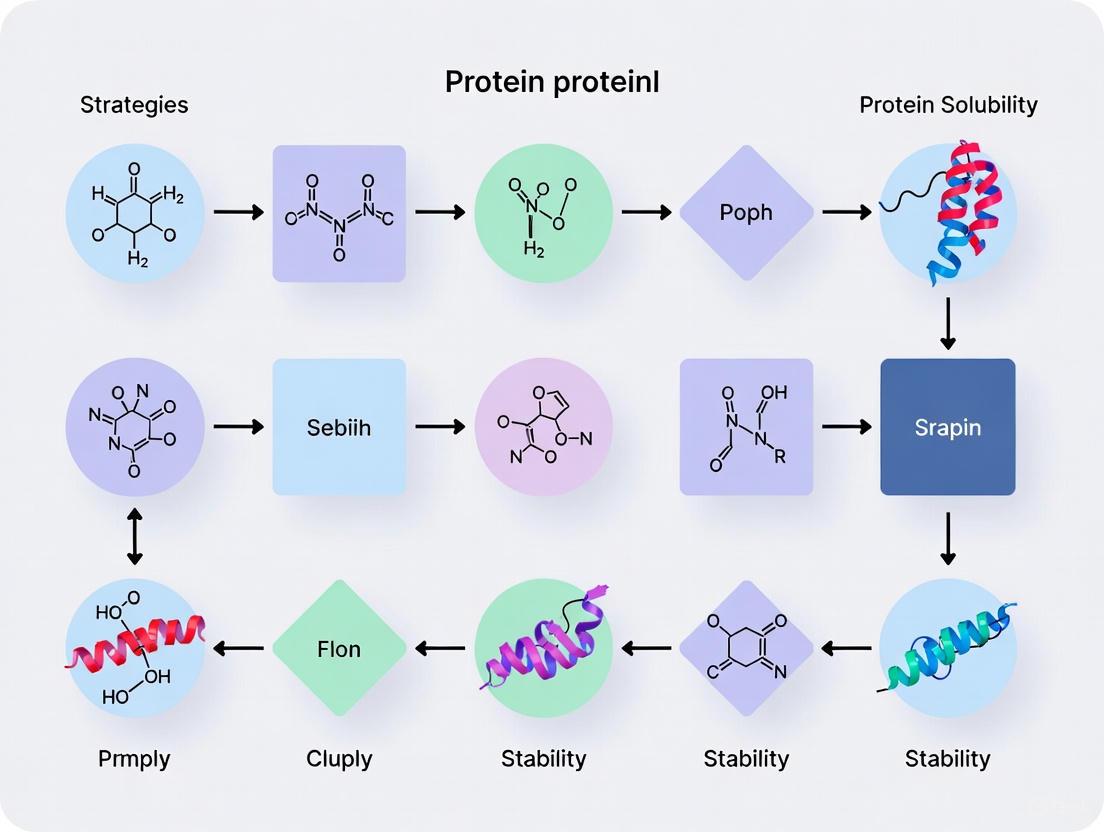
This article provides a comprehensive analysis of contemporary strategies for enhancing protein solubility and stability, critical factors in biotherapeutic development and research applications.
Advanced Strategies for Enhancing Protein Solubility and Stability: From Molecular Design to Clinical Application
Abstract
This article provides a comprehensive analysis of contemporary strategies for enhancing protein solubility and stability, critical factors in biotherapeutic development and research applications. It systematically examines the fundamental causes of protein instability and aggregation, explores molecular engineering techniques including fusion tags and chaperone co-expression, and details computational approaches like AI-driven design for multi-property optimization. The content also covers practical troubleshooting methodologies and comparative validation frameworks to guide researchers and drug development professionals in selecting and implementing the most effective stabilization protocols. By integrating foundational science with cutting-edge methodological advances, this resource aims to bridge the gap between protein engineering innovation and practical biopharmaceutical applications.
Understanding Protein Instability: Fundamental Challenges and Mechanisms
The Economic and Scientific Impact of Protein Instability in Biopharmaceutical Development
Protein instability represents a critical bottleneck in biopharmaceutical development, with profound economic and scientific consequences. The global protein stability analysis market, valued at $2.43 billion in 2024, is projected to reach $5.48 billion by 2031, reflecting a robust CAGR of 11.35% [1]. This growth is driven by the increasing demand for biopharmaceuticals—complex protein-based therapeutics that require rigorous stability analysis to ensure their quality, efficacy, and safety [1]. Protein instability manifests as aggregation, misfolding, and precipitation, leading to reduced therapeutic efficacy, potential immunogenicity, and product failure. For researchers and drug development professionals, addressing these challenges is paramount to advancing biological therapeutics from bench to bedside.
The economic burden of protein instability is staggering. Failed bioprocesses and delayed biological development impose huge costs throughout the development pipeline [2]. As the biopharmaceutical industry continues to expand, with monoclonal antibodies alone expected to reach $16 billion in sales, the capacity for manufacturing stable products becomes increasingly challenging [3]. This technical support center provides comprehensive troubleshooting guides and FAQs to help scientists overcome protein instability challenges, framed within the broader context of enhancing protein solubility and stability research.
Economic Impact Analysis
The economic implications of protein instability extend throughout the biopharmaceutical development lifecycle, from early research to commercial manufacturing.
Table 1: Economic Impact of Protein Instability Across Development Stages
| Development Stage | Key Economic Impacts | Magnitude/Scale |
|---|---|---|
| Early R&D | - Failed bioprocesses- Delayed biological development- Cost of stability analysis | $2.43B protein stability analysis market (2024) [1] |
| Process Development | - Cost of reformulation- Additional analytical characterization- Process optimization | 50 kg/year therapeutic protein capacity requires €300-500M investment [3] |
| Commercial Manufacturing | - Plant utilization costs- Yield losses- Capacity constraints | €8M/year per 15,000L bioreactor [3] |
| Clinical & Regulatory | - Late-stage failure costs- Extended development timelines | Process improvements can reduce cost of goods from $1600/g to $260/g [3] |
Table 2: Capacity and Investment Requirements for Biopharmaceutical Manufacturing
| Parameter | Requirement | Economic Impact |
|---|---|---|
| Strategic Capacity Reserve | ~50 kg therapeutic protein/year | Requires jump investments of €300-500M every 5-10 years [3] |
| Bioreactor Operating Cost | Each 15,000L bioreactor | €8 million per year in costs [3] |
| Greenfield Plant Investment | 6 × 15,000L bioreactors | €300-500 million including commissioning [3] |
| Process Improvement Impact | 10-fold titer increase + 30% yield improvement | Reduces bioreactors from 31 to 2 for 250kg/year production [3] |
The economic analysis reveals that a continuous strategic capacity reserve of approximately 50 kg of therapeutic protein per year is necessary to sustain business operations, backed by jump investments of €300-500 million every 5-10 years [3]. These investments carry significant risk, as they must be committed before clinical success is guaranteed. The high cost of manufacturing infrastructure—with start-up costs around €100 million for a plant with 6 × 15,000L bioreactors—means that inefficient processes due to protein instability can dramatically increase the cost of goods sold [3]. Process improvements that enhance protein stability can generate substantial economic benefits: a 10-fold increase in titer coupled with a 30% increase in yield can reduce the number of required bioreactors from 31 to 2 for annual production of 250 kg of protein, slashing capital requirements from €1600 million to €100 million and reducing cost of goods from $1600/g to $260/g [3].
Troubleshooting Guide: FAQs for Protein Instability Issues
FAQ 1: How can I improve soluble expression of recombinant proteins in prokaryotic systems?
Challenge: A considerable portion of recombinant proteins fail to attain functional conformations in prokaryotic systems, primarily aggregating as inclusion bodies or undergoing proteolytic degradation [2].
Solutions:
- Molecular chaperone co-expression: Overexpress folding catalysts like GroEL-GroES, DnaK-DnaJ-GrpE, and TF to assist proper folding. Co-expression of GroEL-GroES with recombinant proteins in E. coli can enhance soluble yield by 2-5 fold by preventing aggregation [2].
- Fusion tags: Incorporate solubility-enhancing tags such as MBP, GST, NusA, or SUMO at the N- or C-terminus. These tags act as structural scaffolds, with MBP increasing solubility for over 70% of tested proteins [2].
- Culture condition optimization: Add chemical chaperones like glycerol (1-5%), arginine (0.1-0.5M), or cyclodextrins to the culture medium. Glycerol at 2-5% can enhance thermal stability and reduce aggregation of folding intermediates [2].
- Promoter engineering and codon optimization: Use tunable promoters and optimize codons to match host tRNA abundance, reducing translational errors that cause misfolding [2].
FAQ 2: What strategies can prevent protein aggregation during purification and storage?
Challenge: Proteins aggregate during purification steps or have limited shelf-life due to instability.
Solutions:
- Buffer optimization: Adjust pH to maximize stability, typically away from the isoelectric point. Include excipients like sucrose (0.2-0.5M), glycerol (10-20%), or amino acids (e.g., 0.1-0.5M glycine) to stabilize native structure [4].
- Complexation with ligands: Form protein-polyelectrolyte complexes with polysaccharides like pectin, xanthan gum, or carrageenan through electrostatic interactions to enhance stability [5].
- Control ionic strength: Add salts like sodium chloride (50-150mM) to shield electrostatic interactions, but avoid high concentrations that may cause salting-out [4].
- Site-directed mutagenesis: Replace hydrophobic surface residues with hydrophilic ones (e.g., Lys, Arg, Glu) to reduce aggregation propensity. This requires structural knowledge but can dramatically improve solubility [4].
FAQ 3: How can I rapidly screen formulation conditions for protein stability?
Challenge: Traditional stability testing requires large protein amounts and extended timeframes, slowing development.
Solutions:
- High-throughput stability screening: Utilize instruments like Optim1000 or Optim 2 that can analyze up to 144 samples per day using only 9μL sample volumes (as little as 0.1μg protein) [6].
- Accelerated stability studies: Employ thermal shift assays with dyes like SYPRO Orange to measure melting temperatures (Tm) across different formulations in 96-well format [1].
- Advanced analytical techniques: Implement differential scanning fluorimetry (DSF), differential scanning calorimetry (DSC), dynamic light scattering (DLS), and spectroscopy to assess stability under various conditions [1].
- AI-driven prediction tools: Use AlphaFold2 or RoseTTAFold to predict stability changes from sequence, guiding rational design of stabilising mutations [2].
Systematic Troubleshooting Workflow for Protein Instability Issues
FAQ 4: How do I determine if my protein instability issues stem from expression system limitations?
Challenge: Determining whether observed instability is intrinsic to the protein or results from host system limitations.
Solutions:
- Host system comparison: Express the same construct in alternative systems (E. coli, yeast, insect, mammalian cells). Eukaryotic proteins requiring disulfide bonds or specific chaperones often express better in yeast or mammalian systems [4].
- Glycosylation analysis: Characterize post-translational modifications. Changes in host cell (e.g., CHO to NSO) can alter glycosylation patterns and stability [3].
- Genetic construct verification: Sequence verify constructs and check for unintended mutations. A single amino acid change (e.g., duteplase vs. alteplase) can reduce biological activity by 50% [3].
- Proteostasis assessment: Evaluate whether the host proteostasis network is overwhelmed. High-level expression often exceeds quality control capacity, leading to aggregation [2].
Advanced Methodologies for Enhancing Protein Stability
Complexation Strategies for Stability Enhancement
Complexation with ligands provides a powerful approach to enhance protein stability without genetic modification:
- Protein-Polysaccharide Complexes: Form through non-covalent (electrostatic, hydrogen bonding, hydrophobic) or covalent (Maillard reaction) interactions. Pea protein isolate-pectin complexes increase thermal denaturation temperature from 85.12°C to 87.00°C [5].
- Protein-Polyphenol Complexes: Exploit hydrogen bonding and hydrophobic interactions. Polyphenols can prevent aggregation and enhance oxidative stability.
- Chemical Chaperones: Small molecules like glycerol, arginine, and cyclodextrins stabilize proteins by altering solvent properties. Glycerol (1-5%) preferentially excludes from protein surfaces, favoring native state [2].
Table 3: Complexation Strategies for Protein Stabilization
| Complexation Type | Interaction Mechanisms | Stability Enhancement | Applications |
|---|---|---|---|
| Protein-Polysaccharide | Electrostatic, H-bonding, hydrophobic, Maillard reaction | Increased thermal denaturation temperature, improved aggregation stability | Beverages, emulsions, nutritional formulations [5] |
| Protein-Polyphenol | H-bonding, hydrophobic interactions | Enhanced oxidative stability, reduced aggregation | Functional foods, therapeutic delivery [5] |
| Chemical Chaperones | Preferential exclusion, solvent modification | Stabilization of folding intermediates, reduced aggregation | Bioprocessing, formulation buffers [2] |
Experimental Protocol: Protein-Polysaccharide Complex Formation
Objective: Enhance protein stability through complexation with polysaccharides.
Materials:
- Water-soluble protein (e.g., whey protein, pea protein)
- Polysaccharide (e.g., pectin, dextran, xanthan gum)
- Buffer components (e.g., phosphate buffer, pH 7.0)
- Dialysis membrane or desalting columns
- Lyophilizer
Methodology:
- Prepare protein and polysaccharide solutions: Dissolve both components in appropriate buffer to 1-5 mg/mL concentration.
- Non-covalent complex formation: Mix protein and polysaccharide solutions at optimal ratio (typically 1:1 to 1:5 protein:polysaccharide weight ratio). Adjust pH to facilitate electrostatic interaction.
- Covalent complex formation (Maillard reaction):
- Mix protein and polysaccharide in phosphate buffer (0.2M, pH 7.0)
- Lyophilize the mixture
- Incubate at 60°C and 65% relative humidity for 1-7 days
- Stop reaction by cooling to 4°C
- Purification: Dialyze against distilled water or use desalting columns to remove unreacted components.
- Lyophilization: Freeze-dry the complexes for long-term storage.
- Characterization: Analyze by SDS-PAGE, size exclusion chromatography, fluorescence spectroscopy, and differential scanning calorimetry.
This protocol typically enhances emulsifying activity index by 1.5-3 fold and increases thermal denaturation temperature by 2-5°C [5].
Research Reagent Solutions for Protein Stability Studies
Table 4: Essential Research Reagents for Protein Stability Analysis
| Reagent/Category | Specific Examples | Function/Application |
|---|---|---|
| Chemical Chaperones | Glycerol, arginine, cyclodextrins, trehalose | Stabilize folding intermediates, reduce aggregation [2] |
| Fusion Tags | MBP, GST, NusA, SUMO, HaloTag7 | Enhance solubility, improve folding, facilitate purification [2] |
| Molecular Chaperones | GroEL-GroES, DnaK-DnaJ-GrpE, TF | Assist proper folding, prevent aggregation [2] |
| Crosslinkers | DSS, BS3, photo-reactive crosslinkers | Stabilize protein complexes, capture transient interactions [7] |
| Stability Assay Kits | Protein Thermal Shift kits | Monitor thermal stability, screen formulation conditions [1] |
| Protease Inhibitors | PMSF, protease inhibitor cocktails | Prevent proteolytic degradation during expression/purification [7] |
Technology Spotlight: Advanced Analytical Tools
Innovative technologies are transforming protein stability analysis:
- High-throughput stability analyzers: Instruments like Optim1000 and Optim 2 enable analysis of up to 144 samples per day using only 9μL sample volumes (0.1μg protein), providing fifty-fold time savings compared to conventional methods [6].
- Microfluidic T-mixers: Enable spectroscopic monitoring of protein folding reactions on timescales of 20 milliseconds upwards using milligram sample quantities [6].
- Nanosecond protein heating: T-jump apparatus can increase sample temperature by 25°C in 8 nanoseconds while taking spectroscopic readings, enabling observation of ultrafast folding events [6].
- AI-driven prediction platforms: Integration of AlphaFold2 and RoseTTAFold with high-throughput screening enables predictive modeling of protein stability, moving from empirical optimization to rational design [2].
Protein Stability Analysis Workflow
Addressing protein instability in biopharmaceutical development requires an integrated approach combining empirical optimization with rational design. The economic impact of instability—from failed bioprocesses to massive capital investments—demands rigorous stability assessment throughout development. By implementing the troubleshooting strategies, experimental protocols, and advanced methodologies outlined in this technical support center, researchers can significantly enhance protein solubility and stability.
The future of protein stability research lies in the convergence of AI-driven prediction, high-throughput experimentation, and mechanistic understanding of folding pathways. As the biopharmaceutical landscape evolves toward more complex therapeutics, the strategies discussed here will play an increasingly vital role in ensuring the successful development of stable, effective protein-based medicines.
For researchers focused on enhancing protein solubility and stability, a deep understanding of protein degradation pathways is not merely academic—it is a practical necessity. The same mechanisms that maintain cellular homeostasis, such as proteasomal and lysosomal proteolysis, can be harnessed or counteracted to improve protein yield, functionality, and shelf-life in industrial and therapeutic applications [8] [9]. Conversely, uncontrolled aggregation and denaturation are major culprits behind lost research materials, inconsistent experimental results, and failed drug formulations. This guide details the key mechanisms of protein degradation and provides actionable troubleshooting advice to address common challenges encountered in the lab.
FAQ: Core Degradation Concepts for Experimental Design
1. What are the two primary pathways for protein degradation in cells, and which should I consider for my solubility research?
Eukaryotic cells primarily degrade proteins via the Ubiquitin-Proteasome System (UPS) and Lysosomal Proteolysis [9] [10]. The choice between these pathways has significant implications for research.
- Ubiquitin-Proteasome System (UPS): This is the main pathway for degrading short-lived intracellular proteins and soluble misfolded proteins [8] [11]. It is a highly specific, ATP-dependent process that involves tagging target proteins with a polyubiquitin chain (via E1, E2, and E3 enzymes) for recognition and degradation by the 26S proteasome complex [10] [12]. If your protein of interest is a regulatory cytosolic or nuclear protein, it is likely handled by the UPS.
- Lysosomal Proteolysis: This pathway degrades long-lived proteins, extracellular proteins, cell-surface receptors, and large protein aggregates [8] [10]. It involves engulfing cargo via endocytosis, phagocytosis, or autophagy, followed by delivery to the acidic lysosome for enzymatic breakdown [9]. If you are working with protein aggregates or studying clearance of misfolded proteins, this pathway is central.
The following diagram illustrates the core components and flow of the Ubiquitin-Proteasome System:
2. How do protein aggregation and denaturation relate to these degradation pathways?
- Denaturation is the process where a protein loses its native three-dimensional structure, leading to loss of function [13]. It can be a reversible first step or lead to irreversible damage.
- Aggregation occurs when denatured or misfolded proteins self-associate into insoluble complexes [12]. These aggregates are often too large for the proteasome and are primarily targeted for degradation via autophagy, a form of lysosomal proteolysis [8] [11].
In neurodegenerative diseases like Alzheimer's and Parkinson's, the accumulation of protein aggregates indicates an overload or impairment of these degradation systems [12]. In a lab setting, inducing controlled denaturation is key to analyzing unfolding intermediates, while preventing it is crucial for protein storage and function.
Troubleshooting Guide: Common Experimental Issues
Problem 1: Low Protein Solubility and Unwanted Aggregation
Potential Causes and Solutions:
- Cause: Protein is at or near its isoelectric point (pI), leading to loss of electrostatic repulsion. Solution: Adjust the pH of your buffer away from the protein's pI.
- Cause: Harsh environmental conditions (e.g., high temperature, ionic strength). Solution: Optimize buffer conditions. Include stabilizing agents like polyols (e.g., trehalose, glycerol) or use heavy water (D₂O), which can strengthen stabilizing hydrogen bonds [13].
- Cause: Inherent hydrophobicity or poor conformational stability. Solution: Utilize complexation strategies. Formulating water-soluble proteins with ligands like polysaccharides (e.g., pectin, dextran) via covalent (Maillard reaction) or non-covalent (electrostatic, hydrophobic) interactions can significantly improve solubility and colloidal stability by increasing steric hindrance and electrostatic repulsion [14].
Problem 2: Loss of Protein Function Due to Instability
Potential Causes and Solutions:
- Cause: Protein unfolding/denaturation during storage or processing. Solution: Implement physical processing techniques. High-Pressure Homogenization (HPH) has been shown to modify protein structure, decrease particle size, and enhance solubility and functional properties of plant protein suspensions like lentil and pea protein isolates [15].
- Cause: Repetitive freeze-thaw cycles. Solution: Aliquot proteins into single-use portions to avoid repeated freezing and thawing.
- Cause: Oxidative stress or chemical degradation. Solution: Store proteins with reducing agents (e.g., DTT) and protease inhibitor cocktails. For long-term stability, consider engineered covalent modifications like "capping" with polyethylene glycol (PEG) to increase stability and prevent immune responses [13].
Experimental Protocols & Data Analysis
Protocol 1: Assessing Thermal Stability by Electrophoresis
Thermal shift assays can be adapted to gel electrophoresis to visualize unfolding transitions and trap intermediates [13].
- Sample Preparation: Prepare identical protein samples in your desired buffer.
- Heat Treatment: Incubate samples at a range of temperatures (e.g., 25°C to 95°C) for a fixed time (e.g., 10 minutes).
- Cooling: Cool samples on ice to quench the reaction.
- Analysis:
- Native PAGE: Analyze samples to monitor the loss of native structure and the appearance of unfolding intermediates.
- SDS-PAGE: Analyze samples (under non-reducing conditions if applicable) to check for irreversible aggregation or cleavage that occurred upon heating.
Protocol 2: Enhancing Solubility via Protein-Polysaccharide Complexation
This protocol is based on strategies reviewed for enhancing water-soluble protein functionality [14].
- Preparation: Dissolve the water-soluble protein and a chosen polysaccharide (e.g., high methoxyl pectin, dextran) separately in buffer. The pH should be adjusted to favor electrostatic interaction if using non-covalent complexation.
- Complexation:
- For Non-covalent Complexes: Mix the protein and polysaccharide solutions under gentle stirring. The complexes form spontaneously driven by electrostatic and hydrophobic interactions.
- For Covalent Complexes (Conjugates): For a Maillard reaction, mix the protein and polysaccharide in a dry state at a specific ratio and incubate under controlled temperature and humidity (e.g., 60°C, 79% relative humidity) for a set period.
- Purification: Dialyze or centrifugally filter the mixture to remove unreacted components.
- Characterization: Use techniques like size-exclusion chromatography, dynamic light scattering, and SDS-PAGE to confirm complex formation and determine changes in particle size and solubility.
Quantitative Data on Denaturation Agents
The following table summarizes common agents used to denature proteins in controlled experiments and their typical mechanisms [13].
| Denaturation Agent | Typical Working Concentration | Primary Mechanism of Action |
|---|---|---|
| Urea | 4 - 8 M | Disrupts hydrogen bonding and hydrophobic interactions, leading to protein unfolding. |
| Guanidinium HCl | 4 - 6 M | Similar to urea; competes for hydrogen bonds and charges buried amino acids. |
| SDS (Sodium Dodecyl Sulfate) | 0.1 - 1% | Binds to the protein backbone, imparting negative charge and disrupting hydrophobic interactions. |
| DTT (Dithiothreitol) | 1 - 10 mM | Reduces disulfide bonds, disrupting the covalent structure of the protein. |
The Scientist's Toolkit: Key Research Reagents
This table lists essential reagents used in protein stability and degradation research, as cited in the literature.
| Research Reagent | Function / Application | Key Context from Literature |
|---|---|---|
| PROTACs (Proteolysis Targeting Chimeras) | Bifunctional molecules that recruit an E3 ligase to a protein of interest, inducing its ubiquitination and degradation by the proteasome [8] [11]. | Used as a novel therapeutic modality and research tool to degrade specific intracellular proteins [8]. |
| Molecular Glues (e.g., Thalidomide analogs) | Small molecules that induce proximity between an E3 ligase and a target protein, leading to its degradation [8]. | A key modality in targeted protein degradation; includes clinically approved agents like lenalidomide [8] [16]. |
| Polyols (e.g., Trehalose, Glycerol) | Stabilizing cosolvents that can substitute for water, strengthening hydrogen bonds and increasing protein stability under stress [13]. | Used to prevent denaturation during storage or freezing and to increase the free energy required for unfolding [13]. |
| E1/E2/E3 Enzymes | The enzymatic cascade (Activating, Conjugating, and Ligase enzymes) that mediates the ubiquitination of protein substrates [10] [12]. | Essential components of the UPS; the specificity of E3 ligases makes them attractive drug targets [8] [12]. |
| Hydrophobic Tags (HyT) | A targeted degradation strategy that mimics a misfolded protein, recruiting chaperones and the UPS for degradation [8]. | An emerging alternative to PROTACs for inducing targeted protein degradation [8]. |
Pathway Visualization: Lysosomal Proteolysis
The lysosomal pathway is critical for degrading a wide array of materials, including extracellular proteins and large aggregates. The diagram below outlines the major routes into this pathway.
Frequently Asked Questions (FAQs) & Troubleshooting Guides
My protein is not expressing at all. What could be wrong?
Potential Causes and Solutions:
- Problem with the DNA Construct: The expression cassette might contain errors.
- Solution: Check your construct by sequencing the entire expression cassette to ensure there are no unintended stop codons or mutations [17].
- Problem with the Promoter/Translation Initiation: Secondary structures in the mRNA can prevent efficient translation initiation [18].
- Problem with Codon Usage: The gene may contain codons that are rare in your expression host, causing translation to stall [19].
- Toxic Protein: Even low levels of "leaky" basal expression can prevent cell growth if the protein is toxic [18] [19].
My protein is expressing but is insoluble (forming inclusion bodies). How can I improve solubility?
This is a classic symptom of an evolutionary mismatch, where the host's folding machinery is overwhelmed or incompatible with the heterologous protein [2].
- Slow Down Expression: Rapid expression can overwhelm the host's chaperone systems.
- Augment the Folding Machinery: Provide the host with additional helpers to fold the foreign protein.
- Use a Solubility-Enhancing Fusion Tag: Fuse your protein to a highly soluble partner.
- Modify the Protein Sequence Intrinsically: Re-engineer the protein to be more compatible with the host.
How can I ensure proper disulfide bond formation in my recombinant protein?
Disulfide bond formation is often inefficient in the reducing cytoplasm of standard E. coli strains, another form of evolutionary mismatch in redox potential.
- Solution 1: Target the Protein to the Periplasm. Use a vector with a signal sequence (e.g., pelB, ompA) to export the protein to the oxidative periplasm, where the Dsb enzyme family catalyzes disulfide bond formation [18].
- Solution 2: Use Engineered Cytoplasmic Strains. Specialized strains like SHuffle are engineered to have an oxidizing cytoplasm and also express disulfide bond isomerase (DsbC) in the cytoplasm, allowing for correct disulfide bond formation in the cytosolic compartment [18].
What are the latest technological advances for solving these problems?
The field is moving towards more rational and high-throughput strategies.
- Artificial Intelligence (AI) and Machine Learning: Tools like AlphaFold2 can predict protein structures to identify problematic regions [2]. Support Vector Regression (SVR) models can predict solubility from sequence and guide the in silico optimization of protein sequences or the design of short peptide tags before any wet-lab work is done [20].
- Ancestral Sequence Reconstruction: Computational resurrection of ancestral protein sequences can sometimes yield more stable and soluble variants that are easier to express in modern hosts [2].
- High-Throughput Screening: Automated platforms allow for the simultaneous testing of hundreds of expression conditions, chaperone combinations, and fusion tags to rapidly identify the optimal setup for a difficult protein [2].
Experimental Protocols
Protocol 1: Small-Scale Expression Test and Solubility Check
This is a fundamental first step to diagnose expression and solubility issues [17] [21].
Materials:
- LB medium with appropriate antibiotic
- IPTG (or other inducer) stock solution
- Shaking incubator
- Refrigerated centrifuge
- Lysis buffer (e.g., BugBuster reagent)
- SDS-PAGE equipment
Method:
- Inoculate a small culture (5-10 mL) and grow to mid-log phase (OD600 ~0.6).
- Take a 1 mL pre-induction sample. Pellet the cells and store at -20°C.
- Add the optimal concentration of IPTG (e.g., 0.1 mM) to induce expression.
- Induce for 3-4 hours, then take a 1 mL post-induction sample.
- Pellet the cells from the post-induction sample. Resuspend in lysis buffer.
- Lyse the cells by incubation on a shaking platform for 20 minutes.
- Centrifuge the lysate at high speed (e.g., 13,000 rpm) for 10 minutes to separate soluble (supernatant) and insoluble (pellet) fractions.
- Resuspend the pellet in the same volume of buffer as the supernatant.
- Analyze the pre-induction sample, total post-induction lysate, soluble fraction, and insoluble fraction by SDS-PAGE to assess expression levels and solubility.
Protocol 2: Co-expression with Molecular Chaperones
This protocol directly addresses the folding machinery mismatch [2].
Materials:
- Chaperone plasmid set (e.g., Takara's) or individual chaperone plasmids (e.g., for GroEL/GroES, DnaK/DnaJ)
- Two compatible antibiotics
- Culture medium
Method:
- Co-transform your target protein expression vector and a chaperone plasmid into your expression host. The chaperone plasmid should have a compatible origin of replication and a different antibiotic resistance marker.
- Grow a culture from a single colony in medium containing both antibiotics.
- Induce the expression of the chaperones first, typically by adding L-arabinose or elevating the temperature, according to the specific chaperone system's instructions.
- After a period of chaperone induction, induce the expression of your target protein with IPTG.
- Continue with growth, cell harvest, and lysis as in Protocol 1 to check for improvements in soluble yield.
Table 1: Effectiveness of Common Solubility-Enhancing Fusion Tags
| Fusion Tag | Size (kDa) | Key Mechanism | Key Advantage | Consideration |
|---|---|---|---|---|
| Maltose-Binding Protein (MBP) | ~42.5 | Acts as a folding nucleus, improves solubility [18] | Allows purification on amylose resin; often retains activity of fusion partner [18] | Large size may interfere with structure/function studies; requires cleavage |
| Thioredoxin (Trx) | ~11.7 | High intrinsic solubility, can facilitate disulfide bond formation in cytoplasm [2] | Small tag, less likely to interfere with function | May not be as effective as MBP for some proteins |
| N-utilizing substance A (NusA) | ~54.8 | Significantly enhances solubility of fusion partners [2] | One of the most effective solubility tags available | Very large size |
| Small Ubiquitin-like Modifier (SUMO) | ~11 | Acts as a chaperone; recognized by highly specific proteases for cleavage [2] | Enables clean, scarless removal after purification | Requires specific protease (Ulp1) for cleavage |
| Hexa-Lysine Peptide Tag | ~0.8 | Increases net charge, enhancing solubility via electrostatic repulsion [2] [20] | Very small, minimal structural impact | May not be sufficient for severely aggregating proteins |
Table 2: Common Chemical Chaperones and Additives to Enhance Solubility
| Chemical Chaperone/Additive | Typical Concentration | Proposed Mechanism of Action | Example Use Case |
|---|---|---|---|
| Glycerol | 0.5 - 2 M | Preferential exclusion from protein surface, stabilizing native state [2] | Increased yield and activity of human phenylalanine hydroxylase in E. coli [2] |
| L-Arginine | 0.1 - 0.5 M | Suppresses protein aggregation; commonly used in refolding buffers [2] | Used to suppress aggregation during dilution refolding processes |
| Betaine / Proline | 0.5 - 2 M | Acts as an osmolyte, stabilizing proteins under stress conditions [2] | Enhanced soluble expression of pullulanase in E. coli [2] |
| Cyclodextrins | 0.5 - 2% (w/v) | May sequester hydrophobic molecules or protein patches, preventing aggregation [2] | Improved secretion of α-cyclodextrin glucosyltransferase [2] |
| Ethanol | 1-5% (v/v) | Induces heat-shock response, upregulating endogenous chaperones [2] [17] | Increased soluble yield of recombinant proteins when added pre-induction [2] |
Visual Guides
Diagram 1: The Evolutionary Mismatch Crisis in Protein Folding
This diagram illustrates the core concept of evolutionary mismatch in heterologous protein expression.
Diagram 2: Strategic Framework to Overcome Folding Mismatch
This workflow outlines the decision process for selecting the right strategy to enhance soluble protein expression.
The Scientist's Toolkit: Research Reagent Solutions
Table 3: Essential Reagents and Kits for Troubleshooting Expression
| Reagent / Kit | Function | Application Example |
|---|---|---|
| BL21(DE3) & Derivatives | Standard E. coli protein expression host. | General-purpose protein expression [18]. |
| Rosetta / Codon Plus Strains | Supply rare tRNAs for codons not commonly used in E. coli. | Expressing genes with codons for Arg, Ile, Gly, etc., that are rare in E. coli [17] [19]. |
| SHuffle T7 Express | Engineered for disulfide bond formation in the cytoplasm. | Production of proteins requiring disulfide bonds for stability/activity [18]. |
| pLysS / pLysE Strains | Express T7 lysozyme to inhibit basal T7 RNA polymerase activity. | Reducing basal ("leaky") expression of toxic proteins in T7 systems [18]. |
| Chaperone Plasmid Sets | Allow for co-expression of specific molecular chaperone systems. | Enhancing proper folding of complex eukaryotic proteins [2] [17]. |
| pMAL Vectors | Vectors for creating MBP fusion proteins. | Dramatically improving solubility of insoluble target proteins [18]. |
FAQs and Troubleshooting Guides
FAQ 1: How does macromolecular crowding specifically affect the folding kinetics of different protein structural motifs?
Answer: Macromolecular crowding's effect is not uniform and depends critically on the protein's size and structural motif. Contrary to the common assumption that crowding always increases folding rates due to the excluded volume effect, studies on small folding motifs reveal a more complex picture.
For Small Helical Peptides: Crowding agents like Dextran 70 and Ficoll 70 (at 200 g/L) induce no appreciable changes in the folding-unfolding kinetics of a 34-residue α-helix (L9:41-74) and only a moderate decrease in the relaxation rate of a 34-residue cross-linked helix-turn-helix motif (Z34C-m1) [22]. This is surprising given that helix-coil transition kinetics are known to depend on viscosity.
For Small Beta-Hairpins: In contrast, the same crowding conditions lead to an appreciable decrease in the folding rate of a 16-residue β-hairpin (trpzip4-m1) [22]. This indicates that for very small proteins, factors beyond excluded volume, such as increased frictional drag and transient, non-specific interactions with the crowders, can dominate and slow down the folding process.
Troubleshooting Guide: Unexpected Folding Kinetics in Crowded Environments
| Problem | Possible Cause | Suggested Solution |
|---|---|---|
| No change or a decrease in folding rate with crowders. | The protein is too small; dynamic friction and transient interactions outweigh the stabilizing excluded volume effect. | Use a larger protein domain (>50 residues) where the excluded volume effect is more dominant [22]. |
| Inconsistent results between different crowding agents. | The physical nature (e.g., flexible coil vs. rigid sphere) of the crowding agent differentially affects the reaction. | Characterize the crowders (e.g., size, flexibility) and use multiple types (e.g., Ficoll 70, Dextran 70) to isolate the effect [22]. |
| Increased protein aggregation in crowded solutions. | Crowding can enhance undesirable intermolecular interactions. | Optimize solution conditions (pH, ionic strength) or use stabilizing ligands to counteract aggregation [14]. |
FAQ 2: Beyond excluded volume, what other mechanisms does molecular crowding introduce that can alter protein oxidation?
Answer: Macromolecular crowding significantly modulates biochemical reaction rates, including protein oxidation, by altering diffusion and reaction pathways. Research shows that crowding agents like dextran can enhance the rate and extent of oxidation for specific amino acids.
Enhanced Oxidation of Tryptophan: The oxidation rate of free Tryptophan (Trp) by peroxyl radicals doubles in the presence of dextran (60 mg/mL). For peptide-incorporated Trp, crowding also increases the extent of consumption and can induce short-chain reactions where radicals generated from Trp go on to oxidize other targets [23].
Specificity of the Effect: Under the same conditions, the oxidation of Tyrosine (Tyr) remains unaffected by crowding [23]. This highlights the residue-specific nature of the phenomenon.
Proposed Mechanism: The confined environment reduces the volume available for reactive species, which can modulate chain termination reactions in radical-driven oxidation, thereby increasing the propagation of damage [23].
Troubleshooting Guide: Managing Protein Oxidation in Crowded Assays
| Problem | Possible Cause | Suggested Solution |
|---|---|---|
| Higher-than-expected oxidation in crowded in vitro experiments. | Crowding enhances radical propagation, particularly for Trp residues. | Include specific radical scavengers (e.g., antioxidants) in your crowded buffer system [23]. |
| Variable oxidation results between different proteins. | The effect of crowding is dependent on protein structure and solvent exposure of oxidizable residues. | Map oxidizable residues (Trp, Tyr) in your protein structure and monitor their status (e.g., via LC-MS) after experiments [23]. |
FAQ 3: How can I leverage ligand complexation to overcome pH and stability limitations of water-soluble proteins?
Answer: Complexation with various ligands is a established strategy to enhance protein stability and functionality, particularly against aggregation near their isoelectric point (pI) or under harsh environmental conditions [14].
Mechanisms of Stabilization:
- Polysaccharide Complexes: Forming complexes with polysaccharides (e.g., pectin, dextran) via non-covalent (electrostatic, hydrogen bonding) or covalent (Maillard reaction) interactions increases steric hindrance and electrostatic repulsion. This prevents aggregation at pH values near the protein's pI and enhances thermal stability [14].
- Molecular Crowding in Complexes: In covalently linked protein-poly saccharide conjugates, a "molecular crowding effect" is proposed to explain the avoidance of protein denaturation under thermal stress [14].
Enhanced Functionality: Ligand complexation can induce conformational changes that expose hydrophobic groups, thereby improving emulsifying properties. The grafted polysaccharide chains also strengthen electrostatic repulsion between droplets, enhancing emulsion stability [14].
Troubleshooting Guide: Optimizing Protein-Ligand Complexation
| Problem | Possible Cause | Suggested Solution |
|---|---|---|
| Protein still aggregates near its pI after complexation. | Insufficient steric or electrostatic shielding by the ligand. | Use a higher ratio of ligand to protein, or switch to a more highly charged polysaccharide (e.g., pectin) [14]. |
| Poor functional enhancement (e.g., emulsification). | The complex may be too hydrophilic, preventing effective interface adsorption. | Try ligands that impart amphiphilicity or use conjugation methods that partially unfold the protein to expose hydrophobic patches [14]. |
| Inconsistent batch-to-batch results. | Uncontrolled reaction conditions for covalent conjugation. | Strictly control parameters like temperature, time, and pH during the Maillard reaction or other conjugation processes [14]. |
The following table summarizes key quantitative findings from research on the effects of macromolecular crowding.
Table 1: Quantifying the Impact of Macromolecular Crowding (200 g/L) on Protein Folding Kinetics and Stability [22]
| Protein / Peptide | Structure | Crowding Agent | Effect on Thermal Stability (Tm) | Effect on Folding Kinetics |
|---|---|---|---|---|
| L9:41-74 | 34-residue α-helix | Dextran 70 | No appreciable change | No change (Relaxation time: 1.4 ± 0.2 μs vs 1.17 ± 0.15 μs in buffer) |
| Ficoll 70 | No appreciable change | No change (Relaxation time: 1.5 ± 0.2 μs vs 1.17 ± 0.15 μs in buffer) | ||
| Z34C-m1 | 34-residue HTH | Dextran 70 | Slight increase (+2-3°C) | Moderate decrease in relaxation rate |
| Ficoll 70 | Slight increase (+2-3°C) | Moderate decrease in relaxation rate | ||
| trpzip4-m1 | 16-residue β-hairpin | Dextran 70 | Data Not Specified | Appreciable decrease in folding rate |
| Ficoll 70 | Increased | Appreciable decrease in folding rate |
Table 2: Effect of Crowding (60 mg/mL Dextran) on Protein Oxidation Kinetics [23]
| Oxidizable Target | Reaction | Impact of Crowding |
|---|---|---|
| Free Tryptophan | Oxidation by AAPH-derived peroxyl radicals | Rate increased from 15.0 ± 2.1 to 30.5 ± 3.4 μM min⁻¹ |
| Peptide-incorporated Tryptophan | Oxidation by AAPH-derived peroxyl radicals | Significant increase in rate and extent of consumption (up to 2-fold); induced short-chain reactions |
| Tyrosine | Oxidation by AAPH-derived peroxyl radicals | No significant effect detected |
Experimental Protocols
Protocol 1: Assessing Folding Kinetics and Stability in Crowded Environments via T-Jump and CD Spectroscopy
Methodology: This protocol uses Laser-Induced Temperature-Jump (T-Jump) infrared spectroscopy to study folding-unfolding kinetics and Circular Dichroism (CD) spectroscopy to assess thermodynamic stability [22].
Sample Preparation:
- Prepare the peptide/protein in the desired buffer (e.g., 20 mM phosphate buffer in D₂O, pD 7).
- For crowded conditions, dissolve the crowding agent (e.g., Dextran 70 or Ficoll 70) into the buffer at the target concentration (e.g., 200 g/L). Ensure the polymer is fully dissolved and the solution is homogeneous.
- Incubate the protein sample in the crowded buffer prior to measurement.
Circular Dichroism (CD) for Thermodynamics:
- Acquire far-UV CD spectra (e.g., 190-250 nm) at a low temperature (e.g., 4°C) to confirm the native folded structure.
- Perform thermal denaturation experiments by monitoring the change in CD signal at a characteristic wavelength (e.g., 222 nm for helices) as a function of temperature.
- Fit the resulting melting curve to a two-state model to extract the thermal melting temperature (Tₘ) and thermodynamic parameters (ΔH, ΔS).
T-Jump Relaxation Kinetics:
- Use a laser to rapidly increase the temperature of the sample and perturb the folding equilibrium.
- Monitor the relaxation of the system back to equilibrium using an infrared probe, typically at the amide I' band.
- Fit the resulting relaxation kinetics. For simple systems, this may be a single-exponential process. The resolved slow phase corresponds to the conformational folding-unfolding dynamics.
Protocol 2: Evaluating the Impact of Crowding on Protein Oxidation
Methodology: This protocol measures the rate and extent of amino acid oxidation under crowded conditions [23].
Reaction Setup:
- Prepare solutions of the target (free amino acid, peptide, or protein) in an appropriate buffer.
- For the test condition, include a crowding agent like dextran at a physiologically relevant concentration (e.g., 60 mg/mL).
- Initiate oxidation by adding a radical generator, such as AAPH (2,2'-Azobis(2-amidinopropane) dihydrochloride).
Kinetic Analysis:
- Monitor the consumption of the oxidizable target (e.g., Tryptophan) over time. This can be done via spectrophotometry or chromatography (e.g., HPLC).
- Calculate the rate of oxidation (e.g., μM min⁻¹) for the initial phase of the reaction from the slope of the consumption curve.
Endpoint Analysis:
- After a fixed time, quantify the total extent of oxidation by measuring the remaining unoxidized target.
- Use techniques like SDS-PAGE and LC-MS to analyze higher-order products, such as protein oligomers or cross-linked species, which can be enhanced by crowding.
Visualizations
Diagram 1: Protein Folding Energy Landscape Under Crowding
Diagram 2: Experimental Workflow for Crowding Studies
The Scientist's Toolkit: Research Reagent Solutions
Table 3: Essential Reagents for Studying Physicochemical Barriers to Folding
| Reagent / Material | Function in Research | Key Considerations |
|---|---|---|
| Ficoll 70 | A compact, highly branched, spherical crowding agent. Used to simulate the excluded volume effects of the cellular environment. | Semi-rigid sphere (Rh ~55 Å). Less likely to form viscous networks compared to linear polymers [22]. |
| Dextran 70 | A flexible, linear polymer used as a crowding agent. | Behaves as a quasi-random coil (Rh ~63 Å). Solutions can have higher microviscosity, potentially influencing frictional drag [22]. |
| Circular Dichroism (CD) Spectrophotometer | Measures protein secondary structure and monitors thermal denaturation to determine thermodynamic stability (Tₘ). | Essential for confirming that the crowding agent itself does not alter the native fold of the protein under study [22]. |
| Laser T-Jump with IR Detection | Perturbs the folding equilibrium to directly measure the relaxation kinetics of folding and unfolding events on microsecond timescales. | Key for distinguishing between thermodynamic stability (from CD) and kinetic rates of folding [22]. |
| AAPH (Radical Generator) | A chemical initiator that generates peroxyl radicals at a constant rate, used to study protein oxidation under controlled conditions. | Allows for the kinetic analysis of oxidation rates and the probing of chain reaction propagation [23]. |
| Polysaccharides (Pectin, Dextran) | Ligands used to form complexes with proteins to enhance their aggregation, thermal, and pH stability. | Can be used in non-covalent complexes (electrostatic) or covalent conjugates (Maillard reaction) [14]. |
Proteins are fundamental biomolecules for biological research and therapeutic development, yet they are inherently vulnerable to a range of structural instabilities that directly compromise their function. These instabilities—including unfolding, aggregation, and precipitation—present major obstacles in experimental workflows and drug development pipelines. This technical support center operates within a strategic thesis focused on enhancing protein solubility and stability research. It provides targeted troubleshooting guides to help researchers diagnose the root causes of functional deficits—such as loss of activity, poor yields, or inconsistent results—by connecting them to underlying structural vulnerabilities. By adopting this analytical framework, scientists can move beyond trial-and-error approaches to implement rational, effective interventions that rescue protein function and ensure experimental reproducibility.
Troubleshooting Guides: From Problem to Solution
Guide 1: Addressing Low Protein Solubility
Problem: Your purified protein precipitates from solution during storage or handling, leading to inconsistent experimental results and low yields.
Step 1: Diagnose the Cause
- Test: Centrifuge a small sample and measure protein concentration in the supernatant before and after. A significant drop indicates precipitation.
- Analyze: Check buffer conditions (pH, ionic strength). Precipitation often occurs near the protein's isoelectric point or at high salt concentrations.
Step 2: Immediate Interventions
- Modify Buffer Conditions:
- Adjust pH: Move away from the theoretical pI (by ±1 pH unit). Use buffers between pH 7-9 for many proteins.
- Increase ionic strength: Add 50-150 mM NaCl to shield electrostatic attractions.
- Add Stabilizing Agents: Introduce low molecular weight additives to the storage buffer [24].
- Reducing Agents: Dithiothreitol (DTT, 1-5 mM) or β-mercaptoethanol (5-10 mM) to prevent disulfide-mediated aggregation.
- Osmolytes: Glycerol (5-20%) or ethylene glycol to enhance hydration and stability.
- Modify Buffer Conditions:
Step 3: Long-Term Strategies
- Consider Chemical Modification: For persistent issues, explore protein engineering. Deamidation converts asparagine and glutamine residues to aspartic and glutamic acids, increasing charge density and electrostatic repulsion to significantly enhance solubility and emulsification properties [25].
Guide 2: Managing Protein Aggregation
Problem: Your protein forms soluble oligomers or insoluble aggregates, reducing functional protein concentration and potentially causing immunogenicity in therapeutic contexts.
Step 1: Identify Aggregate Type
- Technique: Use Negative Stain Electron Microscopy as a qualitative assay to visualize aggregates directly in your sample [26].
- Protocol Summary: Apply protein sample to a glow-discharged carbon-coated grid, stain with uranyl formate, and image. Aggregates appear as large, irregular clusters compared to monodisperse particles.
Step 2: Disrupt Existing Aggregates
- Mild Detergents: Add non-denaturing detergents (e.g., 0.01-0.1% Triton X-100 or Tween-20).
- Chaotropic Agents: Use low concentrations of urea (1-2 M) or guanidine HCl, but verify functional recovery after removal.
Step 3: Prevent Future Aggregation
- Optimize Storage: Store at high concentration (>1 mg/mL) to discourage dissociation/association cycles.
- Control Temperature: Use constant 4°C storage or flash-freeze in liquid nitrogen for long-term storage. Critical: Avoid repeated freeze-thaw cycles by aliquoting [24].
Guide 3: Recovering Lost Binding Activity
Problem: Your protein appears stable and soluble but fails to bind its interaction partner or substrate in functional assays.
Step 1: Verify Structural Integrity
- Circular Dichroism: Compare the spectrum to a positive control to check secondary structure.
- Differential Scanning Calorimetry (DSC): Measure melting temperature (Tₘ) shifts. A decreased Tₘ suggests global destabilization.
Step 2: Check for Localized Instability
- Hydrogen/Deuterium Exchange-Mass Spectrometry (HDX-MS): This technique can reveal increased flexibility or destabilization in specific regions, such as binding interfaces, that may not affect global stability [27].
Step 3: Strategic Stabilization
- Targeted Mutations: If the binding interface is identified and not critical for function, introduce destabilizing mutations in the unbound state. This strategy increases the free energy of the unbound protein without significantly affecting the bound complex, thereby enhancing binding affinity through thermodynamic coupling [27].
- Add Ligands: Include specific substrates or cofactors during storage to stabilize the active conformation.
Frequently Asked Questions (FAQs)
Q1: My protein is stable at 4°C for a week but aggregates during long-term storage. What are my best storage options?
A: For long-term storage, lyophilization (freeze-drying) is highly effective when combined with stabilizing cryoprotectants like sucrose or trehalose [24]. For solution storage, aliquot your protein, flash-freeze in liquid nitrogen, and store at -80°C. Always include 10-20% glycerol as a cryoprotectant for frozen storage, and avoid repeated freeze-thaw cycles by using single-use aliquots.
Q2: I've identified a potential stabilizing mutation using computational tools, but it made my protein less soluble. Why did this happen?
A: This is a common limitation of current computational tools. Many stability prediction algorithms favor mutations that increase hydrophobicity to gain stability, often at the expense of solubility [28]. When selecting mutations, particularly for surface-exposed residues, prioritize those that maintain or introduce hydrophilic character. Using a meta-predictor that combines multiple tools can improve reliability, but always consider solubility implications in your design strategy.
Q3: What quick methods can I use to check my protein's stability and homogeneity before starting complex experiments?
A: Two rapid quality control assessments are recommended:
- Negative Stain EM: Provides a direct visual assessment of sample homogeneity, complex formation, and the presence of large aggregates within minutes [26].
- Differential Scanning Fluorimetry (Thermal Shift Assay): Measures thermal denaturation curves using a fluorescent dye and real-time PCR instrument, providing a stability profile in under one hour.
Q4: Are there specific chemical modifications that can improve both stability and solubility?
A: Yes, glycosylation is particularly effective. By covalently attaching hydrophilic carbohydrate groups to proteins, glycosylation significantly alters hydrophilicity and can enhance thermal stability, water retention, and mechanical strength of protein gels [25]. Phosphorylation is another valuable technique that introduces negatively charged phosphate groups, increasing electrostatic repulsion and improving solubility and dispersibility [25].
Quantitative Data for Experimental Planning
Table 1: Computational Tools for Predicting Mutation Effects on Stability
The following table summarizes key performance metrics of computational tools for predicting changes in protein stability (ΔΔG) upon amino acid substitution, based on validation against ~600 experimental mutations [28].
| Tool | Underlying Methodology | Correlation Coefficient (R) | Precision (%) | Special Considerations |
|---|---|---|---|---|
| Meta-predictor | Combined 11 tools | 0.73 | 63 | Most reliable overall approach; mitigates individual tool weaknesses |
| PoPMuSiC | Statistical potentials | 0.68 | 59 | Performs well on surface residues |
| FoldX | Empirical force field | 0.54 | 52 | Good for hydrophobic core mutations |
| EGAD | Physical force fields | 0.52 | 50 | Accurate for buried residues |
| Rosetta-ddG | Empirical/Physical hybrid | 0.54 | 46 | Requires structural refinement steps |
| I-Mutant3 | Machine learning | 0.51 | 41 | Sequence-based prediction available |
Data sourced from [28]. The meta-predictor combines multiple tools weighted by performance, available at: meieringlab.uwaterloo.ca/stabilitypredict/
Table 2: Protein Stabilization Methods and Their Applications
This table compares different protein stabilization approaches, their mechanisms, and optimal use cases to guide method selection.
| Method | Mechanism | Key Parameters | Optimal Applications | Functional Impact |
|---|---|---|---|---|
| Deamidation [25] | Converts Asn/Gln to Asp/Glu; increases charge | Acid concentration (0.03-0.14M), temperature (121°C) | Plant proteins (wheat gluten, rice); improves emulsification | ↑ Solubility, ↑ Emulsification |
| Phosphorylation [25] | Adds phosphate groups; increases electronegativity | STMP/STMP concentration (1-6%), pH 9.0 | Perilla, soy protein; enhances foam stability | ↑ Solubility (to 92%), ↑ Foaming |
| Glycosylation [25] | Attaches hydrophilic glycans; alters hydrophilicity | Dry-heat (60°C), 65% humidity, 1-4 sugar:protein ratio | Egg white, casein; improves gel properties | ↑ Gel strength, ↑ Thermal stability |
| Acylation [25] | Adds hydrophobic chains; modifies interactions | Succinic anhydride, pH 8.0, 5% protein concentration | Oat protein, myofibrillar proteins | ↑ Solubility, ↑ Emulsifying properties |
| Additive Stabilization [24] | Various mechanisms depending on additive | Glycerol (5-20%), DTT (1-5mM), EDTA (1-5mM) | Short-term storage & processing | Maintains native state, prevents aggregation |
The Scientist's Toolkit: Essential Research Reagents
Table 3: Key Research Reagents for Protein Stability Research
This table details essential reagents used in protein stability and solubility research, with their specific functions and application notes.
| Reagent | Function | Example Applications | Critical Notes |
|---|---|---|---|
| Uranyl Formate (0.75%) | Negative stain for EM; enhances contrast | Sample quality assessment; single-particle EM [26] | Light-sensitive; adjust with NaOH to prevent precipitation |
| Sodium Trimetaphosphate (STMP) | Phosphorylating agent | Chemical phosphorylation of serine/threonine residues [25] | Use at alkaline pH (8.0-9.0); requires purification post-reaction |
| Succinic Anhydride | Acylating agent | Lysine residue acylation to modify surface properties [25] | Control pH carefully during reaction; unreacted reagent must be removed |
| Glycerol | Cryoprotectant, osmolyte | Storage buffer additive (5-20%) to prevent aggregation [24] | High viscosity can affect some assays; use lower concentrations for kinetics |
| Dithiothreitol (DTT) | Reducing agent | Preventing intermolecular disulfide formation (1-5 mM) [24] | Unstable in solution; prepare fresh or store frozen aliquots |
| EDTA/EGTA | Chelating agents | Metalloprotease inhibition (1-5 mM) [24] | Removes essential metal cofactors for some proteins; test for activity retention |
Experimental Workflows and Structural Relationships
Protein Stability Analysis Workflow
The following diagram outlines a comprehensive workflow for analyzing and addressing protein stability issues, integrating both computational and experimental approaches:
Structural Vulnerabilities to Functional Deficits
This diagram illustrates the conceptual framework connecting different types of structural vulnerabilities to their resulting functional deficits and potential remediation strategies:
Molecular Engineering and Computational Solutions for Enhanced Stability
Troubleshooting Guide: FAQs on Enhancing Protein Solubility and Stability
FAQ 1: What are the primary strategies when my recombinant protein is expressed insolubly in E. coli?
You can approach the problem through two complementary paradigms: intrinsic molecular redesign and extrinsic folding modulation [2] [29].
- Intrinsic Molecular Redesign: Modify the protein's own sequence to improve its folding characteristics. This includes:
- Truncation: Removing unstructured or aggregation-prone terminal regions [2].
- Rational Design & Directed Evolution: Using structure-based knowledge or random mutagenesis with screening to introduce solubility-enhancing mutations [2] [30].
- Ancestral Reconstruction: Inferring and synthesizing ancient protein sequences that are often more stable [2].
- Extrinsic Folding Modulation: Adjust the expression environment to assist folding. This includes:
- Molecular Chaperone Co-expression: Overexpressing host chaperones like GroEL/GroES and DnaK/DnaJ to guide proper folding [2].
- Fusion Tags: Adding solubilizing partners like MBP, GST, or NusA to the N- or C-terminus of the target protein [2].
- Culture Condition Optimization: Using lower induction temperatures or adding chemical chaperones like glycerol and arginine to the culture medium [2].
FAQ 2: Why does enhancing my enzyme's activity through directed evolution often result in reduced stability, and how can I avoid this?
This common problem, known as an activity/stability trade-off, occurs because mutations that improve activity—often in the active site—can disrupt the optimized network of intramolecular interactions that stabilize the protein's native structure [30]. For example, active-site mutations may create steric strain or unsatisfied interactions that destabilize the folded state [30].
Solutions to overcome this trade-off:
- Incorporate Stability Screens: Perform high-throughput stability screening (e.g., using thermal shift assays) in parallel with activity screens to identify variants that maintain or improve both properties [30].
- Use Compensatory Mutations: After identifying an activity-enhancing but destabilizing mutation, perform subsequent rounds of evolution to find second-site compensatory mutations that restore stability, often at positions distal to the active site [30].
- Leverage Computational Design: Use advanced inverse folding models like ABACUS-T, which can redesign protein sequences to significantly enhance thermostability (e.g., ∆Tm ≥ 10 °C) while maintaining or even improving functional activity by considering multiple conformational states and evolutionary information [31].
FAQ 3: What is a practical experimental method to quickly identify which protein domains can be functionally fused?
Incremental Truncation for the Creation of Hybrid Enzymes (ITCHY) is a powerful method for this purpose [32] [33].
- Principle: ITCHY creates a comprehensive library of hybrid proteins by fusing two genes or gene fragments at virtually every possible single-amino-acid position, independent of their DNA sequence homology.
- Procedure: A key implementation, THIO-ITCHY, involves the random incorporation of α-phosphothioate dNTPs into DNA during a fill-in reaction or PCR. Subsequent exonuclease III treatment digests the DNA but stops at the phosphothioate linkages, creating a library of fragments of varying lengths. Ligation of these fragments generates the fusion library [32].
- Application: This method allows you to rapidly screen for functional hybrid enzymes by testing which fusion points yield active proteins, solving the "where to fuse" problem without requiring predefined domain boundaries [33].
Key Experimental Protocols and Data
Protocol 1: Creating an Incremental Truncation (THIO-ITCHY) Library
This protocol enables the generation of a library of hybrid proteins [32].
- Vector Construction: Clone the two gene fragments of interest (Fragment A and Fragment B) into a single plasmid vector, separated by a short linker sequence.
- Linearization: Restriction digest the plasmid to linearize it at a unique site between the two fragments.
- DNA Spiking (Phosphothioate Incorporation):
- Option A (Exonuclease/Klenow): Treat the linearized DNA with exonuclease III to create a single-stranded overhang. Use Klenow fragment (exo-) with a mixture of natural dNTPs and α-phosphothioate dNTPs (αS-dNTPs) to fill in the overhang, randomly incorporating phosphothioate linkages.
- Option B (PCR): Amplify the linearized plasmid via PCR using a mixture of dNTPs and αS-dNTPs.
- Truncation Library Creation: Treat the spiked DNA with exonuclease III. The enzyme will digest the DNA until it encounters a phosphothioate linkage, creating a mixture of fragments with different lengths.
- Blunt-Ending and Ligation: Treat the digested DNA with mung bean nuclease to remove single-stranded overhangs, then with Klenow fragment to ensure all ends are blunt. Cyclize the plasmid via intramolecular ligation.
- Transformation and Screening: Transform the ligation product into a suitable E. coli host and screen the resulting colonies for the desired functional hybrid.
Quantitative Comparison of Molecular Modification Strategies
The table below summarizes the core strategies for enhancing protein solubility and stability [2] [31] [30].
| Strategy | Key Methodology | Typical Mutations Tested | Advantages | Key Limitations |
|---|---|---|---|---|
| Truncation | Removal of unstructured terminal domains. | N/A | Reduces aggregation propensity; simple to implement. | Requires knowledge of domain structure; may compromise function. |
| Rational Design | Structure-based introduction of specific mutations. | Few, targeted mutations. | High precision; targets known problem areas. | Requires high-resolution structural data; limited by design knowledge. |
| Directed Evolution | Iterative random mutagenesis and screening. | Few mutations per round (requires multiple rounds). | No structural information needed; can discover novel solutions. | Prone to activity/stability trade-offs; screening is labor-intensive [30]. |
| Ancestral Reconstruction | Computational inference of ancient sequences. | Dozens of mutations simultaneously. | Can yield highly stable proteins; tests deep functional constraints. | Relies on availability and quality of multiple sequence alignments. |
| Inverse Folding (ABACUS-T) | AI-based sequence redesign for a given structure. | Dozens of mutations simultaneously [31]. | Large stability gains (∆Tm ≥ 10°C); can maintain function [31]. | Complex computational pipeline; requires a 3D structure as input [31]. |
Workflow and Strategy Diagrams
Diagram 1: Strategic Selection of Molecular Modification Approaches
This diagram outlines a decision-making workflow for selecting the most appropriate optimization strategy based on the characteristics of the target protein [2].
Diagram 2: Directed Evolution Experimental Workflow
This chart illustrates the standard iterative cycle of directed evolution, highlighting the key bottleneck where stability trade-offs often occur [30].
The Scientist's Toolkit: Key Research Reagents and Solutions
The table below lists essential reagents and tools used in the featured strategies and experiments.
| Research Reagent | Primary Function | Example Use Case |
|---|---|---|
| α-Phosphothioate dNTPs | Creates exonuclease-resistant sites in DNA. | Essential for the THIO-ITCHY protocol to generate incremental truncation libraries [32]. |
| Exonuclease III | Processively digests double-stranded DNA from blunt or 5'-overhanging ends. | Used in THIO-ITCHY to digest DNA until it encounters an incorporated phosphothioate nucleotide [32]. |
| Molecular Chaperones (GroEL/ES, DnaK/J) | Assist in the proper folding of nascent polypeptide chains in the cell. | Co-expressed with recombinant proteins in E. coli to reduce aggregation and increase soluble yield [2]. |
| Chemical Chaperones (Glycerol, Argining) | Stabilize proteins in solution by altering solvent properties. | Added to culture medium or purification buffers to suppress aggregation and promote correct folding [2]. |
| Fusion Tags (MBP, GST, NusA) | Act as solubility enhancers by providing a folding scaffold. | Fused to the N- or C-terminus of insoluble target proteins to improve their expression solubility [2]. |
| ABACUS-T Model | A multimodal inverse folding model for protein sequence redesign. | Redesigns protein sequences to enhance thermostability while preserving functional activity and dynamics [31]. |
What are fusion tags and why are they used?
Fusion tags are known proteins or peptides that are attached to a protein of interest (POI) using recombinant DNA technology [34]. Researchers use them for several key reasons:
- Purification and Detection: They enable isolation and detection of a protein without a specific antibody [34] [35].
- Solubility Enhancement: They can prevent aggregation and promote correct folding of recombinant proteins [36] [2].
- Versatility: Multiple tags can be attached to the same protein, and they can be used for various applications including live-cell imaging and pull-down assays [34].
What are the advantages and disadvantages of using fusion tags?
Advantages include the ability to isolate proteins without specific antibodies, possibility of tag cleavage after purification, and avoidance of antibody interference in immunoprecipitation [34]. Disadvantages include the potential for tags to affect protein functionality and the often empirical, trial-and-error process for optimal tag placement [34].
Mechanisms of Solubility Enhancement
How do fusion tags enhance protein solubility?
Fusion tags enhance solubility and promote proper folding through several distinct mechanisms [2] [37]:
- Folding Nuclei and Intramolecular Chaperones: Some tags provide stable structural frameworks that guide the folding of the fused protein.
- Chaperone Recruitment: Certain tags can recruit host chaperone systems to assist with folding.
- Increased Electrostatic Repulsion: Tags with charged surfaces can increase protein solubility through charge repulsion that prevents aggregation.
- Reduced Degradation: Fusions can protect recombinant proteins from proteolytic degradation by cellular proteases.
- Compartmentalization: Some tags can translocate fusion proteins to different cellular compartments with more favorable folding environments.
What is the molecular basis for solubility enhancement in different tag types?
Different classes of tags employ distinct molecular strategies [36] [38]:
- Structured Protein Tags (e.g., MBP, NusA): Act as folding scaffolds by providing a stable folded domain that guides proper folding of the target protein.
- Intrinsically Disordered Tags (SynIDPs): Function as "entropic bristles" with high conformational freedom that prevent aggregation through steric and charge effects.
- Small Solubility Motifs (e.g., NT11): Short, acidic peptides that enhance solubility through surface charge modulation without adding substantial structural constraints.
Fusion Tag Selection Guide
How do I choose the right fusion tag for my experiment?
Selecting the appropriate fusion tag requires considering several experimental factors [34] [39]:
- Application Purpose: Determine if you need the tag for purification, solubility enhancement, detection, or multiple functions.
- Protein Characteristics: Consider your protein's size, structure, and potential aggregation tendencies.
- Tag Size: Larger tags are often better for structural studies, while smaller tags are preferable for physiological interactions.
- Expression System: Consider compatibility with your host organism (bacterial, mammalian, etc.).
- Downstream Applications: Evaluate whether the tag needs to be removed and what detection methods you'll use.
Comparison of Commonly Used Fusion Tags
Table 1: Protein-Based Fusion Tags for Solubility Enhancement
| Tag Name | Size | Solubility Enhancement | Key Advantages | Main Limitations |
|---|---|---|---|---|
| Maltose-Binding Protein (MBP) | ~42 kDa | Strong | Powerful solubility enhancer; affinity purification on amylose resin | Large size may alter activity; may require removal [36] |
| NusA | ~55 kDa | Very Strong | Exceptional solubility enhancement for difficult proteins | Very large size; usually requires removal [36] |
| Thioredoxin (Trx) | ~12 kDa | Moderate-Strong | Enhances folding in E. coli; improves solubility | Limited purification use; may require removal [36] |
| SUMO | ~11 kDa | Moderate-Strong | Enhances folding/solubility; precise cleavage by SUMO protease | Requires SUMO protease; adds extra step [36] |
| Glutathione-S-Transferase (GST) | 26 kDa (monomer) | Moderate | Affinity purification with glutathione resin; dimerization | Dimerization may alter activity; can lead to false positives in IP [36] [35] |
| GFP | ~27 kDa | Moderate | Direct fluorescence monitoring; stabilizes fusion proteins | Moderate size; may affect folding/function [36] |
| HaloTag | 34 kDa | Moderate | Covalent binding to ligands; compatible with prokaryotic and eukaryotic systems | Large size; may require cleavage for some applications [35] |
| Fc | 25 kDa (monomer) | Moderate | Protein A/G affinity purification; increases stability and half-life | Large size; promotes dimerization [36] |
Table 2: Peptide-Based Tags and Emerging Technologies
| Tag Name | Size | Solubility Enhancement | Key Advantages | Main Limitations |
|---|---|---|---|---|
| Polyhistidine (6xHis) | ~0.8 kDa | None | Minimal effect on structure; works under denaturing conditions | No solubility enhancement; background binding in mammalian cells [35] [39] |
| NT11 | ~1.2 kDa | Moderate | Very small size; works at N- or C-terminus; minimal interference | Newer technology with less characterization [40] |
| SynIDPs | 10-20 kDa | Moderate-High | Designed for minimal interference; maintain protein activity | Custom design required; relatively new technology [38] |
| FLAG | ~1.0 kDa | Minimal | High specificity; low background; minimal effect on protein function | Low yield in purification; no solubility enhancement [39] |
| HA | ~1.2 kDa | Minimal | Small size; high specificity; minimal disruption | Cleaved by caspases in apoptotic cells; no solubility enhancement [39] |
| HiBiT | 1.2 kDa | Minimal | Very small; high editing efficiency with CRISPR; sensitive detection | No solubility enhancement; requires complementation for detection [35] |
Which tags are most effective for enhancing solubility?
Comparative studies reveal the following general ranking for solubility enhancement [37]:
- SUMO and NusA (consistently high solubility enhancement)
- Ubiquitin and MBP (moderate to strong enhancement)
- Thioredoxin and GST (variable performance depending on target protein)
However, these rankings are protein-dependent, and empirical testing is often necessary.
Troubleshooting Common Experimental Issues
What should I do if my fusion protein is still insoluble?
When facing insoluble expression, consider these systematic approaches [34] [2]:
- Tag Switching: If one tag doesn't work, try a different solubility tag with a distinct mechanism (e.g., switch from GST to MBP or NusA).
- Tag Position: Test both N-terminal and C-terminal fusions, as positioning can dramatically affect solubility.
- Linker Optimization: Modify the linker sequence between the tag and your protein—try flexible (e.g., GGS repeats) or cleavable linkers.
- Expression Condition Screening: Reduce expression temperature (16-30°C), use lower inducer concentrations, or try autoinduction media.
- Chaperone Co-expression: Co-express molecular chaperones like GroEL/GroES, DnaK/DnaJ, or Trigger Factor.
- Chemical Chaperones: Add arginine, glycerol, or cyclodextrins to your culture medium or lysis buffer.
How can I address low protein yield despite soluble expression?
For low yield issues, consider these strategies [2] [37]:
- Promoter Optimization: Use strong, regulated promoters (e.g., T7, tac) with optimal induction timing.
- Codon Optimization: Adapt codon usage to your expression host, particularly for rare codons.
- Strain Selection: Test different expression strains (e.g., BL21, Origami, Rosetta) for enhanced yield.
- Fusion Tag Size Consideration: Use smaller tags (e.g., SUMO, NT11) to increase mass yield of the target protein.
- Protease Inhibition: Include protease inhibitor cocktails in lysis buffers and use protease-deficient strains.
What if the fusion tag interferes with protein function or activity?
When tag interference occurs [34] [35]:
- Implement Tag Removal: Incorporate specific protease sites (TEV, PreScission, Factor Xa) for tag cleavage after purification.
- Try Smaller Tags: Switch to minimal tags like His-tag, NT11, or FLAG that are less likely to interfere.
- Use Structured vs. Disordered Tags: For steric interference, try intrinsically disordered tags (SynIDPs) that are less likely to affect folding.
- Test Multiple Constructs: Create both N-terminal and C-terminal fusions to find the optimal configuration.
Tag Removal and Cleavage Strategies
When and how should I remove fusion tags?
Tag removal is recommended when the tag interferes with protein function, structure, or downstream applications. Key considerations include [36] [35]:
- Protease Selection: Choose specific proteases that minimize non-specific cleavage (TEV protease is popular for its high specificity).
- Cleavage Site Design: Incorporate optimized recognition sequences between the tag and target protein.
- Purification Strategy: Plan for removing the protease and cleaved tag after processing (often using a second affinity step).
- Cost-Benefit Analysis: Balance the benefits of tag removal against the additional steps and potential yield loss.
Table 3: Common Proteases for Tag Removal
| Protease | Recognition Sequence | Advantages | Disadvantages |
|---|---|---|---|
| TEV Protease | ENLYFQ\G | High specificity; active in various buffers | Requires elevated temperatures for optimal activity [35] |
| SUMO Protease | SUMO protein structure | Extremely precise; naturally cleaves at SUMO fold | Only works with SUMO tags [36] |
| Thrombin | LVPR\GS | Well-characterized; commercially available | Lower specificity; potential non-target cleavage |
| Factor Xa | IEGR\ | Specific cleavage; works well for secreted proteins | Can exhibit promiscuity with similar sequences |
| PreScission Protease | LEVLFQ\GP | High specificity; active at low temperatures | Requires specific buffer conditions |
Advanced and Emerging Technologies
What are the latest developments in fusion tag technology?
Recent advances are addressing limitations of traditional tags [38] [40]:
- Synthetic Intrinsically Disordered Proteins (SynIDPs): De novo designed disordered tags (10-20 kDa) that enhance solubility with minimal effect on protein activity, often eliminating the need for tag removal [38].
- Engineered Small Solubility Tags: Minimal tags like NT11 (11-amino acids) that provide substantial solubility enhancement with minimal metabolic burden and structural interference [40].
- AI-Driven Tag Design: Computational approaches using algorithms to predict optimal tags and design stabilizing mutations based on protein structure and properties [2].
- Split-Tag Systems: Technologies that allow conditional activation or purification through split tags reconstituted from separate fragments.
- Multifunctional Tags: Tags that combine solubility enhancement with detection, immobilization, or other functionalities in a single sequence.
How are computational methods improving fusion tag selection?
Artificial intelligence and computational tools are transforming tag selection and design [2] [41]:
- Stability Prediction: Algorithms that predict how tag fusion will affect protein stability and solubility.
- Structural Modeling: Tools like AlphaFold2 that model tag-protein interactions to guide rational design.
- Hydrophobic Core Optimization: Methods that optimize internal packing to enhance stability without affecting function [41].
- High-Throughput Screening Design: Computational guidance for designing efficient screening strategies to test multiple tags in parallel.
Essential Research Reagents and Materials
Table 4: Key Research Reagent Solutions for Fusion Protein Work
| Reagent/Material | Function | Application Notes |
|---|---|---|
| Expression Vectors | Carry fusion tag and cloning site for protein of interest | Select vectors with appropriate promoters (T7, tac), resistance markers, and tag options [34] |
| Affinity Resins | Purify tagged proteins from crude lysates | Choose based on tag: Ni-NTA for His-tag, amylose for MBP, glutathione for GST [36] [35] |
| Proteases | Remove fusion tags after purification | TEV, SUMO, PreScission proteases offer specific cleavage [36] [35] |
| Chemical Chaperones | Enhance solubility during expression | Arginine, glycerol, cyclodextrins - add to culture medium or lysis buffers [2] |
| Chromatography Systems | Purify proteins after cleavage | FPLC, HPLC, or gravity columns for separating target protein from cleaved tags [39] |
| Detection Antibodies | Identify tagged proteins | Anti-His, anti-GST, anti-HA, anti-FLAG for Western blot, ELISA [34] [35] |
| Fluorescent Ligands | Visualize tagged proteins in cells | HaloTag ligands, Janelia Fluor dyes for live-cell imaging [35] |
Frequently Asked Questions (FAQs)
What is the smallest tag that still enhances solubility?
The NT11 tag (11 amino acids, ~1.2 kDa) is among the smallest identified solubility-enhancing tags, derived from the N-terminal domain of a duplicated carbonic anhydrase. It provides substantial solubility enhancement with minimal structural impact and can function at either N- or C-terminal positions [40].
Can I use multiple tags on the same protein?
Yes, tandem tagging is common and can combine advantages of different tags. For example, combining a solubility tag (MBP) with a purification tag (His-tag) and an epitope tag (FLAG) for multi-functionality. Ensure proper linkers between tags and consider potential steric effects [34] [39].
Why is my tagged protein soluble but inactive?
Solubility doesn't guarantee proper folding. Tags can promote solubility without facilitating correct tertiary structure formation. Verify folding using multiple methods: enzymatic assays, ligand binding, circular dichroism, or structural analysis. Consider tag removal or trying different tags that better support native folding [37].
How does tag position (N-terminal vs C-terminal) affect function?
The optimal position depends on protein structure. N-terminal tags are more common, but C-terminal placement may work better for some proteins, particularly those with critical N-terminal domains or complex folding pathways. Always test both orientations if initial constructs fail [34] [40].
Are there tags that work for both prokaryotic and eukaryotic expression?
Yes, several tags show cross-system compatibility: HaloTag works in both prokaryotic and eukaryotic systems [35]; His-tag functions across systems though with varying background; SUMO tags work in diverse expression hosts with appropriate adaptations [36].
What emerging tag technologies show particular promise?
SynIDPs (synthetic intrinsically disordered proteins) show strong potential as they're specifically designed for minimal interference while maintaining high solubility enhancement. The modularity of these designs allows for custom optimization for specific protein classes [38].
Frequently Asked Questions (FAQs)
Q1: I co-expressed GroELS with my target protein to improve solubility, but my final yield decreased dramatically. What happened? This is a documented side effect where chaperones can stimulate proteolytic degradation of the recombinant protein. The GroELS system not only assists folding but also plays a natural role in "protein trash removal," which can inadvertently target your protein for degradation. This has been observed with proteins like basic fibroblast growth factor, where GroELS co-expression led to complete dissolution of inclusion bodies followed by proteolytic degradation [42].
Q2: Why did my recombinant protein show increased solubility but reduced specific activity when I co-expressed the DnaKJE chaperone set? This occurs because solubility and conformational quality are independently controlled. DnaK-mediated folding assistance can sometimes increase soluble aggregate species that, while soluble, have variable specific activity. The protein is prevented from aggregating but may not achieve its perfectly native, functional conformation, leading to the discrepancy between solubility and activity measurements [42].
Q3: Which chaperone systems should I combine for the most robust improvement in protein solubility? Research indicates that coordinating multiple chaperone systems simultaneously is more effective than single chaperone co-expression. The most effective approaches combine the GroEL/GroES (ELS), DnaK/DnaJ/GrpE (KJE), ClpB, and small heat shock proteins (IbpA/IbpB). One systematic study found that 70% of 64 different heterologous proteins showed increased solubility (up to 42-fold) when these chaperone networks were coordinately co-overproduced [43].
Q4: My target protein is large (>60 kDa). Will GroELS co-expression help? GroEL has a limited cavity size and shows a preference for substrate proteins in the molecular mass range of 10/20-55/60 kDa. For larger proteins, GroELS co-expression may have neutral or even negative effects because the protein cannot enter the folding chamber. In such cases, alternative strategies like TRiC/CCT (which accommodates larger proteins) or orthogonal chaperone systems may be more appropriate [42].
Q5: Is there a way to harness DnaK's folding activity while avoiding its proteolysis-stimulating effects? Yes, recent research has explored uncoupling these functions by expressing bacterial chaperones in different host systems. One successful approach expressed E. coli DnaK and DnaJ in insect cells, which lack the bacterial proteases Lon and ClpP that DnaK normally recruits for degradation. This resulted in enhanced yield, biological activity, and stability of reporter proteins [42].
Troubleshooting Guide
Problem: Reduced Protein Yield Despite Increased Solubility
Potential Causes and Solutions:
Chaperone-induced proteolysis: Both DnaK and GroELS can enhance proteolytic degradation of your target protein.
- Solution: Consider using protease-deficient E. coli strains or try an orthogonal chaperone system in a different host (e.g., insect cells for bacterial chaperones) [42].
- Solution: Implement a two-step procedure where chaperones are co-expressed during protein synthesis, then protein biosynthesis is inhibited to permit chaperone-mediated refolding without ongoing production of misfolded species [43].
Growth inhibition: Overexpression of certain chaperones, particularly DnaK alone without its co-chaperones, can be toxic to cells and inhibit growth.
- Solution: Always co-express DnaK with its co-chaperones DnaJ and GrpE, and carefully optimize induction conditions and timing [42].
Problem: Inconsistent Results Between Different Target Proteins
Potential Causes and Solutions:
- Substrate specificity: Different chaperone systems have preferences for specific substrate types and sizes.
- Solution: Test multiple chaperone combinations systematically. Refer to the following table for chaperone-specific limitations:
Table 1: Chaperone System Specificity and Limitations
| Chaperone System | Optimal Substrate Size | Common Side Effects | Reported Efficacy |
|---|---|---|---|
| GroEL/GroES (ELS) | 10/20 - 55/60 kDa [42] | Proteolysis, reduced yield for some substrates [42] | Neutral or negative for large proteins (>60 kDa) [42] |
| DnaK/DnaJ/GrpE (KJE) | Broad range, prefers short hydrophobic stretches [42] | Proteolysis, reduced specific activity, soluble aggregates [42] | Highly variable; can reduce yield while increasing solubility [42] |
| Trigger Factor (TF) | Ribosome-associated, early chain emergence | Reduced specific activity in some fusion partners [42] | Limited as standalone for aggregation-prone proteins |
| ClpB | Disaggregase for aggregated proteins | Requires cooperation with KJE system | Essential for disaggregation function [43] |
| Combined Networks (KJE+ELS+ClpB) | Broad range of sizes and types | Minimal when systems are balanced | Increased solubility for 70% of tested proteins (1 to 42-fold yield increase) [43] |
- Imbalanced chaperone ratios: The stoichiometry between chaperones and their co-factors is critical for function.
- Solution: Use engineered expression systems that maintain optimal stoichiometries, such as polycistronic vectors or specialized E. coli strains like those developed with compatible plasmids for regulated chaperone co-expression [43].
Problem: Increased Solubility But Loss of Biological Activity
Potential Causes and Solutions:
Formation of soluble aggregates: Chaperone assistance can produce soluble but non-native protein species.
- Solution: Analyze your soluble fraction by native gel electrophoresis or size exclusion chromatography to check for higher-order species that may indicate soluble aggregates [42].
- Solution: Compare specific activity rather than just solubility as your primary success metric.
Incorrect folding pathway: The chaperone may be redirecting the folding pathway away from the native state.
- Solution: Try different chaperone combinations or consider N-terminal fusion tags like maltodextrin-binding protein (MBP) or SUMO that provide folding assistance through different mechanisms [44].
Experimental Protocols
Protocol 1: Two-Step Chaperone Co-expression for Enhanced Solubility
This protocol, adapted from [43], uses coordinated chaperone overexpression followed by a recovery phase to maximize yields of soluble recombinant protein.
Materials:
- Engineered E. coli strains with plasmids for regulated expression of chaperone combinations (e.g., KJE, ELS, ClpB, IbpAB)
- Expression vector containing your target gene
- Appropriate antibiotics and IPTG for induction
Procedure:
- Transformation: Co-transform your expression vector with compatible chaperone plasmids into an appropriate E. coli host strain.
- Cultivation and Induction: Grow cells at 30-37°C to mid-log phase (OD600 ≈ 0.5-0.6). Induce both target protein and chaperone expression with appropriate concentrations of IPTG (typically 100 μM).
- First Phase (De Novo Folding): Continue cultivation for 2-4 hours post-induction to allow chaperone-assisted folding of newly synthesized proteins.
- Second Phase (Refolding): Add a protein biosynthesis inhibitor (e.g., chloramphenicol or tetracycline) to halt new protein synthesis. Continue incubation for 1-2 hours to allow chaperones to refold misfolded and aggregated proteins without the burden of new synthesis.
- Harvest and Analysis: Harvest cells and analyze soluble and insoluble fractions by SDS-PAGE and Western blotting. Purify soluble protein using standard methods.
Protocol 2: Testing Multiple Chaperone Combinations
Materials:
- Set of compatible plasmids with different chaperone combinations [43]
- Expression vector with your target gene
- 96-well deep-well plates for parallel cultivation
Procedure:
- Strain Preparation: Create multiple E. coli strains, each containing your target vector plus one set of chaperone plasmids (e.g., KJE only; KJE+ClpB; KJE+ClpB+ELS; etc.).
- Parallel Expression: Inoculate cultures in deep-well plates and grow to mid-log phase. Induce with IPTG simultaneously.
- Small-Scale Analysis: Harvest small aliquots pre- and post-induction. Prepare soluble and insoluble fractions.
- High-Throughput Screening: Use SDS-PAGE densitometry or His-tag detection assays to quantify soluble vs. insoluble target protein for each chaperone combination.
- Optimization: Scale up the most promising chaperone combination for larger protein production.
Research Reagent Solutions
Table 2: Essential Materials for Chaperone Co-expression Experiments
| Reagent Type | Specific Examples | Function/Application |
|---|---|---|
| Chaperone Plasmids | pG-KJE8 (DnaK/DnaJ/GrpE), pGro7 (GroEL/GroES), pTf16 (Trigger Factor) [44] | Individual chaperone sets for systematic testing |
| Engineered E. coli Strains | BL21(DE3) derivatives with chromosomal chaperone mutations or additions | Specialized hosts with altered chaperone networks |
| Protease-Deficient Strains | BL21(DE3) lon/clp protease mutants | Reduce chaperone-mediated proteolysis of target proteins |
| Solubility Enhancement Tags | MBP, SUMO, GST, NusA, Trx [44] [43] | Fusion partners that provide independent folding assistance |
| Cell-Free Expression Systems | E. coli-based extracts supplemented with chaperones [44] | Bypass cellular toxicity and protease issues |
Visual Workflows
Chaperone-Mediated Protein Folding and Quality Control
Two-Step Chaperone Co-expression Protocol
Chaperone Selection Decision Pathway
The following table details key reagent solutions used in the field of protein folding research, specifically focusing on chemical chaperones and additives.
Table 1: Key Research Reagent Solutions for Protein Folding
| Reagent / Solution | Function & Mechanism |
|---|---|
| Polyols (e.g., Glycerol, Trehalose, Sucrose) | Act as excluded osmolytes that alter solvent properties (water structure), increasing the free energy of the unfolded protein state and shifting the equilibrium toward the native, folded conformation [45]. |
| Methylamines (e.g., TMAO) | Protects against urea-induced denaturation; stabilizes protein structure by unfavorable interactions with the peptide backbone, promoting a more compact, folded state [45]. |
| Bile Acids (e.g., TUDCA, UDCA) | Hydrophobic chaperones that may interact with exposed hydrophobic segments of unfolded proteins, shielding them from aggregation [45]. |
| Amino Acid Derivatives (e.g., PBA, β-Alanine) | Some, like PBA, may act as hydrophobic chaperones, while others function as osmolytes. PBA also has documented effects as a histone deacetylase (HDAC) inhibitor, which can modulate chaperone expression [45]. |
| Solubility-Enhancing Fusion Tags (e.g., MBP, GST, NusA) | A genetic fusion tag that increases the solubility and correct folding of a recombinant target protein, often acting as a folding nucleus or intramolecular chaperone [2]. |
FAQs: Core Concepts and Mechanisms
1. What are chemical chaperones, and how do they differ from molecular chaperones?
Chemical chaperones are a class of small molecules that enhance protein folding and stability by modifying the cellular folding environment [45]. They have a non-specific mode of action and often function at high concentrations (molar) [45]. In contrast, molecular chaperones are proteins themselves (e.g., HSP70, HSP90) that directly interact with, stabilize, and assist in the folding of other proteins in an ATP-dependent manner, acting as a primary cellular defense against misfolding [46] [45].
2. What are the primary mechanisms by which chemical chaperones stabilize proteins?
The two main mechanisms are:
- Osmolyte Action: Osmolyte chaperones (e.g., glycerol, TMAO) alter solvent properties. They sequester water molecules, creating a more hydrophobic environment that increases the free energy of a protein's unfolded state. This makes the unfolded state less favorable, shifting the folding-unfolding equilibrium toward the native, folded conformation [45].
- Hydrophobic Interaction: Some hydrophobic chaperones (e.g., bile acids, PBA) are proposed to interact directly with exposed hydrophobic patches on misfolded or unfolding proteins. This interaction shields these hydrophobic regions, preventing aberrant intermolecular interactions that lead to aggregation [45].
3. In what research contexts are chemical chaperones typically employed?
Chemical chaperones are widely used in:
- Recombinant Protein Production: To enhance the soluble expression of proteins in prokaryotic systems like E. coli by preventing aggregation into inclusion bodies [2] [29].
- Disease Modeling & Therapeutic Development: As investigational tools and potential therapeutics for neurodegenerative diseases (e.g., Alzheimer's, Parkinson's, prion diseases) and other conditions characterized by protein misfolding and aggregation [45].
- In Vitro Protein Refolding Studies: To assist in the refolding of denatured proteins in biochemical experiments.
4. What are the main limitations or challenges of using chemical chaperones?
The primary challenge is that many traditional chemical chaperones, particularly osmolytes, require high (often molar) concentrations to be effective, which can lead to toxicity and non-specific effects in cellular or in vivo systems [45]. This has limited their clinical translation. Furthermore, their non-specific, broad mechanism may inadvertently affect various cellular processes.
Troubleshooting Guides
Guide 1: Optimizing Soluble Recombinant Protein Expression in Prokaryotes
Problem: Low yield of soluble, functional recombinant protein due to aggregation and misfolding.
Investigation & Resolution Flowchart: The following diagram outlines a systematic workflow for troubleshooting protein solubility issues.
Detailed Protocols for Key Steps:
Protocol A: Screen Chemical Chaperones in Culture Medium
- Preparation: Prepare a concentrated stock solution of the chemical chaperone (e.g., 4M Betaine, 2.5M TMAO, 80% Glycerol) in water or an appropriate buffer. Sterilize by filtration through a 0.22 µm membrane.
- Culture Setup: Inoculate small-scale expression cultures (e.g., 5-10 mL). At the time of induction for protein expression, add the chemical chaperone from the stock solution to achieve a range of final concentrations.
- Suggested concentrations to test:
- Betaine: 0.5 - 2.0 M
- Glycerol: 0.5 - 2.0 M
- TMAO: 0.1 - 0.5 M
- Sorbitol: 0.5 - 1.5 M
- Suggested concentrations to test:
- Control: Include a culture with no additive and a culture with an equivalent volume of the solvent used for the stock.
- Expression & Analysis: Continue with standard protein expression protocol. Harvest cells and lysate. Analyze the soluble fraction via SDS-PAGE and functional assays to identify the optimal chaperone and its concentration [2].
Protocol B: Co-express Molecular Chaperones
- Strain Selection: Use commercially available E. coli strains engineered to overexpress specific chaperone systems, such as BL21(DE3) pGro7 (for GroEL/GroES) or BL21(DE3) pTf16 (for DnaK/DnaJ).
- Induction: For plasmids like pGro7, induce chaperone expression by adding L-arabinose (e.g., 0.5 mg/mL) to the culture medium 30-60 minutes before inducing the target recombinant protein with IPTG. This gives the chaperone network a head start.
- Optimization: The timing and concentration of chaperone induction may require optimization for your specific target protein [2].
Guide 2: Selecting the Right Chemical Chaperone
Problem: Ineffective stabilization or refolding of a target protein with an initial chemical chaperone.
Investigation & Resolution Flowchart: This diagram guides the selection and optimization of chemical chaperones based on the nature of the folding problem.
Quantitative Data for Comparison:
Table 2: Efficacy of Chemical Chaperones in Disease Models
This table summarizes evidence from preclinical studies, demonstrating the therapeutic potential of chemical chaperones.
| Chemical Chaperone | Model System | Observed Effect | Effective Concentration / Dose | Key Mechanism Implicated |
|---|---|---|---|---|
| Trehalose [45] | Transgenic mouse model of Huntington's disease | Improved motor dysfunction, extended lifespan | 2% oral solution | Minimized aggregation of Huntingtin protein |
| Glycerol [45] | Scrapie-infected mouse neuroblastoma cells; PrP187R cell model | Prevented conversion of PrPC to PrPSc; reduced lysosomal accumulation of mutant PrP | Not specified (in vitro) | Stabilization of native protein conformation |
| TMAO [45] | Scrapie-infected mouse neuroblastoma cells; Molecular dynamics simulations | Prevented PrPC to PrPSc conversion; prevented key residues from forming β-sheet structure | Not specified (in vitro) | Alteration of solvent properties, favoring folded state |
| PBA [45] | In vitro α-synuclein aggregation; Neuronal cell culture models of AD | Inhibited α-synuclein aggregation; Neuroprotective effects | In vitro: mM range; In vivo: Varies | Combined chemical chaperone & HDAC inhibitor activity |
| DMSO [45] | Prion-infected hamsters | Prolonged disease incubation time, delayed PrPSc accumulation | 7.5% oral solution | Chemical chaperone (noted adverse effects at high doses) |
FAQs: Core Concepts and Workflow Integration
Q1: What are the primary functional differences between AlphaFold2, RoseTTAFold, and protein language models (PLMs) in a design pipeline?
These tools serve distinct, complementary roles. The table below summarizes their core functions and primary outputs.
Table 1: Key AI Tool Functions in a Protein Design Pipeline
| AI Tool | Primary Function | Typical Output | Role in Solubility/Stability |
|---|---|---|---|
| AlphaFold2 | Protein structure prediction from sequence [47] [48] | 3D atomic coordinates of a single protein or complex [48] | Validate that a designed sequence folds into the intended, stable structure. |
| RoseTTAFold (RFdiffusion) | De novo protein structure generation [47] [48] | Novel protein backbones and scaffolds based on design specifications [48] | Create novel, stable folds or binders from scratch. |
| Protein Language Models (PLMs) | Protein sequence generation and fitness prediction [47] | Novel amino acid sequences optimized for properties like stability & solubility [47] | Generate soluble, stable sequences for a given backbone (inverse folding). |
Q2: How can I use these tools to specifically improve protein solubility and stability?
AI tools enable several strategic approaches to enhance solubility and stability, moving beyond traditional trial-and-error methods [2] [49].
- Stability-Focused Sequence Design: Use PLMs like ProteinMPNN to generate sequences for a stable backbone scaffold. These models are trained on natural protein sequences and can optimize for properties like solubility, often yielding variants with much improved solubility and stability compared to originals [48].
- Backbone Engineering with RFdiffusion: Generate de novo protein backbones with RFdiffusion that are inherently stable or incorporate structural motifs known to confer stability [48].
- Validation with AlphaFold2: Before moving to the lab, use AlphaFold2 to predict the structure of your AI-designed sequence. A high-confidence prediction that matches your intended design is a strong indicator of a stable fold, helping you avoid insoluble aggregates [47].
Q3: My AlphaFold2 prediction for a flexible protein region has low confidence. Does this mean the model failed?
Not necessarily. Low per-residue confidence (pLDDT) scores often accurately reflect intrinsic protein disorder or flexibility [48]. A static AI-predicted structure may oversimplify flexible regions, which is a known limitation of these tools [48]. For such proteins, consider using ensemble prediction methods like AFsample2, which can generate multiple conformations by perturbing the model's inputs, helping you capture a range of possible states relevant to function and stability [48].
Q4: What is the recommended workflow for designing a novel stable enzyme from scratch?
A robust, iterative workflow integrates generative and validation tools effectively.
Troubleshooting Guides
Issue 1: Poor Soluble Expression of AI-Designed Proteins
Problem: Your AI-designed protein is expressed in E. coli primarily as insoluble inclusion bodies instead of in a soluble, functional form.
Investigation & Solutions:
Analyze the Sequence and Prediction:
- Re-run the AlphaFold2 prediction for your expressed sequence. Does it still match the intended design with high confidence? Look for unstructured regions or misfolded domains that might indicate aggregation-prone areas [2].
- Check if the protein contains rare codons for the expression host that can slow translation and cause misfolding. While codon optimization is a common strategy, its gains can be modest if the fundamental folding issue is not addressed [2].
Employ Solubility Enhancement Strategies: The following table lists proven strategies to rescue soluble expression, which can be integrated with your AI design.
Table 2: Strategies to Enhance Soluble Expression of Recombinant Proteins
Strategy Method Mechanism Considerations Fusion Tags Fuse solubility-enhancing tags (e.g., MBP, GST, NusA, SUMO) to the target protein's N- or C-terminus [2]. Acts as a structural scaffold, improves solubility, and can shield hydrophobic patches [2]. Can be combined with AI to design optimal linkers. Requires a cleavage site for tag removal. Molecular Chaperone Co-expression Co-express chaperone systems (e.g., GroEL/GroES, DnaK/DnaJ/GrpE, Trigger Factor) in the expression host [2]. Assists in the proper folding of nascent polypeptides, preventing aggregation [2]. Can be tuned by using specific promoter systems to express chaperones alongside your target protein. Chemical Chaperones & Culture Optimization Add small molecules like arginine, glycerol, or cyclodextrins to the culture medium [2]. Stabilizes folding intermediates, reduces aggregation, and modifies the cellular folding environment [2]. Simple to implement. Cost and removal of additives post-production can be factors. Molecular Redesign Use AI models to redesign aggregation-prone regions or surface residues, or truncate disordered domains [2]. Addresses the root cause by optimizing intrinsic protein properties for solubility and stability [2]. The most fundamental solution. Requires iteration between design and validation. Refine the Design:
- Use the structural insights from AlphaFold2 and the experimental results to guide a redesigned. For example, identify hydrophobic patches on the surface and use a PLM to design more hydrophilic variants.
- Consider using Boltz-2, a model that predicts both structure and ligand binding affinity, which can provide insights into stability and functional conformity [48].
Issue 2: Handling Multi-Chain Complexes and Dynamics
Problem: Predictions for protein-protein or protein-ligand complexes are inaccurate, or the static model doesn't capture functional dynamics.
Investigation & Solutions:
Use the Right Tool for Complexes:
Account for Flexibility:
- If your protein is known to be flexible, do not rely on a single static prediction. Use ensemble generators like AFsample2 to produce a spectrum of plausible conformations [48].
- Integrate experimental data where possible. For instance, methods like "AlphaFold3x" can incorporate cross-linking mass spectrometry (XL-MS) data as distance restraints to guide predictions for large, flexible complexes [48].
Issue 3: Interpreting and Validating AI Outputs
Problem: How to distinguish a trustworthy AI prediction from a potential failure.
Investigation & Solutions:
Scrutinize Confidence Metrics:
- AlphaFold2/3: Always check the pLDDT score (per-residue) and predicted aligned error (PAE, for inter-domain confidence). High pLDDT (>90) and low inter-domain PAE indicate a high-quality, rigid model. Low pLDDT (<70) often indicates disorder [48].
- RoseTTAFold: Similarly, examine the model confidence scores provided in the output.
Perform Structural Checks:
- Use a protein preparation workflow (like Schrödinger's) or validation tools (like MolProbity) to check for structural anomalies like steric clashes, poor rotamers, or unusual bond lengths [50].
- Compare the predicted model to known structures of related proteins to ensure overall topology is plausible.
Research Reagent Solutions
This table lists key computational and experimental reagents essential for AI-driven protein design projects focused on solubility and stability.
Table 3: Essential Research Reagents and Tools for AI-Protein Design
| Reagent / Tool | Category | Function in Workflow |
|---|---|---|
| AlphaFold2/3 Server | AI Model | Predicts 3D structure from sequence (AF2) or models biomolecular complexes (AF3) [47] [48]. |
| RFdiffusion | AI Model | Generates de novo protein structures and backbones based on geometric constraints [47] [48]. |
| ProteinMPNN | AI Model | A protein language model that designs optimal sequences for a given protein backbone, enhancing stability and solubility [48]. |
| pLDDT / PAE | Analysis Metric | Confidence scores from AlphaFold that help assess prediction reliability and identify flexible regions [48]. |
| Solubility-Tag Vectors | Wet-Lab Reagent | Plasmid systems with tags like MBP, GST, or SUMO for boosting soluble expression in prokaryotic hosts [2]. |
| Chaperone Plasmid Kits | Wet-Lab Reagent | Compatible plasmids for co-expressing bacterial chaperone systems to improve folding in vivo [2]. |
| Chemical Chaperones | Wet-Lab Reagent | Small molecules (e.g., L-arginine, glycerol, betaine) added to culture media to stabilize proteins during expression [2]. |
FAQs: Core Concepts and Mechanisms
What are protein-ligand interactions and why are they important for protein stability? Protein-ligand interactions involve the formation of complexes between proteins (such as water-soluble food proteins) and ligands, which can be small molecules or other macromolecules like polysaccharides or other proteins [51]. These interactions are fundamental in many biochemical processes. For protein stability, they are crucial because complexation can prevent protein aggregation at pH levels near a protein's isoelectric point and under harsh environmental conditions (e.g., high temperature or ionic strength) [5]. This is primarily achieved by increasing steric hindrance and electrostatic repulsion between protein molecules [5].
What are the main mechanisms driving these complexations? Interactions between water-soluble proteins and ligands occur through two primary routes [5]:
- Non-covalent Interactions: These include:
- Electrostatic interactions: Occur between oppositely charged groups on the protein and ligand, such as the amidogen of proteins and the carboxyl of polysaccharides [5].
- Hydrogen bonding: Occurs between polar groups, like the carbonyl oxygen of amino acid residues and the hydroxyl groups of polysaccharides [5].
- Hydrophobic interactions: Take place between non-polar groups on the protein and ligand [5].
- Covalent Interactions: A key example is the Maillard reaction, which occurs between the amino groups of proteins and the carbonyl groups of reducing polysaccharides [5].
My protein is prone to aggregation at its isoelectric point. What complexation strategy should I consider? Utilizing complexation with charged polysaccharides is an effective strategy. At pH levels near your protein's isoelectric point, its net charge is minimal, leading to aggregation. Complexing with a polysaccharide like pectin, xanthan gum, or carrageenan can introduce a new charged layer [5]. This incorporation increases both steric hindrance and electrostatic repulsion, effectively preventing the protein molecules from coming close enough to aggregate [5] [51].
How can I enhance the thermal stability of my protein formulation? Complexation with polysaccharides, either via non-covalent or covalent interactions, can significantly enhance thermal stability [5]. For non-covalent complexes, the formation of hydrogen bonds between the protein and polysaccharide is an exothermic process, meaning more energy is required to denature the protein [5]. For covalent conjugates (e.g., via the Maillard reaction), a "molecular crowding effect" is proposed, where the attached polymer chain helps avoid protein unfolding under thermal stress [5]. For example, pea protein isolate complexed with high methoxyl pectin showed an increase in denaturation temperature from 85.12 °C to 87.00 °C [5].
Troubleshooting Guides
Problem: Poor Emulsifying Properties of Protein
Symptoms: Low emulsifying activity and stability; inability to form or maintain stable emulsions; phase separation.
Possible Causes and Solutions:
- Cause: High hydrophilicity of the protein, making it difficult to adsorb at the oil-water interface.
- Solution: Complex with substituted polysaccharides (e.g., pectin) through non-covalent or covalent interactions. This can induce conformational changes in the protein, exposing hydrophobic groups, or directly graft new hydrophobic moieties onto it. The presence of polysaccharides also enhances electrostatic repulsion between emulsion droplets, improving stability [5].
- Cause: Incompatible protein-to-ligand ratio or suboptimal complexing conditions.
- Solution: Systematically optimize parameters such as pH (to ensure opposite charges for electrostatic driving), ionic strength (which can shield charges and weaken interactions), and the protein-to-ligand mixing ratio. Refer to the experimental protocols section for detailed methodologies.
Problem: Inconsistent or Weak Complex Formation
Symptoms: Lack of observable improvement in stability; low yield of complexes; inconsistent results between batches.
Possible Causes and Solutions:
- Cause: Incorrect pH relative to the isoelectric points (pI) of the protein and ligand.
- Solution: Ensure the pH of the solution is between the pI of your protein and the pI of the ligand (e.g., a polysaccharide) to facilitate attractive electrostatic interactions. If the pH is above or below both pI values, both molecules may carry the same net charge, leading to repulsion.
- Cause: Inadequate control of temperature or time for covalent complexation.
- Solution: For Maillard reaction-based conjugation, carefully control the heating temperature (often 60-80°C) and duration (from hours to days). Excessive heating can lead to advanced, undesirable browning stages and loss of functionality.
- Cause: Instability of formed complexes under specific storage or processing conditions.
- Solution: Characterize the stability of your complexes under the relevant conditions (e.g., digestive pH, ionic strength, storage temperature). You may need to select a different type of ligand or interaction mechanism suited for your application's environment.
Experimental Protocols for Key Complexation Strategies
Protocol 1: Non-covalent Complexation via Electrostatic Interaction
Objective: To form a water-soluble protein-polysaccharide complex through electrostatic driving forces to enhance aggregation stability.
Materials:
- Water-soluble protein (e.g., pea protein isolate, whey protein)
- Polysaccharide (e.g., high methoxyl pectin, carrageenan)
- Buffer solution (e.g., phosphate or acetate buffer)
- Magnetic stirrer/hot plate
- pH meter
- Centrifuge
Methodology:
- Preparation: Prepare separate solutions of the protein and the polysaccharide in a suitable buffer. Typical concentrations range from 0.1% to 2% (w/v).
- pH Adjustment: Adjust the pH of both solutions to a value that ensures the protein and polysaccharide carry opposite net charges. This often means setting a pH between the pI of the protein and the pKa of the polysaccharide's carboxyl groups.
- Complexation: Slowly add the polysaccharide solution into the protein solution under constant stirring at a moderate speed (e.g., 400 rpm).
- Incubation: Continue stirring for a predetermined period (e.g., 30-60 minutes) to allow complex coacervation or soluble complex formation.
- Recovery (if applicable): Complexes can be recovered by centrifugation at low speed (e.g., 2000 × g for 10 minutes) and re-dispersed in the desired solvent for further analysis.
Protocol 2: Covalent Conjugation via Maillard Reaction
Objective: To create a stable, covalent protein-polysaccharide conjugate through the initial stages of the Maillard reaction to improve thermal stability and emulsifying properties.
Materials:
- Water-soluble protein (e.g., lactoferrin, whey protein)
- Reducing polysaccharide (e.g., dextran, modified starch)
- Phosphate Buffer (e.g., 0.1 M, pH 7.0-7.5)
- Freeze dryer
- Incubator or water bath
Methodology:
- Mixture Preparation: Dissolve the protein and polysaccharide in phosphate buffer at a desired mass ratio (e.g., 1:1 to 1:5 protein-to-polysaccharide). Ensure the mixture is well-stirred until fully dissolved.
- Freeze-Drying: Lyophilize the mixed solution to obtain a dry, homogeneous powder. This step creates intimate molecular contact, which is crucial for the reaction.
- Dry-Heating: Place the freeze-dried powder in a sealed container (e.g., a desiccator with controlled relative humidity using saturated salt solutions) and incubate in an oven at a specific temperature (e.g., 60°C for 24-72 hours or 80°C for a shorter duration).
- Reaction Termination: After the incubation period, stop the reaction by dissolving the conjugate in cold water or buffer and store at 4°C or freeze-dry for long-term storage.
- Purification (Optional): To remove unreacted protein or polysaccharide, the conjugate solution can be dialyzed or subjected to size-exclusion chromatography.
The Scientist's Toolkit: Research Reagent Solutions
Table 1: Essential reagents for studying protein-ligand complexation.
| Reagent / Material | Function / Application in Complexation Studies |
|---|---|
| Pectin (HMP/LMP) | A charged polysaccharide used to complex with proteins via electrostatic interactions, enhancing stability against aggregation and improving emulsifying properties [5]. |
| Dextran | A neutral polysaccharide often used in covalent conjugation via the Maillard reaction to improve thermal stability and functionality [5]. |
| Carrageenan | A sulfated polysaccharide that interacts strongly with proteins via electrostatic forces, useful for forming gels and stabilizing complexes [5]. |
| Lactoferrin | A high-isoelectric-point protein often used as a ligand to complex with other proteins through electrostatic attraction [5]. |
| Whey Protein Isolate | A common model water-soluble protein for studying interactions with various ligands like polysaccharides and polyphenols [5]. |
Quantitative Data and Stability Enhancements
Table 2: Experimental data showcasing enhancement of protein stability and functionality through complexation.
| Protein System | Ligand | Interaction Type | Key Enhancement | Quantitative Result |
|---|---|---|---|---|
| Pea Protein Isolate (PPI) | High Methoxyl Pectin (HMP) | Non-covalent (Electrostatic, H-bond) | Thermal Stability | ↑ Denaturation Temp (Td): 85.12°C → 87.00°C [5] |
| Pea Protein Isolate (PPI) | Pectin | Non-covalent | Emulsifying Activity | Increased Emulsifying Activity Index (EAI) [5] |
| Lactoferrin | Dextran | Covalent (Maillard) | Thermal Stability | Increased Denaturation Temperature [5] |
| Water-soluble Protein | Polysaccharides | General | Aggregation Stability | Prevents aggregation at pH ≈ pI via increased steric/electrostatic repulsion [5] |
Workflow and Pathway Visualizations
Practical Implementation and Multi-Parameter Optimization Strategies
Frequently Asked Questions (FAQs)
FAQ 1: How do I choose between sucrose and trehalose for stabilizing my therapeutic protein formulation?
The choice between sucrose and trehalose depends on your specific protein and storage conditions. While trehalose is often considered superior, recent research shows sucrose can provide better stabilization at high temperatures, particularly at low water content, because it binds more directly to the protein surface. Trehalose may be superior under other conditions, as its stabilization mechanism is temperature-dependent [52].
- Decision Framework: The table below summarizes key criteria for selection.
| Criterion | Sucrose | Trehalose |
|---|---|---|
| High-Temperature Stability | Superior at low water content [52] | Variable; can be inferior to sucrose under some conditions [52] |
| Low-Temperature Stability | Effective stabilizer [52] | Generally acknowledged as a superior stabilizer in aqueous environments [52] |
| Primary Mechanism | Direct binding to the protein surface (water replacement model) [52] | Slowing down hydration water dynamics (preferential hydration model) [52] |
| Synergistic Effects | No synergistic effects found when combined with trehalose [52] | No synergistic effects found when combined with sucrose [52] |
FAQ 2: What computational tools can I use to predict and improve my protein's stability before experimental testing?
Several computational tools can identify unstable regions and suggest stabilizing mutations.
- Spatial Aggregation Propensity (SAP): This technology uses molecular simulations to identify aggregation-prone regions on a protein's surface based on the dynamic exposure of spatially-adjacent hydrophobic amino acids. Replacing high-SAP patches with low-SAP scores via site-directed mutagenesis has been validated to enhance stability [53].
- Stability Oracle: A state-of-the-art, structure-based deep learning framework that accurately identifies thermodynamically stabilizing mutations. It uses a single protein structure to predict the stability effects of all possible point mutations, making it highly computationally efficient [54].
- ProTstab: A machine learning-based predictor for cellular protein stability, suitable for large-scale predictions across proteomes. It uses a gradient boosting algorithm and has been trained on high-throughput data [55].
FAQ 3: My recombinant protein is forming inclusion bodies in E. coli. What strategies can I use to enhance its soluble expression?
A combination of intrinsic and extrinsic strategies can significantly improve soluble yield in prokaryotic systems [2].
- Intrinsic Molecular Redesign: Modify the protein itself.
- Truncation: Remove aggregation-prone domains.
- Ancestral Reconstruction: Resurrect more stable ancestral protein sequences.
- Directed Evolution: Use high-throughput screening to select solubility-enhancing mutations.
- Extrinsic Folding Modulation: Adjust the cellular environment.
- Molecular Chaperone Co-expression: Overexpress systems like GroEL-GroES or DnaK-DnaJ-GrpE to assist with proper folding [2].
- Fusion Tags: Fuse the target protein to highly soluble tags like NusA, GST, or MBP, which act as solubility enhancers [2].
- Chemical Chaperones: Add small molecules like arginine, glycerol, or cyclodextrins to the culture medium to stabilize folding intermediates and reduce aggregation [2].
FAQ 4: How does the crowded environment inside a cell affect protein stability, and why does this matter for my in vitro experiments?
The intracellular environment is highly crowded, with protein concentrations reaching ~300 g/L, which can significantly impact stability compared to dilute lab conditions. The "excluded volume" effect was historically thought to universally stabilize proteins, but recent studies show a more complex reality: crowding can both stabilize and destabilize different regions of the same protein simultaneously [56].
- Mechanism: Stabilization occurs through repulsive interactions, while destabilization arises from weak, attractive interactions between crowded proteins [56].
- Implication: Your in vitro results from dilute experiments may not fully represent a protein's behavior in a physiological or dense formulation context. Consider using crowding agents like Ficoll or dextrans to better mimic cellular conditions [56].
Troubleshooting Guides
Problem: Low Soluble Yield of Recombinant Protein
| Step | Problem | Solution |
|---|---|---|
| 1 | Protein aggregation (Inclusion Bodies) | Co-express molecular chaperones (e.g., GroEL/GroES) [2]. Switch to a lower growth temperature (e.g., 25-30°C). Add chemical chaperones (e.g., 0.2-0.4 M arginine) to the culture medium [2]. |
| 2 | Inefficient Folding | Fuse protein to a solubility-enhancing tag (e.g., MBP, NusA) [2]. Optimize codon usage for the expression host. Use a weaker promoter to slow expression and allow proper folding. |
| 3 | Proteolytic Degradation | Use a protease-deficient host strain (e.g., E. coli BL21). Add protease inhibitors to the lysis buffer. |
Problem: Poor Stability in Liquid Formulation
| Step | Problem | Solution |
|---|---|---|
| 1 | Aggregation at high concentration | Use computational tools (SAP or Stability Oracle) to identify and mutate aggregation-prone regions [53] [54]. Screen excipients; consider sucrose for high-temperature stability or trehalose for cryoprotection [52]. |
| 2 | Chemical degradation (e.g., deamidation) | Adjust pH to avoid sensitive ranges. Use appropriate buffers to control pH. |
| 3 | Surface adsorption | Add a non-ionic surfactant (e.g., Polysorbate 80). |
Experimental Protocols
Protocol 1: Assessing Thermal Stability by Differential Scanning Calorimetry (DSC)
DSC directly measures the denaturation temperature (Tden) of a protein in formulation, which is a key indicator of thermal stability [52].
- Sample Preparation: Dialyze your protein solution into the desired buffer and degas. Prepare a matching buffer blank. The protein concentration should be precisely determined.
- Instrument Calibration: Calibrate the DSC instrument according to the manufacturer's guidelines using standard reference materials.
- Loading: Load the sample and reference cells with your protein solution and buffer, respectively.
- Temperature Scan: Run a temperature ramp (e.g., from 20°C to 100°C at a rate of 1°C/min) while recording the heat flow required to keep both cells at the same temperature.
- Data Analysis: Subtract the buffer baseline from the protein scan. The peak of the resulting thermogram corresponds to the Tden. A higher Tden indicates greater thermal stability [52].
Protocol 2: High-Throughput Screening of Stabilizing Excipients
This method uses an environmental stress (e.g., heat) to quickly identify excipients that prevent aggregation.
- Plate Setup: In a 96-well plate, prepare your protein solution in the presence of various excipients (sugars, polyols, amino acids) at different concentrations.
- Stress Application: Subject the plate to a controlled stressor. For thermal stress, seal the plate and incubate in a thermal cycler or heated block at a challenging temperature (e.g., 40-60°C) for a set time (e.g., 30-60 minutes).
- Analysis: Quantify the amount of soluble, non-aggregated protein after stress.
- Turbidity Measurement: Measure absorbance at 350 nm; lower absorbance indicates less aggregation.
- SEC-HPLC: Centrifuge the plate to pellet aggregates and analyze the supernatant by Size-Exclusion Chromatography to quantify the monomeric protein peak [53].
The Scientist's Toolkit: Research Reagent Solutions
| Reagent / Material | Function / Explanation |
|---|---|
| Trehalose & Sucrose | Disaccharide excipients that stabilize proteins during lyophilization and in liquid formulations by forming a protective shell and interacting with hydration water [52]. |
| Chemical Chaperones (e.g., L-Arginine, Glycerol, Betaine) | Small molecules added to cell culture media or formulations to enhance protein folding and reduce aggregation by stabilizing intermediate states [2]. |
| Solubility-Enhancing Fusion Tags (e.g., MBP, NusA, GST) | Proteins or peptides fused to the target recombinant protein to improve its solubility and yield in prokaryotic expression systems [2]. |
| Molecular Chaperone Plasmids (e.g., pGro7, pKJE7) | Plasmids for co-expressing chaperone systems (GroEL/GroES, DnaK/DnaJ/GrpE) in E. coli to assist in the proper folding of complex recombinant proteins [2]. |
Stabilization Strategy Decision Framework
This diagram outlines a logical workflow for selecting the optimal protein stabilization strategy based on your protein's characteristics and research goal.
High-Throughput Screening (HTS) is an automated experimental method that enables researchers to rapidly test thousands to millions of chemical, biological, or material samples against a biological target [57]. This approach has become a cornerstone of modern drug discovery and biomarker development, particularly for projects focusing on protein solubility and stability, where it accelerates the identification of conditions or compounds that enhance protein behavior.
By using robotics, sophisticated liquid handling systems, and sensitive detectors, HTS replaces traditionally slow, manual laboratory processes. It can process over 10,000 samples in a single day, a task that might take a week using conventional methods [57]. This dramatic increase in throughput is transformative; one analysis noted that over 80% of small-molecule drugs approved by the FDA were discovered through HTS [57].
Core Principles and Process Workflow
The fundamental goal of HTS is to identify "hits" – compounds or conditions that show a desired biological activity. The process follows a structured, multi-stage pathway from initial setup to hit confirmation. The following diagram illustrates the typical workflow for a screening campaign focused on identifying compounds that improve protein stability.
Diagram: HTS workflow for protein stability screening.
Key HTS Technologies and Assay Formats
Selecting the appropriate technology and assay format is critical for a successful screening campaign, especially when the research goal is to improve protein solubility and stability.
Major Assay Types and Their Applications
HTS assays can be broadly categorized into biochemical and cell-based formats, each with distinct advantages for different aspects of protein research.
Diagram: Categorization of major HTS assay types.
Detection Technologies and Their Characteristics
The choice of detection method is crucial for assay sensitivity and reliability. The table below summarizes the primary technologies used in HTS.
| Detection Method | Principle | Best For | Advantages | Limitations |
|---|---|---|---|---|
| Fluorescence (FP, TR-FRET) [58] | Measures polarization or energy transfer | Enzyme activity, binding assays | High sensitivity, homogenous (mix-and-read) | Compound interference (auto-fluorescence) |
| Luminescence [59] | Light emission from chemical reaction | Cell viability, reporter genes | Low background, high dynamic range | Fewer multiplexing options |
| Absorbance [59] | Light absorption by samples | Enzymatic assays, simple readouts | Inexpensive, robust | Lower sensitivity |
| High-Content Imaging [60] | Automated microscopy | Complex phenotypes, subcellular localization | Multiplexed data from single cells | Data complexity, lower throughput |
| Mass Spectrometry [61] | Direct detection of mass-to-charge ratio | Label-free detection, complex reactions | Unbiased, measures native molecules | Higher cost, specialized equipment |
Table: Comparison of primary detection technologies used in HTS.
Troubleshooting Common HTS Challenges
Frequently Asked Questions
Q1: Our HTS assay shows high variation between plates, compromising data reliability. What are the key factors to check?
- Plate Design and Controls: Ensure each assay plate contains strategically placed positive and negative controls to monitor performance and identify systematic errors like drift or edge effects. Controls provide the benchmark against which test compound activity is measured [62].
- Environmental Conditions: Miniaturized assays in 384- or 1536-well plates are highly susceptible to evaporation and thermal gradients. Implement procedural adjustments such as pre-incubating plates at room temperature after seeding to allow for thermal equilibration and use plates with secure seals [62].
- Liquid Handling Verification: Calibrate automated liquid handlers regularly to ensure dispensing accuracy and precision. Inaccuracies in nanoliter volumes can significantly impact signal consistency [62].
Q2: We are getting a high rate of false positives in our primary screen for protein stabilizers. How can we mitigate this?
- Implement Orthogonal Assays: Confirm primary screen hits using a secondary assay with a different detection principle (e.g., follow a fluorescence-based assay with a label-free method like SPR or Mass Spectrometry). This helps filter out compounds that act via assay-specific interference [62] [63].
- Use Counter-Screens: Run specific assays designed to identify common artifactual compounds. For example, to weed out auto-fluorescent compounds, run a fluorescence emission scan in the absence of the assay reagent [57] [63].
- Apply Computational Filters: Use cheminformatics tools to flag compounds containing Pan-Assay Interference Compounds (PAINS) substructures or other undesirable chemical motifs before they proceed to costly confirmation studies [62].
Q3: Our protein target tends to aggregate or precipitate during the screening process, leading to poor assay performance. What additives or buffer conditions can help?
- Amino Acid Additives: Supplement your assay buffer with 50 mM L-Arg and L-Glu. This simple method has been shown to dramatically increase the maximum achievable concentration of soluble protein (up to 8.7 times) and prevent aggregation and precipitation without adversely affecting specific interactions [64].
- Optimize Buffer Components: Systematically screen buffering agents, salts, and stabilizing agents like glycerol or CHAPS to identify optimal conditions for your specific protein. Use a low-volume, 96-well format stability assay to test multiple conditions efficiently before scaling up to the full HTS.
- Reduce Incubation Time: If protein instability is time-dependent, shorten the assay incubation period as much as possible. This may require optimizing reagent concentrations to maintain a strong signal window.
Q4: The data volume from our HTS campaign is overwhelming. How can we effectively manage and analyze it to prioritize true hits?
- Leverage Advanced Data Analytics: Utilize specialized software platforms like Genedata Screener that are designed for HTS data analysis. These tools can automate key steps, including QC metric calculation (e.g., Z'-factor), normalization, and hit identification, reducing total data handling time by over 95% in some cases [61] [62].
- Establish a Robust QC Pipeline: Immediately flag and investigate plates that fail quality metrics (e.g., Z' < 0.5). This prevents poor-quality data from entering the analysis stream and ensures only reliable data is used for hit picking [58].
- Use Hit Progression Criteria: Define a multi-parameter prioritization strategy before the screen begins. Criteria may include potency (e.g., IC50 or EC50), compound purity, chemical structure, and desirable physicochemical properties, allowing you to focus resources on the most promising hits [63] [65].
Quantitative Quality Control Metrics
A successful HTS assay requires rigorous quality control. The following metrics should be monitored throughout the screen.
| QC Metric | Target Value | Calculation | Interpretation | ||
|---|---|---|---|---|---|
| Z'-Factor [58] | > 0.5 (Excellent: 0.5-1.0) | `1 - (3*(σp + σn) / | μp - μn | )` | Measures assay robustness and suitability for HTS. |
| Signal-to-Noise (S/N) | > 10 | (μ_p - μ_n) / √(σ_p² + σ_n²) |
Ratio of specific signal to background noise. | ||
| Signal-to-Background (S/B) | > 5 | μ_p / μ_n |
Ratio of mean positive control to mean negative control. | ||
| Coefficient of Variation (CV) | < 10% | (σ / μ) * 100 |
Measures well-to-well variability on a single plate. |
Table: Key quantitative metrics for monitoring HTS assay quality. (σ = standard deviation, μ = mean, p = positive control, n = negative control).
The Scientist's Toolkit: Essential Research Reagents and Materials
A successful HTS campaign, particularly one focused on protein solubility and stability, relies on a suite of high-quality reagents and materials.
| Reagent / Material | Function | Key Considerations |
|---|---|---|
| Compound Libraries [63] [65] | Source of chemical diversity for screening | Quality and diversity are critical. Libraries should be well-curated, covering broad, biologically relevant chemical space. |
| Stabilization Additives (L-Arg/L-Glu) [64] | Enhance protein solubility and long-term stability | A 50 mM concentration of both L-Arg and L-Glutamate can prevent aggregation without disrupting specific interactions. |
| Assay Kits (e.g., Transcreener) [58] | Universal, robust detection of enzyme activity (e.g., ADP detection for kinases) | Offers a flexible, homogeneous, and mix-and-read format suitable for miniaturization and multiple detection modes (FP, FI, TR-FRET). |
| Microplates (384-, 1536-well) [57] [58] | Miniaturized reaction vessels for assays | Material (e.g., polystyrene, glass-bottom) and surface treatment should be compatible with the assay and detection method. |
| Cell Lines (Primary, Reporter) [59] | Provide physiologically relevant systems for cell-based assays | Ensure consistent cell quality, passage number, and authentication. Use relevant disease models where possible. |
Table: Essential reagents and materials for HTS campaigns focused on protein stability.
Experimental Protocol: A Representative HTS Workflow for Identifying Protein Stabilizers
Objective: To identify small molecule compounds that enhance the solubility and thermal stability of a target protein from a diverse chemical library.
Materials:
- Purified target protein.
- A diverse small-molecule library (e.g., 100,000 compounds) formatted in 384-well plates.
- 384-well low-volume, black-walled assay plates.
- Assay buffer with and without 50 mM L-Arg/L-Glu additives [64].
- A fluorescent dye sensitive to protein denaturation (e.g., Sypro Orange).
- A robotic liquid handler and a real-time PCR instrument or thermal shaker with fluorescence detection.
Procedure:
- Library Reformating: Using an automated liquid handler, transfer 10 nL of each compound from the source library into the 384-well assay plates. Include control wells: DMSO-only (negative control) and a well with a known stabilizer (positive control, if available).
- Protein Dispensing: Dilute the purified target protein to the optimal concentration in assay buffer. Dispense 10 µL of the protein solution into all wells of the assay plate.
- Thermal Denaturation: Add 5 µL of the fluorescent dye to each well. Seal the plates to prevent evaporation.
- Run Thermal Shift Protocol: Place the plates in a real-time PCR instrument. Increase the temperature gradually from 25°C to 75°C (e.g., at a rate of 1°C per minute) while continuously monitoring the fluorescence signal.
- Data Analysis:
- For each well, calculate the melting temperature (Tm) of the protein by identifying the inflection point of the fluorescence melt curve.
- A significant increase in Tm (e.g., >2°C) in a compound well compared to the DMSO control wells indicates a potential stabilizing effect.
- Apply a Z'-factor calculation using the positive and negative controls to validate the quality of each plate.
- Hit Confirmation: Select compounds that show a significant Tm shift for retesting in dose-response (e.g., 8-point curve) to confirm the effect and determine potency (EC50).
Frequently Asked Questions (FAQs)
Q1: How do glycosylation, phosphorylation, and deamidation differentially affect protein stability?
These modifications influence protein stability through distinct mechanisms, as summarized in the table below.
Table 1: Impact of Chemical Modifications on Protein Stability
| Modification | Effect on Solubility | Effect on Thermodynamic Stability | Effect on Aggregation Propensity | Key Influencing Factors |
|---|---|---|---|---|
| Glycosylation | Generally increases [66] [67] | Can increase thermostability [67] | Can suppress non-specific aggregation [68] | Type (N-/O-linked), glycan size, site occupancy [66] |
| Phosphorylation | Can change due to added charge | Varies; can stabilize or destabilize specific conformations | Can inhibit or promote, depending on the system | Protein context, phosphorylation site [69] |
| Deamidation | May decrease due to potential for aggregation [67] | Decreases; introduces negative charge and backbone alteration [67] | Increases aggregation propensity [67] | Flexibility (e.g., Asn in loops), pH, temperature [67] |
Q2: What are the primary challenges in experimentally characterizing these PTMs?
Characterizing Post-Translational Modifications (PTMs) presents several challenges:
- Structural Heterogeneity: Glycosylation produces a diverse mixture of glycoforms, making it difficult to determine a single, precise structure [66].
- Lability and Reversibility: Phosphorylation is reversible and can be transient, while deamidation products are labile, making them difficult to capture and analyze without specialized methods [67] [69].
- Site-Specific Analysis: Determining the exact site of modification and its stoichiometry (the fraction of molecules modified at that site) requires advanced analytical techniques like mass spectrometry [70].
Q3: How can I predict or identify potential deamidation sites in my protein of interest?
Deamidation of asparagine is influenced by multiple factors. While a common motif is an asparagine followed by a glycine (Asn-Gly) in a flexible loop region, the occurrence cannot be reliably predicted from sequence alone [67]. Key factors to consider include:
- Local Sequence Context: The nature of the neighboring residues.
- Secondary Structure: Deamidation rates are highest in flexible, unstructured regions [67].
- Solvent Accessibility: The site must be accessible to the solvent. Computational tools that use machine learning, combining both sequence and predicted structural features, are emerging to provide more reliable predictions [67].
Q4: Can glycosylation be used as a rational design strategy to improve protein therapeutics?
Yes, "glycoengineering" is a powerful strategy in therapeutic development. Glycosylation can be intentionally introduced or modified to:
- Enhance Thermostability and Solubility: Improving the protein's resistance to temperature stress and its solution behavior [67].
- Modulate Immune Recognition: Glycans can be used to "mask" immunogenic epitopes on therapeutic proteins or vaccines, directing the immune response away from non-essential regions [67].
- Improve Pharmacokinetics: Glycosylation can increase the in vivo circulation time of therapeutic proteins [71].
Troubleshooting Guides
Glycosylation Analysis
Table 2: Troubleshooting Guide for Glycosylation Analysis
| Problem | Potential Cause | Solution |
|---|---|---|
| Low glycosylation site occupancy | Incorrect sequon context (for N-glycosylation); cellular stress affecting ER/Golgi function. | Verify the NxS/T (x≠P) motif is present and accessible [67]; optimize host cell culture conditions. |
| Unexpected glycoform heterogeneity | Natural variation in glycan processing in eukaryotic expression systems. | Use glycoengineered cell lines (e.g., CHO with knocked-out glycosyltransferases); perform enzymatic deglycosylation for analysis. |
| Difficulty in MS data interpretation | Complex fragmentation patterns of glycopeptides. | Use tandem MS with collision-induced dissociation (CID) or higher-energy collisional dissociation (HCD); employ specialized software for glycoproteomics. |
Phosphorylation Studies
Table 3: Troubleshooting Guide for Phosphorylation Studies
| Problem | Potential Cause | Solution |
|---|---|---|
| Rapid loss of phosphorylation signal | Phosphatase activity in cell lysates. | Use fresh, broad-spectrum phosphatase inhibitors; keep samples on ice during preparation. |
| Low stoichiometry of detection | Transient or sub-stoichiometric nature of phosphorylation. | Enrich phosphorylated peptides using immobilized metal affinity chromatography (IMAC) or titanium dioxide (TiO₂) columns before MS analysis [69]. |
| False-positive immunoblot signals | Non-specific antibody binding. | Include relevant peptide competition controls; validate antibodies using knockdown/knockout cell lines. |
Managing Deamidation
Table 4: Troubleshooting Guide for Managing Deamidation
| Problem | Potential Cause | Solution |
|---|---|---|
| Increased heterogeneity and aggregation during storage | Deamidation of susceptible Asn/Asp residues over time. | Formulate the protein at a slightly acidic pH (e.g., pH 5-6) and store at lower temperatures to slow deamidation rate [67]. |
| Loss of protein activity over time | Deamidation at a critical functional residue. | Identify the deamidation site via LC-MS; employ site-directed mutagenesis to replace the susceptible asparagine with a non-deamidatable residue like glutamine, serine, or isoleucine [67] [71]. |
Key Experimental Protocols
Protocol: Assessing the Impact of Chemical Modification on Protein Stability using Differential Scanning Calorimetry (DSC)
Application: This protocol is used to determine the melting temperature (Tm) of a protein and evaluate how a chemical modification (e.g., glycosylation, deamidation) alters its thermodynamic stability [68].
Principle: DSC directly measures the heat capacity change of a protein solution as it is heated and undergoes unfolding. The midpoint of this transition is the Tm, a key indicator of stability.
Materials and Reagents:
- Purified protein sample (wild-type and modified)
- DSC instrument (e.g., MicroCal VP-DSC)
- Dialysis buffer (e.g., PBS, pH 7.4)
- Dialysis tubing or cassettes
Procedure:
- Sample Preparation: Dialyze both the wild-type and chemically modified protein samples extensively against the same, degassed dialysis buffer. This ensures identical solvent conditions.
- Instrument Setup: Rinse the DSC cell with buffer and perform a baseline scan with buffer in both the sample and reference cells.
- Data Acquisition:
- Load the protein sample (typically at 0.1-1.0 mg/mL) and the matched dialysis buffer into the reference cell.
- Run a temperature scan from 25°C to 90°C at a controlled scan rate (e.g., 1°C/min) [68].
- Perform the same scan for the modified protein under identical conditions.
- Data Analysis:
- Subtract the buffer-buffer baseline scan from the protein-buffer scan.
- Fit the resulting thermogram to a non-two-state unfolding model if the protein has multiple domains.
- Determine the Tm for each domain of the wild-type and modified protein. An increase in Tm indicates a stabilizing effect of the modification, while a decrease indicates destabilization [68].
Troubleshooting:
- No Transition Peak: The protein may be already denatured or the concentration may be too low.
- High Noise: Ensure all solutions are thoroughly degassed before loading.
Experimental DSC Workflow
Protocol: Detecting Deamidation via Mass Spectrometry
Application: To identify the specific sites and extent of deamidation (asparagine to isoaspartate) in a protein [67].
Principle: Deamidation results in a +1 Da mass increase for each occurrence. Peptide mass mapping after proteolytic digestion (e.g., with trypsin) and analysis by LC-MS/MS can pinpoint the modified residues.
Materials and Reagents:
- Purified protein sample
- Denaturant (e.g., Guanidine HCl)
- Reducing agent (e.g., Dithiothreitol - DTT)
- Alkylating agent (e.g., Iodoacetamide)
- Protease (e.g., sequencing-grade Trypsin)
- LC-MS/MS system
Procedure:
- Denaturation and Digestion:
- Denature the protein (e.g., with 6 M Guanidine HCl).
- Reduce disulfide bonds with 5 mM DTT (30-60 min, 37°C).
- Alkylate cysteine residues with 15 mM Iodoacetamide (30 min, room temperature, in the dark).
- Desalt the protein and digest with trypsin overnight at 37°C.
- LC-MS/MS Analysis:
- Separate the resulting peptides using reversed-phase liquid chromatography.
- Analyze eluting peptides with a high-resolution mass spectrometer, acquiring both MS (precursor) and MS/MS (fragmentation) data.
- Data Analysis:
- Search the MS/MS data against the protein sequence using database search software (e.g., MaxQuant, Proteome Discoverer).
- Include deamidation (+0.984 Da) of asparagine and glutamine as a variable modification.
- Manually inspect spectra for sites of interest to confirm the assignment.
Troubleshooting:
- Artifactual Deamidation: Sample preparation steps (especially high pH) can induce deamidation. Use controlled, mild conditions to minimize this.
The Scientist's Toolkit
Table 5: Research Reagent Solutions for Protein Stability and Modification Studies
| Reagent / Tool | Function / Application | Example Use Case |
|---|---|---|
| Ni-Sepharose Column | Affinity purification of recombinant His-tagged proteins. | Initial purification of a recombinantly expressed glycosyltransferase [72]. |
| Phosphatase Inhibitor Cocktails | Broad-spectrum inhibition of serine/threonine and tyrosine phosphatases. | Preserving the native phosphorylation state of a protein during cell lysis and purification for functional studies [69]. |
| PNGase F | Enzyme that removes nearly all N-linked glycans from glycoproteins. | Confirming N-glycosylation and analyzing the deglycosylated protein's stability and function [66]. |
| Malachite Green Assay Kit | Colorimetric detection and quantification of inorganic phosphate. | Measuring the ATPase activity of a chaperone protein like BiP to assess its functional state after chemical modification [68]. |
| Cross-linking Reagents (e.g., BS3) | Covalently link proximate amino groups, stabilizing protein complexes. | Trapping transient protein-protein interactions for structural studies using MS (CXL-MS) [70]. |
| Ulip1 Protease | Highly specific protease that cleaves the SUMO tag from fused proteins. | Generating a tag-free, native protein after purification using a SUMO-fusion system to improve solubility [68]. |
Frequently Asked Questions (FAQs)
Q1: Why is lyophilization a preferred method for stabilizing therapeutic proteins and sensitive biologics?
Lyophilization, or freeze-drying, is a critical dehydration process that preserves the structural integrity and biological activity of heat-sensitive materials like proteins, vaccines, and peptides. By removing water under low temperature and vacuum conditions, it significantly inhibits molecular mobility and degradation pathways, extending shelf life from a few days to several years. This process is essential for stabilizing a wide range of biopharmaceuticals, including approximately 50% of all marketed biopharmaceuticals, such as monoclonal antibodies, vaccines, and RNA therapeutics. It also reduces dependency on the cold chain, enhancing distribution to regions with unreliable refrigeration [73] [74] [75].
Q2: What are the primary stresses a protein encounters during the freeze-drying process?
Proteins face multiple stressors during lyophilization, which can lead to denaturation, aggregation, and loss of activity:
- Freezing-induced Denaturation: Ice formation excludes solutes, leading to a freeze-concentrated solution where proteins can be exposed to damaging concentrations of salts and buffers, and pH shifts [76] [74].
- Interfacial Stresses: During drying, proteins are exposed to new interfaces (e.g., ice-water, solid-gas) which can cause unfolding and aggregation [74].
- Cold Denaturation: Low temperatures themselves can disrupt the hydrophobic interactions that stabilize a protein's native structure [76].
- Dehydration Stress: The removal of water molecules can disrupt hydrogen bonding that is crucial for maintaining a protein's three-dimensional structure [73] [74].
Q3: How do cryoprotectants and lyoprotectants function to stabilize formulations?
These additives play distinct but complementary roles:
- Cryoprotectants (e.g., sucrose, trehalose, amino acids) protect during the freezing stage. They work via the "preferential exclusion" mechanism, meaning they are preferentially excluded from the protein surface. This stabilizes the native protein conformation and helps to prevent ice crystal-induced damage [76].
- Lyoprotectants (often the same sugars) protect during the drying stage and in the final dry solid. They form an amorphous, glassy matrix that immobilizes the protein, greatly reducing molecular mobility and providing a rigid, stable structure that protects during storage. This matrix also serves as a bulking agent to form an elegant and pharmaceutically acceptable freeze-dried cake [73] [77].
Q4: What are the critical parameters to optimize in a freeze-drying cycle for a protein-based drug?
Optimizing the lyophilization cycle is crucial for efficiency and product quality. Key parameters are summarized in the table below.
| Cycle Stage | Critical Parameter | Impact on Product | Optimization Goal |
|---|---|---|---|
| Freezing | Freezing Rate & Ice Nucleation Temperature | Controls ice crystal size; impacts drying rate & protein stability [76]. | Use controlled nucleation for larger crystals, faster drying [77]. |
| Primary Drying | Shelf Temperature & Chamber Pressure | Must be below collapse temperature (Tc) to preserve cake structure [77] [78]. | Set temperature just below Tc for efficient sublimation without collapse. |
| Secondary Drying | Temperature & Time | Removes bound water; high temps or short times can leave damaging moisture [74]. | Apply higher shelf temperature under deep vacuum to achieve low residual moisture (<1%) [78]. |
Q5: What common physical defects can occur in a lyophilized cake, and what are their root causes?
Common physical defects include:
- Collapse: The dried cake structure loses porosity and shrinks. This occurs if the primary drying temperature exceeds the collapse temperature (Tc) of the formulation, leading to poor reconstitution and potential instability [74].
- Melt-Back: The product melts due to excessive heat, causing it to boil or puff. This irrevocably damages the product and is often caused by a loss of vacuum or a significant exceedance of the melting temperature [78].
- Poor Reconstitution: Slow dissolution upon adding water. This can be caused by cake collapse or the use of inappropriate excipients that do not wet easily [77].
Troubleshooting Common Lyophilization Issues
| Problem Observed | Potential Root Cause | Recommended Solution |
|---|---|---|
| High Residual Moisture | Inadequate secondary drying time/temperature; improper stopper venting [78]. | Optimize secondary drying cycle; use Karl Fischer titration for monitoring [74]. |
| Protein Aggregation Post-Reconstitution | Interfacial stress during drying; insufficient protectants [74]. | Incorporate surfactants (e.g., PS20/PS80); optimize sugar-based lyoprotectant ratio [76]. |
| Cake Collapse | Primary drying temperature > Tc of formulation [74]. | Characterize Tc via Freeze-Drying Microscopy (FDM); lower primary drying temperature [77]. |
| Heterogeneous Cake Appearance | Uncontrolled ice nucleation leading to varied crystal size [76]. | Implement controlled nucleation techniques for consistent ice formation [77]. |
| Slow Reconstitution | High cake density; hydrophobic formulation [77]. | Optimize bulking agents (e.g., mannitol); use porous cake formers [73]. |
| Vial Breakage | Internal pressure from deeply frozen solutions in sealed vials [76]. | Modify annealing steps to control ice crystal structure; ensure correct vial type. |
Experimental Protocols for Formulation & Process Development
Protocol 1: Excipient Compatibility Screening for a Monoclonal Antibody
Objective: To identify the optimal combination and ratio of stabilizers for a lyophilized mAb formulation.
Materials:
- Monoclonal Antibody (Drug Substance)
- Candidate Stabilizers: Sucrose, Trehalose, Glycine, Histidine, Polysorbate 80
- Vials and Stoppers
Methodology:
- Formulate: Prepare 2 mL solutions of the mAb at 10 mg/mL in glass vials with different excipient combinations (e.g., Sucrose 5%, Trehalose 5%, Glycine 2%, 10 mM Histidine buffer, Polysorbate 80 0.03%) [76] [74].
- Freeze-Thaw Stress: Subject vials to 3 cycles of freezing (-40°C) and thawing (25°C) [76].
- Lyophilize: Freeze-dry a second set of vials using a conservative cycle.
- Analyze:
- SEC-HPLC: Quantify soluble aggregates and fragments in pre- and post-stress samples [76].
- DSC: Determine the glass transition temperature (Tg') of the frozen formulation and the Tg of the dried cake to guide cycle development [77] [74].
- Visual Inspection: Assess cake appearance for elegance and collapse.
Expected Outcome: Identification of a formulation that minimizes aggregation (e.g., >99% monomer by SEC-HPLC) and provides a pharmaceutically elegant cake with a high Tg.
Protocol 2: Optimization of a Freeze-Drying Cycle Using Thermal Analysis
Objective: To develop an efficient and robust lyophilization cycle based on the critical temperatures of the lead formulation.
Materials:
- Lead Protein Formulation (from Protocol 1)
- Differential Scanning Calorimeter (DSC)
- Freeze-Drying Microscopy (FDM) system
- Pilot-scale Lyophilizer
Methodology:
- Thermal Characterization:
- Cycle Design:
- Freezing: Cool to -45°C and hold. Consider an annealing step if needed.
- Primary Drying: Set shelf temperature 2-5°C below Tc. Set chamber pressure based on heat transfer characteristics (typically 50-200 mTorr). Use manometric temperature measurement to determine the endpoint of primary drying [73] [78].
- Secondary Drying: Ramp shelf temperature to 20-40°C and hold for several hours to reduce residual moisture to desired levels (<1%) [78].
- Cycle Validation: Confirm cake quality, moisture content, and protein stability post-lyophilization.
The following workflow visualizes the interconnected stages of this optimization process.
Protocol 3: Enhancing Drug Solubility via Lyophilized Solid Dispersions
Objective: To significantly enhance the solubility and dissolution rate of a poorly water-soluble drug (e.g., Celecoxib) using a lyophilized solid dispersion [79].
Materials:
- Poorly Soluble Drug (e.g., Celecoxib)
- Hydrophilic Carrier (e.g., Hydroxypropyl-β-cyclodextrin/HP-βCD)
- Solvent (Distilled Water)
Methodology:
- Computational Prediction (Optional): Use molecular dynamics simulations to predict drug-polymer compatibility and interaction energy [79].
- Preparation: Dissolve the polymer (e.g., HP-βCD) in distilled water. Disperse the drug into the polymer solution at a 1:1 ratio. Stir for several hours [79].
- Lyophilization: Freeze the dispersion and lyophilize to obtain a solid powder.
- Characterization:
- Solubility Studies: Compare the saturation solubility of the pure drug versus the solid dispersion.
- FTIR Spectroscopy: Confirm molecular interactions between the drug and polymer.
- In Vitro Dissolution Testing: Analyze the drug release profile and fit data to kinetic models (e.g., Korsmeyer-Peppas) [79].
Expected Outcome: A solid dispersion showing a dramatic increase in solubility (e.g., over 150-fold) and improved dissolution rate compared to the pure drug [79].
The Scientist's Toolkit: Key Research Reagent Solutions
This table details essential materials used in developing and optimizing lyophilized formulations.
| Item | Function & Application | Example Use-Case |
|---|---|---|
| Sucrose / Trehalose | Lyoprotectant; forms a stable amorphous glassy matrix to immobilize and protect proteins during drying and storage [76] [74]. | Primary stabilizer in monoclonal antibody formulations (e.g., Trastuzumab biosimilars) [74]. |
| Polysorbate 20 / 80 | Surfactant; minimizes interfacial stress at air-liquid or ice-water interfaces to prevent protein aggregation and surface-induced denaturation [76] [74]. | Added at 0.01-0.05% to protect proteins during shaking and reconstitution. |
| Glycine | Bulking Agent; crystallizes during freezing to provide structural scaffolding for the cake, preventing collapse. Also buffers pH [76]. | Used in formulations with low solid content to create an elegant and pharmaceutically acceptable cake. |
| Mannitol | Bulking Agent; crystallizes easily, providing a crystalline framework for the cake. Improves reconstitution [73]. | Common in small molecule injectables and some protein formulations where cake structure is a priority. |
| Hydroxypropyl-β-Cyclodextrin | Solubility Enhancer; forms inclusion complexes with hydrophobic drugs, dramatically increasing their aqueous solubility [79]. | Key polymer in lyophilized solid dispersions for BCS Class II drugs like Celecoxib [79]. |
| Type I Glass Vials | Primary Container; provides high transparency, good barrier performance against gases, and avoids light-induced degradation [75]. | Standard container for most lyophilized products, available in 2mL to 100mL sizes. |
| Butyl Rubber Stoppers | Closure; provides an inert and airtight seal to maintain sterility and low residual moisture throughout the product's shelf life [75]. | Elastomeric closure for lyophilized vials, capable of being pierced by a needle for reconstitution. |
The following diagram illustrates the multi-faceted protective mechanism of key excipients during the lyophilization process.
Technical Support Center
Troubleshooting Guides & FAQs
This technical support center provides practical solutions for researchers navigating the common conflicts between protein stability, biological activity, and production yield. Use the following guides to diagnose and resolve issues in your experimental workflows.
FAQ 1: My recombinant protein is expressing in E. coli but forming inclusion bodies. How can I improve soluble yield without compromising activity?
- Problem: A significant portion of recombinant proteins, particularly eukaryotic or complex proteins, fail to reach functional conformations in prokaryotic systems, aggregating as inclusion bodies [2].
- Solution Strategy: Implement a multi-faceted approach combining intrinsic protein engineering and extrinsic folding assistance.
- Molecular Modification: Consider truncating aggregation-prone domains or using computational tools (e.g., AlphaFold2, RoseTTAFold) to identify and redesign unstable regions [2].
- Fusion Tags: Fuse the target protein to a solubility-enhancing tag (e.g., NusA, TrxA, MBP) at its N- or C-terminus. These tags can act as folding scaffolds. A HaloTag7 variant has been genetically engineered to enhance bacterial expression of soluble proteins and improve purification [2].
- Chaperone Co-expression: Co-express molecular chaperone systems (e.g., GroEL/GroES, DnaK/DnaJ/GrpE) to guide proper folding. For proteins with disulfide bonds, co-expression of disulfide isomerases (DsbA, DsbC) may be necessary [2].
- Culture Condition Optimization: Add chemical chaperones like glycerol (1-5%), cyclodextrins, or amino acids (e.g., delta-aminolevulinate) to the culture medium. These stabilize folding intermediates and reduce aggregation [2]. Adjusting growth temperature and induction conditions can also be highly effective.
FAQ 2: I need to develop a high-concentration subcutaneous biologic, but increasing protein concentration leads to high viscosity and aggregation. What are my options?
- Problem: Concentrating intravenous (IV) biologic formulations for subcutaneous (SC) delivery introduces challenges like solubility issues (75% of experts), high viscosity (72%), and aggregation (68%), which can delay clinical trials or product launches [80].
- Solution Strategy: Evaluate alternatives to simple up-concentration.
- Formulation Excipients: Explore traditional excipients and buffer systems to optimize the formulation's stability without drastically increasing concentration [80].
- Large-Volume Delivery Devices: Consider using an on-body delivery system (OBDS) or SC infusion pump that allows for administration of larger volumes (e.g., 24 mL). Industry experts rank this as a lower-risk, less time-consuming, and more cost-effective approach than developing a high-concentration formulation [80].
- Ligand Complexation: For non-therapeutic proteins, complexation with polysaccharides or other ligands can enhance solubility and stability at high concentrations, reducing viscosity-related issues [14].
FAQ 3: The enzymatic treatment I'm using to improve protein solubility has negatively impacted its functional activity. How can I balance this?
- Problem: Enzymatic hydrolysis, while excellent for improving solubility and digestibility, can cleave peptide bonds critical for the protein's functional or bioactive sites [81].
- Solution Strategy: Precisely control the hydrolysis process and consider alternative modification methods.
- Control Degree of Hydrolysis: Use highly specific proteases and meticulously control parameters like enzyme-to-substrate ratio, temperature, pH, and reaction time. Monitor the reaction to stop it before excessive degradation occurs [81].
- Use Specialized Enzymes: Instead of broad-spectrum proteases, employ enzymes like transglutaminases, which can cross-link proteins to improve functionality without breaking peptide bonds critical for activity [81].
- Switch to Glycation: Consider an ultrasound-assisted Maillard reaction to conjugate your protein with a polysaccharide (e.g., high methoxyl pectin). This covalent bonding can significantly improve solubility and stability while preserving the protein's core structure and activity better than hydrolysis [82].
FAQ 4: My protein is stable in solution but loses all activity upon lyophilization. How can I preserve activity during drying?
- Problem: The freeze-drying process can denature proteins, disrupt their tertiary structure, and lead to irreversible activity loss.
- Solution Strategy: The key is to protect the protein's native structure during the freezing and dehydration stages.
- Employ Cryoprotectants: Use sugars (e.g., sucrose, trehalose) or polyols (e.g., glycerol) as stabilizers. These form a glassy matrix that immobilizes the protein molecules, preserving their structure in the absence of water.
- Use Lyoprotectants: These agents, often the same as cryoprotectants, protect the protein during the dehydration phase by replacing water molecules and forming hydrogen bonds with the protein surface, preventing denaturation.
Experimental Protocols & Data Presentation
Detailed Methodology: Ultrasound-Assisted Maillard Reaction for Glycation
This protocol is used to create pea protein isolate-high methoxyl pectin (HMP-PPI) conjugates, significantly improving solubility and stability [82].
- Solution Preparation:
- Hydrate high methoxyl pectin (HMP) in distilled water (2% w/v) by stirring for 1 hour at room temperature, then store at 4°C overnight for complete hydration.
- Dissolve pea protein isolate (PPI) in a 0.01 M NaOH solution. Heat this solution at 80°C for 30 minutes.
- Mixing and Reaction Setup:
- Mix the hydrated HMP and PPI solutions at the desired mass ratio (e.g., 1:1 HMP:PPI).
- Adjust the pH of the mixture to 10.0.
- Ultrasonic Treatment:
- Subject the mixture to ultrasonication in an 80°C water bath at 600 W for 1 hour.
- Post-Reaction Processing:
- Readjust the pH of the solution to 7.0.
- Dialyze the solution against distilled water at 4°C for 3 days to remove unreacted reagents.
- Centrifuge the dialyzed solution at 10,000 rpm and 4°C for 15 minutes.
- Collect the supernatant and freeze-dry to obtain the final HMP-PPI conjugates.
Quantitative Data on Stability Enhancements
Table 1: Enhancement of Protein Stability via Complexation with Polysaccharides [14]
| Protein | Polysaccharide | Interaction Type | Key Stability Enhancement |
|---|---|---|---|
| Whey Protein Isolate | Arabinoxylan | Covalent | Improved thermal, pH, and storage stability |
| Whey Protein Isolate | Tremella fuciformis polysaccharide | Electrostatic | Enhanced digestive and storage stability |
| β-lactoglobulin | Beet pectin | Electrostatic | Improved aggregation stability |
| Soy Protein | Carrageenan | Electrostatic | Enhanced digestive stability |
Table 2: Solubility and Functionality Enhancement of Glycated Pea Protein [82]
| Conjugate Type (HMP:PPI Ratio) | Grafting Degree | Solubility | Emulsifying Capacity & Stability |
|---|---|---|---|
| 3:1 HHMP-PPI | Lower | Moderate | Moderate |
| 1:1 HHMP-PPI | High | Significantly Improved | Best |
| 1:2 HHMP-PPI | Lower | Moderate | Moderate |
The Scientist's Toolkit: Research Reagent Solutions
Table 3: Essential Reagents for Enhancing Protein Solubility and Stability
| Reagent / Material | Function / Explanation | Key Examples |
|---|---|---|
| Fusion Tags | Act as solubility enhancers and folding scaffolds during recombinant expression. Simplify purification. | NusA, TrxA, MBP, HaloTag7, SUMO [2] |
| Molecular Chaperones | Proteins that assist the folding, assembly, and stabilization of other proteins. Co-expression prevents aggregation. | GroEL/GroES, DnaK/DnaJ/GrpE systems [2] |
| Chemical Chaperones | Small molecules added to the culture medium that stabilize proteins and reduce aggregation of folding intermediates. | Glycerol, Cyclodextrins, Betaine, Amino Acids [2] |
| Proteases | Enzymes used for controlled hydrolysis to improve protein solubility and digestibility. | Endoproteases, Exoproteases, specific proteases (e.g., Trypsin) [81] |
| Polysaccharides for Complexation | Ligands that form complexes with proteins via covalent/non-covalent interactions, enhancing stability and solubility. | High methoxyl pectin, Dextran, Arabinoxylan, Carrageenan [14] [82] |
Strategic Workflow Visualizations
Diagram 1: Solubility & Stability Enhancement Strategy
Diagram 2: SC Biologic Development Pathway
Frequently Asked Questions (FAQs)
Q1: My bacterial vector is not expressing my recombinant protein. What are the most common causes?
Several factors can prevent protein expression. First, verify that your plasmid is in an appropriate host strain. For example, T7 promoter-based systems (like pET vectors) require a host strain, such as BL21(DE3), that expresses the T7 RNA polymerase; a standard cloning strain like Stbl3 will not work [83]. Second, check for "leaky" basal expression if your protein is toxic to the host, which can be controlled using strains that express T7 lysozyme (e.g., pLysS or lysY strains) or carry the lacIq gene for tighter repression [84]. Finally, always sequence-verify your plasmid post-cloning to ensure your gene of interest is correct and in-frame [85].
Q2: My protein is expressed but is insoluble, forming inclusion bodies. What can I do?
Insolubility is a frequent challenge. You can employ several strategies to enhance soluble expression [2]:
- Modify growth conditions: Lower the induction temperature (e.g., to 16-25°C) and optimize inducer concentration (e.g., IPTG) to slow down protein synthesis and facilitate proper folding [83] [84].
- Use fusion tags: Fuse your protein to a solubility-enhancing tag, such as Maltose-Binding Protein (MBP) or NusA, which can act as a folding scaffold [2] [84].
- Co-express molecular chaperones: Co-expressing chaperone systems like GroEL/GroES or DnaK/DnaJ/GrpE can assist in the proper folding of the target protein in the host cell [2].
- Switch expression systems: For complex eukaryotic proteins requiring specific folding machinery or post-translational modifications, consider switching to a eukaryotic system like yeast, insect, or mammalian cells [86].
Q3: I am getting low protein yield even after induction. How can I improve it?
Low yield can be addressed by optimizing your expression protocol [85] [86]:
- Conduct a time course: Take samples every hour after induction to determine the optimal expression window. Inducing for too long can lead to proteolysis or cell lysis.
- Optimize culture conditions: Use fresh inducer stock and test different growth media. Ensure your cells are healthy and have a high viability (>95%) at the time of transfection/induction [87].
- Check for rare codons: Analyze your gene sequence for codons that are rare in your expression host. This can cause translational stalling, resulting in truncated proteins. Use a host strain engineered to supply rare tRNAs (e.g., Rosetta strains) or consider codon optimization and gene synthesis [85] [84].
Q4: How can I improve the stability and solubility of a purified recombinant protein in storage?
Protein stability post-purification is crucial for functional assays.
- Use stabilizing agents: Add glycerol, chemical chaperones (e.g., betaine, proline), or cosolvents to your storage buffer to prevent aggregation and denaturation [2] [86].
- Optimize buffer conditions: Control pH and ionic strength carefully. Include protease inhibitor cocktails to prevent degradation [86].
- Consider fusion partners: Besides aiding solubility during expression, some tags can also enhance the stability of the purified protein [2].
Troubleshooting Guide: From DNA to Functional Protein
This guide summarizes common problems, their potential causes, and solutions.
Table 1: Comprehensive Troubleshooting Guide for Recombinant Protein Expression
| Problem | Potential Causes | Recommended Solutions |
|---|---|---|
| No Expression | Incorrect host strain [83]Plasmid loss or mutation [85]Toxic protein, leaky expression [84] | Transfer plasmid to correct expression host (e.g., BL21(DE3) for T7 systems) [83].Sequence-verify plasmid; re-transform [85].Use tighter regulation (e.g., lacIq, pLysS/lysY strains); tune with rhamnose [84]. |
| Low Yield | Suboptimal growth/induction [83] [85]Rare codons [85] [84]Protein degradation [84] | Perform expression time course; optimize OD600, IPTG concentration, temperature, duration [83] [85].Use rare tRNA strains (e.g., Rosetta) or codon-optimize gene [84].Use protease-deficient strains (e.g., lacking OmpT, Lon); add protease inhibitors [84]. |
| Low Solubility (Inclusion Bodies) | Aggregation during folding [2]Misfolding due to rapid synthesisLack of disulfide bonds or chaperones | Lower induction temperature (16-25°C) [84]. Use solubility-enhancing fusion tags (MBP, NusA) [2] [84]. Co-express chaperones (GroEL/GroES, DnaK/DnaJ/GrpE) [2]. Use SHuffle strains for disulfide bond formation in cytoplasm [84]. |
| Protein Inactivity | Incorrect folding [86]Lack of post-translational modifications (PTMs) [86]Purification-induced denaturation | Verify folding via CD spectroscopy, activity assays. Switch expression system (insect/mammalian for complex PTMs) [86]. Use milder elution conditions; add stabilizing agents to buffers. |
Experimental Protocols for Key Optimization Procedures
Protocol 1: Small-Scale Expression and Solubility Test
This protocol is used to quickly screen for expression and solubility of a new construct or under new conditions [85] [88].
Materials:
- LB broth with appropriate antibiotic
- IPTG (or other inducer) stock solution
- Lysis buffer (e.g., PBS or Tris buffer with lysozyme, protease inhibitors)
- Benchtop centrifuge
- SDS-PAGE equipment
Method:
- Inoculation and Growth: Inoculate 5 mL of LB medium with a single colony of your transformed expression strain. Grow overnight at 37°C with shaking.
- Dilution and Induction: Dilute the overnight culture 1:100 into fresh medium. Grow at 37°C until mid-log phase (OD600 ~0.6-0.8).
- Induce: Take a 1 mL sample as an uninduced control. Add inducer (e.g., 0.1-1 mM IPTG) to the remaining culture. Induce for a set time (e.g., 3-4 hours at 37°C or overnight at lower temperatures) [83].
- Harvest and Lysis: Harvest cells by centrifugation. Resuspend the cell pellet in lysis buffer. Lyse cells by sonication or lysozyme treatment.
- Fractionation: Centrifuge the lysate at high speed (e.g., 12,000-15,000 x g) for 10-15 minutes to separate the soluble (supernatant) and insoluble (pellet) fractions.
- Analysis: Analyze the uninduced culture, induced total lysate, soluble fraction, and insoluble fraction by SDS-PAGE to assess expression levels and solubility.
The workflow for this screening process is outlined below.
Protocol 2: Enhancing Solubility via Fusion Tags and Chaperone Co-Expression
This protocol provides a methodology for addressing insoluble protein expression [2] [84].
Materials:
- Expression vector with solubility tag (e.g., pMAL for MBP fusions)
- Chaperone plasmid(s) (e.g., encoding GroEL/GroES)
- Appropriate antibiotic(s)
Method:
- Cloning: Clone your gene of interest into a fusion tag vector, following the manufacturer's instructions.
- Co-transformation/Sequential Transformation: Co-transform the target protein plasmid and the chaperone plasmid into your expression host. Alternatively, use a host strain that already expresses chaperones.
- Expression Test: Follow the small-scale expression test (Protocol 1), but test different induction temperatures (e.g., 16°C, 25°C, 30°C) [83].
- Analysis: Compare the solubility of the fused protein to the unfused protein. Compare solubility with and without chaperone co-expression.
Research Reagent Solutions
This table lists key reagents and their roles in troubleshooting recombinant expression.
Table 2: Essential Reagents for Troubleshooting Protein Expression
| Reagent / Tool | Function / Purpose | Example Use Case |
|---|---|---|
| BL21(DE3) E. coli Strain | Standard host for T7 promoter-driven expression [83]. | General-purpose protein expression with IPTG induction. |
| SHuffle E. coli Strain | Engineered for cytoplasmic disulfide bond formation; expresses disulfide isomerase (DsbC) [84]. | Expression of proteins requiring correct disulfide bond formation for activity. |
| pLysS/E or lysY Strains | Express T7 lysozyme to inhibit T7 RNA polymerase, reducing basal ("leaky") expression [84]. | Expression of proteins toxic to the host cell. |
| Rosetta Strain | Supplies tRNAs for codons rarely used in E. coli (e.g., AGA, AGG, AUA, CUA, GGA) [85]. | Expression of genes with codon bias derived from eukaryotes or other organisms. |
| Solubility Tags (MBP, NusA) | Fusion partners that act as folding nuclei, improving solubility of the target protein [2] [84]. | Rescuing insoluble proteins from inclusion body formation. |
| Molecular Chaperone Plasmids | Plasmids for co-expression of chaperone systems (e.g., GroEL/GroES) to assist protein folding [2]. | Improving the yield of correctly folded, soluble protein. |
| Chemical Chaperones (Betaine, Proline) | Small molecules added to culture medium that stabilize proteins and reduce aggregation [2]. | Enhancing solubility during expression; can also be added to purification buffers. |
High-Throughput Screening Workflow
For structural genomics or large-scale screening projects, a high-throughput (HTP) pipeline can rapidly identify expressible and soluble constructs [88]. The following diagram visualizes this efficient workflow.
Analytical Validation and Strategic Technology Assessment
FAQs and Troubleshooting Guide
Frequently Asked Questions
Q1: What are the primary advantages of detergent-free stabilization methods like SMA polymers over traditional detergents?
A1: Styrene-maleic acid (SMA) copolymers and related polymers like DIBMA offer significant advantages by directly extracting membrane proteins surrounded by their native lipid bilayer, forming SMA lipid particles (SMALPs) [89]. This preserves the native membrane environment, which is often crucial for maintaining protein stability and function. Unlike traditional detergents that can strip away lipids and destabilize proteins, detergent-free methods provide a more physiologically relevant environment, leading to more accurate structural and functional characterization, particularly for techniques like cryo-electron microscopy [89].
Q2: My recombinant protein is precipitating during purification. What are some affordable, readily available additives I can test to improve its stability?
A2: You can screen several low-cost small molecules to enhance protein solubility and stability [90]:
- Amino acids: L-arginine (e.g., 0.1-0.5 M) is commonly used to suppress protein aggregation.
- Sugars and polyols: Sucrose and glycerol (often used at 5-10% v/v) can stabilize the protein backbone through the preferential exclusion mechanism.
- Osmolytes: Compounds like betaine or proline can also enhance stability. It is recommended to empirically test these additives at various concentrations using stability assays like thermal shift assays [90].
Q3: For a high-throughput project requiring the screening of hundreds of soluble protein targets, what is a recommended initial expression pipeline?
A3: A high-throughput (HTP) pipeline using a 96-well plate format is highly efficient [88]. The workflow typically involves:
- Target Optimization: Use computational tools (e.g., BLAST, AlphaFold) to identify structured, globular domains and design constructs with high "crystallizability" scores [88].
- Cloning: Utilize commercial synthetic gene services for codon-optimized genes cloned into an appropriate expression vector (e.g., pMCSG53 with a cleavable His-tag) [88].
- Transformation and Expression: Perform HTP transformation into E. coli and test small-scale expression in different media and temperatures (e.g., 16°C to 30°C) [88].
- Solubility Screening: Assess protein expression and solubility directly from the cell cultures in the plate format. This pipeline allows for parallel testing of up to 96 proteins within a week [88].
Q4: How does the crowded environment inside a cell affect protein stability, and why does this matter for my in vitro experiments?
A4: Intracellular environments are highly crowded, with protein concentrations reaching ~300 g/L, which can significantly impact stability [56]. Classic "excluded volume" theory suggested crowding always stabilizes proteins by favoring compact, folded states. However, recent research shows a more complex picture: repulsive interactions can stabilize proteins, while attractive interactions can destabilize certain regions [56]. This means protein behavior in dilute in vitro conditions (often <1 g/L) may not accurately reflect its cellular state, which is critical for understanding function and designing effective therapeutics [56].
Troubleshooting Common Experimental Issues
Problem 1: Low Yield of Soluble Membrane Protein
- Potential Cause: Use of a destabilizing detergent or loss of native lipids during extraction.
- Solution: Transition from traditional detergents to detergent-free alternatives like SMA or DIBMA copolymers. Ensure the polymer-to-lipid ratio is optimized for your specific membrane source [89].
Problem 2: Protein Aggregation During Storage or Concentration
- Potential Cause: The buffer conditions do not adequately stabilize the protein.
- Solution: Systematically screen stabilizing additives [90]. Start with a thermal shift assay to identify compounds that increase the protein's melting temperature (Tm). Consider adding a combination of arginine and glycerol to your storage buffer.
Problem 3: Poor Success Rate in Structural Genomics Pipeline
- Potential Cause: Targeting full-length proteins with large intrinsically disordered regions.
- Solution: Integrate robust bioinformatic analysis upfront [88]. Use tools like XtalPred or AlphaFold to predict structured domains and design protein constructs that exclude flexible regions, thereby increasing the likelihood of obtaining soluble, monodisperse protein suitable for crystallization or cryo-EM.
Quantitative Data Comparison of Stabilization Technologies
Table 1: Comparison of Membrane Protein Stabilization Agents
| Technology | Key Advantage | Primary Limitation | Ideal Application Scenario |
|---|---|---|---|
| Traditional Detergents | Well-established protocols, wide commercial availability [89]. | Can destabilize proteins by stripping native lipids; functional activity may be lost [89]. | Initial solubilization; proteins known to be stable in specific detergents. |
| Proteoliposomes | Provides a defined lipid environment for functional studies [89]. | Heterogeneous size and structure; not a monodisperse solution [89]. | Transport assays and functional studies requiring a bilayer. |
| Nanodiscs (MSP) | Monodisperse, controllable size via scaffold protein, native-like environment [89]. | Complex, multi-step reconstitution process [89]. | Biophysical and structural studies requiring a lipid bilayer and homogeneity. |
| SMALPs (SMA) | Preserves native lipid annulus; direct extraction from membrane [89]. | Sensitive to low pH and divalent cations; limited commercial variety [89]. | Stabilization for cryo-EM; studying proteins in their native lipid environment [89]. |
| Bicelles | Can be aligned for oriented-sample NMR studies [89]. | Stability and morphology are highly dependent on lipid ratio and temperature [89]. | Solution NMR and structural studies of membrane proteins. |
Table 2: Common Small Molecule Additives for Soluble Protein Stabilization
| Additive | Typical Working Concentration | Proposed Mechanism of Action |
|---|---|---|
| L-Arginine | 0.1 - 0.5 M | Suppresses aggregation by interacting with aggregation-prone residues [90]. |
| Glycerol | 5 - 20% (v/v) | Preferential exclusion, which stabilizes the native folded state [90]. |
| Sucrose | 0.1 - 0.5 M | Preferential exclusion, leading to stabilization of the protein backbone [90]. |
| Glycine | 0.1 - 0.5 M | Can improve solubility, though the mechanism is less well-defined than for arginine [90]. |
Essential Experimental Protocols
Purpose: To rapidly screen a large number of protein targets or conditions for soluble expression in a 96-well format.
Materials:
- Chemically competent E. coli expression cells
- LB broth and agar plates with appropriate antibiotic
- Commercially sourced plasmid clones in a 96-well plate
- IPTG (isopropyl β-d-1-thiogalactopyranoside) for induction
- Lysis buffer (e.g., with lysozyme)
- 96-well deep-well plates and plate seals
- Centrifuge capable of handling microplates
Method:
- Transformation: Thaw chemically competent E. coli cells on ice. Add ~10 ng of plasmid DNA from each well of the source plate to separate aliquots of cells. Incubate on ice, heat-shock, and recover. Plate the transformation mixtures on selective agar plates and incubate overnight.
- Inoculation: Pick single colonies to inoculate 1-2 mL of LB medium with antibiotic in a 96-deep-well plate. Grow overnight at a suitable temperature (e.g., 37°C) with shaking.
- Expression: Use the overnight culture to inoculate fresh medium. Grow until mid-log phase, then induce protein expression with a standardized concentration of IPTG (e.g., 200 µM). Incubate for a set time (e.g., 4-16 hours) and temperature (e.g., 25°C).
- Solubility Analysis:
- Harvest cells by centrifugation.
- Resuspend cell pellets in lysis buffer and lyse cells (e.g., by freeze-thaw, lysozyme, or chemical lysis).
- Centrifuge the lysates at high speed to separate soluble (supernatant) and insoluble (pellet) fractions.
- Analyze the total lysate, soluble fraction, and insoluble fraction by SDS-PAGE to assess expression levels and solubility.
Protocol 2: Assessing Protein Stability Using a Thermal Shift Assay
Purpose: To determine the melting temperature (Tm) of a protein and screen for additives that increase its thermal stability.
Materials:
- Purified protein sample
- Fluorescent dye (e.g., SYPRO Orange)
- Real-time PCR instrument
- 96-well PCR plate
- Tested additives (amino acids, sugars, osmolytes) at various concentrations
Method:
- Sample Preparation: In each well of the PCR plate, mix a fixed volume of purified protein with a buffer and the fluorescent dye. For additive screening, include the compound in the buffer.
- Loading and Running: Seal the plate and place it in the real-time PCR instrument. Set a temperature gradient program (e.g., from 25°C to 95°C with a gradual increase of 0.5-1°C per minute) while monitoring fluorescence.
- Data Analysis: As the protein unfolds, the dye binds to exposed hydrophobic patches, causing a fluorescence increase. Plot fluorescence against temperature. The Tm is the temperature at the midpoint of the unfolding transition. A higher Tm in the presence of an additive indicates a stabilizing effect.
Research Reagent Solutions Toolkit
Table 3: Essential Reagents for Protein Stabilization Research
| Reagent | Function/Application | Key Considerations |
|---|---|---|
| Styrene-Maleic Acid (SMA) Copolymer | Direct extraction and stabilization of membrane proteins in native nanodiscs (SMALPs) [89]. | Sensitive to low pH and divalent cations (e.g., Mg²⁺, Ca²⁺). |
| DIBMA Copolymer | A milder alternative to SMA for membrane protein solubilization, also forming native nanodiscs [89]. | More tolerant of divalent cations than SMA [89]. |
| n-Dodecyl-β-D-Maltoside (DDM) | A common mild detergent for initial solubilization and purification of membrane proteins [89]. | Can slowly destabilize some proteins over time. |
| L-Arginine-HCl | Suppresses protein aggregation and improves solubility during purification and storage [90]. | Use at neutral pH; effective in the 0.1-0.5 M range. |
| Glycerol | Cryoprotectant and stabilizing agent for protein storage [90]. | Commonly used at 5-20% (v/v); high viscosity can affect some assays. |
| HEPES Buffer | A buffering agent for maintaining stable pH during biochemical experiments. | Good buffering capacity in the physiological pH range (7.0-8.0). |
| Imidazole | Used in elution buffers for purifying His-tagged proteins. | Can be chaotropic at high concentrations; remove via dialysis or desalting after purification. |
Experimental Workflow Visualizations
Membrane Protein Stabilization Workflow
High-Throughput Solubility Screening
Protein Stability Screening
### Frequently Asked Questions (FAQs)
FAQ 1: How can HDX-MS data help us understand why a protein mutation improves binding affinity?
HDX-MS provides unique insights into protein dynamics by measuring the exchange rate of amide hydrogens with deuterium in the solvent. When a mutation improves binding affinity, HDX-MS can reveal if this is due to changes in the structural dynamics of the unbound state. For example, research has shown that certain destabilizing mutations in an antibody's Fc region (YTE) or in human growth hormone (hGHv) increase the structural flexibility or free energy of the unbound protein, without significantly affecting the bound state. This makes the transition to the stable, bound complex more favorable, thereby enhancing binding affinity. HDX-MS directly visualizes these changes in flexibility and stability upon mutation. [27]
FAQ 2: We observe an extremely favorable binding enthalpy (ΔH) in our ITC data, but the overall affinity is not as high as expected. What could be the cause?
This is a classic scenario where entropy-enthalpy compensation may be at play. A very favorable (negative) ΔH often indicates strong non-covalent bonding upon complex formation, such as hydrogen bonds or van der Waals interactions. However, this can come at the cost of a unfavorable (negative) entropy change (-TΔS). This entropy penalty can stem from a loss of conformational flexibility in the protein and/or the ligand upon binding, or from the ordering of water molecules at the binding interface. ITC measures the total free energy (ΔG = ΔH - TΔS), so a large entropy penalty can offset a favorable enthalpy. Techniques like HDX-MS can provide a structural rationale by showing regions of the protein that become more rigid (and thus lose entropy) upon binding. [27] [91]
FAQ 3: Our DSC data shows that our therapeutic protein has a low melting temperature (Tm). Should we be concerned about its stability?
A lower Tm generally indicates reduced thermal stability of the native protein structure. While it doesn't necessarily predict functional stability under storage conditions, it is a significant risk factor for aggregation, degradation, and a shorter shelf-life. It is a concern that should be investigated further. Interestingly, some engineered proteins with a lower Tm have shown improved functional characteristics, such as higher binding affinity, because the destabilized unbound state can make the energy barrier to forming the bound complex lower. The key is to correlate DSC data with other stability-indicating methods (e.g., HDX-MS, functional assays) to get a complete picture of stability and function. [27]
FAQ 4: Can these techniques handle proteins with intrinsically disordered regions (IDRs)?
Yes, HDX-MS, ITC, and NMR are particularly well-suited for studying proteins with IDRs, which are often challenging for techniques like X-ray crystallography. HDX-MS can probe the solvent accessibility and dynamics of disordered regions. ITC is excellent for quantifying the thermodynamics of binding, which often involves a disorder-to-order transition. One study on the disordered protein Mint3 binding to FIH-1 used ITC to measure the large enthalpy and entropy changes associated with this transition and used HDX-MS and NMR to confirm the disordered nature of the unbound state. [91] [92]
FAQ 5: What is the most critical parameter to control in an HDX-MS experiment to ensure reproducible results?
The most critical parameters to control are pH and temperature during the hydrogen-deuterium exchange reaction itself. The exchange rate is exquisitely sensitive to both, with the rate increasing with higher pH and temperature. Even minor deviations can significantly alter the deuterium uptake kinetics, making comparisons between different runs or labs unreliable. Maintaining a consistent quench solution pH and temperature is also vital for stopping the exchange reaction at the desired time point. [92]
### Troubleshooting Guides
Table 1: Troubleshooting ITC Experiments
| Problem | Potential Cause | Solution |
|---|---|---|
| Poor Signal-to-Noise Ratio | - Low protein concentration- Air bubbles in the syringe or cell- Improper degassing | - Increase concentration if possible; ensure accurate concentration measurement.- Carefully load samples to avoid bubbles.- Degas all buffers and samples properly before the experiment. |
| Irregular or "Spiky" Injection Peaks | - Stirring speed too high or too low- Precipitate or aggregates in the sample | - Optimize stirring speed (typically 250-1000 rpm).- Centrifuge samples and filter (0.22 µm) after dialysis/buffer exchange. |
| Heat of Dilution is Large | - Significant mismatch between the sample cell and syringe buffer.- High ligand concentration. | - Ensure perfect buffer matching via dialysis or buffer exchange.- If unavoidable, run a control titration (ligand into buffer) and subtract from the experimental data. |
| Fitting Errors / Unreliable Data | - Incorrect binding model selected.- c-value outside optimal range (1-1000).- Not enough data points defining the binding isotherm. | - Verify the stoichiometry (N) from the fit is physically reasonable.- Adjust cell concentration to target a c-value (c = NKa[Mcell]) between 10 and 100 for best results.- Ensure injections cover a sufficient range to reach full saturation. |
Table 2: Troubleshooting DSC Experiments
| Problem | Potential Cause | Solution |
|---|---|---|
| No Thermal Transition Observed | - Protein has already denatured/aggregated.- Scan rate is too fast.- Protein concentration is too low. | - Check protein integrity with a complementary technique (e.g., SEC).- Use a slower scan rate (e.g., 1°C/min).- Increase protein concentration; ensure accurate measurement. |
| Poor Reproducibility Between Scans | - Incomplete cleaning of the cell.- Sample aggregation/precipitation during the scan.- Inconsistent sample loading. | - Implement a rigorous cleaning protocol between runs.- Add stabilizing excipients to the formulation buffer.- Use a precise method for loading the sample cell. |
| Multiple or Broad Transitions | - Multi-domain protein with independent unfolding.- Protein aggregation during unfolding.- Sample heterogeneity (e.g., misfolded species). | - Deconvolute transitions if domains unfold independently.- Compare scans at different concentrations; aggregation is often concentration-dependent.- Improve protein purification and refolding protocols. |
| High Baseline Noise | - Air bubbles in the sample cell.- Improper degassing, leading to bubble formation during heating.- Pressure not properly applied to the cells. | - Centrifuge sample and load carefully to avoid bubbles.- Degas all buffers thoroughly.- Ensure the cell pressure is set correctly as per instrument manual. |
Table 3: Troubleshooting HDX-MS Experiments
| Problem | Potential Cause | Solution |
|---|---|---|
| Low Deuterium Uptake | - Exchange reaction pH or temperature too low.- Quench was too effective (pH too low).- Protein is highly structured with low solvent accessibility. | - Verify and calibrate pH meter for reaction and quench buffers.- Ensure quench pH is 2.5 and not lower.- This may be a real biological result; compare with a known disordered control protein. |
| Back-Exchange is High | - Long analysis time during LC separation.- Quench solution pH is not low enough.- LC system and samples not kept cold enough. | - Optimize and shorten the LC gradient.- Confirm quench buffer is at pH 2.5.- Maintain the entire LC and MS injection system at 0°C. |
| Poor Peptide Coverage/Identification | - Incomplete or too rapid digestion.- Protease is inactive.- Protein precipitates at quench conditions. | - Optimize digestion time and protease-to-protein ratio.- Prepare fresh protease stock solutions.- Test if a small amount of organic solvent (e.g., 5% ACN) in the quench buffer improves recovery. |
| High Data Variability | - Inconsistent timing during labeling and quenching.- Liquid handling errors.- LC-MS performance drift. | - Automate the labeling and quenching steps using a liquid handler.- Use precise pipettes and practice consistent technique.- Monitor LC-MS performance with a standard peptide mix. |
### Experimental Protocols for Key Techniques
Protocol 1: Isothermal Titration Calorimetry (ITC) for Binding Affinity Measurement This protocol is used to determine the binding affinity (K~d~), stoichiometry (n), and thermodynamics (ΔH, ΔS) of a protein-protein or protein-ligand interaction. [27] [91]
Sample Preparation:
- Purification: Purify both the protein (in the cell) and the ligand (in the syringe) to high homogeneity.
- Buffer Matching: Dialyze both molecules into an identical, degassed buffer. Precise buffer matching is critical to minimize heats of dilution.
- Concentration: Concentrate the samples and determine concentration accurately (e.g., A~280~). Typical concentrations are in the 10-100 µM range for the cell, with the syringe concentration 10-20 times higher.
Instrument Setup:
- Loading: Carefully load the protein solution into the sample cell and the ligand solution into the syringe, avoiding bubbles.
- Temperature: Set the experimental temperature (typically 25°C or 37°C).
- Stirring Speed: Set the stirring speed to 750-1000 rpm.
- Titration Program: Program the injection sequence. A typical setup includes a single initial 0.5 µL injection (discarded in data analysis) followed by 15-20 injections of 2-2.5 µL each, with 120-180 seconds between injections.
Data Collection:
- Run the titration. The instrument will measure the heat (microcalories per second) released or absorbed with each injection of the ligand.
Data Analysis:
- Integrate the peak for each injection to get the total heat change per mole of injectant.
- Subtract the heat of dilution (measured from a control experiment of ligand injected into buffer).
- Fit the corrected isotherm (heat vs. molar ratio) to an appropriate binding model (e.g., "One Set of Sites") to obtain K~a~ (1/K~d~), n, and ΔH. The software will then calculate ΔG and ΔS.
Protocol 2: Hydrogen/Deuterium Exchange-Mass Spectrometry (HDX-MS) for Probing Protein Dynamics This protocol is used to study protein structure, dynamics, and conformational changes by monitoring the exchange of backbone amide hydrogens. [27] [92]
Labeling Reaction:
- Dilute the purified protein (e.g., 1 µL of 10 µM stock) into deuterated buffer (e.g., 19 µL) to initiate H/D exchange.
- Incubate for a range of time points (e.g., 10 seconds, 1 minute, 10 minutes, 1 hour, 4 hours) at a controlled temperature (e.g., 25°C).
Quenching:
- After each time point, stop the exchange reaction by adding a quench solution (typically an acidic buffer, pH 2.5, kept at 0°C). This lowers the pH to a point where amide H/D exchange is minimal.
Digestion and Chromatography:
- Immediately inject the quenched sample onto an immobilized pepsin column for rapid online digestion (≈1 minute) at 0°C.
- Trap the resulting peptides on a UPLC column at 0°C.
Mass Spectrometry Analysis:
- Perform a fast gradient to separate the peptides and elute them directly into a high-resolution mass spectrometer.
- Measure the mass of each peptide. The mass increase compared to the undeuterated control corresponds to the number of deuterons incorporated.
Data Processing:
- Use specialized software to identify peptides and calculate deuterium uptake for each peptide at each time point.
- Generate uptake plots (Deuterium uptake vs. time) and compare between different states of the protein (e.g., unbound vs. bound, wild-type vs. mutant) to identify regions with altered dynamics.
### Research Reagent Solutions
Table 4: Essential Reagents and Materials for Stability Assessment Experiments
| Item | Function/Benefit |
|---|---|
| High-Purity Protein Samples | Essential for all techniques. Homogeneous, properly folded samples are critical for generating reliable and interpretable data. |
| ITC: Matched Buffer Systems | A perfectly matched buffer between the cell and syringe is necessary to minimize heats of dilution, which can obscure the binding signal. |
| HDX-MS: Deuterium Oxide (D~2~O) | The labeling reagent that facilitates the hydrogen/deuterium exchange process. High isotopic purity is required. |
| HDX-MS: Quench Buffer (Low pH) | Stops the H/D exchange reaction. Typically a solution at pH ~2.5 and 0°C, often containing a denaturant like guanidinium chloride. |
| HDX-MS: Immobilized Pepsin Column | Provides rapid, online digestion of the protein into peptides under quench conditions (low pH, 0°C) for analysis. |
| DSC: Reference Buffer | The buffer used in the reference cell must be identical to the sample buffer to correctly baseline the instrument and measure the excess heat capacity of protein unfolding. |
### Workflow and Relationship Diagrams
Diagram 1: HDX-MS Experimental Workflow
Diagram 2: Integrating HDX-MS, ITC, and DSC Data
Diagram 3: ITC Titration and Data Analysis Flow
Frequently Asked Questions (FAQs)
Q1: What is the primary challenge in computationally optimizing proteins for both stability and solubility? A key challenge is that stability and solubility are often conflicting properties; mutations that improve one can detrimentally impact the other [93] [28]. Computational pipelines must be explicitly designed for this simultaneous co-optimization to avoid gaining stability at the cost of solubility, which can increase aggregation [28].
Q2: How do automated pipelines incorporate phylogenetic data to improve predictions? Pipelines use Multiple Sequence Alignments (MSAs) of homologous proteins to build a Position-Specific Scoring Matrix (PSSM) [93]. This phylogenetic information identifies mutations observed more frequently in nature than expected by chance, which are more likely to be well-tolerated. Using this data as a filter significantly reduces the false discovery rate of stability predictions [93].
Q3: Why might a mutation predicted to be highly stabilizing actually decrease solubility? Computational tools often stabilize proteins by increasing surface hydrophobicity, a common mechanism in the underlying force fields [28]. Since hydrophobic patches on the protein surface can act as aggregation hotspots, this gain in stability frequently comes at the direct expense of solubility, leading to aggregation and reduced functional yield [28].
Q4: What are some experimental strategies to rescue the soluble expression of a computationally designed protein? If a designed protein exhibits poor soluble expression, consider these strategies:
- Fusion Tags: Fuse the protein to solubility-enhancing tags like NusA, MBP, or SUMO [2].
- Chaperone Co-expression: Co-express with molecular chaperone systems like GroEL-GroES or DnaK-DnaJ-GrpE to assist with proper folding [2].
- Culture Condition Modulation: Add chemical chaperones like glycerol or arginine to the culture medium, or induce protein expression at a lower temperature to slow down production and facilitate correct folding [94] [2].
Troubleshooting Guide
| Problem | Potential Cause | Recommended Solution |
|---|---|---|
| Low/No Soluble Expression | Protein aggregation into inclusion bodies [94] [95]. | Fuse protein to a solubility tag; induce at lower temperature; co-express with chaperones; add chemical chaperones to culture medium [94] [2]. |
| High Stability, Low Solubility | Mutations increasing surface hydrophobicity [28]. | Re-run design pipeline with stricter filters on surface hydrophobicity; incorporate explicit solubility predictions (e.g., CamSol) alongside stability predictions [93] [28]. |
| Poor Phylogenetic Analysis | Low-quality or scarce homologous sequences [93]. | Adjust search parameters for homologs; for antibodies, use specialized tools designed for immunoglobulin variable domains [93]. |
| Low Predictive Accuracy | High false positive rate from computational tools [28]. | Use a meta-predictor that combines several tools; apply phylogenetic filters to reduce false discoveries [93] [28]. |
| Loss of Biological Function | Mutations introduced in functionally critical regions (e.g., active sites) [93]. | Define and exclude functionally relevant residues from the mutational space during the computational design process [93]. |
Key Computational Tools and Experimental Metrics
Table 1: Key Computational Tools for Stability and Solubility Prediction
| Tool Name | Primary Function | Underlying Principle |
|---|---|---|
| FoldX [93] [28] | Predicts change in conformational stability (ΔΔG) upon mutation. | Empirical force field that includes terms for van der Waals, solvation, and hydrogen bonding. |
| CamSol [93] | Predicts protein solubility and the solubility effect of mutations. | Method based on the physicochemical properties of amino acids and their spatial arrangement. |
| Rosetta-ddG [28] | Predicts change in conformational stability (ΔΔG) upon mutation. | A physical force field combined with statistical potentials and Monte Carlo conformational sampling. |
| Meta-Predictor [28] | Combines multiple tools for improved stability prediction accuracy. | A weighted consensus approach that leverages the strengths of individual tools like FoldX, Rosetta, and others. |
Table 2: Quantitative Metrics for Experimental Validation
| Property | Common Experimental Method | Key Metric(s) | Target Outcome for Improved Developability |
|---|---|---|---|
| Conformational Stability | Thermal denaturation (e.g., DSF) [28] | Melting Temperature (Tm), ΔG of unfolding | Increased Tm and ΔG [28] |
| Solubility | Static light scattering, protein concentration in supernatant after centrifugation [28] | Soluble protein yield (mg/L), aggregation propensity | Higher soluble yield, lower aggregation [93] [28] |
| Aggregation Propensity | Size-exclusion chromatography (SEC), dynamic light scattering [93] | Percentage of monomeric peak in SEC | Higher monomeric fraction [93] |
The Scientist's Toolkit: Research Reagent Solutions
| Reagent / Material | Function in Optimization Pipeline |
|---|---|
| Molecular Chaperones (GroEL/GroES, DnaK/DnaJ/GrpE) | Co-expressed to assist in the proper folding of recombinant proteins, reducing aggregation [2]. |
| Fusion Tags (His-tag, MBP, NusA, SUMO) | Enhances solubility and aids in purification; some tags like MBP can act as folding nuclei [94] [2]. |
| Chemical Chaperones (Glycerol, Arginine) | Added to the culture medium to stabilize proteins, suppress aggregation, and promote correct folding [2]. |
| Protease-Deficient Strains | Host strains (e.g., E. coli) engineered to lack specific proteases, minimizing degradation of the target protein [94]. |
Experimental Protocol: Validating Computational Designs
This protocol outlines a standard workflow for experimentally testing protein variants designed by a computational pipeline.
1. Design and In Silico Analysis
- Input: A high-quality 3D structure of the target protein.
- Procedure: Run the automated computational pipeline (e.g., utilizing FoldX for stability and CamSol for solubility) to generate a list of candidate mutations [93].
- Filtering: Apply phylogenetic filters and exclude functional residues to select final variants for experimental testing [93].
2. Gene Synthesis and Cloning
- Synthesize genes encoding the wild-type and designed variant(s).
- Clone genes into an appropriate expression vector (e.g., a plasmid with an inducible promoter like T7 or lac).
3. Protein Expression and Small-Scale Solubility Test
- Transformation: Transform expression plasmids into a suitable host strain (e.g., E. coli BL21(DE3)).
- Expression: Grow cultures and induce protein expression, typically at a lower temperature (e.g., 18-25°C) to favor soluble folding [94].
- Lysis and Fractionation:
- Lyse the cells via sonication or chemical methods.
- Centrifuge the lysate at high speed (e.g., 15,000 x g) to separate the soluble supernatant from the insoluble pellet (inclusion bodies).
- Analysis: Analyze both fractions by SDS-PAGE to compare the soluble expression levels of the variant against the wild-type protein.
4. Protein Purification
- Purify the soluble protein from the supernatant using affinity chromatography (e.g., Ni-NTA for His-tagged proteins) [94].
- Further purify and buffer-exchange the protein using size-exclusion chromatography (SEC). The elution profile from SEC also provides an initial assessment of monodispersity and aggregation state.
5. Biophysical Characterization
- Thermal Stability: Use Differential Scanning Fluorimetry (DSF) to determine the protein's melting temperature (Tm). An increased Tm indicates improved conformational stability [28].
- Conformational Stability: Use techniques like chemical denaturation to determine the free energy of folding (ΔG).
- Solubility & Aggregation Propensity: Use Static Light Scattering (SLS) or monitor the protein's behavior over time in formulation buffer via SEC or Dynamic Light Scattering (DLS) to quantify aggregation [93].
6. Functional Assay
- Perform an activity assay specific to the protein's function (e.g., an antigen-binding assay for an antibody) to confirm that the stabilizing and solubilizing mutations did not compromise functionality [93].
Workflow and Pathway Visualizations
Diagram 1: Automated Optimization Pipeline. The workflow integrates phylogenetic data with parallel calculations for solubility and stability to propose optimized protein designs ready for experimental testing [93].
Diagram 2: Stability-Solubility Trade-off. This diagram outlines a common failure mode where stabilizing mutations inadvertently reduce solubility, along with potential computational solutions [93] [28].
Troubleshooting Guides
Low Soluble Protein Yield in Prokaryotic Expression
Problem: Recombinant proteins aggregate as inclusion bodies or show low solubility in prokaryotic systems like E. coli.
Possible Causes and Solutions:
| Problem Cause | Evidence | Solution Steps | Verification Method |
|---|---|---|---|
| Evolutionary mismatch with host machinery | Eukaryotic proteins requiring disulfide bonds or specific chaperones fail to fold [2] | - Co-express molecular chaperones (DnaK-DnaJ-GrpE, GroEL-GroES) [2]- Use strains with enhanced disulfide bond formation (e.g., SHuffle) [2] | SDS-PAGE under reducing vs. non-reducing conditions; activity assays |
| Overwhelmed proteostasis network | High expression levels lead to aggregation and ribosomal quality control disruption [2] | - Use weaker promoters or tune expression induction [2]- Lower growth temperature post-induction (e.g., 18-25°C) [2] | Monitor growth curve and cell viability; analyze solubility fraction |
| Suboptimal protein sequence | Protein contains aggregation-prone regions or is unstable in prokaryotic cytoplasm [2] | - Perform N- or C-terminal fusion with solubility tags (MBP, SUMO, NusA) [2]- Apply computational redesign to truncate problematic domains [2] | Compare solubility of tagged vs. untagged constructs; use aggregation prediction software |
Loss of Biological Activity After Stabilization
Problem: Protein is soluble and stable but lacks functional, ligand-binding, or enzymatic activity.
Possible Causes and Solutions:
| Problem Cause | Evidence | Solution Steps | Verification Method |
|---|---|---|---|
| Incorrect conformational state | Protein is locked in a non-functional conformation, or essential dynamics are restricted [31] | - Use multimodal inverse folding (e.g., ABACUS-T) considering multiple backbone states [31]- Incorporate ligands during stabilization to lock active conformation [31] | Ligand-binding assays; comparative activity assays under different conditions |
| Critical residue alteration | Mutations introduced for stability affect active site, allosteric site, or conformational change residues [31] | - Redesign using models integrating evolutionary (MSA) and structural data to preserve functional motifs [31]- Test smaller sets of mutations | Site-directed mutagenesis of critical residues; structural analysis |
| Destabilization of functional oligomeric state | Stabilization process disrupts essential quaternary structure [14] | - Add cross-linkers to preserve complexes during purification [14]- Use buffer conditions and ligands that stabilize native quaternary structure [14] | Size-exclusion chromatography with multi-angle light scattering (SEC-MALS); analytical ultracentrifugation |
Protein Instability During Storage or Processing
Problem: Protein loses activity during storage, purification, or after freeze-thaw cycles.
Possible Causes and Solutions:
| Problem Cause | Evidence | Solution Steps | Verification Method |
|---|---|---|---|
| Surface adsorption and interfacial denaturation | Activity loss after filtration, agitation, or storage in low-protein-binding tubes [14] | - Add non-reactive carrier proteins (e.g., BSA) or surfactants (e.g., Pluronic F68) [14]- Use complexation with polysaccharides or polyphenols [14] | Measure concentration after processing; activity recovery assays |
| Chemical degradation | Deamidation, oxidation, or hydrolysis detected by mass spectrometry [96] | - Optimize buffer pH and ionic strength away from degradation hotspots [96]- Add antioxidants (e.g., methionine) or chemical chaperones (e.g., betaine, glycerol) [2] | Liquid Chromatography-Mass Spectrometry (LC-MS) peptide mapping; stability-indicating assays |
| Inadequate cryoprotection | Precipitation or activity loss after freeze-thaw [97] | - Include cryoprotectants (e.g., glycerol, sucrose, sorbitol) at optimal concentrations (5-10%) [97]- Control freezing/thawing rates; use small aliquots [97] | Post-thaw visual inspection; dynamic light scattering for aggregation; activity assays |
Experimental Protocols
Assessing Thermostability with Activity Correlation
Purpose: To determine the melting temperature (Tm) and ensure retained biological function after thermal stress.
Procedure:
- Sample Preparation:
- Dialyze purified protein into a stable storage buffer (e.g., 20 mM HEPES, 150 mM NaCl, pH 7.4).
- Add 5% (v/v) glycerol or 250 mM betaine as a chemical chaperone if needed [2].
- Divide into 50 µL aliquots.
Heat Challenge:
- Incubate aliquots at temperatures ranging from 25°C to 75°C (e.g., 5°C increments) for 10 minutes in a thermal cycler.
- Immediately cool samples on ice for 5 minutes.
- Centrifuge at 15,000 × g for 10 minutes to pellet aggregates.
Analysis:
- Tm Determination: Use the supernatant for:
- Differential Scanning Fluorimetry (DSF): Mix supernatant with Sypro Orange dye, run a temperature ramp (25-95°C) in a real-time PCR machine, and calculate Tm from the inflection point [31].
- Activity Retention: Assay enzymatic activity or ligand binding of the heat-challenged supernatant relative to an unchallenged control. Calculate the percentage activity remaining.
- Tm Determination: Use the supernatant for:
Data Interpretation:
Solubility Enhancement via Fusion Tags and Chaperone Co-expression
Purpose: To increase the soluble yield of a recalcitrant recombinant protein in E. coli.
Procedure:
- Construct Design:
Co-expression of Chaperones:
- Transform the construct into an E. coli strain expressing plasmid-based or genomic copies of chaperone systems (e.g., pGro7 for GroEL/ES, pKJE7 for DnaK/DnaJ/GrpE) [2].
- Include chaperone inducers in the growth medium (e.g., 0.5 mg/mL L-arabinose for pGro7).
Expression and Analysis:
- Grow culture in auto-induction medium or induce with 0.1-0.5 mM IPTG at low temperature (18-25°C) for 16-20 hours [2].
- Harvest cells by centrifugation and lyse via sonication in a suitable lysis buffer.
- Separate soluble and insoluble fractions by centrifugation at 15,000 × g for 30 minutes.
- Analyze both fractions by SDS-PAGE to assess the distribution of the target protein.
Purification and Tag Removal:
- Purify the soluble fusion protein using affinity chromatography appropriate for the tag (e.g., amylose resin for MBP).
- Cleave the tag with the specific protease and remove the tag and protease by a second affinity step.
- Verify the identity, monodispersity, and activity of the final cleaved product.
Frequently Asked Questions (FAQs)
Q1: My protein is soluble but inactive. Have I stabilized it into a non-functional conformation? This is a common issue. Over-stabilization can restrict conformational dynamics essential for function [31]. To diagnose this, use methods like Hydrogen-Deuterium Exchange Mass Spectrometry (HDX-MS) to compare dynamics between active and inactive states. As a solution, consider redesigning the stabilization strategy using computational tools like ABACUS-T that incorporate multiple backbone conformational states and ligand interactions during the design process, which helps preserve functionally essential dynamics [31].
Q2: What is the fastest way to determine if a stabilization attempt has been successful? A high-throughput initial assessment is to use Differential Scanning Fluorimetry (DSF) to measure the melting temperature (Tm) shift. A successful stabilization should show a significant increase in Tm (e.g., ≥ 5-10°C). However, this must always be followed by a functional activity assay to confirm that the stabilization has not compromised biological function [31] [96].
Q3: How do I choose between fusion tags, chaperones, and chemical additives for improving solubility?
- Fusion Tags (e.g., MBP, SUMO): Best for increasing initial soluble yield of highly aggregation-prone proteins. They act as solubility enhancers and can simplify purification [2].
- Chaperone Co-expression: Ideal for proteins that require assistance with folding within the cellular environment, especially multi-domain or eukaryotic proteins [2].
- Chemical Chaperones/Additives (e.g., betaine, glycerol): Easiest to implement post-lysis or in storage buffers to maintain solubility and prevent aggregation, but may not address folding issues during synthesis [2]. A combination of these strategies is often the most effective approach.
Q4: When should I consider computational protein redesign for stability? Computational redesign is a powerful option when traditional methods (e.g., tags, buffers) fail, or when you need to introduce substantial stability (e.g., for industrial enzymes or harsh formulation conditions). Modern tools like ABACUS-T can introduce dozens of mutations simultaneously and have shown success in significantly increasing thermostability (∆Tm ≥ 10°C) while maintaining or even enhancing activity [31]. It is particularly useful when you have a high-resolution structure or a good homology model.
Q5: How can I stabilize a membrane protein for functional studies? Membrane proteins require a native-like lipid environment. Beyond traditional detergents, consider using:
- Nanodiscs: Provide a controlled phospholipid bilayer environment [89].
- Amphipols/Polymers: Such as Styrene Maleic Acid (SMA) copolymers, which can solubilize membrane proteins directly with their native lipid annulus (SMALPs), often preserving function better than harsh detergents [89]. The choice of system can significantly impact stability and activity.
Workflow and Relationship Diagrams
Research Reagent Solutions
Table: Essential Reagents for Functional Preservation Assessment
| Reagent Category | Specific Examples | Function / Purpose | Key Considerations |
|---|---|---|---|
| Solubility Enhancement Tags | MBP, GST, SUMO, NusA, Trx [2] | Increases soluble expression by acting as a folding scaffold; simplifies purification. | May require cleavage and removal; can influence protein dynamics. Size and properties vary. |
| Molecular Chaperone Plasmids | pGro7 (GroEL/ES), pKJE7 (DnaK/DnaJ/GrpE), pG-Tf2 (TF) [2] | Co-expressed in host to assist proper folding of nascent polypeptide chains, reducing aggregation. | Requires addition of specific inducers (e.g., arabinose, tetracycline); can add metabolic burden. |
| Chemical Chaperones & Additives | Betaine (0.5-1.5 M), Glycerol (5-20%), Sorbitol, Cyclodextrins [2] | Stabilize folding intermediates, reduce aggregation, and shield protein surfaces in solution and during storage. | Can be viscous, interfering with assays; optimal concentration is protein-specific. |
| Ligands for Complexation | Polysaccharides (e.g., dextran, pectin), Polyphenols [14] | Form complexes with proteins, enhancing stability (thermal, pH) and functional properties like emulsification. | Compatibility and binding specificity must be tested; can modify protein charge and size. |
| Cryoprotectants | Sucrose, Trehalose, Glycerol [97] | Protect against ice crystal formation and dehydration during freezing and thawing. | High concentrations may be needed; can affect osmolarity and initial solvent conditions. |
| Computational Design Tools | ABACUS-T, AlphaFold2, RoseTTAFold [31] | Redesigns protein sequences for enhanced stability (e.g., ∆Tm ≥ 10°C) while aiming to preserve function. | Requires structural data or good models; experimental validation of designed sequences is critical. |
| Membrane Protein Stabilizers | DIBMA, SMA copolymer, Nanodiscs (MSP), Bicelles [89] | Solubilize and stabilize membrane proteins in a native-like lipid environment, preserving structure and function. | Each system has different size constraints and optimal conditions for protein insertion and analysis. |
Frequently Asked Questions (FAQs)
Q1: What are the key differences between traditional inverse folding models and next-generation models like ABACU-T and ProRefiner in designing for solubility?
| Feature | Traditional Models (e.g., GVP-GNN, ProteinMPNN) | Next-Generation Models (e.g., ProRefiner, ABACU-T) |
|---|---|---|
| Context Processing | Often rely on noisy predicted residues from the local neighborhood during sequence generation [98]. | Utilizes global, denoised residue context. ProRefiner employs an entropy-based selection to filter out low-confidence predictions, effectively removing noise [98]. |
| Residue Interaction Modeling | May use localized graph attention or autoregressive decoding, which can limit the use of global structural information [98]. | Uses memory-efficient global graph attention, allowing every residue to attend to all others in the structure, capturing long-range interactions critical for core packing and surface design [98]. |
| Design Approach | Often designed for single-round, entire sequence generation. | Can act as an add-on refinement module. It takes a partially designed sequence and refines it in a single, non-autoregressive step, correcting errors from a base model [98]. |
| Handling of Multiple Objectives | Primarily focused on sequence recovery for a single structure. Not inherently multi-objective. | Frameworks like AReUReDi are built for multi-objective optimization, simultaneously balancing stability, solubility, and binding affinity through strategies like annealed Chebyshev scalarization [99]. |
Q2: Our lab is experiencing low experimental success rates with computationally designed proteins, which often show poor expression and aggregation. How can modern tools address this?
This is a common challenge where computational designs fail in wet-lab experiments due to inadequate stability or solubility. Next-generation models integrate stability and solubility considerations directly into the design process.
- Explicit Stability Optimization: Tools like Pythia can perform zero-shot prediction of free energy changes (ΔΔG) due to mutations, allowing you to screen designs for thermostabilizing mutations before synthesis. It has shown a higher experimental success rate for identifying stabilizing mutations compared to previous predictors [100].
- Multi-Objective Design: The AReUReDi method is specifically designed to handle conflicting objectives. You can guide the sequence generation to not only fold into the target structure but also to achieve high solubility scores and low toxicity, as demonstrated in its design of peptide binders with high solubility (>0.85) and low hemolytic activity [99].
- Structure-Guided Core Packing: Beyond sequence-based models, energy-based algorithms can optimize the hydrophobic core. One study used this approach to engineer the protein NEDD8, resulting in a 17°C increase in melting temperature (Tm) and a stability gain of 1.7 kcal/mol by optimizing buried hydrocarbon chain lengths to reduce internal voids [101].
Q3: What is the typical computational workflow for using a model like ProRefiner to redesign a protein for enhanced stability?
The following diagram illustrates the refinement workflow of ProRefiner, which can be used to enhance protein stability and other properties.
Q4: Are there any ready-to-use web servers for these technologies to evaluate designs before full-scale implementation?
Yes, to make these advanced tools accessible, some teams have developed public web servers.
- Pythia Server: Available at https://pythia.wulab.xyz. This server allows you to easily perform zero-shot predictions of the change in folding free energy (ΔΔG) resulting from single-point mutations on your protein of interest [100]. This is invaluable for a quick stability assessment of your designs.
Troubleshooting Guides
Issue: Computationally Designed Protein Has Low Soluble Expression
| Possible Cause | Recommended Solution | Underlying Principle |
|---|---|---|
| Aggregation-prone surfaces | Use a multi-objective model (e.g., AReUReDi) with an explicit solubility objective. | Balances structural fidelity with the requirement for a hydrophilic surface residue distribution, minimizing hydrophobic patches that drive aggregation [102] [99]. |
| Poor core packing leading to instability | Employ a structure-based stability predictor (e.g., Pythia) to screen designs or use a core-packing algorithm. | Reduces internal voids and improves van der Waals interactions, increasing the free energy of unfolding (ΔG) and thereby improving both stability and solubility [100] [101]. |
| Over-reliance on a single base model's output | Implement a refinement step with ProRefiner using its entropy-based selection. | Filters out noisy, low-confidence residue predictions from the initial design that may disrupt the fold, providing a more robust and reliable sequence [98]. |
Issue: High-Performance Model is Too Slow for Large-Scale Screening
| Possible Cause | Recommended Solution | Underlying Principle |
|---|---|---|
| Use of supervised models on limited labeled data | Utilize self-supervised models like Pythia. | SSL models learn directly from vast unlabeled structural data, avoiding bottlenecks of experimental data. Pythia achieves a 10^5-fold speed increase over some traditional methods while maintaining high accuracy [100]. |
| Inefficient sequence generation scheme | Choose models with one-shot generation capabilities like ProRefiner over older autoregressive methods. | Non-autoregressive generation produces the entire sequence at once, drastically reducing computational steps compared to residue-by-residue generation [98]. |
Experimental Protocols & Workflows
Protocol 1: Optimizing Protein Solubility and Stability Using AReUReDi
Methodology: This protocol uses the AReUReDi multi-objective molecular design method to concurrently optimize a protein for stability, solubility, and low toxicity [99].
Objective Definition: Define the numerical objectives for your design. Example objectives for a therapeutic peptide include:
- Binding Affinity: Predictor score for binding to the target protein.
- Solubility: Predicted solubility score.
- Safety: Hemolysis score (e.g., target >0.90 for low red blood cell toxicity).
- Stability: Predicted half-life in serum (e.g., target >40 hours).
- Anti-fouling: Score for resistance to non-specific adsorption.
Model Setup: Configure the AReUReDi framework with the chosen objectives. The method uses an annealed Chebyshev scalarization strategy to balance these goals, initially exploring the design space broadly before focusing on high-quality solutions [99].
Sequence Generation: Run the AReUReDi algorithm on your target backbone structure. The model will generate candidate sequences that represent a Pareto-optimal trade-off between your defined objectives.
In-silico Validation: Screen the top candidates using independent tools.
- Run Pythia to predict ΔΔG for point mutations and assess stability.
- Use a solubility predictor to confirm results.
Experimental Validation:
- Expression & Purification: Express the designed proteins in a suitable system (e.g., E. coli for simple proteins, mammalian cells for complex domains). Monitor the level of soluble protein in the lysate [102].
- Thermal Stability: Use techniques like Differential Scanning Fluorimetry (DSF) to measure the melting temperature (Tm). A successful design should show a significant increase in Tm [101].
- Functional Assay: Perform activity assays to confirm that optimization for stability and solubility did not compromise function [99].
Protocol 2: Rapid Stability Enhancement of an Enzyme using Pythia
Methodology: This protocol uses Pythia for zero-shot prediction of thermostabilizing mutations [100].
Input Preparation: Obtain the high-resolution 3D structure of your wild-type enzyme (e.g., from PDB or via AlphaFold2 prediction).
Mutation Scanning: Use the Pythia web server or local installation to calculate the predicted ΔΔG for all possible single-point mutations across the enzyme sequence.
Variant Selection: Filter and select mutations based on:
- Stability: Choose mutations with the most negative predicted ΔΔG (indicating stabilization).
- Location: Prioritize mutations in the core or rigid regions of the protein, as these are less likely to affect function.
- Conservation: Avoid mutating highly conserved active site residues.
Experimental Validation:
- Site-Directed Mutagenesis: Create the top candidate mutant constructs.
- Activity Assay: Measure the specific activity of the wild-type and mutant enzymes at a standard temperature to ensure function is retained.
- Thermostability Assay: Incubate the wild-type and mutant enzymes at an elevated temperature for a set time, then cool and measure residual activity. The mutant with a higher residual activity is more thermostable. Alternatively, directly measure the Tm via DSF [100].
The Scientist's Toolkit: Research Reagent Solutions
| Tool / Reagent | Function in Solubility/Stability Research | Example Use Case |
|---|---|---|
| ProRefiner Software | An inverse folding model that refines protein sequences by utilizing a global, denoised structural context to improve foldability and stability [98]. | Redesigning a poorly expressing protein by using ProRefiner to correct the sequence output from a base model, leading to a protein with better core packing and higher soluble yield. |
| Pythia Web Server | A self-supervised graph neural network for zero-shot prediction of mutation-induced changes in folding free energy (ΔΔG) [100]. | Rapidly screening in-silico single-point mutants of a therapeutic enzyme to identify stabilizing mutations before moving to costly and time-consuming experimental mutagenesis. |
| AReUReDi Algorithm | A multi-objective molecular design method based on annealed corrected discrete flow, capable of optimizing for efficacy, solubility, and safety simultaneously [99]. | Designing a de novo peptide therapeutic that must be highly soluble in physiological buffer, non-hemolytic, and maintain high affinity for its target. |
| Molecular Dynamics (MD) Simulation Software | Simulates the physical movements of atoms over time, used to analyze conformational fluctuations and stability of wild-type vs. designed proteins [101]. | Validating that a computationally stabilized mutant of NEDD8 shows reduced conformational fluctuations in simulation, corroborating experimental stability data [101]. |
Industry Standards and Regulatory Considerations for Therapeutic Protein Development
Regulatory Framework for Demonstrating Biosimilarity
What are the core regulatory requirements for developing a therapeutic protein biosimilar?
For a proposed therapeutic protein product to be approved as a biosimilar in the United States, the sponsor must demonstrate that it is highly similar to a reference product licensed under the Public Health Service (PHS) Act, notwithstanding minor differences in clinically inactive components, and that there are no clinically meaningful differences in terms of safety, purity, and potency [103] [104]. The Food and Drug Administration (FDA) provides guidance on the design and evaluation of comparative analytical studies, which form the scientific foundation for this demonstration [104].
The Chemistry, Manufacturing, and Controls (CMC) section of a marketing application must contain comprehensive scientific and technical information. Per FDA guidance, the comparative analytical assessment should be more extensive and of higher resolution than what is typically conducted for an originator product [103]. This rigorous head-to-head comparison is intended to overcome the residual uncertainty that arises from the fact that biosimilars are not identical to their reference products.
Table: Key Elements of a Biosimilar Development Program
| Development Component | Regulatory Objective | Key Considerations |
|---|---|---|
| Comparative Analytical Assessment | To demonstrate high similarity to the reference product. | Should be more extensive than for originator products; assesses structure, function, and purity [103]. |
| Clinical Studies | To address residual uncertainty and investigate any potential differences. | May include clinical pharmacokinetic (PK), pharmacodynamic (PD), and immunogenicity studies [105]. |
| CMC Information | To ensure product quality and manufacturing consistency. | Must be comprehensive in the marketing application [103]. |
The diagram below illustrates the logical flow of a biosimilar development program, from analytical comparisons to clinical evaluation, based on FDA recommendations.
Troubleshooting Guides & FAQs
FAQ: What strategies can I employ to improve the solubility of a recombinant protein during expression?
Poor solubility is a common challenge that can lead to protein aggregation and the formation of inclusion bodies. Addressing this requires a multi-faceted approach targeting both the protein itself and the expression environment [4] [106] [2].
- Modify the Protein Sequence: Introduce targeted mutations to replace hydrophobic surface residues with more hydrophilic ones, reducing aggregation-prone interactions [4]. Machine learning optimization algorithms can effectively design short peptide tags to improve solubility. One study used a support vector regression model to guide the evolution of tag sequences, resulting in a 250% activity improvement for one protein [20].
- Optimize Expression Conditions: Lowering the induction temperature and reducing inducer concentration can slow down protein synthesis, giving the cellular folding machinery more time to function correctly [106] [2].
- Use Fusion Tags: Fusing the target protein to a highly soluble partner tag (e.g., MBP, GST, NusA) at its N- or C-terminus can act as a structural scaffold and enhance solubility [2].
- Co-express Chaperones: Co-expressing molecular chaperones (e.g., GroEL-GroES, DnaK-DnaJ-GrpE) helps guide the proper folding of the nascent polypeptide chain, preventing aggregation [2].
- Add Chemical Chaperones: Supplementing the culture medium with small molecules like glycerol, sugars (e.g., trehalose), or amino acids (e.g., arginine) can stabilize proteins in their native conformation and improve folding yields [2].
FAQ: My therapeutic protein is prone to aggregation. How can I enhance its stability?
- Buffer Optimization: Systematically adjust the pH, ionic strength, and composition of the formulation buffer. Solubility is often highest near the protein's isoelectric point, and salts can shield electrostatic interactions that lead to aggregation [4].
- Use Stabilizing Additives: Incorporate excipients such as glycerol, sucrose, or polyethylene glycol (PEG) to provide a more favorable stabilizing environment. Detergents are particularly useful for membrane proteins [4].
- Employ Robust Formulation and Packaging: For final drug products, use optimized formulations with stabilizers and innovative packaging (e.g., moisture-resistant, UV-protected vials) to prolong shelf life [107].
The following workflow outlines a systematic approach to diagnosing and resolving common protein solubility issues.
FAQ: What are the most significant manufacturing hurdles for therapeutic proteins, and how can they be addressed?
Scalability, batch-to-batch consistency, and supply chain fragility are critical hurdles in biopharmaceutical manufacturing [108]. Transitioning from small-scale lab production to full-scale Good Manufacturing Practice (GMP) and commercial manufacturing often reveals process gaps and inefficiencies, especially for complex biologics involving living systems [108].
- Embrace Advanced Manufacturing Technologies: Implement automation, single-use systems, and modular platforms to improve flexibility, reduce contamination risk, and enable smoother tech transfers [108]. Process Analytical Technology (PAT) tools allow for real-time monitoring and better control over critical process parameters [108].
- Strengthen Process Development and Control: Adopt Quality by Design (QbD) principles, perform thorough process validation, and implement rigorous in-process quality control checks to identify deviations early [107] [108].
- Mitigate Supply Chain Risks: Conduct rigorous supplier audits, maintain secondary sources for critical raw materials, and implement strict incoming material testing protocols to ensure consistency and prevent batch failures [107].
Experimental Protocols & Data
Detailed Methodology: Machine Learning-Guided Peptide Tag Design to Enhance Solubility and Activity
This protocol is based on a study that used a support vector regression (SVR) model to design short peptide tags for improving enzyme solubility and activity [20].
Data Pre-processing:
- Obtain a dataset of protein sequences with associated solubility values (e.g., the eSol database, which contains 3148 proteins with continuous solubility values) [20].
- Extract the amino acid composition descriptor from each protein sequence, converting the amino acid characters into numerical values representing their composition [20].
Model Training:
- Train a Support Vector Regression (SVR) model using the entire dataset to predict continuous values of protein solubility from the amino acid composition data [20].
In-silico Optimization:
- Select a target protein with low solubility for optimization.
- Use a genetic algorithm or Monte Carlo optimization method to guide the evolution of short peptide tag sequences fused to the target protein.
- In each iteration, the algorithm introduces a random sequence change to the tag. The new sequence is evaluated by the SVR model. If the predicted solubility is higher than the parent sequence, the change is accepted and used for the next iteration [20].
Experimental Validation:
- Express the original protein and the top in-silico designed variants in a suitable host (e.g., E. coli).
- Measure the solubility by separating the soluble and insoluble fractions via centrifugation and quantifying the proteins using SDS-PAGE. Solubility is calculated as the ratio of supernatant protein to total protein [20].
- Measure the catalytic activity of the soluble fractions to confirm that increased solubility translates to functional improvement [20].
Table: Key Research Reagent Solutions for Solubility Enhancement
| Reagent / Material | Function | Example Applications |
|---|---|---|
| Fusion Tags (e.g., MBP, GST, NusA, SUMO) | Acts as a solubility enhancer and folding scaffold; can simplify purification. | Enhancing soluble expression of recalcitrant proteins in E. coli [2]. |
| Molecular Chaperone Plasmids (e.g., GroEL/GroES, DnaK/DnaJ/GrpE, TF) | Co-expression provides folding assistance to nascent polypeptides, reducing aggregation. | Improving yield of properly folded, active complex proteins [2]. |
| Chemical Chaperones (e.g., Glycerol, Betaine, L-Arginine) | Stabilizes protein folding intermediates and native state in solution. | Added to cell culture medium or purification buffers to suppress aggregation [2]. |
| Protease-Deficient Strains (e.g., E. coli BL21) | Minimizes degradation of the recombinant protein during expression. | Standard host for protein expression to increase intact protein yield [106]. |
Advanced Optimization Strategies
How can artificial intelligence and high-throughput technologies be applied to protein optimization?
The integration of artificial intelligence (AI) and high-throughput automation is transforming protein engineering from an empirical, trial-and-error process to a rational, predictive science [2]. AI-driven tools like AlphaFold2 and RoseTTAFold can predict protein structures with high accuracy, providing critical insights for guiding solubility-enhancing mutations [2].
Machine learning models trained on large datasets of protein sequences and properties can be used for in-silico directed evolution. As demonstrated with the SVR model, these algorithms can efficiently navigate the vast sequence space to identify variants with improved properties, such as solubility, before any wet-lab experiments are conducted [20]. This approach significantly increases the success rate and reduces the resource intensity of protein engineering projects [20] [2].
Conclusion
The integration of molecular engineering, computational intelligence, and empirical optimization represents a paradigm shift in protein stabilization strategies. Successful enhancement of protein solubility and stability requires a multimodal approach that considers both intrinsic protein properties and extrinsic environmental factors. The convergence of AI-driven design with high-throughput experimental validation enables unprecedented precision in developing biologics with enhanced developability profiles. Future directions will focus on personalized protein therapeutics, oral delivery systems, and fully automated design-stability pipelines that simultaneously optimize multiple conflicting properties. These advances will critically impact biomedical research by enabling next-generation biotherapeutics with improved efficacy, manufacturability, and clinical applicability, ultimately expanding the therapeutic landscape for complex diseases.
References
- 1. Protein Stability Analysis Market to Hit $5.48 Billion by ... [https://finance.yahoo.com/news/protein-stability-analysis-market-hit-160200257.html]
- 2. Optimizing protein folding in prokaryotes: Strategies to ... [https://www.sciencedirect.com/science/article/abs/pii/S0960852425012337]
- 3. Economic aspects of commercial manufacture of ... [https://www.sciencedirect.com/science/article/abs/pii/S016816560400313X]
- 4. Troubleshooting Guide for Common Protein Solubility Issues [https://synapse.patsnap.com/article/troubleshooting-guide-for-common-protein-solubility-issues]
- 5. Complexation Strategies for Enhancing Water-Soluble ... [https://www.mdpi.com/2304-8158/14/13/2359]
- 6. New techniques in protein analysis speed ... [https://impact.ref.ac.uk/casestudies/CaseStudy.aspx?Id=6331]
- 7. Protein-Protein Interactions Support—Troubleshooting [https://www.thermofisher.com/my/en/home/technical-resources/technical-reference-library/protein-assays-analysis-support-center/protein-protein-interactions-support/protein-protein-interactions-support-troubleshooting.html]
- 8. Targeted protein degradation: mechanisms, strategies and ... [https://www.nature.com/articles/s41392-022-00966-4]
- 9. Mechanisms of Protein Degradation [https://www.thermofisher.com/us/en/home/life-science/cell-analysis/cell-analysis-learning-center/protein-degradation-resource-center/mechanisms-protein-degradation.html]
- 10. Protein Degradation - The Cell - NCBI Bookshelf - NIH [https://www.ncbi.nlm.nih.gov/books/NBK9957/]
- 11. Protein Degradation Pathways and Analytical Techniques [https://www.creative-biostructure.com/protein-degradation-pathways-and-analytical-techniques.htm?srsltid=AfmBOoqLK7ADFG93RE8ZD2pQX55ZXBiWgeJAAS7nRu8wxSyxybw_Bgl9]
- 12. Assembly of Protein Aggregates in Neurodegeneration ... - NCBI [https://www.ncbi.nlm.nih.gov/books/NBK6166/]
- 13. Conformational Stability and Denaturation Processes of ... [https://pmc.ncbi.nlm.nih.gov/articles/PMC9610776/]
- 14. Complexation Strategies for Enhancing Water-Soluble ... [https://pmc.ncbi.nlm.nih.gov/articles/PMC12248647/]
- 15. Lentil protein isolate suspensions with improved solubility ... [https://www.sciencedirect.com/science/article/abs/pii/S2213329125000644]
- 16. Protein degradation resources [https://www.bms.com/media/media-library/scientific-media-resources/understanding-protein-degradation-and-resources.html]
- 17. Solved: Heterologous Gene Expression Problems [https://bitesizebio.com/10285/heterologous-gene-expression-problems/]
- 18. Avoid Common Obstacles in Protein Expression [https://www.neb.com/en-us/tools-and-resources/feature-articles/bypassing-common-obstacles-in-protein-expression?srsltid=AfmBOooAmKQu0C6_h7spB5AxtIPpRasL2X0_p5IMcXtKMFW-dNnsWrFA]
- 19. Troubleshooting: Protein Expression [https://www.goldbio.com/blogs/articles/troubleshooting-protein-expression?srsltid=AfmBOoo6qoKDlMsjeuG5E0APSHHQIhfqHhdDQsAQJN3U7zUmj6_FpDiN]
- 20. Improving protein solubility and activity by introducing ... [https://pmc.ncbi.nlm.nih.gov/articles/PMC7334598/]
- 21. Troubleshooting Recombinant Protein Expression: General [https://www.sciencedirect.com/science/article/abs/pii/B9780124201194000173]
- 22. Effect of Macromolecular Crowding on Protein Folding ... [https://pmc.ncbi.nlm.nih.gov/articles/PMC2754818/]
- 23. Effect of macromolecular crowding on protein oxidation [https://www.sciencedirect.com/science/article/pii/S2213231721003621]
- 24. Decoding Protein Durability: Novel Stability and Storage ... [https://istanus.com/istanusjabs/article/view/protein-stability]
- 25. Recent Advances, Challenges, and Functional ... [https://pmc.ncbi.nlm.nih.gov/articles/PMC12385948/]
- 26. and Macromolecular Complexes by Negative... Visualizing Proteins [https://www.jove.com/t/3227/visualizing-proteins-macromolecular-complexes-negative-stain-em-from]
- 27. Enhancement of Protein-Protein Interactions by ... [https://pubmed.ncbi.nlm.nih.gov/40867645/]
- 28. Computational tools help improve protein stability but with ... [https://pmc.ncbi.nlm.nih.gov/articles/PMC5582830/]
- 29. Optimizing protein folding in prokaryotes: Strategies to ... [https://pubmed.ncbi.nlm.nih.gov/40915584/]
- 30. Directed evolution methods for overcoming trade-offs ... [https://pmc.ncbi.nlm.nih.gov/articles/PMC7384606/]
- 31. Enhancing functional proteins through multimodal inverse ... [https://www.nature.com/articles/s41467-025-65175-3]
- 32. Rapid generation of incremental truncation libraries for protein ... [https://pmc.ncbi.nlm.nih.gov/articles/PMC29623/]
- 33. Incremental truncation as a strategy in the engineering ... [https://www.sciencedirect.com/science/article/abs/pii/S0968089699001431]
- 34. Fusion Tags [https://www.abcam.com/en-us/technical-resources/guides/fusion-tags-guide/fusion-tags]
- 35. How to Choose a Tag for Your Protein [https://www.promega.com/resources/pubhub/2019/choosing-a-tag-for-your-protein/]
- 36. Beyond Purification: Evolving Roles of Fusion Tags in ... [https://pmc.ncbi.nlm.nih.gov/articles/PMC12468823/]
- 37. Applying Fusion Protein Technology to E. coli [https://www.biopharminternational.com/view/applying-fusion-protein-technology-e-coli]
- 38. Synthetic intrinsically disordered protein fusion tags that ... [https://www.nature.com/articles/s41467-024-47519-7]
- 39. How to choose between affinity tags for protein purification [https://www.biotage.com/blog/how-to-choose-between-affinity-tags-for-protein-purification]
- 40. Further characterization and engineering of an 11-amino acid ... [https://microbialcellfactories.biomedcentral.com/articles/10.1186/s12934-025-02738-5]
- 41. Structure-guided engineering of protein stability through ... [https://pubmed.ncbi.nlm.nih.gov/41230880/]
- 42. Side effects of chaperone gene co-expression in recombinant ... [https://pmc.ncbi.nlm.nih.gov/articles/PMC2944165/]
- 43. Chaperone-based procedure to increase yields of soluble ... [https://pmc.ncbi.nlm.nih.gov/articles/PMC1904446/]
- 44. Improving the soluble expression of difficult-to- ... [https://www.sciencedirect.com/science/article/abs/pii/S1096717623000800]
- 45. The therapeutic potential of chemical chaperones in protein folding diseases - PMC [https://pmc.ncbi.nlm.nih.gov/articles/PMC4189890/]
- 46. Advances in the structures, mechanisms and targeting of molecular chaperones | Signal Transduction and Targeted Therapy [https://www.nature.com/articles/s41392-025-02166-2]
- 47. Folding the Future: How AI is Reshaping Protein Engineering [https://www.synbiobeta.com/read/folding-the-future-how-ai-is-reshaping-protein-engineering]
- 48. 2025 Guide to AI-Driven Protein Design & Machine Learning ... [https://nanohelix.ai/blog/ai-protein-design-guide-2025]
- 49. The Role of AI-Driven De Novo Protein Design in the ... [https://pmc.ncbi.nlm.nih.gov/articles/PMC12467925/]
- 50. Protein Preparation Workflow - Schrödinger [https://www.schrodinger.com/life-science/learn/white-papers/protein-preparation-workflow/]
- 51. Protein–Ligand Interactions: Recent Advances in ... [https://pmc.ncbi.nlm.nih.gov/articles/PMC12525376/]
- 52. of Sucrose and Trehalose for Comparison ... Protein Stabilization [https://pmc.ncbi.nlm.nih.gov/articles/PMC11129304/]
- 53. Predictive tools for stabilization of therapeutic proteins - PMC [https://pmc.ncbi.nlm.nih.gov/articles/PMC2791315/]
- 54. Stability Oracle: a structure-based graph-transformer ... [https://www.nature.com/articles/s41467-024-49780-2]
- 55. ProTstab – predictor for cellular protein | BMC Genomics stability [https://bmcgenomics.biomedcentral.com/articles/10.1186/s12864-019-6138-7]
- 56. Study Finds Protein Stability in Cells a Complex Balance of ... [https://chem.unc.edu/news/study-finds-protein-stability-in-cells-a-complex-balance-of-repulsion-and-attraction/]
- 57. High-Throughput Screening (HTS): A Simple Guide ... [https://www.chemcopilot.com/blog/hts-material-discovery]
- 58. High Throughput Screening Assays for Drug Discovery [https://bellbrooklabs.com/high-throughput-screening-assays-drug-discovery/?srsltid=AfmBOoqzbdAvIMhAa8wqhYPBDvo-DLP2q7_rZ198Diu44EaPc8J-dXCl]
- 59. High-Throughput Screening Platforms in the Discovery of ... [https://pmc.ncbi.nlm.nih.gov/articles/PMC7926814/]
- 60. HCS and HCA Resources [https://www.thermofisher.com/us/en/home/life-science/cell-analysis/cellular-imaging/hcs-hca/resources.html]
- 61. High-Throughput Screening | Genedata Screener [https://www.genedata.com/platform/screener/applications/high-throughput-screening]
- 62. A Researcher's Guide to Optimizing High-throughput ... [https://www.ranomics.com/navigating-the-hurdles-a-researchers-guide-to-optimizing-high-throughput-screens-library-design-and-protein-engineering]
- 63. High Throughput Screening (HTS) Services [https://www.evotec.com/solutions/drug-discovery-preclinical-development/discovery/hit-identification-services/high-throughput-screening-hts-services]
- 64. A simple method for improving protein solubility and long ... [https://pubmed.ncbi.nlm.nih.gov/15264823/]
- 65. High Throughput Screening [https://axcelead-us.com/high-throughput-screening/]
- 66. Glycosylation: mechanisms, biological functions and ... [https://www.nature.com/articles/s41392-024-01886-1]
- 67. Combining machine learning with structure-based protein ... [https://pmc.ncbi.nlm.nih.gov/articles/PMC10965067/]
- 68. Biophysical analysis of the effect of chemical modification ... [https://pmc.ncbi.nlm.nih.gov/articles/PMC5590874/]
- 69. Overview of Post-Translational Modifications (PTMs) [https://www.thermofisher.com/us/en/home/life-science/protein-biology/protein-biology-learning-center/protein-biology-resource-library/pierce-protein-methods/overview-post-translational-modification.html]
- 70. Mass Spectrometry Methods for Measuring Protein Stability [https://pmc.ncbi.nlm.nih.gov/articles/PMC9197173/]
- 71. Engineering protein-based therapeutics through structural ... [https://www.nature.com/articles/s41467-023-38039-x]
- 72. Challenges and opportunities in the purification of ... [https://pmc.ncbi.nlm.nih.gov/articles/PMC7125906/]
- 73. Freeze-drying Technology in Pharmaceutical and ... [https://www.pharmaexcipients.com/news/freeze-drying-pharmaceutical/]
- 74. How Lyophilization Protects Proteins: Overcoming Stability ... [https://www.pharmanow.live/pharma-manufacturing/protein-stability-lyophilization-challenges-solutions]
- 75. Lyophilized Vial:The Complete FAQ Guide In 2025 [https://aipakengineering.com/lyophilized-vial/]
- 76. Protein stability and critical stabilizers in frozen solutions [https://www.sciencedirect.com/science/article/abs/pii/S0939641125001419]
- 77. Optimization of the different phases of the freeze-drying ... [https://www.sciencedirect.com/science/article/abs/pii/S0378517323001370]
- 78. Understanding the Freeze-Drying Process [https://www.jublhs.com/articles/demystifying-lyophilization/]
- 79. Enhancing the solubility of celecoxib via lyophilized solid ... [https://www.nature.com/articles/s41598-025-20755-7]
- 80. Insights from a Survey of Drug Formulation Experts [https://link.springer.com/article/10.1208/s12248-025-01132-8]
- 81. The Benefits of Using Enzymes in Protein Isolates 2025 [https://www.amano-enzyme.com/news/the-benefits-of-using-enzymes-in-protein-isolates-2025/]
- 82. Improving solubility and stability of pea protein isolate by ... [https://pmc.ncbi.nlm.nih.gov/articles/PMC12363566/]
- 83. Troubleshooting Recombinant Protein Expression [https://en.vectorbuilder.com/resources/faq/failed-bacterial-vector.html]
- 84. Avoid Common Obstacles in Protein Expression [https://www.neb.com/en-us/tools-and-resources/feature-articles/bypassing-common-obstacles-in-protein-expression?srsltid=AfmBOorE2ZJ9_89-B1qAMDgqn5cc9WA1TImVraHXMaxW-UHIQXd2EpGY]
- 85. Troubleshooting: Protein Expression [https://www.goldbio.com/blogs/articles/troubleshooting-protein-expression?srsltid=AfmBOoqteUQsRJqRzUQWscV0E8Fg-MJCj0oDS9JjA36V4zzKHo_xG7pa]
- 86. Troubleshooting Guide for Common Recombinant Protein ... [https://synapse.patsnap.com/article/troubleshooting-guide-for-common-recombinant-protein-problems]
- 87. Mammalian Expression for High-Yield Protein Production ... [https://www.thermofisher.com/us/en/home/technical-resources/technical-reference-library/protein-expression-support-center/high-yield-protein-support/high-yield-protein-support-troubleshooting.html]
- 88. High‐Throughput Pipeline for Protein Expression and ... [https://pmc.ncbi.nlm.nih.gov/articles/PMC12306927/]
- 89. Advances in solubilization and stabilization techniques for ... [https://pmc.ncbi.nlm.nih.gov/articles/PMC11974516/]
- 90. Stabilising proteins in solution using affordable and readily ... [https://link.springer.com/article/10.1007/s12551-025-01341-7]
- 91. Structural and thermodynamical insights into the binding ... [https://www.sciencedirect.com/science/article/pii/S0021925821011108]
- 92. Fundamentals of HDX-MS [https://pubmed.ncbi.nlm.nih.gov/36251047/]
- 93. Automated optimisation of solubility and conformational ... [https://www.nature.com/articles/s41467-023-37668-6]
- 94. General Troubleshooting Guide for Protein Synthesis [https://www.cusabio.com/m-306.html?srsltid=AfmBOooMeuBbpsbHcOGLK18PgfVjyQTdzeGXEo2uA_iSo6NsKBQDq0MW]
- 95. Protein Expression Basics Support—Troubleshooting [https://www.thermofisher.com/us/en/home/technical-resources/technical-reference-library/protein-expression-support-center/expression-basics-support/expression-basics-support-troubleshooting.html]
- 96. 2025 Stability Conference [https://bebpa.org/2025-stb/]
- 97. Advanced technologies for the preservation of mammalian ... [https://pmc.ncbi.nlm.nih.gov/articles/PMC8765766/]
- 98. ProRefiner: an entropy-based refining strategy for inverse ... [https://www.nature.com/articles/s41467-023-43166-6]
- 99. 宾夕法尼亚大学提出分子设计新方法:如何让药物既有效又 ... [https://www.techwalker.com/2025/1027/3173127.shtml]
- 100. Structure-based self-supervised learning enables ultrafast ... [https://pmc.ncbi.nlm.nih.gov/articles/PMC11763918/]
- 101. 通过核心疏水性实现蛋白质稳定性的结构导向工程 [https://www.ebiotrade.com/newsf/2025-11/202511150009053472.htm]
- 102. 可溶性蛋白的表达优化与稳定性研究 - CN-Healthcare [https://www.cn-healthcare.com/articlewm/20251111/content-1660536.html]
- 103. Development of Therapeutic Protein Biosimilars ... [https://www.federalregister.gov/documents/2025/09/09/2025-17226/development-of-therapeutic-protein-biosimilars-comparative-analytical-assessment-and-other]
- 104. Development of Therapeutic Protein Biosimilars ... [https://www.fda.gov/regulatory-information/search-fda-guidance-documents/development-therapeutic-protein-biosimilars-comparative-analytical-assessment-and-other-quality]
- 105. Scientific Considerations in Demonstrating Biosimilarity to ... [https://www.fda.gov/regulatory-information/search-fda-guidance-documents/scientific-considerations-demonstrating-biosimilarity-reference-product-updated-recommendations]
- 106. General Troubleshooting Guide for Protein Synthesis [https://www.cusabio.com/m-306.html?srsltid=AfmBOooFjnilnoBqdGD5FFLofhK-VdfineLvTq9Us-qzt3iCoZQ39p9I]
- 107. Troubleshooting Common Pharmaceutical Manufacturing ... [https://globalpharmacenter.com/manufacturing/troubleshooting-common-pharmaceutical-manufacturing-challenges/]
- 108. What are the most significant manufacturing hurdles in ... [https://www.pharmasalmanac.com/articles/what-are-the-most-significant-manufacturing-hurdles-in-biopharma-and-how-can-they-be-addressed]