Addressing Proteolysis in Protein Purification: From Workflow Challenges to Targeted Degradation Technologies
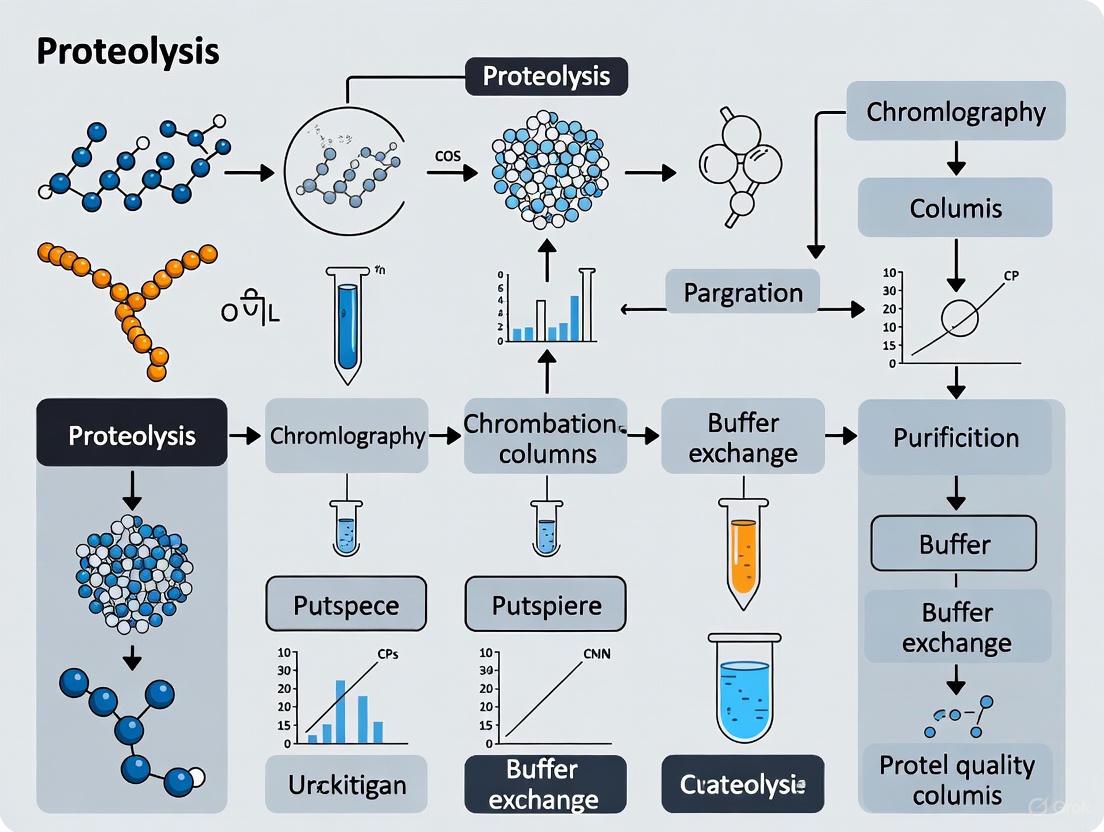
This article provides a comprehensive analysis of proteolysis in protein workflows, addressing both the challenge of unwanted protein degradation during purification and the opportunity of intentional proteolysis for therapeutic purposes.
Addressing Proteolysis in Protein Purification: From Workflow Challenges to Targeted Degradation Technologies
Abstract
This article provides a comprehensive analysis of proteolysis in protein workflows, addressing both the challenge of unwanted protein degradation during purification and the opportunity of intentional proteolysis for therapeutic purposes. We first explore the fundamental causes and impacts of protease contamination in traditional protein production. The discussion then progresses to advanced methodological applications, including the engineering of proteases with tailored specificity and the revolutionary PROTAC platform for targeted protein degradation in drug development. A dedicated troubleshooting section offers practical strategies for optimizing buffer systems, fusion tags, and expression conditions to prevent unwanted proteolysis, supported by large-scale statistical trends. Finally, we examine cutting-edge validation techniques, from machine learning-driven protease engineering to non-invasive monitoring systems, providing researchers and drug development professionals with a holistic framework for navigating the dual nature of proteolysis in both basic research and clinical translation.
Understanding Proteolysis: Fundamental Challenges in Protein Stability and Purification
In the context of protein purification workflows, proteolysis presents a dual challenge. It is a fundamental biological process defined as the breakdown of proteins into smaller polypeptides or amino acids [1] [2] [3]. For researchers, it manifests in two distinct ways:
- Unwanted Degradation: An experimental obstacle where valuable recombinant or purified proteins are inadvertently hydrolyzed by proteases, compromising yield, homogeneity, and activity [4] [5] [6].
- Targeted Protein Removal: An advanced technological tool that deliberately hijacks cellular proteolysis mechanisms to eliminate specific disease-associated proteins [7] [8] [9].
This technical support guide is designed to help you troubleshoot the common problem of unwanted proteolysis and introduces the foundational principles of targeted degradation platforms like PROTACs that are revolutionizing drug discovery.
FAQs: Troubleshooting Unwanted Proteolysis in Purification
What are the primary indicators of proteolysis during my purification?
You can identify proteolysis through several tell-tale signs in your experimental results:
- Multiple Lower-Molecular-Weight Bands on an SDS-PAGE gel, especially below your protein of interest, indicating cleavage fragments [6].
- Reduced Yield or Loss of Activity in your final protein preparation, even when mRNA levels are detectable [4].
- Inability to Obtain a Homogeneous Sample after affinity purification, as proteolytic fragments containing the affinity tag will co-purify with the full-length protein [6].
Which types of proteins are most susceptible to proteolysis?
Proteins with certain structural characteristics are inherently more prone to degradation. These include:
- Proteins with long, exposed, unstructured loops or intrinsically disordered regions that are accessible to proteases [1] [6].
- Unstable proteins, misfolded proteins, and some mutant proteins [1] [6].
- Proteins rich in specific amino acid sequences (e.g., PEST sequences rich in Proline, Glutamic acid, Serine, and Threonine) are known to have short half-lives [1].
What practical steps can I take to prevent proteolysis during cell lysis and purification?
A two-pronged strategy of inhibition and rapid separation is most effective [5]. Key methods are summarized in the table below.
Table 1: Strategies to Prevent Unwanted Proteolysis During Protein Purification
| Method | Protocol / Solution | Key Benefit |
|---|---|---|
| Protease Inhibitor Cocktails | Add a commercial broad-spectrum cocktail to all lysis and purification buffers. | Quickly inhibits a wide range of protease classes (serine, cysteine, metallo-, etc.) [5]. |
| Cold Temperature | Perform all steps after cell harvest at 4°C. | Slows down enzymatic activity, including proteolysis [5]. |
| Rapid Processing | Minimize the time between lysis and the first chromatography step. | Reduces the window for proteolysis to occur [5] [6]. |
| Filter Flow-Through Purification | Pass the crude lysate or purified sample through a low-protein-binding filter (e.g., 0.1 or 0.22 µm). | Rapidly removes aggregated proteolytic products that are retained by the filter, while full-length protein flows through [6]. |
Are there expression strategies that can minimize proteolysis in planta or in microbial systems?
Yes, optimizing the expression system itself can significantly reduce in vivo degradation:
- Modulate Expression Conditions: Slowing protein expression by lowering the induction temperature, shortening expression time, or using less rich media can decrease aggregation and proteolysis [6].
- Use Protease-Deficient Strains: For microbial expression, use commercially available protease-deficient strains (e.g., for E. coli) [4].
- Employ Organelle-Specific Targeting: In plant systems, targeting protein accumulation to specific organelles or using tissue-specific promoters (e.g., seed-specific) can shield the protein from highly proteolytic environments [4].
Experimental Protocol: A Standard Workflow for Proteolysis Prevention
The following protocol outlines a standard workflow for purifying a susceptible protein, incorporating key steps to mitigate degradation.
Materials
- Lysis Buffer (e.g., 50 mM Tris-HCl, 150 mM NaCl, pH 8.0)
- Complete, EDTA-free Protease Inhibitor Cocktail Tablets
- Affinity Purification Resin (e.g., Ni-NTA Agarose for His-tagged proteins)
- Syringe Filter Units (0.22 µm or 0.45 µm, low protein binding)
Procedure
Harvesting and Lysis:
- Harvest cells by centrifugation.
- Resuspend cell pellet in ice-cold Lysis Buffer containing a freshly added protease inhibitor cocktail.
- Lyse cells using your preferred method (e.g., sonication, French press) while keeping the sample on ice.
Clarification and Filtration:
- Centrifuge the lysate at high speed (e.g., 15,000 x g for 20 min at 4°C) to remove insoluble debris.
- Critical Step: Immediately pass the clarified supernatant through a syringe filter unit. This step rapidly removes aggregated proteolytic products [6].
Affinity Chromatography:
- Incubate the filtered lysate with the pre-equilibrated affinity resin for a defined, short period (e.g., 1 hour at 4°C) to minimize contact time with potential contaminants.
- Wash the resin with Wash Buffer (containing protease inhibitors) to remove non-specifically bound proteins.
Elution and Storage:
- Elute the target protein with Elution Buffer. Keep the eluate on ice.
- Proceed immediately to the next purification step or flash-freeze the protein in small aliquots using liquid nitrogen for storage at -80°C to prevent degradation during storage.
Diagram 1: Proteolysis prevention workflow.
Fundamentals of Targeted Protein Removal
While unwanted proteolysis is a problem to solve, controlled proteolysis is a powerful tool. Targeted Protein Degradation (TPD) technologies, particularly PROteolysis-Targeting Chimeras (PROTACs), are a breakthrough therapeutic strategy [8] [9].
What is a PROTAC?
A PROTAC is a heterobifunctional small molecule with three components [7] [8]:
- A warhead that binds to a Protein of Interest (POI).
- A ligand that recruits an E3 ubiquitin ligase.
- A linker connecting the two.
How does a PROTAC work?
The mechanism involves hijacking the cell's natural ubiquitin-proteasome system, as illustrated below.
Diagram 2: PROTAC mechanism of action.
- Ternary Complex Formation: The PROTAC molecule simultaneously binds to the target protein (POI) and an E3 ubiquitin ligase, forming a ternary complex [7] [8].
- Ubiquitination: The E3 ligase transfers ubiquitin chains onto the POI, marking it for destruction [8] [9].
- Degradation: The ubiquitinated POI is recognized and degraded by the 26S proteasome into small peptides and amino acids [1] [7].
- Recycling: The PROTAC is released unchanged and can catalyze another round of degradation, functioning substoichiometrically [8].
What are the key advantages of PROTACs over traditional inhibitors?
- Targets "Undruggable" Proteins: PROTACs require only binding to the target protein, not functional inhibition, opening up previously inaccessible proteins for drug development [7] [9].
- Catalytic Activity: A single PROTAC molecule can degrade multiple copies of the target protein, allowing for lower and less frequent dosing [8].
- Eliminates All Functions: By degrading the entire protein, PROTACs abolish all its functions (e.g., enzymatic and scaffolding), which can lead to more profound therapeutic effects [9].
The Scientist's Toolkit: Key Research Reagents
This table outlines essential reagents used in the fields of proteolysis prevention and targeted protein degradation.
Table 2: Key Research Reagents for Proteolysis Research
| Reagent / Tool | Function / Application |
|---|---|
| Broad-Spectrum Protease Inhibitors | Added to lysis buffers to inactivate a wide range of proteases (e.g., serine, cysteine, metalloproteases) during protein extraction and purification [5]. |
| PROTAC Molecule | A heterobifunctional degrader used to induce targeted ubiquitination and degradation of a specific protein of interest for research or therapeutic purposes [7] [8]. |
| E3 Ubiquitin Ligase Ligands | Key components of PROTACs that recruit specific E3 ligases (e.g., VHL, CRBN) to the target protein complex [7] [9]. |
| TR-FRET Assay Kits | Used to monitor key steps in targeted degradation, such as ternary complex formation and protein ubiquitination, in a high-throughput format [8]. |
| Ubiquitin Enrichment Kits | Utilize affinity resins to isolate and analyze polyubiquitinated proteins from cell lysates to confirm PROTAC mechanism of action [8]. |
Protease contamination is a significant challenge in cellular expression systems, often leading to reduced yield, degraded products, and unreliable experimental results in protein purification workflows. Understanding the sources of these proteases and implementing robust detection and prevention strategies is crucial for successful research and drug development. This guide provides a technical overview and troubleshooting resource for managing protease-related issues.
FAQ: Frequent Issues and Rapid Solutions
Q1: My purified recombinant protein shows multiple lower molecular weight bands on SDS-PAGE. Is this protease contamination? Yes, this is a classic sign of proteolysis during expression or purification. Proteolytic cleavage produces protein fragments that co-purify with your target, appearing as extra bands. To confirm, run a protease activity assay and check if adding protease inhibitors during purification reduces the bands [6].
Q2: I am using E. coli for expression. What are the most common sources of proteases? In E. coli, proteases like Lon, DegP, and OmpT are major contaminants. They are often released during cell lysis. Using protease-deficient E. coli strains can help, but intrinsic proteolytic activity remains a concern, especially for susceptible proteins [6].
Q3: How does the choice of expression system (mammalian vs. bacterial) influence protease contamination? The profile of contaminating proteases differs significantly:
- Mammalian Systems (e.g., Expi293): Contain endogenous cathepsins (B, L, S) and other lysosomal proteases. These are cysteine proteases and require specific inhibitors [10].
- Bacterial Systems (e.g., E. coli): Produce a different set of proteases like Lon, DegP, and OmpT, which are primarily serine proteases [6]. The mammalian system may provide more physiologically relevant post-translational modifications but introduces a different set of contaminants to manage.
Q4: What is a quick method to remove pre-formed proteolytic fragments from my full-length protein sample? For proteolytic products that have already formed and aggregated, filter flow-through purification can be effective. This rapid technique leverages the tendency of cleaved fragments to aggregate. The full-length protein passes through a filter, while the aggregated fragments are retained. This process can be completed in minutes, much faster than dialysis or gel filtration [6].
Troubleshooting Guide: Detection and Prevention of Protease Contamination
Detection and Confirmation of Protease Activity
Before troubleshooting, confirm that your issue is due to protease activity.
- Suspected Cause: Nonspecific protein degradation observed as smearing or unexpected bands on SDS-PAGE.
- Solution: Fluorometric Protease Activity Assay
- Principle: This assay uses a quenched, fluorescently-labeled protein substrate (e.g., FITC-casein). Protease cleavage unquenches the fluorophore, increasing fluorescence measurable with a plate reader [11].
- Protocol Summary:
- Sample Preparation: Dilute cell culture supernatant, lysate, or purified sample in assay buffer. Avoid protease inhibitors at this stage [11].
- Reaction Setup: Add 50 µL of sample to a well. Add 50 µL of Reaction Mix (assay buffer containing FITC-casein substrate) [11].
- Measurement: Read fluorescence immediately (Ex/Em = 485/530 nm) as your initial reading (T1). Incubate at 25°C for 30 minutes protected from light, then take a second reading (T2) [11].
- Data Analysis: Calculate the change in fluorescence (ΔRFU = R2 - R1). Compare to a standard curve to quantify activity. One unit of activity is defined as the amount of protease that generates fluorescence equivalent to 1.0 µmol of unquenched FITC per minute [11].
Addressing Endogenous Proteases in Mammalian Expression Systems
Mammalian cells, such as the Expi293 system, naturally produce active proteases like cathepsins, which can co-purify with your protein of interest [10].
- Suspected Cause: Co-purification of host cell proteases (e.g., Cathepsins B, L, S) leading to ongoing degradation during and after purification.
- Solution: Optimized Purification from Mammalian Culture Media
- Principle: Efficiently capturing the secreted pro-form of the protease and controlling its activation to prevent degradation.
- Protocol Summary (based on cathepsin purification):
- Harvesting: Collect culture media 3 days post-transfection. The target proteases are often secreted into the media in an inactive pro-form [10].
- Buffer Exchange: Dialyze the media against a compatible buffer (e.g., 50 mM Tris-HCl, pH 7.5, 250 mM NaCl, 10% glycerol) to prepare for Immobilized Metal Affinity Chromatography (IMAC) [10].
- Purification: Use Ni-NTA affinity chromatography if your protein is His-tagged. Note that both the pro-form and mature, autocleaved forms may be present in the elution [10].
- Handling: Maintain a pH above 6 during purification to prevent autocatalytic activation and denaturation that can occur in acidic conditions [10].
Preventing Proteolysis in Bacterial Expression Systems
Bacterial lysates are particularly rich in proteases that are released upon cell disruption.
- Suspected Cause: Protease release during bacterial cell lysis, degrading the target protein.
- Solution: Integrated Prevention Strategy
- Principle: Combine genetic, biochemical, and procedural methods to minimize proteolysis.
- Protocol Summary:
- Strain Selection: Use protease-deficient E. coli strains (e.g., lacking Lon and OmpT proteases) [6].
- Expression Control: Slow protein expression by lowering the incubation temperature after induction (e.g., to 4°C) and using less rich media. This reduces aggregation and misfolding, making the protein less susceptible to proteases [6].
- Lysis Conditions: Always perform lysis on ice or in a cold room. Include a broad-spectrum protease inhibitor cocktail in the lysis buffer. For proteins extremely susceptible to proteolysis, consider purification under denaturing conditions [6].
The table below summarizes key proteases found in different expression systems, their classification, and common triggers for their activity.
| Expression System | Common Contaminating Proteases | Protease Class | Primary Source / Trigger |
|---|---|---|---|
| Mammalian (e.g., Expi293) | Cathepsin B, L, S [10] | Cysteine Protease | Endogenous lysosomal proteases; Auto-activation at low pH [10] |
| Bacterial (e.g., E. coli) | Lon, DegP, OmpT [6] | Serine Protease | Released during cell lysis; Target unstable proteins or those with unfolded regions [6] |
| General | Various (e.g., from serum in culture media) | Mixed | Introduced via contaminated reagents or poor aseptic technique |
The Scientist's Toolkit: Essential Reagents for Managing Proteolysis
| Reagent / Material | Function in Troubleshooting Proteolysis |
|---|---|
| Protease Inhibitor Cocktails | Broad-spectrum or specific cocktails (e.g., targeting cysteine proteases) added to lysis and purification buffers to inactivate contaminating proteases. |
| Protease-Deficient E. coli Strains | Expression hosts genetically engineered to lack key bacterial proteases (e.g., Lon, OmpT), reducing degradation at the source [6]. |
| Fluorometric Protease Assay Kit | A quantitative, mix-and-read kit for confirming and measuring protease activity in samples using a FITC-casein substrate [11]. |
| Ni-NTA Affinity Resin | For efficient one-step purification of His-tagged recombinant proteins from complex mixtures like cell culture media, helping to separate the target from proteases [10]. |
| Filtration Devices (Filter Flow-Through) | A rapid method to separate full-length protein from aggregated proteolytic products based on size, completed in minutes [6]. |
Workflow Diagram: Managing Protease Contamination
The following diagram outlines a logical pathway for diagnosing and addressing protease contamination in protein purification workflows.
Impact of Proteolysis on Protein Yield, Function, and Structural Integrity
Frequently Asked Questions (FAQs)
What is proteolysis and why is it a major concern in protein production? Proteolysis is the enzymatic process by which proteins are broken down into smaller peptides or amino acids. In the context of biopharmaceutical production, it is a critical concern because it can degrade therapeutic proteins, directly impacting final yield, product homogeneity, biological activity, and overall quality. Unlike simpler pharmaceuticals, recombinant proteins have a natural tendency toward structural heterogeneity, and proteolytic processing can dramatically alter their structural integrity both during expression (in planta) and after extraction (ex planta) [4].
How can I tell if my recombinant protein is being degraded by proteases? Common signs of proteolytic degradation include:
- The appearance of multiple lower molecular weight bands on an SDS-PAGE gel or Western blot in addition to, or instead of, the expected full-length protein band [4] [12].
- A noticeable reduction in the yield of the full-length, active protein, even when mRNA transcripts are easily detectable [4].
- A loss of biological activity in the final purified product that cannot be explained by other factors like aggregation [4] [12].
My protein is unstable during purification. What immediate steps can I take? To immediately stabilize your protein during purification, implement the following best practices [13] [12]:
- Work Quickly and Cold: Perform all purification steps on ice or in a cold room at 4°C.
- Use Protease Inhibitors: Add broad-spectrum or specific protease inhibitor cocktails to your lysis and purification buffers.
- Prevent Shear Stress: Avoid vigorous pipetting, vortexing, or high-speed centrifugation. Use wide-bore pipette tips and gentle mixing [13].
- Optimize Buffer Conditions: Include stabilizing additives like glycerol, and use reducing agents (e.g., DTT) to prevent oxidation of sensitive cysteine residues [13].
Which host cell proteases are of highest concern in bioprocessing? Host cells contain a wide array of proteases. Recent research highlights serine hydrolases as a particularly high-risk group. These enzymes can persist through the purification process and impact critical quality attributes, such as degrading stabilizing excipients like polysorbates in the final drug formulation. Activity-based protein profiling (ABPP) methods have been developed to specifically monitor these troublesome enzymes during process development [14].
Are some expression systems better than others for minimizing proteolysis? Yes, the choice of expression system can significantly impact proteolysis. While all systems have proteases, some strategies include:
- Using Protease-Deficient Strains: For bacterial systems like E. coli, protease-deficient strains are commercially available and routinely used to minimize recombinant protein loss [4].
- Subcellular Targeting: In more complex systems like plants, targeting protein accumulation to specific organelles (e.g., chloroplasts) or using tissue-specific expression (e.g., seed-specific promoters) can shield the protein from the most active proteases [4].
- Extracellular Secretion: Secreting the protein into the culture medium can separate it from intracellular proteases, though extracellular proteases must then be considered [15].
Troubleshooting Guides
Problem: Low Yield of Full-Length Protein
Potential Causes and Solutions:
| Cause | Diagnostic Method | Solution |
|---|---|---|
| High protease activity in host cell | Activity-based protein profiling (ABPP) to identify active proteases [14] | Use protease-deficient host strains; add protease inhibitors to lysis buffer; co-express companion protease inhibitors [4]. |
| Protein degradation during purification | SDS-PAGE/Western blot analysis of samples from each purification step [12] | Keep samples cold; shorten purification time; include stabilizing additives (e.g., glycerol, EDTA) in buffers [13]. |
| Vulnerable protein sequence/structure | Bioinformatic analysis to identify exposed protease cleavage sites | Engineer the protein sequence to remove susceptible sites; fuse to a stable protein tag (e.g., GST, MBP) for protection [4]. |
| Inappropriate expression system | Compare yield and integrity across different systems (bacterial, yeast, mammalian) | Switch to a more compatible system; use tissue-specific or inducible promoters to control expression timing [4]. |
Problem: Protein Inactivation or Loss of Function
Potential Causes and Solutions:
| Cause | Diagnostic Method | Solution |
|---|---|---|
| Proteolytic cleavage at critical sites | Functional assay + SDS-PAGE to correlate activity with integrity | Identify and mutate critical cleavage sites; use fusion tags that enhance stability [4]. |
| Oxidation of sensitive residues | Mass spectrometry analysis | Purify under inert atmospheres (N₂, Argon); include reducing agents (DTT, β-mercaptoethanol) in all buffers [13]. |
| Removal of essential cofactors | Activity assay before and after adding cofactors back | Add required cofactors (e.g., metal ions, coenzymes) to purification and storage buffers [12]. |
| Aggregation leading to inactivity | Dynamic light scattering (DLS) or size-exclusion chromatography | Optimize buffer pH and ionic strength; use chaotropes or detergents to prevent aggregation [12]. |
Advanced Diagnostic and Monitoring Techniques
Activity-Based Protein Profiling (ABPP) for Host Cell Proteases
Activity-based protein profiling is a powerful method for identifying and quantifying the activity of specific classes of proteases, such as serine hydrolases, within complex bioprocess samples. This technique uses reactive, mechanism-based probes that covalently label the active site of target enzymes, allowing for their subsequent purification and identification via LC-MS. This provides a direct readout of active protease levels, not just their concentration, which is crucial for assessing the risk to your product [14].
The workflow for ABPP is as follows:
Research Reagent Solutions for Mitigating Proteolysis
The following table lists key reagents and materials used to prevent proteolysis and stabilize proteins during purification workflows.
| Reagent/Material | Function | Example Applications |
|---|---|---|
| Protease Inhibitor Cocktails | Broad-spectrum or specific inhibition of serine, cysteine, metallo-, etc., proteases. | Added to lysis and extraction buffers to prevent degradation during cell disruption [4]. |
| Affinity Purification Resins | Rapid, specific capture of target protein to separate it from proteases. | His-tag purification with Ni-NTA resin; antibody purification with Protein A/G resin [16]. |
| Stabilizing Additives (Glycerol, Sucrose) | Reduce protein dynamics and denaturation, making the protein less susceptible to proteolysis. | Included in storage and purification buffers at 5-20% (v/v) to maintain protein stability [13]. |
| Reducing Agents (DTT, TCEP) | Prevent formation of incorrect disulfide bonds and oxidation of cysteine residues. | Essential for stabilizing proteins with free cysteines; maintained in buffers at 0.5-5 mM [13]. |
| Tag Cleavage Proteases (rTEV, Enterokinase) | Highly specific proteases for removing affinity tags to restore native protein structure. | rTEV protease cleaves at ENLYFQ*S sequence; Enterokinase cleaves at DDDDK* sequence [16]. |
Experimental Protocol: Assessing and Controlling Proteolysis During Purification
Objective: To isolate a recombinant protein with high yield and functional integrity by monitoring and inhibiting proteolysis throughout the purification process.
Materials:
- Lysis Buffer (e.g., 50 mM Tris-HCl, pH 8.0, 150 mM NaCl)
- Protease Inhibitor Cocktail (commercial or prepared with AEBSF, E-64, Leupeptin, etc.)
- EDTA (1-10 mM, to inhibit metalloproteases)
- Dithiothreitol (DTT) or Tris(2-carboxyethyl)phosphine (TCEP)
- Affinity chromatography resin (e.g., Ni-NTA for His-tagged proteins) [16]
- SDS-PAGE equipment and reagents
Method:
- Cell Lysis and Extraction:
- Harvest cells and resuspend in ice-cold Lysis Buffer.
- Critical Step: Immediately prior to use, supplement the buffer with a protease inhibitor cocktail and 1-5 mM DTT/TCEP.
- Lyse cells using a gentle method (e.g., lysozyme treatment, mild sonication on ice) to minimize release and activation of proteases [13].
- Clarify the lysate by centrifugation at 4°C to remove debris.
Rapid Capture and Washing:
- Incubate the clarified lysate with the affinity resin at 4°C with gentle mixing. Reducing the flow rate or stopping the column for a short incubation can improve binding if the target protein level is low [12].
- Wash the resin with >10 column volumes of Wash Buffer (Lysis Buffer with added salt, e.g., 20-30 mM Imidazole for His-tag purification) to stringently remove nonspecifically bound proteins and proteases [12].
Elution and Stabilization:
- Elute the target protein using the appropriate elution buffer (e.g., 250 mM Imidazole, or low pH buffer). Prepare the elution buffer fresh to ensure efficacy [12].
- Immediately after elution, adjust the buffer conditions if needed (e.g., by dialysis or desalting) to place the protein into a stable storage buffer (e.g., containing glycerol and at an optimal pH).
Monitoring and Analysis:
- At each stage (lysate, flow-through, wash, eluate), take a small sample and analyze by SDS-PAGE and Western blotting.
- Look for the disappearance of the full-length band or the appearance of lower-weight bands, which indicate where and when degradation is occurring [4] [12].
- Use functional assays to confirm the biological activity of the final eluted protein.
In protein purification workflows, particularly for sensitive recombinant proteins, proteolysis—the enzymatic cleavage of peptide bonds—presents a significant and ubiquitous obstacle. This irreversible post-translational modification can generate protein fragments with altered or lost biological activity, compromising experimental results and structural studies [17]. The challenge intensifies when working with complex proteins such as the Plasmodium falciparum Heme Detoxification Protein (HDP), which is essential for the malaria parasite's survival but notoriously difficult to express in a native, soluble form [18] [19]. This case study examines the specific challenges encountered during HDP recombinant expression and outlines a systematic troubleshooting framework to mitigate proteolysis, preserving protein integrity for downstream analysis.
The HDP Expression Challenge: A Troubleshooting Guide
FAQ: What makes Plasmodium HDP particularly difficult to express recombinantly?
Answer: HDP is an essential protein for the malaria parasite, responsible for detoxifying the heme released during hemoglobin digestion by converting it into inert hemozoin crystals [19]. Despite its importance, HDP has proven exceptionally challenging to express in its native, soluble form in E. coli-based systems. A primary reason is its inherent tendency to form insoluble aggregates or soluble aggregates when heterologously expressed. Furthermore, its functional activity appears critically dependent on its flexible, unstructured N-terminal region, which is highly susceptible to proteolytic degradation or misfolding in recombinant systems [18].
FAQ: What specific strategies were employed to achieve soluble expression of HDP?
Answer: Researchers employed a multi-pronged strategy to tackle HDP's solubility issues [18] [19]:
- Expression of Orthologs: Testing HDP genes from different Plasmodium species (e.g., P. falciparum, P. vivax, P. knowlesi).
- Fusion Tags: Utilizing solubility-enhancing partners like GST and MBP.
- Consensus Sequence Design: Creating a synthetic HDP sequence based on conserved residues across species.
- Chaperone Co-expression: Co-expressing molecular chaperones in E. coli to aid proper protein folding.
- Construct Optimization: Systematically designing N-terminal and C-terminal truncations.
Despite these extensive efforts, only one construct—an HDP with a 44-residue N-terminal truncation and a C-terminal 6-His tag (HDPpf-C10)—was expressed in a soluble form. Surprisingly, this truncated, soluble protein lacked detectable heme-to-hemozoin transformation activity, underscoring the critical role of the N-terminal region for function [18].
Troubleshooting Proteolysis in Protein Purification
Proteolysis becomes a significant concern after cell lysis, as the regulated compartmentalization of proteases within the cell is destroyed, allowing them to come into contact with and degrade the protein of interest [5]. The table below outlines common symptoms of proteolysis and the corresponding solutions.
Table 1: Troubleshooting Guide for Proteolysis During Protein Purification
| Observed Problem | Potential Cause | Recommended Solutions |
|---|---|---|
| Multiple unexpected bands on SDS-PAGE gel | Non-specific proteolysis by endogenous proteases released during lysis [5]. | Use protease inhibitor cocktails; Keep samples on ice; Perform purifications quickly at low temperatures [5] [20]. |
| Loss of protein activity/function | Specific cleavage in a critical functional domain (e.g., the N-terminus of HDP) [18]. | Optimize construct (e.g., use truncations, fusion partners); Use more specific protease inhibitors. |
| Low protein yield | Extensive degradation of the target protein. | Combine protease inhibition with early and fast chromatographic separation from proteases [5]. |
| Inconsistent results between purifications | Variable levels of protease activity due to slight differences in cell lysis or handling. | Standardize protocols; Use automated purification systems to increase reproducibility and speed [21]. |
Experimental Protocol: A Two-Pronged Approach to Avoid Proteolysis
As outlined in the literature, a robust method to prevent proteolysis involves a combination of inhibition and separation [5].
1. Inhibition In Situ
- Prepare Lysis Buffer: Chill the chosen lysis buffer (e.g., M-PER, T-PER, B-PER reagents for mammalian, tissue, or bacterial samples, respectively) on ice [20].
- Add Inhibitors: Supplement the buffer with a broad-spectrum, ready-to-use protease inhibitor cocktail. These are available in tablet or liquid form, with options containing EDTA (to inhibit metalloproteases) or being EDTA-free. Phosphatase inhibitors can be added concurrently if preserving phosphorylation status is important [20].
- Lysis: Perform cell lysis in the prepared, chilled buffer. Maintain samples at 0-4°C throughout the lysis process.
2. Early Separation via Chromatography
- After clarification of the lysate by centrifugation, immediately proceed to the first chromatography step.
- Affinity Chromatography (e.g., His-tag or GST-tag purification) is highly effective as an initial capture step because it rapidly separates the target protein from the bulk of cellular proteases.
- For multi-step purification, automation systems (e.g., ÄKTA go) can be configured to run sequential columns (e.g., affinity followed by size-exclusion) without manual intervention, minimizing handling time and the window for proteolysis [21].
Research Reagent Solutions
The following table lists key reagents and tools essential for successful recombinant protein expression and purification, especially when combating challenges like proteolysis.
Table 2: Essential Research Reagents for Protein Expression and Purification
| Reagent / Tool | Function / Application | Examples / Key Features |
|---|---|---|
| Protease Inhibitor Cocktails | Inhibits a wide range of protease classes (serine, cysteine, metallo-, etc.) to protect target proteins during and after lysis [20]. | Available as tablets, capsules, or liquids; EDTA-containing or EDTA-free formulations for flexibility [20]. |
| Detergent-Based Lysis Reagents | Gentle, efficient cell lysis with formulations optimized for different sample types (mammalian, bacterial, yeast, tissue) [20]. | M-PER (Mammalian), B-PER (Bacterial), T-PER (Tissue) reagents; minimize cross-contamination between subcellular fractions [20]. |
| Affinity Chromatography Resins | Rapid, specific capture of tagged recombinant proteins, enabling quick separation from proteases. | Ni-NTA for His-tagged proteins; Glutathione resin for GST-tagged proteins. |
| Automated FPLC Systems | Enables fast, reproducible, multi-step purification with minimal manual intervention, reducing the time for proteolysis to occur [21]. | ÄKTA go systems, configurable with a column valve and auto-sampler for sequential purification steps [21]. |
| Solubility-Enhancing Fusion Tags | Improves solubility and expression yield of difficult-to-express proteins; can also aid in detection. | GST (Glutathione S-transferase), MBP (Maltose-Binding Protein). |
Workflow and Strategy Visualization
The following diagram illustrates the logical decision process and strategies used to overcome the challenges of recombinant HDP expression, as detailed in the case study.
The case of Plasmodium HDP highlights that achieving soluble recombinant expression is only half the battle. Functional integrity is paramount. The successful expression of a truncated, soluble HDP that lacked activity underscores a critical lesson: the most soluble construct may not be the most functional. This necessitates a balanced approach where solubility optimization must be continually evaluated alongside functional assays.
The broader strategy for combating proteolysis involves a combination of robust biochemical practices—using protease inhibitors and maintaining cold temperatures—and efficient workflow design that leverages automation and fast purification to minimize the exposure of sensitive proteins to degradative elements [5] [21]. For particularly challenging targets like HDP, extensive construct engineering remains a non-negotiable step in the process, requiring researchers to systematically test various homologs, fusions, and truncations to find a expressible and functional protein variant [18] [19].
FAQ: Understanding the Ubiquitin-Proteasome System
What is the ubiquitin-proteasome system (UPS) and why is it important? The ubiquitin-proteasome system (UPS) is the primary mechanism for regulated, processive degradation of intracellular proteins in eukaryotes [22] [23] [24]. It is responsible for protein homeostasis and quality control, maintaining proper levels of protein expression and removing misfolded or dysfunctional proteins [22]. This tightly regulated process is crucial for numerous cellular functions, including cell cycle regulation, stress response, DNA transcriptional regulation, and apoptosis [22] [25]. Defects in the UPS can lead to various diseases, including cancer, Parkinson's disease, and cystic fibrosis [22].
How are proteins targeted for degradation by the UPS? Proteins are targeted for degradation through a three-step enzymatic cascade that tags them with ubiquitin molecules [22]:
- Activation: Ubiquitin is activated by an E1 ubiquitin-activating enzyme in an ATP-dependent reaction.
- Conjugation: The activated ubiquitin is transferred to an E2 ubiquitin-conjugating enzyme.
- Ligation: An E3 ubiquitin ligase facilitates the transfer of ubiquitin from E2 to a lysine residue on the target protein.
Once a protein is tagged with a single ubiquitin molecule, additional ubiquitin molecules are added to form a polyubiquitin chain, which marks the protein for recognition and degradation by the proteasome [22].
What is the structure of the proteasome and how does it function? The 26S proteasome is a 2.5 MDa multi-subunit complex consisting of two main components [22] [25]:
- 20S Core Particle (CP): A cylindrical structure composed of four rings (two α-rings and two β-rings) with three different proteolytic activities (caspase-like, trypsin-like, and chymotrypsin-like) housed in the inner β-rings.
- 19S Regulatory Particle (RP): A cap complex that recognizes polyubiquitinated proteins, unfolds them, and directs them into the 20S core for degradation in an ATP-dependent manner.
The proteasome's architecture ensures that only unfolded proteins can enter the proteolytic core, making the process highly specific [22].
Is the ubiquitination process reversible? Yes, ubiquitination is a reversible process until proteins become polyubiquitinated and destined for degradation [22]. Deubiquitinating enzymes (DUBs) are a family of over 100 enzymes that cleave mono-ubiquitin and polyubiquitin chains from proteins, potentially rescuing specific target proteins from degradation [22]. DUBs are responsible for recycling ubiquitin and play significant roles in various biological processes, including cell growth, differentiation, and transcriptional regulation.
How is the UPS relevant to drug development? The UPS has emerged as a promising therapeutic target, particularly through targeted protein degradation (TPD) strategies [22] [26]. Proteolysis-targeting chimeras (PROTACs) are bifunctional molecules designed to hijack the UPS to selectively degrade disease-causing proteins [26] [27]. Unlike traditional inhibitors that merely block protein activity, PROTACs catalytically eliminate the target protein, offering advantages for targeting "undruggable" proteins such as transcription factors, mutant oncoproteins, and scaffolding molecules [26].
Troubleshooting Common UPS-Related Experimental Issues
Troubleshooting UPS and Protein Degradation Experiments
Table: Troubleshooting Common UPS-Related Experimental Problems
| Problem | Potential Causes | Recommended Solutions |
|---|---|---|
| No protein in eluate | Protein level below binding threshold; Protein not expressed; Protein aggregation; Improperly prepared elution solution [12] | Increase input amount for affinity columns; Check induction system for recombinant proteins; Adjust buffer conditions for stability; Prepare fresh elution solution [12] |
| High background noise | Insufficient washing; Incorrect buffer composition; Resin binding impurities [12] | Add additional wash steps; Optimize wash buffer composition; Reduce total protein sampled; Consider additional purification steps [12] |
| Protein does not bind | Insufficient binding time; Suboptimal binding conditions; Protein tag issues [12] | Reduce flow rate or incubate column; Adjust buffer pH/concentration; Check plasmid sequence or reposition tag [12] |
| Protein degradation during purification | Cellular proteases released during lysis [5] | Use protease inhibitor cocktails; Keep samples on ice or at 4°C; Process samples quickly; Use fast protein liquid chromatography for early protease separation [5] |
| Inconsistent ubiquitination results | Improper handling; Inspecific antibodies; Lack of controls | Use proteasome inhibitors (e.g., MG-132) to accumulate ubiquitinated proteins [22]; Validate antibodies; Include appropriate positive/negative controls |
Experimental Protocols for Studying the UPS
Protocol: Detecting Protein Ubiquitination
Purpose: To determine whether a specific protein of interest (POI) has been ubiquitinated.
Materials:
- Ubiquitin Enrichment Kit (for isolation of polyubiquitinated proteins) [22]
- Proteasome inhibitor (e.g., MG-132) [22] [25]
- Cell or tissue lysates
- Antibodies against your POI and ubiquitin [22]
- LanthaScreen Conjugation Assay Reagents (for high-throughput screening) [22]
Method:
- Treat cells with a proteasome inhibitor (e.g., 10-20 μM MG-132) for 4-6 hours before harvesting to accumulate ubiquitinated proteins [22].
- Lyse cells using appropriate lysis buffer with protease inhibitors.
- Isolate polyubiquitinated proteins using a Ubiquitin Enrichment Kit according to manufacturer's instructions [22].
- Elute bound proteins and separate by SDS-PAGE.
- Transfer to membrane and probe with antibody against your POI to confirm ubiquitination [22].
- Alternatively, for more specific detection:
- Immunoprecipitate your POI using a target-specific antibody.
- Perform Western blot with an anti-ubiquitin antibody to detect ubiquitinated forms [22].
Protocol: Assessing Protein Degradation Rates
Purpose: To measure the degradation rate of your protein of interest.
Materials:
- Click-iT Plus protein labeling reagents [22]
- Cycloheximide (for translation inhibition)
- Proteasome inhibitors (optional controls)
Method (Pulse-Chase Analysis):
- Pulse: Label nascent proteins using Click-iT Plus technology with fluorescent labels [22].
- Chase: Replace labeling medium with complete medium and harvest cells at various time points.
- Detect your protein of interest at each time point using specific antibodies or other detection methods.
- Quantify signal intensity and plot against time to determine degradation kinetics.
- Include proteasome inhibitor treatments as controls to confirm UPS-dependent degradation.
Key Signaling Pathways and Workflows
The Ubiquitin-Proteasome Pathway
Troubleshooting Protein Purification Workflow
The Scientist's Toolkit: Research Reagent Solutions
Table: Essential Reagents for Studying the Ubiquitin-Proteasome System
| Reagent/Category | Specific Examples | Function/Application |
|---|---|---|
| Proteasome Inhibitors | MG-132, Lactacystin [25] | Inhibit proteasomal activity, allowing accumulation of ubiquitinated proteins for study [22] [25] |
| Activity Assay Kits | Proteasome 20S Activity Assay Kit [25] | Measure chymotrypsin-like, trypsin-like, or caspase-like proteasome activity using fluorescent substrates |
| Ubiquitination Detection | Ubiquitin Enrichment Kits, LanthaScreen Conjugation Assay [22] | Isolate polyubiquitinated proteins or monitor ubiquitin conjugation rates in high-throughput screens |
| Validated Antibodies | Anti-ubiquitin, Anti-Ubiquitin B [22] | Detect ubiquitin expression and protein ubiquitination in Western blot, ELISA, and protein isolation assays |
| Chromatography Resins | Affinity matrices (agarose, polyacrylamide) [12] | Purify proteins based on specific binding properties; key for separating proteases from proteins of interest [5] [12] |
| PROTAC Molecules | ARV-471 (ER-targeting), ARV-110 (AR-targeting) [27] | Investigate targeted protein degradation for research and therapeutic development |
Advanced Methodologies: Engineering Proteases and Harnessing PROTAC Technology
This technical support center provides a focused resource for researchers integrating a novel DNA-recorder system for protease specificity profiling into their protein purification workflows. Engineered proteases are crucial tools for cleaving fusion tags or modulating protein activity, but their off-target proteolysis can compromise experimental results and protein yields. The methodology outlined here addresses this by enabling the parallel assessment of on- and off-target activities for hundreds of thousands of protease variants, providing the high-quality data necessary to build predictive machine learning models and select highly specific proteases for downstream applications [28] [29].
FAQs & Troubleshooting Guide
System Fundamentals
Q1: What is the core principle behind the DNA-recorder system for profiling protease specificity? The system is a genetic device in E. coli that directly links proteolytic activity to a permanent, sequenceable DNA output. It couples the cleavage of a substrate peptide to the stabilization of a phage recombinase (Bxb1), which in turn catalyzes the inversion of a DNA recombination array. The fraction of inverted arrays in a population, quantifiable via Next-Generation Sequencing (NGS), serves as a kinetic measure of proteolytic activity for a specific protease-substrate pair [28].
Q2: What kind of data volume does this system generate, and why is it significant? In a single demonstration, the system profiled approximately 600,000 protease-substrate pairs, testing 29,716 candidate proteases against up to 134 substrates in parallel [28] [29]. This massive scale of sequence-activity data is sufficient to train accurate, data-hungry deep learning models, moving beyond simple variant screening to predictive in-silico protease design.
Q3: How does this method improve the engineering of proteases for therapeutic or precise purification applications? Traditional methods often screen for enhanced on-target activity first and test for problematic off-target cleavage only as a secondary step. This DNA-recorder system profiles activity against dozens of off-target substrates concurrently with the on-target activity during the initial high-throughput step. This allows for the direct selection of variants with desired on-target activity and minimal promiscuity from the outset, a critical feature for therapeutic safety and preserving protein integrity in purification workflows [28].
Experimental Setup & Optimization
Q4: During initial setup, we observe a high background recombination signal even with inactive proteases. How can this be mitigated? A low but consistent background signal is attributed to protease binding without catalytic cleavage, which can partially stabilize the Bxb1-SsrA fusion. This binding contribution remains constant over time, unlike the increasing signal from true proteolysis. You can account for this by:
- Establishing a Threshold: Determine the background flipping fraction using catalytically inactive proteases (e.g., TEVp C151A mutant) and set a minimal activity threshold above which variants are considered active [28].
- Optimizing Linkers: Incorporate flexible amino acid linkers flanking the protease substrate peptide to improve accessibility and the signal-to-background ratio [28].
- Kinetic Analysis: Analyze the flipping fraction over time (the "flipping curve"); a true proteolytic signal will accumulate, whereas the binding signal will be static [28].
Q5: What are the key genetic elements to optimize for maximizing the dynamic range of the recorder? The system's sensitivity depends on the efficient translation of protease activity into recombination. Key optimizations include:
- Promoter/RBS Engineering: Fine-tune the expression levels of both the candidate protease and the Bxb1 recombinase by engineering their promoters and ribosomal binding sites (RBS) [28].
- Induction Timing: Optimize the timing of Bxb1 induction relative to protease expression to ensure the recorder is active during peak protease production [28].
- Degradation Tag: The C-terminal SsrA tag is essential for rapid degradation of Bxb1 in the absence of cleavage. Ensure this degradation signal is intact and functional [28].
Data Generation & Analysis
Q6: Our NGS data processing is struggling to correctly assign protease and substrate sequences to the recombination output. What is the recommended workflow? The system uses a two-step sequencing approach to accurately link sequences to activity:
- Long-Read Sequencing (PacBio): Use this to separately sequence the TEVp and TEVs variant libraries, creating a lookup table that assigns each variant's actual amino acid sequence to its unique DNA barcode [28].
- Short-Read Sequencing (Illumina): Use this for the high-throughput activity reads. It sequences the barcodes for the protease and substrate, along with the recombination array state (flipped/unflipped) [28].
- Data Processing: In your analysis pipeline, replace the Illumina-read barcodes with the actual sequences from the PacBio lookup table. This reconstructs the full sequence-activity dataset for hundreds of thousands of pairs [28].
Q7: How can we use the generated data to find a protease with a completely new specificity profile? The collected sequence-activity data enables a machine learning (ML)-driven search of the vast sequence space. By training a deep learning model on your dataset of ~600,000 measured pairs, the model can learn the complex relationships between protease sequence and specificity. You can then use the trained model to predict the activity of millions of unseen protease sequences against your desired substrate profile, virtually screening for candidates with the optimal on- and off-target activities before synthesis and testing [28].
Quantitative System Performance
The table below summarizes key quantitative metrics from a typical large-scale experiment using the DNA-recorder system [28].
Table 1: DNA-Recorder System Performance Metrics
| Metric | Value | Significance |
|---|---|---|
| Protease Variants Tested | 29,716 | Enables sampling of a large combinatorial sequence space. |
| Substrates Profiled | Up to 134 | Allows for comprehensive on- and off-target specificity profiling in a single experiment. |
| Protease-Substrate Pairs | ~600,000 | Generates a dataset of sufficient scale for training deep learning models. |
| Data Output | Fraction Flipped over time | Provides kinetic, quantitative activity measurements, not just binary hit identification. |
| Key Innovation | Epistasis-aware training set design | A sampling strategy that maximizes machine learning model accuracy for a given experimental effort. |
Essential Protocols
Protocol 1: DNA-Recorder Assembly and Library Construction
This protocol outlines the steps to create a plasmid library for protease specificity profiling.
- Vector Backbone: Use the established plasmid architecture containing the protease expression cassette, the Bxb1-SsrA fusion cassette, and the recombination array flanked by Bxb1 att sites [28].
- Library Cloning: Clone diversified protease and substrate variant libraries into their respective positions using Golden Gate, Gibson assembly, or traditional restriction-ligation cloning. The use of a visual (RFP) dropout marker can streamline the screening of recombinant clones [28] [30].
- Barcoding and Lookup Table Generation: Ensure each protease and substrate variant is associated with a unique DNA barcode. Perform long-read PacBio sequencing on the pooled library to create a lookup table matching barcodes to sequences [28].
- Transformation: Transform the library into your expression strain (e.g., E. coli) for the profiling experiment.
Protocol 2: Parallel Specificity Profiling and NGS Sample Preparation
This protocol details the experimental workflow for running the assay and preparing samples for sequencing.
- Culture and Induction: Inoculate and grow the E. coli library. Induce expression of the candidate proteases and the Bxb1 recombinase at the pre-optimized time [28].
- Time-Point Sampling: Collect samples at multiple time points (e.g., 0, 2, 4, 8 hours) post-induction to capture the kinetics of recombination.
- Plasmid Extraction: Isolate plasmids from each sample time point.
- PCR-Free Fragment Isolation: Isolate the target DNA fragment (containing the barcodes and recombination array) from the plasmids using a PCR-free protocol to avoid amplification bias [28].
- NGS Library Prep: Ligate Illumina sequencing adapters with sample-specific indices to the isolated fragments. Pool all samples for collective sequencing on an Illumina platform [28].
System Workflows and Pathways
The following diagrams illustrate the core operational and data processing workflows of the DNA-recorder system.
DNA-Recorder Mechanism
Specificity Profiling Pipeline
The Scientist's Toolkit: Research Reagent Solutions
Table 2: Key Reagents and Materials for DNA-Recorder Experiments
| Item | Function in the Experiment | Examples / Notes |
|---|---|---|
| DNA-Recorder Plasmid | Genetic backbone for expressing protease and Bxb1-SsrA, and housing the recombination array. | Contains separate expression cassettes for the protease and Bxb1-SsrA; optimized promoters and RBS are critical [28]. |
| Bxb1 Recombinase | Phage integrase that catalyzes the inversion of the DNA recombination array upon stabilization. | Fused C-terminally to the substrate peptide and SsrA degradation tag [28]. |
| Protease Substrate Library | Peptide sequences inserted into the Bxb1-SsrA fusion that are cleaved by active proteases. | Includes the target substrate and numerous off-targets; flanking flexible linkers (e.g., GGSGG) improve performance [28]. |
| NGS Services/Reagents | For long-read (PacBio) barcode-to-sequence mapping and short-read (Illumina) activity readout. | Essential for deconvoluting the complex library data [28]. |
| Affinity Purification Resins | For purifying protease candidates or cleaved target proteins during validation. | Ni-NTA for His-tagged proteins [16], Anti-Flag gel for Flag-tagged proteins [16]. |
| Tag Cleaving Proteases | For precision cleavage of affinity tags in protein purification workflows. | TEV Protease, HRV 3C Protease; available as recombinant enzymes [30] [16]. |
Machine Learning Approaches for Predicting Protease Substrate Specificity
Within protein purification workflows, unintended proteolysis is a significant and common problem that can compromise yield and integrity. Proteases, enzymes that cleave peptide bonds, are often present in cell lysates and can co-purify with the target protein, leading to its degradation. Accurately predicting protease substrate specificity is therefore not just a fundamental scientific question but a practical necessity for developing robust purification protocols. Traditional methods for characterizing protease activity are low-throughput and ill-suited for profiling the vast sequence space of potential substrates. This article explores how machine learning (ML) is revolutionizing the prediction of protease substrate specificity, providing tools that can be integrated into experimental design to safeguard protein purification.
Core Machine Learning Methodologies
Data Generation: The Foundation of ML Models
The accuracy of any ML model is contingent on the quality and scale of the data used for its training. Traditional datasets for protease specificity are often limited, but recent advances in high-throughput (HTP) experimental techniques are generating the comprehensive data required for powerful predictive models.
DNA Recorder for Specificity Profiling: A groundbreaking method involves using a DNA-based recorder to capture proteolytic activity within a living cell. This system links the cleavage of a specific substrate sequence to the activation of a recombinase enzyme, which in turn modifies a DNA array. The fraction of modified DNA arrays, quantifiable via next-generation sequencing (NGS), directly correlates with the proteolytic activity for a given protease-substrate pair. This approach allows for the parallel testing of tens of thousands of candidate proteases against hundreds of substrates, generating sequence-activity data for hundreds of thousands of protease-substrate combinations in a single experiment [28].
In Vitro Peptide Arrays: Another method utilizes chemically synthesized peptide arrays representing a vast swath of the proteome. These arrays are exposed to the enzyme of interest, and the modification sites are identified. The resulting data on which sequences are susceptible to enzymatic activity serves as a rich training set for ML models. This "ML-hybrid" approach, which starts with experimental generation of enzyme-specific training data, has been shown to mark a significant performance increase over traditional in vitro methods [31].
Machine Learning Algorithms and Tools
Once large-scale sequence-activity data is available, various ML models can be employed to predict specificity.
Epistasis-Aware Deep Learning: When engineering proteases, interactions between amino acids (epistasis) can profoundly influence function. Standard ML models can struggle with this complexity. "Epistasis-aware" training set design is a strategy that accounts for these non-additive effects, streamlining the search within enormous sequence spaces and strongly increasing model accuracy for a given experimental effort. This leads to data-efficient deep learning models that can accurately predict protease sequences with desired on- and off-target activities [28].
The EZSpecificity AI Tool: This publicly available tool demonstrates the power of combining expanded datasets with novel algorithms. EZSpecificity analyzes an enzyme's amino acid sequence to predict which substrate will best fit its active site. To overcome the limitation of scarce experimental data, its developers complemented existing data with millions of computational docking simulations, which provide atomic-level detail on how enzymes of various classes conform around different substrates. This model has been validated to achieve 91.7% accuracy in its top pairing predictions for certain enzyme classes, significantly outperforming previous models [32].
ML-Hybrid Ensemble Models: This approach involves creating a unique ML model for a specific enzyme. The model is trained on high-throughput in vitro data (e.g., from peptide arrays) and is often augmented with generalized PTM-specific predictions. This creates an ensemble model with enhanced predictive accuracy in cell models, capable of uncovering novel enzyme-substrate networks [31].
Table 1: Comparison of Featured ML Approaches for Specificity Prediction
| ML Approach | Key Feature | Reported Advantage | Primary Data Source |
|---|---|---|---|
| DNA Recorder with Epistasis-Aware ML [28] | Accounts for non-additive amino acid interactions. | Increased data efficiency and model performance. | In vivo specificity profiling in E. coli. |
| EZSpecificity Tool [32] | Integrates enzyme sequence with docking simulation data. | 91.7% prediction accuracy in validation tests. | Experimental data & computational docking. |
| ML-Hybrid Ensemble [31] | Combines in vitro experimental data with computational models. | Important performance increase over conventional methods. | Peptide array screening. |
Experimental Protocols & Validation
Protocol: DNA Recorder for Protease Specificity Profiling
This protocol outlines the key steps for employing the DNA recorder system to generate data for ML model training [28].
- Plasmid Construction: Design a plasmid architecture containing:
- An expression cassette for the candidate protease (e.g., a library of TEVp variants).
- An expression cassette for a recombinase (e.g., Bxb1), fused to a C-terminal peptide containing the substrate sequence (e.g., TEVs) followed by a proteolytic degradation tag (SsrA).
- A recombination array DNA segment, flanked by the recombinase's attachment sites.
- Transformation and Culture: Transform the plasmid library into a suitable E. coli host strain. Grow the culture in shake flasks.
- Induction and Sampling: Induce expression of the recombinase. Draw samples from the culture at multiple time points post-induction.
- Plasmid Extraction and NGS Library Prep: Extract plasmids from each sample. Isolate the target DNA fragment containing the protease barcode, substrate barcode, and recombination array using a PCR-free protocol. Ligate Illumina sequencing adapters with sample-specific indices.
- Long-Read Sequencing for Barcode Mapping: Separately, use long-read sequencing (e.g., PacBio) to determine the actual amino acid sequences of the protease and substrate variants linked to each DNA barcode, creating a lookup table.
- Data Processing and Analysis: Process the Illumina NGS data to obtain, for each protease-substrate pair:
- The protease and substrate sequences (by matching barcodes to the lookup table).
- The fraction of DNA arrays in the "flipped" state over time (the flipping curve).
- The proteolytic activity is derived from the kinetics of this flipping curve.
Protocol: In Vitro Validation of Predicted Substrates
After an ML model predicts novel substrates, these hits must be experimentally validated.
- Peptide Synthesis: Synthesize the peptide sequences identified by the ML model as potential substrates.
- In Vitro Cleavage Assay:
- Reaction Setup: Incubate the purified protease with the candidate peptide substrate in an appropriate reaction buffer.
- Reaction Control: Include a control with a catalytically inactive protease mutant (e.g., TEVp C151A) to account for non-specific effects [28].
- Time Course: Allow the reaction to proceed for a set duration or take multiple time-points.
- Analysis:
- Mass Spectrometry: Analyze the reaction products by mass spectrometry to confirm the precise cleavage of the peptide bond at the predicted location [31].
- Other Analytical Methods: Alternatively, use HPLC or electrophoretic methods to separate and visualize cleavage products.
The Scientist's Toolkit: Research Reagent Solutions
Table 2: Essential Reagents and Kits for Protease and Protein Purification Research
| Item / Reagent | Function / Application | Example Product (from search results) |
|---|---|---|
| His-Tag Purification Resin | Affinity purification of recombinant His-tagged proteins. | HisSep Ni-NTA Agarose Resin [16] |
| Protease Inhibitor Cocktails | Added to lysis buffers to prevent proteolytic degradation of the target protein during extraction. | Pierce Protease Inhibitor Mini Tablets, EDTA-Free [20] |
| Mammalian Protein Extraction Reagent | Gentle, detergent-based lysis of mammalian cells for protein extraction. | M-PER Mammalian Protein Extraction Reagent [20] |
| Phosphatase Inhibitor Cocktails | Preserves protein phosphorylation status by inhibiting phosphatases during extraction. | Pierce Phosphatase Inhibitor Mini Tablets [20] |
| Recombinant Proteases (e.g., Trypsin, Enterokinase) | Used for specific cleavage of fusion tags from purified proteins. | Recombinant Enterokinase (Tag Cleavage) [16] |
| Affinity Gels for Tagged Proteins | Immunoprecipitation or purification of specific tagged proteins (e.g., Flag, HA). | Anti-Flag Affinity Gel [16] |
| Size-Exclusion Chromatography Columns | Final polishing step in protein purification to separate proteins by size and remove aggregates. | Geldex 200 PG Chromatography Column [16] |
Troubleshooting Guide & FAQs
FAQ 1: Our ML model for a novel protease has low predictive accuracy. What could be the issue?
- Cause: The most common cause is an insufficient or low-quality training dataset. If the training data is too small, lacks diversity, or has poor signal-to-noise, the model cannot learn the underlying rules of specificity.
- Solution: Prioritize generating high-quality, high-throughput data. Consider implementing a DNA recorder system [28] or peptide array screening [31] to profile a much larger number of protease-substrate combinations. Ensure your experimental readout (e.g., the flipping fraction in the DNA recorder) has a strong, quantifiable correlation with enzymatic activity.
FAQ 2: How can we assess and minimize off-target protease activity during protein purification?
- Cause: Promiscuous protease activity can lead to the degradation of non-target proteins, which is a critical concern for therapeutic applications [28].
- Solution: Integrate off-target activity directly into your ML screening process. The DNA recorder system, for instance, can test each protease variant against a large panel of potential off-target substrates simultaneously [28]. Furthermore, tools like EZSpecificity can be used to predict and screen for enzymes with high selectivity for your desired target over other structurally similar proteins [32]. Always include a broad-spectrum protease inhibitor cocktail in your lysis and purification buffers to stabilize your protein of interest [20].
FAQ 3: The purified protein is still being degraded despite using protease inhibitors. What steps should we take?
- Cause: The degradation could be due to an especially abundant or resilient protease that is not fully inhibited by the standard cocktail, or the inhibitors may not be effective against the specific protease class present.
- Solution:
- Re-optimize Buffers: Test different inhibitor cocktails (e.g., EDTA-free if your protein is metal-dependent) and ensure they are fresh and used at the correct concentration [20].
- Speed and Temperature: Perform all purification steps as quickly as possible and at 4°C to slow enzymatic activity.
- Identify the Culprit: Use ML-based specificity predictors to analyze your protein's sequence for potential cleavage sites [28] [32]. This can help you identify which class of protease might be responsible, allowing you to select a more tailored inhibitor.
- Shear Stress: Avoid vigorous pipetting, vortexing, or high-speed centrifugation, as shear stress can denature proteins and make them more susceptible to proteolysis [33].
Workflow Visualization
Targeted protein degradation using Proteolysis Targeting Chimeras (PROTACs) represents a revolutionary approach in drug discovery and chemical biology. Unlike traditional small-molecule inhibitors that merely block protein activity, PROTACs mediate the complete removal of target proteins from cells by hijacking the cell's natural protein degradation machinery—the ubiquitin-proteasome system (UPS) [34] [9]. These heterobifunctional molecules catalyze the degradation of select proteins of interest (POIs), offering advantages in targeting proteins previously considered "undruggable" and potentially overcoming drug resistance mechanisms [34] [35].
Frequently Asked Questions (FAQs)
Q1: What are the core components of a PROTAC molecule? A PROTAC consists of three essential elements: (1) a ligand that binds a protein of interest (POI), (2) a ligand for recruiting an E3 ubiquitin ligase (E3 recruiting element; E3RE), and (3) a linker connecting these two ligands [34] [35].
Q2: How do PROTACs achieve catalytic, sub-stoichiometric activity? After mediating target ubiquitination and degradation by the proteasome, the PROTAC molecule is released and can be recycled to degrade additional POI copies. This "event-driven" pharmacology contrasts with the "occupancy-driven" model of traditional inhibitors, which require sustained target binding [34] [35].
Q3: What are the main advantages of PROTACs over conventional inhibitors? PROTACs can target proteins without deep binding pockets, eliminate both catalytic and scaffolding functions of a protein, operate catalytically at low doses, and potentially circumvent resistance mechanisms arising from target overexpression or mutations [34] [9].
Q4: Why is the choice of E3 ligase important in PROTAC design? While humans have over 600 E3 ligases, most current PROTACs recruit only a handful, primarily VHL and CRBN. The selection of E3 ligase influences degradation efficiency, selectivity, and potential on-target toxicities due to the degradation of natural E3 substrates [36] [35].
Q5: What is the "Hook effect"? At high concentrations, a PROTAC may saturate its binding sites on the POI and E3 ligase independently, forming non-productive binary complexes instead of the productive POI-PROTAC-E3 ternary complex. This leads to a paradoxical decrease in degradation efficiency [35].
Troubleshooting Common PROTAC Experiments
Issue 1: Lack of Target Protein Degradation
Potential Causes and Solutions:
- Confirm E3 Ligase Engagement: Verify that your PROTAC can effectively bind the intended E3 ligase. Use competitive binding assays or cellular thermal shift assays (CETSA) to confirm engagement [36].
- Verify Proteasome Dependence: Treat cells with a proteasome inhibitor (e.g., MG132). If degradation is blocked, the process is proteasome-dependent, as expected. Lack of blockade suggests an off-mechanism [36].
- Check Ternary Complex Formation: The PROTAC must facilitate a productive interaction between the POI and E3 ligase. Use techniques like co-immunoprecipitation to detect ternary complex formation [35].
- Investigate Ubiquitination: Implement ubiquitination assays to check if the POI is being polyubiquitinated, particularly with K48-linked chains which are a primary signal for proteasomal degradation [37] [9].
Issue 2: Off-Target Degradation or Effects
Potential Causes and Solutions:
- Evaluate Ligand Selectivity: The warhead (POI ligand) might have unknown off-target binding. Profile warhead selectivity across the proteome where possible [34].
- Assess E3 Ligase Substrate Interference: E3 ligases like CRBN have native substrates (e.g., IKZF1/3, GSPT1). Your PROTAC may inadvertently promote their degradation, causing off-target effects. Monitor levels of these common substrates [36].
- Optimize for Selective Ternary Complex Formation: PROTACs can achieve selectivity even with promiscuous warheads by forming productive ternary complexes only with specific POIs. Screen various E3RE and linker combinations to exploit cooperative interactions [34] [35].
Issue 3: High Degradation Concentrations (Poor Potency)
Potential Causes and Solutions:
- Optimize Linker Length and Composition: The linker is critical for optimal geometry. Systematically vary linker length and chemistry (flexible PEG, alkyl, rigid rings) to find the most potent configuration [34] [35].
- Explore Different E3 Ligases: If degradation with one E3 ligase recruiter (e.g., CRBN) is weak, try recruiting an alternative E3 (e.g., VHL). Degradation efficiency is cell-type and POI-dependent [34] [35].
- Utilize Lower Affinity Warheads: High-affinity POI binding is not always necessary for efficient degradation. Even weak binders or ligands that lack inhibitory activity can be effective in a PROTAC context due to positive cooperativity in the ternary complex [34].
Issue 4: Hook Effect Observed in Dose-Response
Solution: This is an expected characteristic of the PROTAC mechanism. Carefully map the full dose-response curve and identify the optimal concentration range that precedes the hook effect. Use this concentration for subsequent experiments [35].
The Scientist's Toolkit: Essential Reagents and Assays
Table 1: Key Research Reagents for PROTAC Development and Validation
| Reagent / Tool | Function / Purpose | Example(s) |
|---|---|---|
| E3 Ligase Ligands | Recruit E3 ubiquitin ligase to form ternary complex. | Thalidomide, Lenalidomide, Pomalidomide (for CRBN); VHL ligand analogs [34] [9]. |
| PROteasome Inhibitors | Confirm proteasome-dependent degradation mechanism. | MG132, Bortezomib, Carfilzomib [36] [38]. |
| Neddylation Inhibitor | Blocks CRBN activity by inhibiting cullin neddylation. | MLN4924 [36]. |
| Tag-Targeted Degraders | Pre-validate target degradability before designing a PROTAC (e.g., dTAG, HaloTAG, BromoTAG systems) [35]. | |
| Ubiquitin Variants (UbVs) | High-affinity, specific inhibitors of Ub-binding domains; useful as mechanistic probes [39]. |
Table 2: Critical Assays for Characterizing PROTAC Activity
| Assay | Parameter Measured | Technical Notes |
|---|---|---|
| Western Blotting | Target protein level reduction (DC₅₀, Dmax) [35]. | Standard method; can be low-throughput. |
| Cellular Viability Assays | Functional consequence of degradation (IC₅₀) [36]. | e.g., CellTiter-Glo. |
| Ternary Complex Assays | Formation and stability of POI:PROTAC:E3 complex. | e.g., Surface Plasmon Resonance (SPR), Analytical Ultracentrifugation (AUC) [35]. |
| Ubiquitination Assay | Detection of ubiquitin chains on the POI. | Can use tagged ubiquitin (e.g., HA-Ub) followed by immunoprecipitation of the POI and Western blot for the tag [9]. |
Experimental Workflows and Mechanisms
The following diagrams illustrate the core mechanisms and a generalized experimental workflow for PROTAC development and testing.
PROTAC Mechanism of Action
PROTAC Development Workflow
The Ubiquitin-Proteasome System: A Primer
PROTACs function by co-opting the native ubiquitin-proteasome system (UPS). The UPS is the primary mechanism for controlled intracellular protein degradation in eukaryotes [38] [9]. It involves a cascade of enzymatic reactions:
- Activation: A ubiquitin-activating enzyme (E1) activates ubiquitin in an ATP-dependent manner.
- Conjugation: The ubiquitin is transferred to a ubiquitin-conjugating enzyme (E2).
- Ligation: A ubiquitin ligase (E3) recognizes a specific substrate and facilitates the transfer of ubiquitin from E2 to a lysine residue on the target protein.
- Polyubiquitination: The process repeats, building a polyubiquitin chain on the substrate. K48-linked polyubiquitin chains are the canonical signal for proteasomal degradation [9].
- Degradation: The polyubiquitinated protein is recognized and unfolded by the 26S proteasome, and its peptide fragments are released for recycling [38].
PROTACs act as a bridge, bringing an E3 ubiquitin ligase into proximity with a POI that it would not normally recognize, thereby leading to the POI's ubiquitination and destruction [34].
Clinical Landscape of PROTAC Therapies
Proteolysis-Targeting Chimeras (PROTACs) represent a paradigm shift in drug discovery, moving beyond traditional inhibition to actively degrade disease-causing proteins through the ubiquitin-proteasome system [26]. This technology has unlocked therapeutic possibilities for previously "undruggable" targets, including transcription factors, mutant oncoproteins, and scaffolding proteins [26]. As of 2025, no PROTAC therapy has received full market approval, but the field has progressed rapidly, with the first New Drug Application submitted to the FDA [26] [40].
PROTACs in Active Clinical Development
The following table summarizes key PROTAC candidates currently in clinical trials, highlighting their targets, indications, and development status [27].
Table 1: Selected PROTAC Degraders in Clinical Trials (2025 Update)
| Drug Candidate | Company/Sponsor | Target | Indication(s) | Phase |
|---|---|---|---|---|
| Vepdegestran (ARV-471) | Arvinas/Pfizer | Estrogen Receptor (ER) | ER+/HER2- Breast Cancer | Phase III |
| CC-94676 (BMS-986365) | Bristol Myers Squibb (BMS) | Androgen Receptor (AR) | Metastatic Castration-Resistant Prostate Cancer (mCRPC) | Phase III |
| BGB-16673 | BeiGene | Bruton's Tyrosine Kinase (BTK) | Relapsed/Refractory B-cell Malignancies | Phase III |
| ARV-110 | Arvinas | Androgen Receptor (AR) | mCRPC | Phase II |
| KT-474 (SAR444656) | Kymera Therapeutics | IRAK4 | Hidradenitis Suppurativa and Atopic Dermatitis | Phase II |
| ASP-3082 | Astellas | KRAS G12D | Solid Tumors | Phase I |
| DT-2216 | Dialectic Therapeutics | BCL-XL | Liquid and Solid Tumors | Phase I |
| NX-2127 | Nurix | BTK, IKZF1/3 | Relapsed/Refractory B-cell Malignancies | Phase I |
Highlights from Advanced-Stage Clinical Programs
- Vepdegestran (ARV-471): This oral ER-targeting degrader is the most advanced PROTAC in development. In the Phase III VERITAC-2 trial, it demonstrated a statistically significant and clinically meaningful improvement in progression-free survival (PFS) compared to fulvestrant in patients with ESR1-mutated advanced or metastatic breast cancer. A New Drug Application is currently under FDA review [27] [40].
- BMS-986365 (CC-94676): As the first AR-targeting PROTAC to reach Phase III, this molecule has shown superior potency in preclinical models, degrading both wild-type and mutant AR and suppressing AR-driven transcription approximately 100 times more potently than the AR antagonist enzalutamide [27].
- Expanding Target Scope: Clinical programs now extend beyond oncology to immunology and inflammatory diseases, as evidenced by KT-474 targeting IRAK4 for hidradenitis suppurativa and atopic dermatitis [27] [26].
PROTAC Mechanism and Workflow
Molecular Design and Mechanism of Action
PROTACs are bifunctional molecules consisting of three elements [26]:
- A ligand that binds to the Protein of Interest (POI).
- A ligand that recruits an E3 ubiquitin ligase.
- A linker that connects the two ligands.
The mechanism is event-driven and catalytic. The PROTAC molecule facilitates the formation of a ternary complex (POI-PROTAC-E3 ligase), bringing the E3 ligase into close proximity with the target protein. This induces ubiquitination of the POI, marking it for recognition and degradation by the 26S proteasome. The PROTAC molecule is then released and can be recycled for multiple rounds of degradation [26] [41].
Figure 1: PROTAC-mediated protein degradation mechanism.
Key Advantages Over Traditional Therapeutics
PROTAC technology offers several pharmacological advantages [26]:
- Targeting "Undruggables": Capable of degrading proteins that lack defined active sites, such as transcription factors (MYC, STAT3) and scaffold proteins [26] [42].
- Overcoming Resistance: Effective against proteins with mutations that confer resistance to small-molecule inhibitors [26] [41].
- Catalytic Activity: Operates sub-stoichiometrically, as a single PROTAC molecule can mediate multiple degradation events [26].
- High Specificity: Specificity is derived from the ternary complex formation, not just binary binding, potentially reducing off-target effects [26].
The Scientist's Toolkit: Essential Research Reagents and Materials
Table 2: Key Reagent Solutions for PROTAC Research
| Reagent/Material | Function in PROTAC Workflow | Key Considerations |
|---|---|---|
| E3 Ligase Ligands | Recruit specific E3 ubiquitin ligases to form the ternary complex. | CRBN (e.g., Lenalidomide derivatives) and VHL ligands are most common. Expanding the E3 ligase toolbox (e.g., IAPs, MDM2) is an active research area [26]. |
| Target Protein Ligands | Bind and bring the protein of interest into the degradation complex. | Can be inhibitors, agonists, or other binders. Affinity and ternary complex cooperativity are critical [26]. |
| Linker Libraries | Covalently connect the E3 and POI ligands. | Linker length, composition, and rigidity profoundly affect ternary complex stability, degradation efficiency, and physicochemical properties [26]. |
| Cell Lines with Endogenous E3 Ligases | Model systems for evaluating PROTAC efficacy and specificity. | Ensure the cell line expresses the E3 ligase being recruited. Engineered lines (e.g., E3 ligase knockouts) are valuable for control experiments. |
| Ubiquitin-Proteasome System Assays | Confirm the mechanism of action and validate on-target engagement. | Include assays for ubiquitination (e.g., Ub-remnant pulldown/MS), proteasome activity, and global proteomic changes to monitor selectivity. |
| PROTAC-PatentDB | A public dataset of 63,136 unique PROTAC compounds from patents. | Provides a vast chemical space for machine learning and CADD/AIDD, helping to overcome data scarcity in PROTAC design [43]. |
Troubleshooting Common PROTAC Experimental Challenges
FAQ 1: Our PROTAC shows poor degradation efficiency despite high-affinity ligands. What could be the issue?
Potential Causes and Methodologies for Diagnosis:
- Ternary Complex Instability: High-affinity binary binding does not guarantee productive ternary complex formation.
- Experimental Protocol: Perform a Cooperative Binding Assay. Use techniques like Isothermal Titration Calorimetry (ITC) or Surface Plasmon Resonance (SPR) to quantify the binding affinity for the ternary complex versus the binary complexes. A positive cooperativity (α > 1) is often indicative of efficient degradation [26].
- Suboptimal Linker Geometry: The linker may not be enabling the correct spatial orientation for ubiquitin transfer.
- Experimental Protocol: Conduct a Linker Structure-Activity Relationship (SAR) Study. Synthesize a small library of PROTACs with systematic variations in linker length (e.g., PEG units, alkyl chains) and rigidity (flexible vs. aromatic). Test their degradation efficiency (DC50) and maximum degradation (Dmax) in cells via western blot. Correlate performance with linker properties [26].
- Insufficient Protein Turnover Measurement: The assay may be measuring protein levels too soon after PROTAC addition.
- Experimental Protocol: Perform a Kinetic Time-Course Experiment. Treat cells with the PROTAC and harvest lysates at multiple time points (e.g., 0, 1, 2, 4, 8, 12, 24 hours). Analyze POI levels by western blot to determine the optimal time for maximal degradation.
FAQ 2: We observe a "hook effect" where high concentrations of our PROTAC lose efficacy. How can we resolve this?
Background and Solution Strategies:
- Understanding the Hook Effect: At high concentrations, the PROTAC saturates the binding sites of both the POI and the E3 ligase, leading to the formation of inactive POI-PROTAC and E3-PROTAC binary complexes instead of the productive ternary complex. This is a hallmark of PROTAC pharmacology [26].
- Experimental Protocol for Characterization:
- Generate a Full Dose-Response Curve: Test the PROTAC over a wide concentration range (e.g., 1 nM to 100 µM) in a cellular degradation assay.
- Measure Viability and Degradation: Use western blot for target protein levels and a cell viability assay (e.g., CTG) in parallel.
- Identify Optimal Range: The dose-response curve will show an initial increase in degradation, followed by a decrease at higher concentrations. The goal is to identify the concentration window for maximal degradation while avoiding the hook effect.
- Mitigation Strategies:
- Rational Redesign: Focus on improving the cooperativity of the ternary complex. A highly cooperative PROTAC is less susceptible to the hook effect, as it favors ternary complex formation even at high concentrations [26].
- In Vivo Dosing Optimization: Ensure that the dosing regimen in animal models or patients maintains plasma and tissue concentrations within the therapeutic window, avoiding concentrations that trigger the hook effect.
FAQ 3: How can we confirm that protein degradation is occurring via the intended ubiquitin-proteasome pathway?
Mechanistic Validation Workflow:
A stepwise protocol to confirm the on-mechanism activity of your PROTAC.
Figure 2: PROTAC mechanism validation workflow.
Detailed Experimental Protocols:
- Step 1: Proteasome Inhibition Rescue [41]
- Pre-treat cells with a proteasome inhibitor (e.g., 10 µM MG132 for 4-6 hours) before adding the PROTAC.
- Continue co-incubation for an additional 4-16 hours. If protein levels are restored (or degradation is blocked) compared to PROTAC treatment alone, it confirms proteasome dependence.
- Step 2: E3 Ligase Competition [26]
- Co-treat cells with the PROTAC and a high concentration of the free E3 ligase ligand (e.g., 100 µM Lenalidomide for CRBN-recruiting PROTACs).
- If the free ligand competes with the PROTAC for E3 binding, it will inhibit target protein degradation, validating the specific E3 ligase involvement.
- Step 3: Direct Ubiquitination Detection [26]
- Perform an Immunoprecipitation (IP) of the POI from PROTAC-treated cells under denaturing conditions to preserve ubiquitination.
- Analyze the immunoprecipitate by western blot using an anti-ubiquitin antibody. A smeared pattern of higher molecular weight indicates polyubiquitination of the POI.
- Step 4: Negative Control [26]
- Synthesize and test a control molecule that is identical to the PROTAC but cannot bind the POI (e.g., a scrambled ligand). This control should show no degradation activity, confirming that degradation is not a non-specific effect.
Proteolysis-Targeting Chimeras (PROTACs) represent a revolutionary technology in chemical biology and drug discovery, enabling the targeted degradation of disease-associated proteins by hijacking the cell's endogenous ubiquitin-proteasome system [44]. These heterobifunctional molecules consist of three key components: a ligand that binds to a protein of interest (POI), a ligand that recruits an E3 ubiquitin ligase, and a connecting linker [45]. Unlike traditional small-molecule inhibitors that merely block protein function, PROTACs catalytically induce the complete degradation of target proteins, offering advantages for tackling "undruggable" targets and overcoming drug resistance [26] [44].
However, the transition of PROTAC technology from conceptual tool to robust research application faces significant delivery challenges. PROTACs typically exhibit high molecular weights (>800 Da), substantial hydrophobicity, and multiple hydrogen bond donors and acceptors, which collectively lead to poor aqueous solubility, limited cell permeability, and suboptimal pharmacokinetic properties [46] [47]. These physicochemical limitations manifest in practical research obstacles including low degradation efficiency, the concentration-dependent "hook effect" (where high PROTAC concentrations paradoxically reduce degradation efficacy), and unpredictable off-target protein degradation [46] [26]. Consequently, developing advanced formulation strategies has become essential for realizing the full potential of PROTACs in protein purification workflow research and broader therapeutic applications.
Table: Key Challenges in PROTAC Delivery for Research Applications
| Challenge | Root Cause | Impact on Research |
|---|---|---|
| Low Aqueous Solubility | High molecular weight & hydrophobicity [46] | Limited dosing concentration, precipitation in buffer systems, poor reproducibility |
| Poor Cell Permeability | Molecular obesity, multiple H-bond donors/acceptors [46] [47] | Reduced intracellular bioavailability, high compound requirements, failed degradation assays |
| Hook Effect | Preferential binary complex formation at high concentrations [46] [26] | Bell-shaped dose-response curves, complicated dose optimization, misleading efficacy assessment |
| Rapid Clearance | Suboptimal pharmacokinetics [47] | Short exposure windows, requires continuous dosing, challenging in vivo applications |
| Off-Target Degradation | Nonspecific E3 ligase engagement [47] | Confounded experimental results, toxicity concerns in model systems |
Frequently Asked Questions (FAQs): Troubleshooting PROTAC Delivery
Q1: Why does my PROTAC compound show excellent binding affinity in biochemical assays but fails to induce target protein degradation in cellular models?
This common discrepancy often stems from inadequate cellular uptake due to the inherently poor membrane permeability of PROTAC molecules. Their high molecular weight and polar surfaces prevent efficient transit across cell membranes, preventing them from reaching intracellular targets despite strong binding capability [46] [47]. Solution: Consider lipid-based nanoparticle encapsulation or employing cell-penetrating peptide conjugates to enhance intracellular delivery. Additionally, verify that your target cell line expresses adequate levels of the E3 ligase being recruited, as tissue-specific E3 ligase expression is required for productive ternary complex formation [47].
Q2: What is the "hook effect" and how can I identify and mitigate it in my degradation assays?
The "hook effect" describes the paradoxical decrease in target degradation efficiency at high PROTAC concentrations. This occurs because excessive PROTAC molecules favor the formation of non-productive binary complexes (PROTAC:POI or PROTAC:E3) instead of the functional ternary complex (POI:PROTAC:E3) necessary for degradation [46] [26]. Identification: Always test a broad concentration range (at least 4-5 log units) in cellular degradation assays. A bell-shaped dose-response curve where degradation efficiency decreases after an optimal concentration indicates the hook effect. Mitigation: Carefully optimize dosing concentration rather than simply using the highest soluble concentration. Nano-formulation approaches can also help maintain optimal local concentrations that favor ternary complex formation [47].
Q3: My PROTAC appears to degrade off-target proteins – how can I improve degradation specificity?
Off-target degradation typically occurs when the warhead ligand lacks sufficient selectivity or when the PROTAC engages with non-cognate E3 ligases expressed in your experimental system [47]. Troubleshooting Steps: (1) Conduct proteomic analysis (e.g., mass spectrometry) to identify the full spectrum of degraded proteins; (2) Employ negative control PROTACs with inactive E3 ligase ligands to identify non-specific effects; (3) Consider switching to tissue-specific E3 ligase recruiters that match your experimental model; (4) Utilize targeted nano-delivery systems that enhance tissue-specific accumulation, thereby reducing off-target exposure [47].
Q4: Which formulation strategy should I prioritize for in vivo applications of my PROTAC compound?
The optimal formulation depends on your PROTAC's specific physicochemical properties and research objectives. Lipid nanoparticles (LNPs) generally offer high encapsulation efficiency for hydrophobic PROTACs and excellent biocompatibility [47]. Polymeric nanoparticles (e.g., PLGA-based) provide sustained release profiles beneficial for maintaining PROTAC concentrations within the therapeutic window. For targeted delivery to specific tissues, surface-functionalized nanocarriers with antibodies, peptides, or affinity ligands show particular promise [46] [47]. Begin with simple solubility screening, then progress to microemulsion or liposomal formulations for initial in vivo testing before investing in more complex targeted systems.
Advanced Nano-Formulation Strategies for PROTAC Delivery
Advanced nanodrug delivery systems (nanoDDS) have emerged as powerful tools to overcome the inherent limitations of PROTAC molecules. These systems enhance PROTAC solubility, improve cellular uptake, extend circulation half-life, and enable tissue-specific targeting while mitigating the hook effect through controlled release kinetics [47].
Table: Comparison of Nano-Formulation Strategies for PROTAC Delivery
| Formulation Platform | Key Advantages | Ideal PROTAC Candidates | Research Applications |
|---|---|---|---|
| Lipid Nanoparticles (LNPs) | High encapsulation of hydrophobic compounds, excellent biocompatibility, clinical translation feasibility [47] | Highly hydrophobic PROTACs with logP >5 | In vivo efficacy studies, systemic administration models |
| Polymeric Nanoparticles (e.g., PLGA) | Tunable release kinetics, sustained degradation activity, protection from premature metabolism [46] [47] | PROTACs requiring prolonged exposure, unstable linker chemistries | Long-term degradation studies, implantable delivery systems |
| Inorganic Nanoparticles (e.g., gold, silica) | Surface functionalization versatility, stimulus-responsive release (pH, ROS), imaging capabilities [47] | PROTACs targeting acidic tumor microenvironments or requiring real-time tracking | Theranostic applications, tumor-specific delivery |
| Liposomes | Enhanced solubility of hydrophobic compounds, passive targeting via EPR effect, established manufacturing [46] | PROTACs with moderate hydrophobicity, combination therapies | Solid tumor research, pharmacokinetic optimization |
| Hybrid/Bioinspired Systems | Multifunctionality, immune evasion, superior targeting capabilities [47] | Challenging targets requiring precise spatial control | Neuroscience applications, delivery across biological barriers |
The selection of an appropriate nano-formulation strategy should be guided by the specific physicochemical properties of your PROTAC and the experimental requirements of your research program. Key considerations include the hydrophobicity/hydrophilicity balance, chemical stability of warhead and linker components, target tissue accessibility, and desired release kinetics.
Experimental Protocols: Key Methodologies for Nano-PROTAC Evaluation
Protocol: Formulation of PROTAC-Loaded Lipid Nanoparticles
This protocol describes the preparation of PROTAC-loaded lipid nanoparticles using the ethanol injection method, suitable for in vitro and in vivo delivery applications [47].
Materials Required:
- PROTAC compound (lyophilized powder)
- Phospholipid (e.g., DSPC, DPPC)
- Cholesterol
- PEGylated lipid (e.g., DMG-PEG2000)
- Absolute ethanol (warmed to 60°C)
- PBS or Tris buffer (pH 7.4, pre-warmed to 60°C)
- Round-bottom flask and glass syringes
- Thermonixer or water bath
- Probe sonicator or high-pressure homogenizer
- Zetasizer for particle characterization
Procedure:
- Lipid Phase Preparation: Dissolve phospholipid, cholesterol, PEG-lipid, and PROTAC compound in warm ethanol (60°C) at molar ratios optimized for your specific PROTAC (typically 50:38:2:10 molar ratio).
- Aqueous Phase Preparation: Heat the aqueous buffer (PBS or Tris) to 60°C in a separate container.
- Nanoparticle Formation: Rapidly inject the lipid-PROTAC ethanolic solution into the heated aqueous phase under vigorous stirring (magnetic stirrer, 500-700 rpm).
- Incubation: Continue stirring for 30 minutes at 60°C to allow for nanoparticle self-assembly and ethanol evaporation.
- Size Reduction: Process the crude suspension through probe sonication (3×30 second pulses at 40% amplitude) or high-pressure homogenization (10,000-15,000 psi for 3-5 cycles).
- Purification: Remove non-encapsulated PROTAC and free lipids using dialysis (against PBS, 4°C, 12 hours) or size exclusion chromatography.
- Characterization: Determine particle size, PDI, and zeta potential using dynamic light scattering. Measure PROTAC encapsulation efficiency via HPLC after nanoparticle disruption in methanol.
Protocol: Assessing PROTAC Degradation Efficiency and Specificity
This standardized protocol evaluates the efficiency and specificity of nano-formulated PROTACs in cellular models, providing critical data for formulation optimization.
Materials Required:
- Target cell line with confirmed POI and E3 ligase expression
- Nano-formulated PROTAC and free PROTAC controls
- Lysis buffer (RIPA with protease and phosphatase inhibitors)
- Western blot equipment or quantitative PCR system
- Proteomics sample preparation kit (for off-target assessment)
- Cell viability assay kit (e.g., MTT, CellTiter-Glo)
Procedure:
- Cell Seeding and Treatment: Seed cells in 6-well or 12-well plates at appropriate density. After attachment, treat with:
- Serial dilutions of nano-formulated PROTAC (typically 1 nM - 10 µM)
- Free PROTAC controls at equivalent concentrations
- Vehicle controls (empty nanoparticles, formulation excipients)
- Negative control PROTAC (inactive E3 ligase ligand) if available
Incubation and Harvest: Incubate for predetermined time (typically 4-24 hours). Harvest cells at multiple time points (e.g., 4h, 8h, 24h) for time-course analysis.
Target Degradation Assessment:
- Western Blotting: Lyse cells, quantify protein, separate by SDS-PAGE, and probe for target protein and loading controls. Quantify band intensity normalized to controls.
- qPCR: Extract RNA, synthesize cDNA, and measure target mRNA levels to confirm degradation is post-translational.
Specificity Evaluation:
- Proteomic Analysis: For comprehensive off-target assessment, prepare samples for LC-MS/MS analysis. Identify proteins significantly downregulated in PROTAC-treated vs. control samples.
- Selectivity Index: Calculate as (POI degradation DC50) / (off-target degradation DC50) for known sensitive off-targets.
Viability Assessment: Perform cell viability assays in parallel to distinguish specific degradation from general cytotoxicity.
Data Analysis: Calculate DC50 (concentration for 50% degradation) and Dmax (maximum degradation) values. Compare dose-response curves to identify and quantify hook effects.
The Scientist's Toolkit: Essential Reagents and Materials
Table: Key Research Reagent Solutions for PROTAC Delivery Studies
| Reagent/Category | Specific Examples | Research Function | Key Considerations |
|---|---|---|---|
| E3 Ligase Ligands | VHL ligands (e.g., VH032), CRBN ligands (e.g., Pomalidomide), MDM2 ligands (e.g., Nutlin) [45] [44] | Recruit specific E3 ubiquitin ligases for targeted degradation | Match E3 ligase expression to your cell model; different ligands impart varying degradation profiles |
| PROTAC Linkers | PEG chains, alkyl chains, triazoles [45] | Connect warhead and E3 ligase ligand with optimal spatial orientation | Linker length and composition critically influence ternary complex formation and degradation efficiency |
| Nanocarrier Components | Cationic lipids (DLin-MC3-DMA), PEG-lipids (DMG-PEG2000), polymers (PLGA) [47] | Formulate PROTACs into nano-delivery systems for enhanced cellular delivery | Balance encapsulation efficiency with release kinetics; consider endosomal escape capabilities |
| Characterization Kits | Dynamic Light Scattering, BCA Protein Assay, Cell Viability Assays (MTT, CellTiter-Glo) | Evaluate nanoparticle properties and PROTAC biological activity | Establish standardized protocols for consistent results across experiments |
| Control Compounds | Inactive PROTACs (warhead-only, E3-ligand only), proteasome inhibitors (MG132) [47] | Verify mechanism of action and specificity of degradation | Critical for distinguishing specific degradation from non-specific effects or toxicity |
Visual Guide: PROTAC Mechanism and Delivery Workflow
Nano-PROTAC Delivery and Cellular Degradation Mechanism
This diagram illustrates the complete pathway from PROTAC structure and formulation through cellular uptake to the molecular mechanism of targeted protein degradation. The visualization highlights how various nanoparticle delivery systems facilitate the intracellular delivery of PROTAC molecules, which then initiate the catalytic degradation cycle through ternary complex formation and ubiquitination.
Optimizing Workflows: Practical Strategies to Prevent Unwanted Proteolysis
Within the broader context of a thesis addressing proteolysis in protein purification workflows, the optimization of purification buffers is a critical first line of defense. Effective buffers are not merely a background component; they are active tools for maintaining protein stability, inhibiting protease activity, and ensuring the integrity of your samples. This technical support center provides targeted troubleshooting guides and FAQs to help researchers and drug development professionals overcome common challenges related to buffer composition and pH, directly supporting the goal of obtaining pure, intact, and functional proteins.
Troubleshooting Guide: Common Buffer-Related Issues
| Problem & Phenomenon | Potential Root Cause | Recommended Solution | Preventive Strategy |
|---|---|---|---|
| Protein Degradation/Proteolysis [12] [48] | Co-purifying proteases remain active in the lysis or purification buffer. | Perform all purification steps at 4°C and include a cocktail of protease inhibitors (e.g., PMSF, EDTA) in all buffers [48]. | Use a more specific initial purification step (e.g., affinity chromatography) to quickly separate the target from proteases [48]. |
| Low Yield/Protein Not Binding to affinity resin [12] [49] | Buffer pH or salt concentration is suboptimal, preventing binding; the affinity tag is inaccessible. | For His-tag purification, reduce imidazole in the binding buffer to ≤10 mM and lower NaCl concentration to ~250 mM [49]. | Check plasmid sequence to ensure the tag is present and adjust buffer pH to ensure the protein's charge facilitates binding [12] [50]. |
| High Background/Non-specific Binding [12] | Wash steps are not stringent enough to remove weakly bound contaminating proteins. | Increase salt concentration (e.g., up to 500 mM NaCl) or add a low concentration of imidazole (5-25 mM) to the wash buffer [50] [49]. | Optimize wash buffer composition through small-scale tests. For Ni-NTA, include 20 mM β-mercaptoethanol to reduce disulfide bonds of contaminating proteins [49]. |
| Protein Inactivation/Loss of Function [51] [12] | Buffer lacks necessary cofactors or has incorrect pH; oxidation of cysteine residues; shear stress from pipetting. | Add stabilizing cofactors and 5-10 mM reducing agents (DTT, TCEP). Avoid vortexing and use wide-bore pipette tips [51] [12] [50]. | Keep protein samples on ice, flash-freeze in aliquots with glycerol, and avoid repeated freeze-thaw cycles [12]. |
| Protein Aggregation/Precipitation [48] | Buffer ionic strength is too low, or the protein is unstable at the chosen pH. | Increase NaCl concentration (e.g., 150-500 mM) to "salt in" the protein. Include additives like glycerol to increase stability [50] [48]. | Use a multi-step purification strategy with a final Size Exclusion Chromatography (SEC) step to remove aggregates [48]. |
Frequently Asked Questions (FAQs)
1. How do I choose the right pH for my protein purification buffer? The optimal pH depends on your protein's isoelectric point (pI) and the purification technique. To keep your protein stable and soluble, choose a buffer with a pH at least one unit away from its pI. For ion exchange chromatography, select a pH that ensures your protein is charged: below its pI for cation exchange or above its pI for anion exchange. A good starting point is a biologically relevant pH of 7.4, but this should be optimized [50].
2. What is the role of salt in purification buffers, and what concentration should I use? Salt (e.g., NaCl) serves two primary purposes. First, it increases the ionic strength to help keep proteins soluble—a process known as "salting in," with 150 mM being a standard starting concentration. Second, it screens ionic interactions; low salt (5-25 mM) is used in ion exchange binding, while higher salt (up to 500 mM) can reduce non-specific binding in affinity and gel filtration chromatography [50].
3. My protein is being degraded by proteases. What can I add to my buffers to prevent this? Proteolysis is a common issue. To address it:
- Always perform lysis and purification at 4°C.
- Include a broad-spectrum protease inhibitor cocktail in your lysis buffer.
- For proteins prone to oxidation, add reducing agents like 1-5 mM DTT or TCEP to your buffers [51] [48]. TCEP is more stable and effective for long experiments [50].
4. How can I prevent my purified protein from aggregating or precipitating? Aggregation can be mitigated by optimizing buffer conditions:
- Additives: Include stabilizers like glycerol (5-20%), detergents (for membrane proteins), or amino acids to shield ionic interactions.
- Salt Concentration: Ensure the salt concentration is appropriate to maintain solubility.
- Final Polishing: Use Size Exclusion Chromatography (SEC) as a final purification step to remove aggregates and obtain a monodisperse sample [48].
Statistical Data on Effective Buffer Compositions
The following table summarizes key findings from a systematic study evaluating protein extraction protocols, highlighting the impact of the extraction method on protein and peptide yield. This data underscores that the initial buffer and lysis conditions statistically significantly influence downstream proteomic analysis depth and reproducibility [52].
Table 1: Protein and Peptide Identification Statistics from Different Extraction Methods [52]
| Extraction Method | E. coli Unique Peptides (DDA) | E. coli Proteins (DDA) | S. aureus Unique Peptides (DDA) | S. aureus Proteins (DDA) | Technical Replicate Correlation (R²) in DIA |
|---|---|---|---|---|---|
| SDT-B-U/S (Boiling + Ultrasonication) | 16,560 | Not Specified | 10,575 | Not Specified | 0.92 |
| SDT-B (Boiling) | Not Specified | Not Specified | Not Specified | Not Specified | 0.89 |
| SDT-U/S (Ultrasonication) | Not Specified | Not Specified | Not Specified | Not Specified | 0.87 |
| SDT-LNG-U/S (Liquid N₂ Grind + Ultrasonication) | Not Specified | Not Specified | Not Specified | Not Specified | 0.85 |
Abbreviations: SDT: SDS-DTT-Tris buffer; DDA: Data-Dependent Acquisition; DIA: Data-Independent Acquisition.
Table 2: Impact of Lysis Method on Membrane Protein Recovery and Reproducibility [52]
| Performance Metric | SDT-B-U/S Method | Other Methods (Average) |
|---|---|---|
| Reproducibility (Correlation R²) | 0.92 | < 0.90 |
| Membrane Protein Recovery | Enhanced (e.g., OmpC) | Lower |
| Effective MW Range (E. coli) | 20 - 30 kDa | Narrower/less specific |
| Effective MW Range (S. aureus) | 10 - 40 kDa | Narrower/less specific |
Experimental Protocols for Key Experiments
Protocol 1: Systematic Evaluation of Protein Extraction Methods for Bacterial Proteomics
This protocol is adapted from a study that compared four extraction methods for E. coli and S. aureus, identifying the combined boiling and ultrasonication method as superior for protein recovery and reproducibility [52].
1. Solutions and Reagents:
- SDT Lysis Buffer: 4% (w/v) SDS, 100 mM DTT, 100 mM Tris-HCl (pH 7.6) [52].
- Phosphate-buffered saline (PBS).
- Pre-cooled acetone.
- BCA protein assay kit.
2. Procedure for the Optimal SDT-B-U/S Method:
- Cell Harvesting: Culture bacterial cells to mid-log phase. Harvest by centrifugation at 9,000 × g for 10 min at 4°C. Wash the cell pellet three times with PBS [52].
- Boiling Lysis: Resuspend the cell pellet in SDT lysis buffer. Vortex thoroughly and incubate in a 98°C water bath for 10 minutes [52].
- Ultrasonication: Cool the lysate on ice. Subject it to ultrasonication on ice using a 70% amplitude setting for a total of 5 minutes, using a cycle of 5 seconds on and 8 seconds off [52].
- Clarification: Centrifuge the lysate at 10,000 × g for 10 min at 4°C. Collect the supernatant [52].
- Protein Precipitation: Add four volumes of pre-cooled acetone to the supernatant and incubate overnight at -20°C. Centrifuge at 10,000 × g for 10 min at 4°C to pellet the proteins. Wash the pellet twice with ice-cold acetone [52].
- Protein Quantification: Resuspend the final protein pellet in 100 mM Tris-HCl and quantify using a BCA assay kit [52].
Protocol 2: Framework for Optimizing Protein Purification Buffers
This general protocol provides a step-by-step framework for designing and optimizing a buffer for keeping your protein soluble and active during purification [50].
1. Define the Purpose: Determine the purification step (e.g., lysis, binding, elution) and the technique used (e.g., affinity, IEX, SEC).
2. Select a Buffer System and pH:
- Choose a buffer with a pKa within one unit of your desired pH (e.g., Tris for pH ~7.5-9.0; Phosphate for pH ~6.0-8.0).
- Use a concentration between 50-100 mM for sufficient buffering capacity [50].
- Consider temperature sensitivity (e.g., Tris pH is highly temperature-dependent).
3. Add Essential Components:
- Salt: Start with 150 mM NaCl for general solubility. Adjust based on the purification step [50].
- Reducing Agents: Add 1-5 mM DTT or TCEP to prevent cysteine oxidation. Note that DTT and β-mercaptoethanol can reduce nickel in Ni-NTA columns, so TCEP is often preferred for His-tag purifications [50] [49].
4. Incorporate Additives for Stability:
- Add 10-20% glycerol to enhance protein stability and prevent aggregation.
- For challenging proteins, small amounts of non-ionic detergents or ligands can help maintain solubility and activity [50].
5. Validate and Test:
- Test different buffer conditions on a small scale.
- Use Dynamic Light Scattering (DLS) to check for aggregation and Thermal Shift Assays (DSF) to measure stability across different pH and buffer conditions [48].
Workflow and Relationship Diagrams
Buffer Optimization Workflow
Problem-Solution Map for Proteolysis
The Scientist's Toolkit: Research Reagent Solutions
Table 3: Essential Reagents for Protein Purification Buffer Optimization
| Reagent Category | Specific Examples | Function & Rationale |
|---|---|---|
| Buffering Agents | Tris-HCl, Phosphate, HEPES | Maintain stable pH during purification. Choice depends on desired pH range and technique (e.g., avoid phosphate in kinase studies) [50]. |
| Salts | Sodium Chloride (NaCl) | Controls ionic strength. Low concentration (∼150 mM) aids solubility; higher concentrations (up to 500 mM) reduce non-specific binding [50]. |
| Reducing Agents | Dithiothreitol (DTT), Tris(2-carboxyethyl)phosphine (TCEP) | Prevent oxidation and formation of incorrect disulfide bonds, protecting cysteine residues. TCEP is more stable and compatible with nickel-based resins [50] [49]. |
| Stabilizing Additives | Glycerol, Detergents (e.g., Triton X-100) | Glycerol (10-20%) reduces aggregation and stabilizes protein structure. Detergents are essential for solubilizing membrane proteins [50] [48]. |
| Protease Inhibitors | PMSF, EDTA, Commercial Cocktails | Prevent proteolytic degradation of the target protein during lysis and purification. Essential for maintaining protein integrity [48]. |
| Affinity Elution Agents | Imidazole, Glutathione, Low pH buffers | Competitively displace the target protein from the affinity resin (e.g., imidazole for His-tagged proteins, low pH for antibody elution) [49]. |
Frequently Asked Questions (FAQs) & Troubleshooting
FAQ 1: Which fusion tag should I choose to maximize solubility and yield for my unstable protein?
The optimal fusion tag is often protein-dependent, but data from the RCSB PDB archive shows that some tags consistently outperform others. The table below summarizes key findings on the most prevalent and effective tags used in successful structural studies [53] [54].
| Fusion Tag | Prevalence in PDB (Relative Frequency) | Key Solubility Benefits | Common Elution Method | Compatible Expression Systems |
|---|---|---|---|---|
| GST (Glutathione S-transferase) | High | Dimeric tag; enhances solubility of unstable monomers. | Reduced Glutathione | E. coli, Insect Cells |
| MBP (Maltose-binding protein) | Very High | Large size; promotes proper folding and solubility. | Maltose | E. coli, Mammalian Cells |
| His-tag (Polyhistidine) | Extremely High | Small size; minimal effect on structure; excellent for screening. | Imidazole or Low pH | All major systems [54] |
| SUMO (Small Ubiquitin-like Modifier) | Medium | Enhances expression & solubility; precise cleavage by SUMO proteases. | Ulp1 Protease | E. coli, Yeast |
| NUS A | Medium | Potent solubility enhancer; often used in combination with other tags. | Protease or Affinity | E. coli |
Troubleshooting Guide: If your protein is insoluble:
- First, try MBP or NUS A tags. Their large size and robust folding mechanisms make them the most effective solubility enhancers.
- Use a dual-tag system (e.g., His-SUMO). This combines easy purification with high solubility and clean tag removal.
- Switch expression systems. If a tag works well in E. coli but the protein is inactive, try a eukaryotic system like insect or mammalian cells to ensure proper post-translational modifications [54].
FAQ 2: I've confirmed my protein is soluble, but I'm experiencing proteolysis (degradation) during purification. How can I stop this?
Proteolysis is a common issue where proteases in the cell lysate cleave your target protein. The solution involves inhibiting protease activity and accelerating purification [55].
Troubleshooting Guide:
- Add Protease Inhibitors: Always use a broad-spectrum protease inhibitor cocktail to your lysis and initial purification buffers.
- Work Quickly and Keep Samples Cold: Perform all purification steps at 4°C and reduce the time between cell lysis and the first chromatography step.
- Optimize Lysis pH: Some proteases have pH-specific activity. Adjusting your lysis buffer to a pH outside the optimal range for common proteases (e.g., pH 8.0-9.0) can minimize degradation.
- Use Affinity Tags with Gentle Elution: Tags like the His-tag, which can be eluted with imidazole, are preferable to tags requiring harsh acidic elution (like some Protein A applications), as low pH can activate proteases or destabilize the protein [55].
FAQ 3: My fusion tag improved solubility, but now the tag is affecting my protein's function or structure. What are my options?
This is a key challenge. The tag can sometimes interfere with biological activity or crystallization. The strategy is to use a tag that can be cleanly and completely removed after purification [54].
Troubleshooting Guide:
- Select a Tag with a Specific Protease Site: Fuse your tag to the target protein via a recognition sequence for a highly specific protease (e.g., TEV, HRV 3C, or Thrombin). This allows for precise tag removal after purification.
- Choose the Right Protease: TEV protease is often favored for its high specificity and ability to function in mild buffers, though it is slower. HRV 3C protease is faster but slightly less specific.
- Remove the Protease Post-Cleavage: After cleavage, use a chromatography step (e.g., a His-tag on the protease itself) to separate the protease, the freed tag, and any uncut protein from your pure target protein.
FAQ 4: How does my choice of expression system impact fusion tag performance and solubility?
The expression system is critical as it provides the cellular environment for folding and modification. Data shows that the performance of a fusion tag can vary significantly across systems [54].
The following workflow outlines the decision process for selecting an expression system based on protein properties and research goals:
The Scientist's Toolkit: Research Reagent Solutions
The following table details essential materials for designing a successful protein purification experiment with fusion tags [54] [55].
| Reagent / Material | Function / Explanation | Key Considerations |
|---|---|---|
| pET Vector Series | Common expression vectors for T7-promoter driven, high-yield protein production in E. coli. | Ideal for initial solubility screening with different N- or C-terminal tags. |
| Broad-Spectrum Protease Inhibitor Cocktail | A mixture of inhibitors that targets serine, cysteine, metallo-, and aspartic proteases. | Critical for preventing proteolysis during cell lysis and initial purification steps [55]. |
| Affinity Chromatography Resins | Matrices functionalized with ligands (e.g., Ni-NTA for His-tags, Glutathione for GST). | The core of tag-based purification. Choice depends on the tag. |
| TEV Protease | Highly specific protease that recognizes a seven-amino-acid sequence (Glu-Asn-Leu-Tyr-Phe-Gln-Gly/Ser). | The preferred enzyme for clean tag removal without leaving unwanted residues on the target protein. |
| Size-Exclusion Chromatography (SEC) Columns | Used for polishing step to remove aggregates, cleaved tags, and contaminants based on molecular size. | Essential for obtaining high-purity, monodisperse protein for structural or functional studies. |
Experimental Protocols for Enhanced Solubility
Protocol 1: High-Throughput Solubility Screening with Fusion Tags
Objective: To rapidly identify the fusion tag that confers the highest solubility and expression to your target protein.
Methodology:
- Clone your target gene into a set of compatible expression vectors, each containing a different N-terminal fusion tag (e.g., His, GST, MBP, SUMO, NUS A).
- Transform each construct into an appropriate E. coli expression strain (e.g., BL21(DE3)).
- Induce expression in small-scale cultures (e.g., 5 mL) and grow for 4-16 hours at a range of temperatures (e.g., 18°C, 25°C, 37°C).
- Lyse cells via sonication or lysozyme treatment.
- Separate soluble and insoluble fractions by centrifugation.
- Analyze fractions by SDS-PAGE. The tag that produces the strongest band for your target protein in the soluble fraction is the lead candidate for large-scale production.
The following workflow visualizes the key steps in this screening process:
Protocol 2: Standard Purification & Tag Cleavage Workflow for a His-SUMO Construct
Objective: To purify a protein using a dual-tag system that combines high solubility with easy purification and clean removal.
Methodology:
- Lysis: Resuspend cell pellet in Lysis Buffer (e.g., 50 mM HEPES pH 8.0, 300 mM NaCl, 10 mM Imidazole, 5% Glycerol, 1 mM DTT) containing protease inhibitors. Lyse by sonication or homogenization [55].
- Clarification: Centrifuge the lysate at high speed (e.g., 20,000 x g) to remove insoluble debris.
- Capture: Load the clarified supernatant onto a Ni-NTA affinity column. The His-tag will bind to the immobilized nickel ions.
- Wash: Wash the column with 10-20 column volumes of Wash Buffer (similar to Lysis Buffer but with 25-50 mM Imidazole) to remove weakly bound contaminants.
- Elution: Elute the bound His-SUMO-target protein with Elution Buffer (similar to Lysis Buffer but with 250-300 mM Imidazole).
- Tag Cleavage: Add TEV protease to the eluted protein at a recommended ratio (e.g., 1:50 protease:protein by mass). Incubate at 4°C for 4-16 hours.
- Tag Removal: Pass the cleavage reaction mixture back over a Ni-NTA column. The cleaved tag and the His-tagged TEV protease will bind to the resin, while your pure, tag-less target protein flows through in the collection fraction.
- Polishing (Optional): Further purify the target protein using Size-Exclusion Chromatography (SEC) to isolate monodisperse protein and exchange into the final storage buffer.
FAQs and Troubleshooting Guides
Q1: My purified protein yield is low, and I suspect proteolytic degradation. What are the primary factors I should check in my expression conditions?
A1: Proteolysis during expression is a common issue. Focus on these three key areas:
- Temperature: Lower your expression temperature. While 37°C is standard for E. coli, it also maximizes the activity of endogenous proteases. Shifting to a lower temperature (e.g., 10–25°C) slows cell metabolism, giving your protein more time to fold correctly and reducing protease activity [56] [57].
- Induction Timing & Duration: Inducing during the exponential growth phase can lead to higher specific activity of the target protein [57]. However, avoid excessively long induction times, as this can stress the cells and increase protease release.
- Host System: Ensure your host system is appropriate. For proteins prone to degradation in E. coli, consider switching to a system that offers a more compatible cellular environment, such as an E. coli strain engineered to lack specific proteases, or move to a eukaryotic system like insect or mammalian cells for more authentic post-translational control [58] [59].
Q2: How does induction temperature specifically affect protein solubility and the prevention of inclusion body formation?
A2: Temperature is a critical lever for controlling solubility.
- High Temperature (37°C): Promotes very rapid protein production. However, this can overwhelm the cell's chaperone systems, leading to improper folding, aggregation into inclusion bodies, and increased exposure to proteases [56].
- Low Temperature (10–18°C): Significantly slows transcription and translation. This provides nascent protein chains more time to interact with chaperones and fold properly, thereby increasing the fraction of soluble, correctly folded protein and reducing aggregation [56]. This also concurrently decreases general protease activity.
Q3: I am expressing a plant protein in E. coli and facing issues with low yield and insolubility. Could the host system be the problem?
A3: Yes, this is a classic challenge. E. coli is a common host but is often suboptimal for plant proteins because it lacks the native chaperones, cofactors, and the specific redox environment of plant cells. This can lead to misfolding, insolubility, and degradation [30]. Consider these alternatives:
- Plant-based Expression: For the most native folding and PTMs, express the protein directly in a plant system like Nicotiana benthamiana [30].
- Advanced Bacterial Systems: Try specialized E. coli strains that express rare tRNAs or molecular chaperones to aid in the folding of difficult proteins [58].
- Eukaryotic Hosts: If PTMs are essential, switch to a eukaryotic host like yeast, insect cells (Sf9), or mammalian cells (HEK293, CHO), which are better equipped to handle complex proteins [58] [59].
Q4: What is the recommended IPTG concentration range to balance high protein yield and minimize cellular stress that can activate proteases?
A4: High IPTG concentrations can cause metabolic burden and promote inclusion body formation. The optimal range is often lower than traditionally used [57]. The following table summarizes IPTG concentration strategies:
| Induction Level | IPTG Concentration | When to Use |
|---|---|---|
| Low-Level | 0.1 - 0.5 mmol/L | Standard practice; recommended for temperature-inducible promoters to control expression rate and minimize stress [57]. |
| Moderate-Level | 0.5 - 0.8 mmol/L | Balancing protein yield and cell viability [57]. |
| High-Level | > 0.8 mmol/L | Only for applications demanding maximum yield; high risk of inclusion bodies and metabolic stress [57]. |
Q5: During purification, my protein appears to be degraded. What immediate steps can I take in my purification protocol to mitigate this?
A5: Implement strict protease inhibition measures throughout the purification workflow.
- Work Quickly and Cold: Perform all purification steps at 4°C to slow down all enzymatic activity [49].
- Use Protease Inhibitors: Include a broad-spectrum protease inhibitor cocktail in your lysis buffer [49].
- Check Purification Buffers: Ensure your buffers are at the correct pH, as some proteases have pH optima. Using Tris or HEPES buffers in the neutral range (pH 7.2-8.0) is common and can help maintain stability [60] [49].
Optimization Data and Protocols
Quantitative Optimization Data
Table 1: Expression Host System Selection Guide
| Expression System | Examples | Expression Speed | PTM Capability | Advantages | Disadvantages | Scalability | Cost |
|---|---|---|---|---|---|---|---|
| E. coli | BL21(DE3), Rosetta | 2–3 weeks | None | Low cost; fast growth; high yield; simple culture | No eukaryotic PTMs; risk of misfolding & inclusion bodies | Excellent | Low [58] |
| Mammalian Cells | CHO, HEK293 | 4–6 weeks | Complete human-like PTMs | Authentic PTMs; high bioactivity; correct folding | Higher cost; longer culture; technically demanding | Moderate | High [58] |
| Insect Cells | Sf9, Sf21 | 6–8 weeks | Partial eukaryotic PTMs | Good for complex proteins; high expression | Limited PTM types; baculovirus handling | Moderate | Medium [58] |
| Yeast | P. pastoris | 3–5 weeks | Basic eukaryotic PTMs | Low cost; high-density culture; soluble expression | Hyperglycosylation; less complex PTMs | Good | Low-Medium [58] |
| Plant-based | N. benthamiana | Weeks (stable) | Native plant PTMs | Native folding for plant proteins; low-cost DIY purification | Slower to generate stable lines; tissue complexity | Good for transient | Low [30] |
Table 2: Summary of Key Expression Condition Parameters
| Parameter | Standard Condition | Optimized Range for Solubility/Activity | Protocol & Rationale |
|---|---|---|---|
| Temperature | 37°C | 10°C - 25°C [56] [57] | Lower temperatures slow translation, aiding proper folding and reducing protease activity [56]. |
| IPTG Concentration | ~1.0 mmol/L | 0.1 - 0.5 mmol/L [57] | Low-level induction reduces metabolic stress and inclusion body formation, balancing yield and solubility [57]. |
| Induction Point | Mid-log phase | OD600 ~0.5-0.8 [57] | Inducing during exponential growth can lead to the highest specific biocatalyst activity [57]. |
| Induction Duration | 2-4 hours (37°C) | 12-16 hours (for low temp) [60] [56] | Longer induction times at lower temperatures compensate for slower metabolism to achieve good yields [56]. |
| Culture Medium | LB | Terrific Broth (TB) [57] | Rich media like TB can support higher cell densities, potentially increasing yield. Medium optimization is a major cost and yield factor [59]. |
Detailed Experimental Protocol: Optimization of Induction Conditions
This protocol is adapted from a high-throughput pipeline and a specific study on optimizing cyclohexanone monooxygenase (CHMO) production in E. coli [61] [57].
Objective: To empirically determine the optimal IPTG concentration and induction temperature for maximizing soluble yield of a recombinant protein while minimizing proteolysis.
Materials:
- Recombinant E. coli strain (e.g., BL21(DE3)) harboring the plasmid of interest.
- LB and TB growth medium with appropriate antibiotic.
- IPTG stock solution (e.g., 0.1M, 0.5M).
- Shaking incubators set to 37°C, 25°C, and 18°C.
- Centrifuges and sonication equipment.
Method:
- Starter Culture: Inoculate a single colony into 5-10 mL of LB medium with antibiotic. Grow overnight at 37°C with shaking.
- Main Culture: Dilute the overnight culture 1:100 into fresh TB medium (e.g., 10 mL cultures in flasks). Grow at 37°C with vigorous shaking (e.g., 210 rpm) until the OD600 reaches ~0.6 [57].
- Induction Setup: At the target OD600, divide the culture into aliquots for different induction conditions.
- Post-Induction Incubation: Continue shaking the cultures for the prescribed time (e.g., 3-4 hours for 37°C; 16-20 hours for 18°C) [60].
- Harvesting: Centrifuge the cultures (e.g., 4000 x g, 15 min) to pellet cells. Discard the supernatant.
- Analysis:
- Solubility Check: Lyse the cell pellets (e.g., by sonication in lysis buffer with protease inhibitors). Separate the soluble (supernatant) and insoluble (pellet) fractions by centrifugation. Analyze both fractions by SDS-PAGE to assess the total expression and the soluble/insoluble ratio [61].
- Activity Assay: If possible, perform a functional activity assay on the soluble fraction to determine which conditions produce the most active protein [57].
Visualizations
Expression Condition Optimization Workflow
Temperature Impact on Protein Folding and Proteolysis
The Scientist's Toolkit: Research Reagent Solutions
Table 3: Essential Reagents for Expression Optimization and Purification
| Item | Function/Explanation | Key Considerations |
|---|---|---|
| pMCSG53 Vector | An expression vector with a cleavable N-terminal hexa-histidine tag, highly effective for affinity purification and structural genomics pipelines [61]. | Small affinity tag minimizes interference with protein structure and function. |
| Specialized E. coli Strains | Strains like BL21(DE3) and its derivatives (e.g., C41, C43) are optimized for protein expression. Some strains lack specific proteases (e.g., lon, ompT) to reduce degradation [58] [57]. | Choose a strain based on the target protein's properties (e.g., toxicity, disulfide bonds). |
| Terrific Broth (TB) | A rich culture medium that supports high cell densities, often leading to increased recombinant protein yield compared to standard LB medium [57]. | |
| Protease Inhibitor Cocktails | Added to lysis buffers to irreversibly or reversibly inhibit a wide range of serine, cysteine, metallo-, and other proteases, protecting the target protein during extraction [49]. | Use a broad-spectrum cocktail and add fresh for each purification. |
| Ni-NTA Resin | Affinity chromatography resin that binds to polyhistidine (His-) tags. It is a standard, high-yield method for rapid purification of recombinant proteins [49]. | Can be used under native or denaturing conditions. Imidazole is used for competitive elution. |
| TEV Protease | A highly specific protease used to remove affinity tags from the purified protein of interest, leaving a native sequence or only a short remnant [49] [30]. | Prevents potential interference of the tag in functional or structural studies. |
| DIY GFP-Trap | A cost-effective, homemade affinity resin for purifying GFP-fusion proteins. Can reduce purification costs by up to 60-fold compared to commercial options [30]. | Ideal for lab-based, high-throughput purification workflows, especially in plant systems. |
Troubleshooting Guide: Addressing Common Experimental Issues
Problem: Protein Degradation in Lysates
- Symptoms: Smearing on Western blots, multiple unexpected bands, or loss of signal [62].
- Possible Causes:
- Protease inhibitor cocktail was omitted from the lysis buffer.
- The chosen cocktail does not effectively inhibit all protease classes present in your sample.
- The inhibitor cocktail was added to the buffer after cell lysis, giving proteases a head start.
- Lysates were handled at room temperature for extended periods.
- Recommendations:
- Add a broad-spectrum, pre-made protease inhibitor cocktail to your lysis buffer just before use [63] [64].
- Keep samples on ice throughout the lysis process [63].
- For tissues or samples with high protease activity, consider using a 2X or 3X final concentration of the inhibitor cocktail [63].
- Use fresh samples and consider the stability of your lysate; some proteins degrade even in the presence of inhibitors during long-term storage [62].
Problem: Low Signal for Post-Translationally Modified Proteins
- Symptoms: Weak or absent signal for phosphorylated or cleaved protein targets on a Western blot, while total protein levels are detectable [62].
- Possible Causes:
- In addition to proteases, phosphatases in the sample are dephosphorylating your target protein.
- The degradation of the low-abundance modified protein is occurring.
- Recommendations:
Problem: Inconsistent Results with Homemade Cocktails
- Symptoms: Variable protein yields or degradation patterns between different experimental batches.
- Possible Causes:
- Small batch-to-batch inconsistencies in the formulation of homemade inhibitor cocktails.
- Improper storage or expiration of individual inhibitor stock solutions.
- Recommendations:
Problem: Fusion Protein Degradation in E. coli
- Symptoms: The primary protein product is smaller than expected, often close to the size of the fusion tag (like MBP) [66].
- Possible Causes:
- Degradation by endogenous E. coli proteases (e.g., Lon or OmpT) during harvest and lysis.
- Recommendations:
Frequently Asked Questions (FAQs)
Q1: At what step should I add a protease inhibitor cocktail? You should add the protease inhibitor cocktail to your lysis or extraction buffer just before you homogenize or rupture your cells or tissues [63] [64]. The goal is to have the inhibitors present at the moment proteases are released from cellular compartments. Working on ice throughout the process further limits protease activity [63].
Q2: What is the typical working concentration for a protease inhibitor cocktail? Most commercial protease inhibitor cocktails are supplied as 100X concentrated stock solutions. A final 1X concentration in your lysate is standard, typically achieved by adding 10 µL of stock per 1 mL of lysis buffer [63] [64]. For samples with high protease content, you may need to optimize and use a higher concentration, such as 2X or 3X [63] [64].
Q3: Can protease inhibitor cocktails affect my cells in culture or co-purifying organisms? Yes, this is a critical consideration. Protease inhibitors are designed to be bioactive and can have off-target effects.
- Microbial Profiles: One study found that a common cocktail (Halt, Thermo Scientific) did not significantly affect the growth or composition of oral microbiota in saliva samples [67].
- Parasites: In contrast, a novel protease inhibitor cocktail (containing AEBSF, aprotinin, E-64, leupeptin, and bestatin) showed a significant inhibitory effect on Toxoplasma gondii tachyzoites, impairing their ability to invade host cells [68].
- Conclusion: If your experiment involves live cells, complex microbiomes, or intracellular pathogens, you should verify that your chosen cocktail does not interfere with your specific system.
Q4: Why should I use a pre-made cocktail instead of making my own? Premade cocktails offer several advantages [63] [64]:
- Consistency: They are manufactured at scale, ensuring batch-to-batch reproducibility and more consistent experimental results.
- Optimization: The inhibitor blends are pre-optimized for broad-spectrum activity against multiple protease classes.
- Cost-Effectiveness: Purchasing individual inhibitors can be expensive and lead to waste if you don't use the full quantity. Premade cocktails provide a cost-effective blend in the right amounts.
- Convenience: They are ready to use, saving time and eliminating the need to weigh and dissolve multiple compounds.
Q5: Are protease inhibitor cocktails stable? Stability depends on the formulation. Many liquid cocktails are stable for:
- 1-2 weeks at 4°C once added to a buffer or extract [63].
- 4-6 weeks at -20°C once added to a buffer or extract [63].
- At least 2 years at -20°C in their concentrated stock form. Some commercial products feature a non-freezing formula, allowing them to be used directly from the freezer without thawing [65]. Always refer to the manufacturer's specific instructions.
Quantitative Data on Protease Inhibitor Cocktail Effects
The efficacy and limitations of protease inhibitor cocktails can be quantified. The table below summarizes key findings from research studies on their performance in different biological systems.
TABLE 1: Quantitative Effects of Protease Inhibitor Cocktails in Different Systems
| System / Parameter Measured | Protease Inhibitor Cocktail Used | Key Quantitative Finding | Reference |
|---|---|---|---|
| Oral Microbiota (Saliva) | Halt (AEBSF, Aprotinin, Bestatin, E-64, Leupeptin, Pepstatin A) | No significant difference in total cultivable bacteria or microbial composition. Correlation coefficients (r²) for cultivable counts were ≥ 0.847. [67] | |
| Toxoplasma gondii (Parasite) | Novel PIC (AEBSF, Aprotinin, E-64, Leupeptin, Bestatin) | Significant reduction in host cell invasion. Tachyzoite counts reduced to a mean of 5 ± 2.89 × 10³/mL (Day 4) vs. control. [68] | |
| Protein Stability (General) | Broad-spectrum cocktails (e.g., with AEBSF, Pepstatin A, E-64) | Prevents degradation. Cocktails inhibit serine, cysteine, aspartic, and metalloproteases, protecting protein integrity during purification. [63] [64] |
Experimental Protocol: Evaluating Cocktail Efficacy on Microbial Systems
This protocol is adapted from a study that investigated the effect of a protease inhibitor cocktail on oral microbial profiles [67].
Objective: To determine if the addition of a protease inhibitor cocktail to a sample affects the viability and composition of microorganisms co-present in the sample.
Materials and Reagents:
- Sample of interest (e.g., saliva, gut microbiome sample, culture supernatant)
- Protease Inhibitor Cocktail (e.g., Halt, Thermo Scientific)
- Suitable culture media (e.g., enriched tryptic soy agar (ETSA), selective media)
- Reduced transport fluid (RTF) buffer or similar
- Phosphate-buffered saline (PBS)
- Equipment for anaerobic incubation (if required)
Methodology:
- Sample Collection and Treatment:
- Divide the sample into two equal aliquots immediately after collection.
- To the test aliquot, add protease inhibitor cocktail at the manufacturer's recommended working concentration (e.g., 10 µL/mL for a 100X stock).
- The control aliquot receives no additives.
- Keep all samples on ice and process within 1 hour.
Microbial Cultivation and Counting:
- Briefly vortex both sample aliquots.
- Prepare serial dilutions (e.g., 1/10, 1/100, 1/1000) of each aliquot in PBS or an appropriate buffer.
- Plate the diluted samples onto the selected culture media using an automated spiral plater or spread-plate technique.
- Incubate plates under optimal conditions for the target microbes (e.g., 72 hours anaerobically at 37°C).
- Count the Colony-Forming Units (CFUs) per mL for each sample and condition.
Data Analysis:
- Compare the total cultivable counts and the counts of specific microbial groups (from selective media) between the test and control aliquots.
- Use statistical analysis (e.g., paired t-test) to determine if any observed differences are significant. High correlation coefficients (r² > 0.8) between paired samples indicate minimal impact from the cocktail.
Research Reagent Solutions
TABLE 2: Key Reagents for Protease Inhibition Studies
| Reagent | Function / Specificity | Example Application |
|---|---|---|
| AEBSF | Irreversible serine protease inhibitor | Broad-spectrum protection; alternative to toxic PMSF. [63] [64] |
| Aprotinin | Reversible serine protease inhibitor | Inhibits trypsin, chymotrypsin, and plasmin. [63] [64] |
| E-64 | Irreversible cysteine protease inhibitor | Specifically targets papain-family and cathepsins. [63] [64] |
| Leupeptin | Reversible cysteine and serine protease inhibitor | Broad inhibition of cysteine, trypsin-like, and serine proteases. [63] [62] [64] |
| Pepstatin A | Reversible aspartic protease inhibitor | Inhibits cathepsin D and pepsin. [63] [64] |
| Bestatin | Reversible aminopeptidase inhibitor | Inhibits membrane-bound aminopeptidases. [63] [64] |
| EDTA | Reversible metalloprotease inhibitor | Chelates metal ions required for metalloprotease activity. [63] [64] |
| ReadyShield Cocktails | Pre-mixed, non-freezing liquid formulations | Convenient, ready-to-use broad-spectrum inhibition for various sample types. [65] |
| Protease/Phosphatase Inhibitor Cocktail | Combined formulation | Essential for protecting labile post-translational modifications like phosphorylation. [62] [65] |
Experimental Workflow Visualization
The following diagram visualizes the logical workflow for testing the effects of a protease inhibitor cocktail on a sample containing microorganisms, as described in the experimental protocol.
Addressing the Hook Effect and Other PROTAC-Specific Challenges
Troubleshooting Guide: Common PROTAC Challenges and Solutions
This guide addresses frequent challenges encountered during Proteolysis-Targeting Chimera (PROTAC) experimentation, providing targeted solutions to help researchers achieve robust and reproducible protein degradation.
Problem: The "Hook Effect" – Paradoxical Reduction in Degradation Efficiency
Problem Description At high concentrations, your PROTAC molecule shows a unexpected and paradoxical decrease in target protein degradation efficiency, contrary to typical dose-response relationships.
Underlying Mechanism The Hook Effect occurs when high concentrations of the bifunctional PROTAC molecule saturate the binding sites of either the target Protein of Interest (POI) or the E3 ubiquitin ligase independently. This prevents the formation of the productive POI-PROTAC-E3 ternary complex necessary for ubiquitination and degradation [69] [26]. Instead of facilitating proximity, the PROTAC acts like two separate inhibitors, binding each protein individually without bringing them together [70].
Diagnostic Steps
- Perform a Broad Concentration Range Assay: Test PROTAC concentrations across a wide range (e.g., 0.1 nM to 10 µM) instead of a limited high-concentration window [69].
- Monitor Ternary Complex Formation: Use techniques like Native Mass Spectrometry or Surface Plasmon Resonance (SPR) to directly assess ternary complex formation across different concentrations.
- Correlate Degradation with Concentration: Use Western blotting or mass spectrometry-based proteomics to measure target protein levels at each concentration, expecting a bell-shaped or plateauing curve instead of a standard sigmoidal response [71].
Solution Strategies
- Optimize Dosing Concentration: Identify the optimal concentration that maximizes degradation before the hook effect becomes prominent. This is often lower than expected.
- Incorporate PK/PD Modeling: Use pharmacokinetic/pharmacodynamic modeling to predict the therapeutic window and avoid supra-optimal concentrations in vivo [71].
- Explore DAO-PROTAC Designs: Consider Dual-Action-Only PROTACs, which are designed to only bind both targets simultaneously, thereby mitigating the hook effect [69].
Problem: Inefficient Ternary Complex Formation
Problem Description The PROTAC molecule binds its individual targets but fails to facilitate a stable interaction between the POI and the E3 ligase, leading to poor degradation.
Underlying Mechanism Efficient degradation requires more than just binding; it relies on the formation of a productive ternary complex with correct spatial orientation. The stability and geometry of this complex, influenced by the linker and binding moieties, determine the efficiency of ubiquitin transfer [26].
Solution Strategies
- Optimize Linker Length and Composition: Systematically vary the linker's length, flexibility (e.g., PEG chains, alkyl chains), and composition (e.g., triazole, cycloalkane) to find the optimal spatial arrangement for the ternary complex [26] [72].
- Employ Cooperative Binding Assays: Use biophysical methods (e.g., ITC, SPR) to measure cooperativity factors and identify PROTACs that stabilize the ternary complex.
- Leverage Structural Biology: Use X-ray crystallography or Cryo-EM structures of the ternary complex to inform rational design of the PROTAC for a more favorable protein-protein interface [69] [73].
Problem: Off-Target Degradation and Toxicity
Problem Description The PROTAC causes degradation of proteins beyond the intended target, leading to unintended phenotypic effects and potential toxicity.
Underlying Mechanism Off-target effects can arise from non-specific binding of the POI ligand to other proteins, recruitment of unintended E3 ligases, or promiscuous engagement of the E3 ligase with neo-substitutes created by the molecular glue activity of the PROTAC [69] [71].
Solution Strategies
- Conduct Global Proteomics Analysis: Implement mass spectrometry-based proteomic profiling (e.g., TMT or DIA workflows) to comprehensively identify all proteins degraded by the PROTAC treatment [69] [74].
- Validate E3 Ligase Specificity: Confirm that the E3 ligase ligand does not recruit other members of the E3 ligase family unintentionally.
- Develop Conditional PROTACs: Utilize strategies like photocaged PROTACs (opto-PROTACs) or pro-PROTACs that are activated only in specific cellular contexts or upon external triggers (e.g., light), enabling spatiotemporal control over degradation [75].
Problem: Poor Cellular Permeability and Oral Bioavailability
Problem Description The PROTAC shows potent degradation in cell-free systems but has low activity in cellular assays or poor pharmacokinetics in vivo.
Underlying Mechanism PROTACs are large molecules (typically 700-1200 Da) with high molecular weight and often significant polar surface area. These properties can lead to poor membrane permeability, limited cellular uptake, and challenging oral absorption [69] [74] [73].
Solution Strategies
- Explore Peptide-PROTACs: Investigate smaller peptide-based PROTACs which can offer better solubility and cell permeability while maintaining degradation efficacy [74].
- Utilize Advanced Delivery Systems: Employ nanoparticle formulations, antibody-PROTAC conjugates (Ab-PROTACs), or lipid-based delivery systems to improve cellular delivery and tissue targeting [69] [74].
- Apply Prodrug Strategies (pro-PROTACs): Design inert prodrugs with masking groups (e.g., photocleavable groups like DMNB) that are removed upon reaching the target site, improving bioavailability and reducing off-target exposure [75].
Problem: Variable Efficacy Across Cell Lines or Model Systems
Problem Description PROTAC efficacy significantly differs between cell lines, tissue types, or when translating from in vitro to in vivo models.
Underlying Mechanism This variability is often due to differences in the expression levels of the required E3 ubiquitin ligase, the target POI, or key components of the ubiquitin-proteasome system across different biological contexts [71] [73].
Solution Strategies
- Profile E3 Ligase Expression: Quantify the mRNA and protein levels of the recruited E3 ligase (e.g., CRBN, VHL) in your model systems using qPCR and Western blotting. Choose models with adequate E3 ligase expression [71].
- Select Appropriate In Vivo Models: Use "humanized" mouse models that express the human E3 ligase to better predict human response, as E3 ligase expression and function can vary between species [71].
- Expand the E3 Ligase Toolkit: If a specific E3 ligase is poorly expressed in the target tissue, consider re-designing the PROTAC to recruit an alternative, more abundantly expressed E3 ligase. Out of ~600 human E3 ligases, only a small fraction are currently utilized [74].
Frequently Asked Questions (FAQs)
Q1: What is the single most critical parameter to optimize when designing a new PROTAC? While high-affinity ligands for the POI and E3 ligase are important, the stability and cooperativity of the ternary complex are often more critical for degradation efficiency. Even weak-affinity ligands can drive potent degradation if the linker supports a favorable ternary complex geometry [26].
Q2: How can I quickly determine if my PROTAC is suffering from the hook effect? Run a dose-response degradation assay testing a wide concentration range (e.g., over 4-5 logs). If you observe a peak in degradation efficiency at an intermediate concentration, followed by a decrease at higher concentrations, you are likely observing the hook effect [69] [70].
Q3: Are there computational tools to help predict and design better PROTACs? Yes, several AI and computational tools are emerging, such as AIMLinker and ShapeLinker for generating novel linker structures, and DeepPROTACs for predicting PROTAC activity based on molecular features [75]. Furthermore, structure-based design using AlphaFold Multimer can help predict the structure of ternary complexes [69].
Q4: Why is my potent in vitro degrader inactive in animal models? This is typically a pharmacokinetic (PK) issue. The large size and polar nature of PROTACs often lead to poor absorption, rapid clearance, or insufficient tissue distribution. Solutions include developing pro-PROTAC prodrugs, using advanced formulation strategies like nanoparticles, or switching to alternative administration routes [71] [75].
Q5: How can I assess the selectivity of my PROTAC to ensure no off-target degradation? Global, unbiased proteomics is the gold standard. Techniques like mass spectrometry-based TMT or DIA proteomics allow you to monitor changes in thousands of proteins simultaneously after PROTAC treatment, providing a comprehensive view of degradation selectivity and potential off-targets [69] [74].
The table below summarizes key quantitative aspects of major PROTAC challenges to guide experimental design and interpretation.
| Challenge | Key Parameter | Typical Problematic Value/Range | Optimal Value/Range |
|---|---|---|---|
| Hook Effect | PROTAC Concentration | > 1 µM (high concentration leading to saturation) [69] | Nanomolar (nM) range, must be empirically determined [69] |
| Molecular Size | Molecular Weight | 700 - 1200 Da [69] [74] | Ideal: <700 Da (improves permeability) |
| Oral Bioavailability | Lipinski's Rule of 5 Violations | Common due to high MW and H-bond donors/acceptors [73] | Minimize violations where possible |
| E3 Ligase Utilization | Number of E3s Used in Designs | ~13 E3s commonly used [74] | ~600 E3s available in human genome [74] [70] |
| Ternary Complex | Cooperativity (α) | α < 1 (negative cooperativity) | α > 1 (positive cooperativity) [26] |
Essential Research Reagent Solutions
The following table lists key reagents and materials crucial for troubleshooting and advancing PROTAC-based research.
| Research Reagent | Function in PROTAC Development | Key Considerations |
|---|---|---|
| E3 Ligase Ligands (e.g., for VHL, CRBN) | Recruits the cellular degradation machinery. | Specificity, affinity, and expression profile of the E3 ligase in target cells are critical [69] [70]. |
| Linker Toolkits (PEG, Alkyl, Triazole) | Connects POI and E3 ligands; optimizes ternary complex geometry. | Length, flexibility, and polarity must be systematically varied for optimal activity [26] [72]. |
| Proteomics Kits (e.g., TMT, DIA kits) | Globally profiles protein levels to confirm on-target degradation and identify off-target effects. | Essential for validating selectivity and understanding full phenotypic impact [69] [74]. |
| Ternary Complex Assays (SPR, ITC, Native MS) | Measures the stability and cooperativity of the POI-PROTAC-E3 complex. | Provides critical mechanistic insight beyond binary binding affinity [26]. |
| Photo-caging Groups (e.g., DMNB) | Creates inert opto-PROTACs activated by light for spatiotemporal control. | Enables precise mechanistic studies in complex systems and reduces off-target effects [75]. |
Visualizing PROTAC Mechanisms and Challenges
The diagram below illustrates the core mechanism of PROTAC action and how the Hook Effect disrupts it.
PROTAC Mechanism vs. Hook Effect
Detailed Experimental Protocol: Diagnosing the Hook Effect
This protocol provides a step-by-step methodology to identify and characterize the Hook Effect for a novel PROTAC molecule.
Objective: To determine the concentration-dependent degradation profile of a PROTAC and identify its optimal degradation concentration and the point at which the Hook Effect diminishes efficacy.
Materials
- Your novel PROTAC compound (lyophilized powder, >95% purity)
- Target cell line (e.g., HEK293, Ramos, or a relevant cancer cell line)
- Cell culture media and supplements
- DMSO (cell culture grade)
- Phosphate-Buffered Saline (PBS)
- Lysis Buffer (RIPA buffer supplemented with protease and phosphatase inhibitors)
- BCA or Bradford Protein Assay Kit
- Western Blotting equipment and reagents
- Antibodies against the target Protein of Interest (POI) and a loading control (e.g., GAPDH, β-Actin)
- Optional: Mass spectrometry-based proteomics platform (e.g., for TMT or DIA analysis)
Procedure
- PROTAC Solution Preparation:
- Prepare a high-concentration stock solution (e.g., 10 mM) of your PROTAC in DMSO.
- Serially dilute the stock in DMSO to create a working concentration series spanning at least 4-5 orders of magnitude. A suggested range is 0.1 nM, 1 nM, 10 nM, 100 nM, 1 µM, and 10 µM. Keep the final DMSO concentration constant (e.g., ≤0.1%) across all treatments.
Cell Seeding and Treatment:
- Seed your target cells in multi-well plates at an appropriate density (e.g., 50-70% confluency) and allow them to adhere overnight in standard culture conditions.
- The next day, treat the cells with the pre-diluted PROTAC solutions in triplicate. Include a vehicle control (DMSO only).
Incubation and Harvest:
- Incubate the cells for a predetermined time (typically 16-24 hours) to allow for protein degradation.
- After incubation, wash the cells with PBS and lyse them in an appropriate volume of ice-cold lysis buffer.
- Centrifuge the lysates to remove debris and collect the supernatant.
Protein Quantification and Analysis:
- Quantify the total protein concentration of each lysate using a BCA or Bradford assay.
- Method A (Western Blot):
- Separate equal amounts of protein by SDS-PAGE and transfer to a PVDF membrane.
- Probe the membrane with antibodies against your POI and a loading control.
- Quantify the band intensities using densitometry software. Normalize the POI signal to the loading control.
- Method B (Global Proteomics):
- For a more robust and unbiased analysis, submit lysates for mass spectrometry-based proteomic analysis (e.g., TMT or DIA).
- This method quantifies the POI level and simultaneously assesses the degradation of thousands of other proteins, providing crucial data on selectivity.
Data Interpretation:
- Plot the normalized remaining POI level (as a percentage of the DMSO control) against the log of the PROTAC concentration.
- A hallmark of the Hook Effect is a curve that initially descends, reaches a minimum (optimal degradation), and then ascends again at higher concentrations, indicating a loss of efficacy.
- The optimal working concentration is at or near the point of maximum degradation (the trough of the curve).
Validation Technologies: Assessing Proteolysis and Degradation Efficiency
This technical support center provides a comparative analysis of two prominent software platforms for mass spectrometry-based proteomics: FragPipe and Proteome Discoverer (PD). Framed within thesis research on addressing proteolysis in protein purification workflows, this guide helps researchers select and troubleshoot the optimal software for their specific needs in protein identification.
FragPipe is a comprehensive, open-source computational platform that uses the MSFragger search engine for ultrafast peptide identification, suitable for both conventional and "open" searches [76]. It is freely available for non-commercial use and includes a full suite of tools for post-processing, quantification, and post-translational modification (PTM) analysis [76] [77].
Proteome Discoverer is a commercial software suite from Thermo Fisher Scientific, optimized for Orbitrap instruments [78]. It provides a stable, node-based workflow environment that integrates multiple search engines and is widely used in core facilities and industrial settings, though it requires paid licensing [77] [78].
Key Comparative Data
Table 1: Core Software Characteristics and Performance
| Feature | FragPipe | Proteome Discoverer |
|---|---|---|
| Cost & Licensing | Free, open-source (Apache license) [76] [78] | Commercial, paid license required [77] [78] |
| Core Search Engine | MSFragger [76] | Integrated multiple engines (e.g., Mascot, Sequest) [79] [78] |
| Typical Search Speed | ~1 minute (95.7-96.9% faster than PD in benchmark) [77] | Significantly slower than FragPipe [77] |
| Primary Strength | Computational speed, open modification searches, cost-effectiveness [76] [77] | Nuanced analysis of specific proteins, stability, integrated workflows [77] [78] |
| User Interface | Functional GUI and command-line mode [76] [78] | Polished, node-based Windows GUI [78] |
| Quantification Support | LFQ, SILAC, TMT/iTRAQ via IonQuant, DIA [76] | LFQ, SILAC, TMT/iTRAQ [78] |
Table 2: Performance in Heritage Science Study (npj Heritage Science 2025)
| Performance Metric | FragPipe | Proteome Discoverer |
|---|---|---|
| Protein Identification Numbers | Comparable to PD [77] | Comparable to FragPipe [77] |
| Identification Accuracy | Comparable to PD, robust accuracy [77] | Comparable to FragPipe [77] |
| Processing Time | 95.7-96.9% reduction relative to PD [77] | Baseline for speed comparison [77] |
| Analysis of Complex Matrices | Good overall performance [77] | Strengths in complex matrices (e.g., egg white glue, mixed adhesives) [77] |
| Detection of Low-Abundance Proteins | Good sensitivity [77] | Enhanced capacity for low-abundance proteins [77] |
Experimental Protocols and Workflows
General LC-MS/MS Analysis Protocol
The following methodology is adapted from a comparative study published in npj Heritage Science and is relevant for analyzing proteinaceous binders, which can be affected by proteolysis [77].
- Sample Preparation: Dissolve protein samples in a suitable buffer. For simulated aged samples, thermal aging can be performed (e.g., 100°C for 100 hours) [77].
- Protein Extraction: Incubate samples with a denaturing agent (e.g., 1.89 M guanidine hydrochloride). Use ultrasonic treatment (e.g., 210 W, 57°C, 5 h). Centrifuge and collect the supernatant [77].
- Digestion (e.g., Trypsin):
- Dissolve proteins in 8 M urea.
- Reduce with 5 mM DTT at 50°C for 30 minutes.
- Alkylate with 15 mM IAA in the dark at room temperature for 30 minutes.
- Exchange buffer to 50 mM AMBIC (pH 8.0).
- Digest overnight at 37°C with trypsin at a 1:20 (w/w) enzyme-to-protein ratio [77].
- LC-MS/MS Analysis:
- Use an EASY-nLC 1200 system coupled to an Orbitrap Fusion Lumos mass spectrometer.
- Perform chromatographic separation with a 120-minute linear gradient of 3–35% acetonitrile in 0.1% formic acid.
- Operate the mass spectrometer in data-dependent acquisition (DDA) mode with a 2-second cycle time. Acquire full MS scans at a resolution of 60,000 and MS/MS scans at 15,000 [77].
Database Search Configuration
Table 3: Example Database Search Parameters for FragPipe
| Parameter | Typical Setting |
|---|---|
| Enzyme | Trypsin [77] |
| Missed Cleavages | 3 [77] |
| Fixed Modification | Carbamidomethylation (C) [77] |
| Variable Modifications | Oxidation (M), Acetylation (Protein N-terminus) [77] |
| Precursor Mass Tolerance | 10 ppm [77] |
| Fragment Mass Tolerance | 0.02 Da [77] |
| Max Variable Mods per Peptide | 3 [77] |
Software Selection and Analysis Workflow
Diagram 1: Software selection and analysis workflow for protein identification.
The Scientist's Toolkit: Research Reagent Solutions
Table 4: Essential Reagents and Materials for Proteomics Workflows
| Reagent/Material | Function/Description | Example Use in Protocol |
|---|---|---|
| Trypsin (Sequencing Grade) | Protease for digesting proteins into peptides for MS analysis. | Overnight digestion at 37°C at 1:20 enzyme-to-protein ratio [77]. |
| Dithiothreitol (DTT) | Reducing agent that breaks disulfide bonds in proteins. | Reduction at 5 mM concentration, 50°C for 30 minutes [77]. |
| Iodoacetamide (IAA) | Alkylating agent that modifies cysteine residues to prevent reformation of disulfide bonds. | Alkylation at 15 mM concentration, in the dark at room temperature for 30 minutes [77]. |
| Urea | Denaturing agent that unfolds proteins to make them more accessible to enzymatic digestion. | Dissolving protein pellets at 8 M concentration prior to digestion [77]. |
| Guanidine Hydrochloride | Chaotropic agent used for efficient protein extraction from complex or solid samples. | Extraction of aged protein specimens (e.g., 1.89 M) with sonication [77]. |
| Formic Acid (FA) | Acidifying agent used to stop enzymatic digestion and for ion pairing in LC mobile phases. | Acidification of peptide solutions to pH 2 (1% final concentration) [77]. |
| Acetonitrile (ACN) | Organic solvent used in reversed-phase chromatography for peptide separation. | Component of the LC mobile phase for peptide elution (e.g., 3-35% gradient) [77]. |
| Ammonium Bicarbonate (AMBIC) | Buffer salt used to maintain optimal pH for enzymatic digestion. | Digestion buffer at 50 mM concentration, pH 8.0 [77]. |
Troubleshooting Guides and FAQs
FAQ 1: Software Selection and Setup
Q1: Which software should I choose for analyzing samples susceptible to proteolysis or containing complex modifications? A: For a high-speed, cost-effective workflow capable of detecting unexpected modifications (e.g., proteolytic cleavage products or other PTMs) via "open search," FragPipe is highly recommended [76] [77]. If your priority is a polished, commercial platform with strong performance in characterizing low-abundance proteins in complex mixtures, Proteome Discoverer may be preferable, assuming the licensing cost is not a barrier [77] [78].
Q2: I am new to computational proteomics. Is one platform easier to use than the other? A: Proteome Discoverer generally offers a more intuitive and guided node-based graphical interface, which can be easier for beginners [78]. FragPipe also provides a GUI, but it may be considered less polished; however, it includes built-in presets for common workflows like LFQ or TMT to ease setup [78].
FAQ 2: Performance and Results
Q3: The software finished running, but I identified fewer proteins than expected. What could be wrong? A: This is a common issue. Please check the following:
- Database: Ensure you are using the correct and comprehensive protein sequence database for your sample [80].
- FDR Settings: Confirm that the false discovery rate (FDR) threshold is set appropriately (typically 1% at peptide and protein level) [81].
- Software-Specific Settings:
- In Proteome Discoverer, if using Mascot with machine learning, ensure "MudPIT scoring" is disabled in the Mascot Protein Score settings to prevent the Protein FDR Validator from failing to utilize additional peptide matches [79].
- In FragPipe, review the parameters in MSFragger and IonQuant, such as precursor and fragment mass tolerances, to ensure they match your instrument's accuracy [76] [78].
Q4: My analysis is taking a very long time. How can I speed it up? A: FragPipe consistently demonstrates a significant speed advantage due to the MSFragger search engine, often completing searches in minutes where other tools take much longer [77] [78]. If you are using Proteome Discoverer and experiencing slow performance, check the computational resources allocated and consider simplifying the workflow by removing unnecessary nodes. For large datasets, the processing time difference between the two platforms can be very substantial [77].
FAQ 3: Data Interpretation and Downstream Analysis
Q5: How do I know if my protein identifications are reliable? A: Both platforms employ robust statistical methods for validation. They control the False Discovery Rate (FDR), typically at 1%, using target-decoy strategies [76] [81]. You should look for q-value columns in the result tables, where a q-value ≤ 0.01 indicates a 1% FDR. Manual validation of spectra for critical proteins is also a good practice.
Q6: The software identified my protein of interest, but also many known contaminants. How should I handle this? A: It is standard practice to search against a database of common contaminants (e.g., The GPM CRAP database) [77]. Both software platforms will identify and label these. These contaminant hits should be filtered out during downstream analysis before biological interpretation. The identified protein of interest should be judged based on the number of unique peptides, sequence coverage, and the confidence of the peptide-spectrum matches (PSMs) excluding those mapped to contaminants.
What are Environment-Sensitive Reporters (ESRs) and how do they enable real-time degradation assessment?
Environment-Sensitive Reporters (ESRs) are innovative molecular tools designed for the non-invasive, real-time monitoring of protein degradation within living systems. Their core function relies on a fluorescence signal that directly correlates with the concentration of your target protein of interest (POI).
The fundamental mechanism is based on the principle of solvatochromism, where a fluorophore's properties change based on the polarity of its immediate environment [82]. An ESR is a heterobifunctional molecule composed of three key elements:
- A targeting ligand with high affinity for your specific POI.
- An environment-sensitive fluorophore (e.g., a Nile Red derivative).
- A short linker connecting the ligand and the fluorophore [83].
In an aqueous, polar cellular environment, the ESR molecule rotates freely, and the excited fluorophore releases energy through non-radiative pathways, resulting in a weak fluorescence signal. However, when the ESR binds to the hydrophobic binding pocket of the target POI, the fluorophore's motion is severely restricted. This restriction reduces non-radiative energy loss, leading to a significant enhancement of fluorescence intensity [83]. Therefore, a strong fluorescence signal indicates high levels of intact POI, while a decrease in signal reports successful degradation, enabling real-time assessment without the need for cell lysis.
Diagram: Environment-Sensitive Reporter (ESR) Mechanism of Action
Technical Support & Troubleshooting Guides
Frequently Asked Questions (FAQs)
FAQ 1: My ESR is showing high background fluorescence, obscuring the specific signal from my protein of interest. What could be the cause?
High background is a common issue, often stemming from suboptimal probe design or sample handling.
- Potential Cause 1: Inadequate linker length. If the linker connecting your targeting ligand and the fluorophore is too long, the fluorophore may not be fully immersed in the protein's hydrophobic pocket upon binding, leading to insufficient restriction and residual fluorescence [83].
- Potential Cause 2: Non-specific binding. The ESR might be binding to other cellular components or surfaces.
- Potential Cause 3: Probe aggregation. The ESR molecules may be forming aggregates, which can create a local hydrophobic environment and cause fluorescence irrespective of the POI.
Troubleshooting Steps:
- Verify Linker Length: Synthesize and test ESR analogs with varying linker lengths (e.g., JQ1-1-NR vs. JQ1-2-NR). A shorter linker often provides better signal-to-noise by ensuring tighter environmental restriction [83].
- Include Control Groups: Always run parallel experiments with:
- Cells treated with the fluorophore alone (no targeting ligand).
- Cells where the POI is knocked down or degraded prior to ESR application.
- This helps quantify and subtract non-specific background.
- Optimize Incubation Conditions: Titrate the concentration of the ESR. High concentrations can saturate the POI and lead to excess unbound probe, increasing background. Ensure proper washing steps are included to remove unbound reporter.
FAQ 2: The fluorescence signal from my ESR does not decrease upon treatment with a known protein degrader (e.g., a PROTAC). What should I investigate?
A lack of expected signal drop indicates a failure in the degradation reporting pathway.
- Potential Cause 1: Inefficient degradation. The PROTAC or degrader molecule may not be functioning optimally in your cellular model.
- Potential Cause 2: Disruption of the ubiquitin-proteasome system (UPS). Protein degradation via PROTACs is typically UPS-dependent.
- Potential Cause 3: ESR binding is interfering with degradation. The ESR might be sterically hindering the recruitment of E3 ligase machinery required for degradation.
Troubleshooting Steps:
- Validate Degradation Independently: Use Western blotting to confirm that the POI is actually being degraded in your experimental setup. This is the most critical step to isolate the problem to the ESR itself [83].
- Inhibit the Proteasome: Co-treat cells with a proteasome inhibitor like MG132. If the fluorescence signal is restored or stabilized, it confirms that the ESR is correctly reporting on a functional UPS-dependent degradation process [83].
- Check ESR Binding Site: Ensure the ESR's targeting ligand binds to a site on the POI that does not conflict with the PROTAC's binding or the subsequent formation of the ternary complex. Consult structural data if available.
FAQ 3: Can I use ESRs for in vivo applications, such as in mouse models?
Yes. The primary advantage of ESRs is their suitability for non-invasive monitoring in live cells and animal models. The study on the JQ1-NR reporter demonstrated its use for quantifying BRD4 protein degradation and screening degraders directly in mouse models [83]. For in vivo work, ensure your imaging system has the appropriate excitation/emission filters for your chosen fluorophore and consider the tissue penetration depth of the fluorescence signal.
Experimental Protocol: Quantifying PROTAC-Mediated Degradation Using an ESR
This protocol outlines the steps to monitor protein degradation kinetics in live cells using an environment-sensitive reporter, based on methodologies from recent literature [83].
Objective: To non-invasively quantify the degradation of a target protein (e.g., BRD4) induced by a PROTAC (e.g., JV8) using the JQ1-NR ESR in a mammalian cell line.
Materials:
- Cells expressing the protein of interest (e.g., 4T1 cells for BRD4 studies).
- Complete cell culture medium.
- PROTAC molecule (e.g., JV8) dissolved in DMSO.
- Environment-Sensitive Reporter (e.g., JQ1-NR) dissolved in DMSO.
- Proteasome inhibitor (e.g., MG132) as a control.
- DMSO (vehicle control).
- 96-well or 384-well black-walled, clear-bottom microplate.
- Fluorescence plate reader or live-cell imaging system equipped with correct filters (e.g., Ex/Em ~550/630 nm for Nile Red derivatives).
- Phosphate Buffered Saline (PBS).
Method:
- Cell Seeding: Seed cells into the microplate at an optimal density (e.g., 10,000 cells/well for a 96-well plate) in complete medium. Incubate for 24 hours to allow cell attachment.
- PROTAC Treatment: Prepare serial dilutions of your PROTAC (e.g., 0 nM, 1 nM, 10 nM, 100 nM) in culture medium. Replace the medium in the designated wells with the PROTAC-containing medium. Include wells with DMSO vehicle only as a negative control. Incubate the plate for your desired time course (e.g., 4, 8, 16, 24 hours).
- ESR Staining and Signal Measurement:
- After PROTAC treatment, prepare a working solution of the ESR (e.g., JQ1-NR) in pre-warmed culture medium or PBS.
- Carefully remove the treatment medium from the wells and add the ESR-containing solution.
- Incubate the plate for a predetermined time (e.g., 30-60 minutes) at 37°C in the dark.
- Gently wash the cells 2-3 times with PBS to remove unbound reporter.
- Add fresh PBS or phenol-red-free medium to the wells.
- Immediately measure the fluorescence intensity using a plate reader.
- Control Experiments:
- Proteasome Inhibition: Pre-treat a set of cells with MG132 (e.g., 10 µM) for 1 hour before and during PROTAC and ESR treatment. This should inhibit degradation and maintain a high fluorescence signal [83].
- Background Fluorescence: Measure fluorescence from wells treated with the ESR but no cells, and cells stained with the fluorophore core alone (if available).
Data Analysis:
- Subtract the average background fluorescence from all experimental values.
- Normalize the fluorescence readings of the PROTAC-treated wells to the DMSO vehicle control (set to 100%).
- Plot normalized fluorescence (%) versus PROTAC concentration or time to generate dose-response or kinetic degradation curves.
- Calculate the half-maximal degradation concentration (DC₅₀) or rate constants from the fitted curves.
The Scientist's Toolkit: Research Reagent Solutions
The table below lists essential materials and their functions for implementing ESR-based degradation monitoring, as featured in the cited research.
Table: Essential Reagents for ESR-Based Degradation Assays
| Item Name | Function / Explanation | Featured Use in Research |
|---|---|---|
| Environment-Sensitive Fluorophore (e.g., Nile Red skeleton) | Core signaling component; fluorescence increases in hydrophobic environments (e.g., protein binding pockets) while remaining quenched in aqueous cytosol [83]. | Served as the environment-sensitive module in JQ1-NR and ML-NR reporters for BRD4 and GPX4 [83]. |
| High-Affinity POI Ligand (e.g., JQ1 for BET proteins) | Targeting module that delivers the fluorophore specifically to the protein of interest (POI) [83]. | JQ1 ligand was used to target the ESR specifically to the BRD4 protein [83]. |
| PROTAC Degrader Molecule | Heterobifunctional molecule that induces targeted protein degradation by recruiting an E3 ubiquitin ligase to the POI. | JV8, a BET protein degrader, was used to induce BRD4 degradation in validation experiments [83]. |
| Proteasome Inhibitor (e.g., MG132) | Control reagent that blocks the activity of the 26S proteasome. Used to confirm that a observed decrease in fluorescence is due to UPS-dependent degradation [83]. | MG132 was used to hinder BRD4 degradation, verifying the ubiquitin-proteasome system mechanism of JV8 [83]. |
| Automated Chromatography System (e.g., ÄKTA) | For purifying and characterizing proteins and antibodies during related workflow steps (e.g., buffer optimization, protein production for assays). | Systems like ÄKTA pure and ÄKTA go automate and enhance the efficiency and reproducibility of protein purification workflows [84]. |
Diagram: Experimental Workflow for ESR-Based Degradation Assay
Machine Learning Models for Predicting Protease Sequence-Activity Relationships
Core Concepts and Workflow
This section outlines the fundamental principles and the modern workflow for integrating machine learning (ML) into protease engineering, specifically to address challenges in protein purification where unwanted proteolysis can degrade valuable samples.
The Shift from DBTL to LDBT
Traditional Design-Build-Test-Learn (DBTL) cycles, while systematic, can be slow because knowledge is acquired gradually through iterative experimental rounds. A transformative paradigm, the Learn-Design-Build-Test (LDBT) framework, leverages machine learning at the outset to accelerate the process [85].
In the LDBT model:
- Learn comes first. Researchers utilize pre-trained machine learning models that have learned the complex relationships between protein sequence, structure, and function from vast evolutionary or experimental datasets.
- Design is then guided by these ML models, which can perform "zero-shot" predictions to propose novel protease sequences with desired activity and specificity without any initial experimental data on the target.
- This approach streamlines the path to functional proteases, moving synthetic biology closer to a "Design-Build-Work" model seen in more established engineering disciplines [85].
Key Machine Learning Approaches
Several ML architectures are being leveraged to predict protein function from sequence:
- Protein Language Models (PLMs): Models like ESM and ProGen are trained on millions of natural protein sequences, allowing them to predict beneficial mutations and infer function by learning evolutionary patterns [85].
- Structure-Based Models: Tools like ProteinMPNN and MutCompute use deep neural networks trained on protein structures to design sequences that fold into a specific backbone or to optimize residues for stability and activity in their local chemical environment [85].
- Epistasis-Aware ML: This advanced strategy accounts for non-additive, synergistic interactions between mutations (epistasis). It intelligently designs training datasets to explore sequence space more efficiently, dramatically improving model performance for a given experimental effort [28].
- Specialized Multi-Module Frameworks: For complex predictions involving environmental factors like temperature, frameworks that separate the problem into dedicated modules (e.g., one for optimum temperature, another for maximum activity) have shown improved generalization and reduced overfitting compared to single-model approaches [86].
Experimental Protocols & Methodologies
This section provides detailed methodologies for key experiments that generate data for training ML models or for validating their predictions.
Deep Specificity Profiling Using a DNA Recorder
This protocol enables the high-throughput testing of tens of thousands of protease variants against hundreds of substrates in parallel, generating the large-scale sequence-activity data required for training robust ML models [28].
1. Principle: A genetic device in E. coli links proteolytic activity to a DNA recombination event. When a protease cleaves its target substrate, it stabilizes a recombinase enzyme (Bxb1), which inverts a specific DNA array. The fraction of inverted ("flipped") arrays in the cell population, quantifiable by Next-Generation Sequencing (NGS), correlates directly with proteolytic activity [28].
2. Key Reagents and Setup:
- Plasmid Architecture: Contains expression cassettes for the candidate protease and the Bxb1 recombinase fused to a C-terminal peptide containing the protease substrate (TEVs) followed by an SsrA degradation tag.
- Recombination Array: A DNA sequence flanked by Bxb1 attachment sites, whose inversion is the recorded signal.
- Barcoding: Unique DNA barcodes are used to identify each protease and substrate variant in the pooled library.
3. Workflow:
- Step 1: Library Transformation. The plasmid library, encompassing a diverse pool of protease and substrate sequences, is transformed into an E. coli host strain.
- Step 2: Cultivation and Induction. Cells are grown in culture, and expression of the Bxb1 fusion is induced.
- Step 3: Sampling and DNA Extraction. Samples are drawn at multiple time points post-induction. Plasmid DNA is extracted from these samples.
- Step 4: NGS Library Preparation. Target fragments containing the barcodes and recombination array are isolated via a PCR-free protocol, ligated to Illumina adapters with sample indices, and pooled for sequencing.
- Step 5: Data Processing. NGS data is processed to determine, for each protease-substrate pair, the fraction of flipped recombination arrays over time (the "flipping curve"), which serves as a kinetic measure of proteolytic activity [28].
The workflow of the DNA recorder system for profiling protease specificity is illustrated below.
Cell-Free Expression for High-Throughput Testing
Cell-free systems accelerate the Build and Test phases by expressing proteases without the need for live cells, enabling direct and rapid activity assays.
1. Principle: Cell-free gene expression uses the transcription and translation machinery from cell lysates or purified components to synthesize proteins from added DNA templates. This bypasses cloning and transformation steps, making it ideal for testing thousands of ML-designed protease variants [85].
2. Key Reagents:
- Cell-Free Extract: Prepared from a chosen chassis organism (e.g., E. coli, wheat germ).
- DNA Template: PCR-amplified linear DNA or plasmid encoding the protease variant.
- Reaction Mix: Contains amino acids, nucleotides, energy sources (ATP, GTP), and salts.
3. Workflow for Protease Testing:
- Step 1: DNA Template Preparation. Synthesize or amplify DNA sequences of the candidate proteases.
- Step 2: Cell-Free Reaction Assembly. Using liquid handling robots, assemble micro-scale reactions (µL to nL) by mixing DNA templates with the cell-free extract and reaction mix. Fluorescent or colorimetric protease substrates can be included directly in the reaction.
- Step 3: Incubation and Measurement. Incubate reactions at a defined temperature and monitor substrate cleavage in real-time using plate readers or via end-point measurements.
- Step 4: Data Collection. Record kinetic or endpoint activity data for each protease variant, which is used for model validation or further training [85].
Troubleshooting Guides and FAQs
Frequently Asked Questions
Q1: Our ML model for predicting protease activity performs well on training data but poorly on new variants. What could be wrong? A: This is a classic sign of overfitting. Your model may be too complex or your training dataset too small. To address this:
- Increase Data Diversity: Use experimental methods like the DNA recorder [28] to collect a larger and more diverse dataset.
- Simplify the Model or Use Regularization: Reduce model complexity or employ techniques like dropout to prevent the model from memorizing noise.
- Adopt a Modular Framework: Consider a multi-module ML framework, which has been shown to reduce prediction variability and mitigate overfitting compared to single-model approaches [86].
Q2: How can I efficiently explore the vast sequence space of proteases with limited experimental budget? A: Implement an epistasis-aware training set design. This strategy uses priors about how mutations interact to select a minimal set of informative sequences for testing. This maximizes the information gained per experiment, strongly increasing model accuracy for a given experimental effort [28].
Q3: We need a protease that is highly specific to a single target and has no off-target activity. How can ML help with this? A: Train your models on multi-task or specificity-profile data. Instead of screening for activity against one target and testing off-targets later, use a platform like the DNA recorder that profiles each protease against dozens to hundreds of substrates in a single experiment [28]. The resulting dataset allows you to build models that explicitly optimize for high on-target and low off-target activity.
Q4: What is the advantage of the "LDBT" (Learn-Design-Build-Test) paradigm over the traditional "DBTL" cycle? A: The key advantage is speed and a better starting point. LDBT uses powerful pre-trained models (the "Learn" step) to make zero-shot designs from the beginning, potentially yielding functional sequences in a single cycle. In contrast, DBTL requires multiple slow Build-Test-Learn rounds to acquire the same knowledge [85].
Troubleshooting Common Experimental Issues
Problem: High Background Signal in DNA Recorder Assay
- Potential Cause 1: Non-specific stabilization of the Bxb1 recombinase without proteolysis.
- Solution: Include a catalytically inactive protease control (e.g., C151A mutant for TEVp) to quantify background binding signal. Apply a minimum threshold above this background level to define true catalytic activity [28].
- Potential Cause 2: Leaky expression of the recombinase.
- Solution: Optimize the promoter and RBS controlling Bxb1 expression to minimize expression before induction [28].
Problem: Low Throughput in Cell-Free Protease Testing
- Potential Cause: Manual pipetting limits the number of reactions that can be set up and monitored.
- Solution: Integrate with liquid handling robotics and droplet microfluidics. Systems like DropAI can screen over 100,000 picoliter-scale reactions in parallel, drastically increasing throughput [85].
The Scientist's Toolkit: Research Reagent Solutions
The following table details key reagents and computational tools essential for developing ML models for protease engineering.
Table 1: Essential Research Reagents and Computational Tools
| Category | Item / Tool | Function / Explanation |
|---|---|---|
| Experimental Reagents | DNA Recorder Plasmid System | Genetic device that encodes protease sequence, substrate sequence, and proteolytic activity into a scitable DNA memory [28]. |
| Cell-Free Protein Synthesis System | Cell lysate or purified reconstituted system for rapid, high-throughput expression of protease variants without cell culture [85]. | |
| Glutathione Sepharose Media | For purification of GST-tagged proteins; understanding its use is critical in protein purification workflows to avoid unintended proteolysis [87]. | |
| Machine Learning Models | Protein Language Models (e.g., ESM, ProGen) | Pre-trained on evolutionary data to predict functional sequences and beneficial mutations in a zero-shot manner [85]. |
| Structure-Based Design Tools (e.g., ProteinMPNN, MutCompute) | Design protein sequences that fold into a desired structure or optimize local residue environments for stability and activity [85]. | |
| Epistasis-Aware ML | A sampling strategy that designs optimal training datasets by accounting for mutational interactions, maximizing data efficiency [28]. | |
| Data Analysis & Benchmarks | DNALONGBENCH | A benchmark suite for evaluating DNA deep learning models on tasks with long-range dependencies, useful for regulatory element analysis [88]. |
| BCalm & MPRAsnakeflow | Statistical and workflow tools for analyzing Massively Parallel Reporter Assay (MPRA) data, a method for functional regulatory genomics [89]. |
Visualizing the Machine Learning-Driven Workflow
The following diagram summarizes the integrated LDBT workflow, showing how machine learning and high-throughput experiments combine to engineer proteases with desired properties.
Proteolysis-Targeting Chimeras (PROTACs) represent a paradigm shift in therapeutic development, moving beyond traditional occupancy-based inhibition to achieve catalytic removal of disease-driving proteins. These heterobifunctional molecules recruit an E3 ubiquitin ligase to a protein of interest (POI), triggering its ubiquitination and subsequent degradation by the proteasome. As PROTAC technology transitions from basic research to clinical application, with over 30 candidates currently in clinical trials, robust and predictive efficacy validation has become increasingly critical. Traditional methods, particularly Western blotting, have been foundational in quantifying protein degradation. However, they fall short in enabling non-invasive monitoring within living cells or assessing dynamic degradation effects in vivo. This technical support document outlines a comprehensive framework for PROTAC validation, integrating classical approaches with cutting-edge live-cell imaging and high-throughput methodologies to address the complex pharmacological profile of degraders and advance protein purification workflow research.
Core Methodologies for PROTAC Efficacy Assessment
Established Workhorses: Endpoint and Quantitative Assays
Western Blotting and Its Evolution Western blotting remains a trusted, antibody-based method to confirm target protein degradation, providing direct visual evidence of protein level reduction. However, its limitations in throughput, quantification, and reproducibility have driven the development of enhanced alternatives [90].
- Capillary Western Blot (e.g., Jess System): This automated, capillary-based system eliminates manual steps, improves dynamic range, and offers significantly enhanced reproducibility. A case study screening over 300 bifunctional PROTACs in HeLa cells demonstrated its utility for rapid hit identification and characterization, generating dose-response curves and IC₅₀ values with low variability between replicates in just 3-5 hours [90].
Genetic Tagging and Luminescent Reporters
- HiBiT-Based Detection: The HiBiT system uses a small 11-amino-acid peptide tag genetically fused to the POI. Upon complementation with its partner LgBiT, it forms a bright luciferase signal proportional to the tagged protein's abundance. This method enables quantitative, real-time monitoring of degradation in live cells without antibodies, offering high sensitivity, a broad dynamic range, and compatibility with high-throughput screening. A key application is validating ligase-dependent degradation, as demonstrated in assays monitoring HiBiT-BRD4 degradation, which achieved robust performance with Z' values > 0.8 [90] [91].
The table below summarizes the key characteristics of these core validation methods.
Table 1: Comparison of Core Methodologies for Assessing PROTAC-Mediated Degradation
| Method | Key Principle | Throughput | Quantification | Live-Cell Monitoring | Key Advantages |
|---|---|---|---|---|---|
| Classical Western Blot | Antibody-based protein detection post-gel electrophoresis | Low | Semi-Quantitative | No | Direct, widely trusted method; visual confirmation of degradation [83] [90] |
| Capillary Western (Jess) | Automated immunodetection in capillaries | Medium to High | Excellent | No | High reproducibility, low hands-on time, excellent for dose-response studies [90] |
| HiBiT Luminescent System | Luminescence upon complementation of a small peptide tag | High | Excellent | Yes | Antibody-free, real-time kinetics, highly suited for large-scale screening [90] [91] |
A New Paradigm: Live-Cell Imaging with Environment-Sensitive Reporters
A groundbreaking advancement is the development of Environment-Sensitive Reporters (ESRs) for the non-invasive, in vivo quantification of PROTAC-mediated protein degradation [83].
- Design Principle: ESRs are heterobifunctional molecules comprising a POI-targeting ligand, an environment-sensitive fluorophore (e.g., a Nile Red skeleton), and a short linker. In aqueous cellular environments, these reporters exhibit minimal fluorescence. However, upon binding the hydrophobic binding pocket of the target protein, the fluorophore's motion is restricted, leading to a significant fluorescence enhancement [83].
- Quantitative Correlation: The resulting fluorescence intensity directly correlates with the levels of the bound POI, allowing for precise quantification of protein abundance in living systems [83].
- Experimental Workflow: The diagram below illustrates the conceptual workflow and mechanism of action for using ESRs to monitor PROTAC efficacy.
The Scientist's Toolkit: Essential Reagents and Materials
Successful validation of PROTAC efficacy relies on a suite of specialized reagents and tools.
Table 2: Key Research Reagent Solutions for PROTAC Validation
| Item / Reagent | Function / Role in Validation | Specific Examples & Notes |
|---|---|---|
| PROTAC Molecule | The bifunctional degrader itself; induces POI degradation. | e.g., JV8 (BET degrader), MD-224 (MDM2/PXR degrader). Structure influences efficiency [83] [91]. |
| Environment-Sensitive Reporter (ESR) | For non-invasive, live-cell quantification of POI levels. | e.g., JQ1-NR (for BRD4), ML-NR (for GPX4). Nile Red fluorophore senses polarity changes [83]. |
| HiBiT Tagging System | A luminescent method for quantifying endogenous protein levels. | Requires CRISPR/Cas9 engineering to endogenously tag the POI (e.g., HiBiT-PXR cells) [91]. |
| E3 Ligase Ligands | A critical component of the PROTAC; recruits the ubiquitination machinery. | Common ligands: Thalidomide analogs (for CRBN), VHL ligands. Essential for ternary complex formation [75] [26]. |
| Proteasome Inhibitor | Confirms ubiquitin-proteasome system (UPS) dependency of degradation. | e.g., MG132. Blocks degradation if the mechanism is UPS-dependent [83]. |
| CRISPR/Cas9 System | For gene editing to create endogenously tagged cell lines or knockout validation. | Used to generate CRBN-knockout cells to confirm E3-ligase dependency [91]. |
Troubleshooting Common Experimental Challenges
FAQ 1: My PROTAC shows excellent binding in target engagement assays but fails to induce significant degradation. What could be the cause? This common issue, often termed "non-productive complex formation," can arise from several factors:
- Inefficient Ternary Complex Geometry: The linker length or composition may not facilitate a proper orientation between the POI and the E3 ligase for productive ubiquitin transfer. Solution: Systematically optimize the linker length and flexibility [26] [92].
- Insufficient E3 Ligase Activity or Expression: The effectiveness of a PROTAC is tied to the expression and activity of the recruited E3 ligase in your specific cellular context. Solution: Profile E3 ligase expression (e.g., CRBN, VHL) across your cell models and consider switching E3 ligase recruiters if degradation is inefficient [93] [92].
- Lack of Accessible Lysines: The POI may lack surface lysine residues in proximity to the ternary complex that are suitable for ubiquitination. Solution: This is a more fundamental target-specific challenge and may require trying different PROTACs that engage different surfaces of the POI [92].
FAQ 2: I observe a "hook effect" in my dose-response experiments. Is this normal, and how should I handle it? Yes, the hook effect is a well-documented and expected property of bifunctional degraders like PROTACs.
- Cause: At high concentrations, the PROTAC saturates the binding sites of both the POI and the E3 ligase independently. This prevents the formation of the productive POI-PROTAC-E3 ternary complex, as the components are engaged in unproductive binary complexes, leading to a paradoxical reduction in degradation efficiency [26] [93].
- Solution: This is not an artifact but a pharmacological characteristic. Ensure your dose-response curves cover a broad concentration range to identify the peak of degradation efficacy. Advanced simulations and AI-guided design are now being used to manage this effect through optimized linker design and dosing strategies [93].
FAQ 3: How can I confirm that the observed protein loss is truly due to PROTAC-mediated degradation and not off-target effects? A robust validation strategy requires multiple control experiments:
- Confirm Ubiquitin-Proteasome System (UPS) Dependence: Co-treat with a proteasome inhibitor (e.g., MG132). The prevention of degradation confirms UPS dependency [83].
- Verify E3 Ligase Dependency: Use CRISPR/Cas9 to generate E3 ligase knockout cells (e.g., CRBN KO). The PROTAC should be inactive in these cells, and degradation should be restored upon re-expression of the E3 ligase [91].
- Use Negative Control Compounds: Test the POI ligand and E3 ligand alone, as well as a PROTAC with an inactive E3 ligand. These should not induce degradation, confirming the bifunctional mechanism is required [83] [91].
Advanced Concepts: Visualization of the PROTAC Mechanism and Pathways
Understanding the cellular pathway is crucial for effective troubleshooting and rational experimental design. The following diagram maps the journey of a PROTAC molecule from cellular entry to target degradation, highlighting key mechanistic steps and potential points of failure.
High-Throughput Screening Platforms for Protease Specificity Profiling
Proteases are a large and important class of enzymes, comprising approximately 2% of all gene products, and play critical roles in most biological processes. A fundamental understanding of protease substrate specificity is essential for predicting physiologic substrates, designing activated imaging agents, and developing active-site inhibitors. High-throughput screening (HTS) platforms have emerged as powerful tools for defining the fine substrate recognition profiles of individual proteases, enabling researchers to efficiently characterize large numbers of enzymes and accelerate drug discovery pipelines. This technical support center provides comprehensive troubleshooting guides and detailed methodologies to address common challenges in protease specificity profiling within the context of protein purification workflows, where uncontrolled proteolysis can compromise experimental results.
Core Methodologies and Workflows
Substrate Phage Display
Substrate phage display is a powerful biological method for profiling protease substrate specificity. This technique involves displaying a randomized peptide substrate as a fusion protein with the gene 3 protein (g3p) of filamentous M13 bacteriophage. The polyvalent display of the substrate peptide (typically a randomized hexapeptide) is flanked on its C-terminal side by g3p and a "spacer" to maintain a disordered conformation. An N-terminal affinity tag (such as FLAG epitope) enables separation of cleaved from uncleaved phages during selection [94].
Figure 1: Substrate phage display workflow for protease specificity profiling.
Detailed Protocol:
Phage Propagation and Purification:
Phage Substrate Selection:
Substrate Identification:
Substrate Sequencing:
Fluorescence-Based HTS Assays
Fluorescence-based assays provide a robust, quantitative platform for high-throughput screening of protease activity and inhibition. These assays utilize fluorogenic substrates where protease cleavage releases a fluorescent reporter (e.g., 7-amino-4-methylcoumarin, AMC), enabling real-time monitoring of enzymatic activity [95].
Detailed Protocol for Dengue Protease HTS [95]:
Assay Setup:
- Prepare protease in assay buffer (e.g., 30 nM DENV2 protease in 20 μL per well of 384-well plates) using automated liquid dispensers [95].
- Add test compounds (100 nL from 5 mg/mL DMSO stock) via pin-transfer robot [95].
- Include appropriate controls: bovine pancreatic trypsin inhibitor (aprotinin, 7.5 μM) as positive inhibition control and DMSO-only as negative control [95].
Reaction Initiation and Detection:
Hit Identification:
Automated Protein Production and Purification
Recent advancements have enabled the development of low-cost, robot-assisted pipelines for high-throughput protein production, essential for protease characterization. These systems allow parallel processing of hundreds of proteins weekly with minimal human intervention [96].
Figure 2: Automated protein expression and purification workflow.
Detailed Protocol for Robot-Assisted Pipeline [96]:
Gene Synthesis and Cloning:
Transformation:
Inoculation and Expression:
Purification:
Essential Research Reagent Solutions
Table 1: Key reagents and materials for high-throughput protease screening
| Reagent/Material | Function/Application | Examples/Specifications |
|---|---|---|
| Phage Display Library | Substrate specificity profiling | fUSE5-based phagemid with randomized hexapeptide and FLAG tag [94] |
| Fluorogenic Substrates | Protease activity quantification | Bz-Nle-Lys-Arg-Arg-AMC for flavivirus proteases [95] |
| Affinity Beads | Capture and separation | Dynabeads M-450 epoxy for anti-FLAG conjugation [94] |
| Detection Antibodies | Phage and tag detection | Anti-FLAG M2, anti-M13 antibodies (HRP-conjugated for detection) [94] |
| Lysis Buffers | Protein extraction with varied compositions | NP-40, RIPA, Tris-Triton buffers with 50-100 mM Tris-HCl, 50-150 mM NaCl, 0.1-2% detergents [97] |
| Protease Inhibitors | Prevent unwanted proteolysis during purification | Commercial cocktails (e.g., Pierce Protease Inhibitor Mini Tablets, EDTA-free formulations) [20] |
| Chromatography Resins | Automated protein purification | Ni-NTA for His-tagged proteins, variety of columns for ÄKTA systems [96] [21] |
Instrumentation Platforms for HTS
Table 2: Comparison of automation platforms for high-throughput protease screening
| Platform/System | Throughput Capability | Key Features | Approximate Cost |
|---|---|---|---|
| Liquid-Handling Robots | 96-384 proteins weekly | Flexible protocol development, minimal human intervention | $20,000-$30,000 (OT-2) [96] |
| High-End Liquid Handlers | Higher throughput | Advanced capabilities, extensive training required | >$150,000 (Hamilton, Tecan) [96] |
| Specialized Purification Systems | 96 samples per run | Optimized for biomolecule purification, less flexible | ~$80,000 (KingFisher) [96] |
| ÄKTA go Systems | Moderate throughput | Entry-level FPLC, customizable for multi-step purification | Affordable academic pricing [21] |
Troubleshooting Guides and FAQs
Sample Preparation and Handling
Q: My protein yields are consistently low after purification. What might be causing this?
A: Low protein yields can result from several factors in the preparation process:
- Inefficient extraction: Ensure you're using appropriate lysis buffers. NP-40, RIPA, or Tris-Triton buffers with 50-100 mM Tris-HCl, 50-150 mM NaCl, and 0.1-2% detergents can optimize extraction [97]. For membrane proteins, consider octyl glucoside instead of NP-40 or Triton X-100 [97].
- Proteolytic degradation: Always add protease inhibitors to lysis buffers. Use commercial cocktails like Pierce Protease Inhibitor Mini Tablets (EDTA-free if metalloproteases are a concern) [20]. Process samples quickly at 4°C and avoid multiple freeze-thaw cycles [97].
- Poor homogenization: For tissues, use mechanical homogenizers (Dounce, Polytron) or high-throughput bead mills (Retsch Mixer Mill). For difficult tissues, cryogenic grinding in liquid nitrogen may be necessary [97].
Q: How can I prevent proteolysis during protein purification?
A: Implement these strategies to minimize unwanted proteolysis:
- Maintain low temperatures: Perform all purification steps at 4°C when possible [97].
- Use protease-deficient strains: For recombinant expression, use bacterial strains deficient in cytoplasmic proteases [96].
- Include appropriate inhibitors: Add protease inhibitors to all buffers during purification. EDTA or EGTA can inhibit metalloproteases, while PMSF, leupeptin, or aprotonin can inhibit serine and cysteine proteases [20].
- Increase purification speed: Automated systems like the ÄKTA go with multi-step purification capabilities can significantly reduce processing time, thereby limiting proteolysis [21].
Assay Optimization and Validation
Q: I'm experiencing high background noise in my fluorescence-based protease assays. How can I improve the signal-to-noise ratio?
A: High background can arise from multiple sources:
- Substrate autofluorescence: Test substrate alone to establish baseline fluorescence. Consider alternative fluorogenic substrates if background is excessive [95].
- Compound interference: Some small molecules may fluoresce at your detection wavelengths. Include compound-only controls to identify interfering substances [95].
- Non-specific cleavage: Validate protease specificity with negative control substrates or use selective protease inhibitors to confirm signal specificity [95].
- Aggregation-based inhibition: Include low concentrations of mild detergents (e.g., 0.1% CHAPS) in your assay buffer to reduce compound aggregation that can cause artificial inhibition [95].
Q: My phage display selections aren't yielding specific substrates. What could be wrong?
A: This common issue can be addressed by:
- Optimizing protease concentration: Use active-site titration to determine appropriate protease concentrations. Excess protease can lead to non-specific cleavage, while insufficient protease won't generate enough cleaved phages for detection [94].
- Validating capture efficiency: Test your anti-FLAG bead conjugation efficiency using known standards. Ensure thorough washing to remove non-specifically bound phages [94].
- Controlling reaction time: Limit protease incubation time to favor cleavage of optimal substrates over less specific ones [94].
- Ensuring adequate diversity: Sequence your initial library to confirm adequate diversity before selection [94].
Automation and Throughput Challenges
Q: My automated purification system is clogging frequently. How can I prevent this?
A: System clogging often stems from sample-related issues:
- Clarify lysates thoroughly: Increase centrifugation speed and time (e.g., 14,000 × g for 20 minutes) or incorporate depth filtration before loading onto automated systems [20].
- Reduce viscosity: Use sonication or nucleases to shear genomic DNA that can increase viscosity [98].
- Filter buffers: Always filter buffers (0.22-0.45 μm) before use in automated systems to remove particulates [21].
- Implement pre-column filters: Use in-line filters between the sample loop and column to protect expensive chromatography columns [21].
Q: How can I improve reproducibility in high-throughput screening campaigns?
A: Enhance reproducibility through these measures:
- Standardize protocols: Use identical reagent sources, buffer formulations, and equipment across all experiments [97].
- Implement robust controls: Include both positive and negative controls on every plate to normalize for inter-plate variation [95].
- Automate critical steps: Use liquid-handling robots for consistent reagent dispensing, particularly for time-sensitive protease reactions [96].
- Quality control checkpoints: Implement quality control measures such as protein concentration verification, activity assays, and purity assessment at critical stages [96].
Advanced Applications and Future Directions
The integration of high-throughput screening platforms with emerging technologies is expanding the capabilities of protease research. Semi-automated substrate phage display now allows researchers to obtain an order of magnitude more data, enabling precise comparisons among related proteases [94]. When combined with advanced computational methodologies and machine learning, these high-throughput experimental data are accelerating both the discovery of novel enzymes from natural diversity and the engineering of known enzymes with enhanced properties [96].
These platforms are particularly valuable for profiling proteases with clinical relevance, such as the SARS-CoV-2 3C-like protease and dengue virus NS2B-NS3 protease, where understanding substrate specificity informs therapeutic development [99] [95]. The continued refinement of automated, cost-effective platforms promises to make high-throughput protease profiling accessible to more laboratories, ultimately accelerating research in both basic science and drug development.
Conclusion
The landscape of addressing proteolysis in protein workflows has evolved from merely preventing unwanted degradation to strategically harnessing controlled proteolysis for therapeutic applications. Foundational understanding of protease mechanisms and stability challenges informs robust purification strategies, while advanced technologies like engineered proteases and PROTACs open new frontiers in targeting previously undruggable proteins. Optimization approaches derived from large-scale statistical analyses provide practical guidance for enhancing protein stability and yield. Meanwhile, cutting-edge validation technologies, including machine learning and non-invasive monitoring systems, enable unprecedented precision in characterizing and controlling proteolytic events. As PROTAC technology advances through clinical trials and protease engineering becomes more sophisticated with AI-driven design, the future of proteolysis management points toward increasingly precise, personalized therapeutic interventions across oncology, neurodegenerative diseases, and beyond. The integration of these approaches represents a paradigm shift in how researchers conceptualize and manipulate protein degradation, transforming a persistent laboratory challenge into a powerful therapeutic strategy.
References
- 1. Proteolysis [https://en.wikipedia.org/wiki/Proteolysis]
- 2. PROTEOLYSIS Definition & Meaning [https://www.merriam-webster.com/dictionary/proteolysis]
- 3. Proteolysis | Protein Degradation, Enzymes & Peptides [https://www.britannica.com/science/proteolysis]
- 4. Preventing unintended proteolysis in plant protein biofactories [https://pmc.ncbi.nlm.nih.gov/articles/PMC7159130/]
- 5. Avoiding Proteolysis During Protein Purification [https://pubmed.ncbi.nlm.nih.gov/27730548/]
- 6. Separating full-length protein from aggregating proteolytic ... [https://www.sciencedirect.com/science/article/abs/pii/S0003269716302895]
- 7. Proteolysis targeting chimera [https://en.wikipedia.org/wiki/Proteolysis_targeting_chimera]
- 8. Targeted Protein Degradation using Proteolysis- ... [https://www.thermofisher.com/us/en/home/life-science/cell-analysis/cell-analysis-learning-center/protein-degradation-resource-center/targeted-protein-degradation-using-proteolysis-targeted-chimeras.html]
- 9. Targeted protein degradation: mechanisms, strategies and ... [https://www.nature.com/articles/s41392-022-00966-4]
- 10. Production of human cathepsins using Expi293 ... [https://pmc.ncbi.nlm.nih.gov/articles/PMC12560255/]
- 11. Protease Activity Assay Kit. FITC-Casein method. (ab111750) [https://www.abcam.com/en-us/products/assay-kits/protease-activity-assay-kit-ab111750]
- 12. Protein Purification Protocol & Troubleshooting Guide [https://www.creativebiolabs.net/protein-purification.htm]
- 13. Protein Purificaiton Troubleshooting & Best Practices [https://www.bostonind.com/blog/protein-purificaiton-troubleshooting-and-best-practices?srsltid=AfmBOopWdrWW7IwcwD4n6HmhPUDetu5phqfKb78U1BfGHvBIyj7tDQjB]
- 14. Activity-Based Protein Profiling of Active Host Cell Serine ... [https://pubmed.ncbi.nlm.nih.gov/40515991/]
- 15. Advancing recombinant protein production by bacteria [https://www.sciencedirect.com/science/article/pii/S2590262825000735]
- 16. Free Guide: Optimizing Protein Purification Workflows - Yeasen [https://www.yeasenbio.com/blogs/protein/free-guide-optimizing-protein-purification-workflows]
- 17. Proteolytic Post-translational Modification of Proteins [https://pmc.ncbi.nlm.nih.gov/articles/PMC3861706/]
- 18. Recombinant Expression and Purification of Plasmodium ... [https://pubmed.ncbi.nlm.nih.gov/40759288/]
- 19. Protein Expression and Purification [https://www.sciencedirect.com/science/article/abs/pii/S1046592825001317]
- 20. 5 Steps to Protein Isolation and Purification [https://www.thermofisher.com/us/en/home/life-science/protein-biology/protein-purification-isolation/5-steps-protein-purification.html]
- 21. A fast and simple automated multi-step protein purification ... [https://www.sciencedirect.com/science/article/abs/pii/S1046592824001323]
- 22. Protein Degradation using the Ubiquitin-Proteasome ... [https://www.thermofisher.com/us/en/home/life-science/cell-analysis/cell-analysis-learning-center/protein-degradation-resource-center/protein-degradation-using-ubiquitin-proteasome-pathway.html]
- 23. The ubiquitin-proteasome system [https://pubmed.ncbi.nlm.nih.gov/16595883/]
- 24. Illuminating the ubiquitin/proteasome system [https://pubmed.ncbi.nlm.nih.gov/20149791/]
- 25. Unlocking the proteasome: Structure and function [https://www.abcam.com/en-us/knowledge-center/cell-biology/proteasome]
- 26. Proteolysis‐Targeting Chimera (PROTAC) - PubMed Central [https://pmc.ncbi.nlm.nih.gov/articles/PMC12495453/]
- 27. PROTAC Degraders in Clinical Trails: 2025 Update [https://www.biochempeg.com/article/434.html]
- 28. Data-driven protease engineering by DNA-recording and ... [https://www.nature.com/articles/s41467-025-60622-7]
- 29. Data-driven protease engineering by DNA-recording and ... [https://pubmed.ncbi.nlm.nih.gov/40593579/]
- 30. Catch & Release—rapid cost‐effective protein purification ... [https://pmc.ncbi.nlm.nih.gov/articles/PMC12611452/]
- 31. Machine learning-driven prediction of substrates for ... [https://www.nature.com/articles/s42004-025-01717-6]
- 32. New AI tool helps match enzymes to substrates [https://las.illinois.edu/news/2025-11-03/new-ai-tool-helps-match-enzymes-substrates]
- 33. Protein Purificaiton Troubleshooting & Best Practices [https://www.bostonind.com/blog/protein-purificaiton-troubleshooting-and-best-practices?srsltid=AfmBOooflak7WrKWLu-MlPDiZSNIk03RjLdfXJnjyMaxzL5oJlYJsHOS]
- 34. Targeted Protein Degradation: Elements of PROTAC Design [https://pmc.ncbi.nlm.nih.gov/articles/PMC6930012/]
- 35. Methods to accelerate PROTAC drug discovery - PMC [https://pmc.ncbi.nlm.nih.gov/articles/PMC12312393/]
- 36. Hijacking the ubiquitin-proteasome system to degrade LSD1 [https://www.eurekalert.org/news-releases/1105866]
- 37. Emerging functions of branched ubiquitin chains [https://www.nature.com/articles/s41421-020-00237-y]
- 38. Targeting the Ubiquitin–Proteasome System for Cancer - PMC [https://pmc.ncbi.nlm.nih.gov/articles/PMC12495026/]
- 39. A Panel of Engineered Ubiquitin Variants Targeting ... [https://pmc.ncbi.nlm.nih.gov/articles/PMC9305627/]
- 40. The end of the undruggable: Targeted protein degradation ... [https://www.statnews.com/sponsor/2025/07/21/the-end-of-the-undruggable-targeted-protein-degradation-therapies-open-new-frontiers-in-cancer-care/]
- 41. Design and development of PROTACs: A new paradigm in ... [https://www.sciencedirect.com/science/article/pii/S2590098625000181]
- 42. Recent advances in targeting the “undruggable” proteins [https://www.nature.com/articles/s41392-023-01589-z]
- 43. PROTAC-PatentDB: A PROTAC Patent Compound Dataset [https://www.nature.com/articles/s41597-025-06136-9]
- 44. PROTAC: a revolutionary technology propelling small ... [https://www.frontiersin.org/journals/oncology/articles/10.3389/fonc.2025.1676414/full]
- 45. Current strategies for the design of PROTAC linkers [https://pmc.ncbi.nlm.nih.gov/articles/PMC9400730/]
- 46. PROTAC Delivery Strategies for Overcoming Physicochemical Properties and Physiological Barriers in Targeted Protein Degradation - PMC [https://pmc.ncbi.nlm.nih.gov/articles/PMC12030311/]
- 47. Recent Advances in Nanomedicine: Cutting-Edge Research on Nano-PROTAC Delivery Systems for Cancer Therapy - PMC [https://pmc.ncbi.nlm.nih.gov/articles/PMC12389584/]
- 48. Optimizing Protein Production and Purification for ... [https://www.creative-biostructure.com/resource-optimizing-protein-production-purification-crystallography.htm?srsltid=AfmBOooT1keV-2KJ-MTQr6lhFuaS-gIR2zOlsbyeGKXj3O3GBZkz6SO0]
- 49. Protein Purification Support—Troubleshooting [https://www.thermofisher.com/us/en/home/technical-resources/technical-reference-library/protein-purification-isolation-support-center/protein-purification-support/protein-purification-support-troubleshooting.html]
- 50. Perfect Protein Purification Buffers: 5 Top Ingredients [https://bitesizebio.com/7893/how-to-design-the-perfect-protein-purification-buffer/]
- 51. Protein Purificaiton Troubleshooting & Best Practices [https://www.bostonind.com/blog/protein-purificaiton-troubleshooting-and-best-practices?srsltid=AfmBOopNIRiqlDoXqL7sLcB_pNTaBCOye2aVLexB5-7Bfa_-jiq4q32a]
- 52. Evaluation of protein extraction methodologies on bacterial ... [https://pmc.ncbi.nlm.nih.gov/articles/PMC12312612/]
- 53. RCSB PDB: Homepage [https://www.rcsb.org/]
- 54. 1Progress, applications, challenges and prospects of protein ... [https://pmc.ncbi.nlm.nih.gov/articles/PMC9763899/]
- 55. Challenges and solutions for the downstream purification ... [https://pmc.ncbi.nlm.nih.gov/articles/PMC10791043/]
- 56. Determining the Optimal Temperature of Protein Expression [https://arvysproteins.com/blog/2021/04/19/determining-the-optimal-temperature-of-protein-expression/]
- 57. Optimization of growth and induction conditions for the ... [https://www.nature.com/articles/s41598-025-99461-3]
- 58. Protein Expression Host Systems | Selection Guide ... [https://www.betalifesci.com/pages/protein-expression-host-selection?srsltid=AfmBOoqbgTbC52L4cBzpiiO1jz7ajdNXXtnkRxBqRRgWZtkk9xWcAXgh]
- 59. Smart culture medium optimization for recombinant protein ... [https://www.sciencedirect.com/science/article/abs/pii/S0734975025002241]
- 60. Using Large Language Model to Optimize Protein Purification [https://pmc.ncbi.nlm.nih.gov/articles/PMC12005808/]
- 61. High‐Throughput Pipeline for Protein Expression and ... [https://pmc.ncbi.nlm.nih.gov/articles/PMC12306927/]
- 62. Western Blotting Troubleshooting Guide [https://www.cellsignal.com/learn-and-support/troubleshooting/western-blot-troubleshooting-guide?srsltid=AfmBOoqqIHwzFoVHK2nBJa_7Q9D91qVJnqRqFwiCa-75tkYY9gPWN6sf]
- 63. Understanding Protease Inhibitor Cocktails: Deep Overview [https://www.goldbio.com/blogs/articles/understanding-protease-inhibitors-and-protease-inhibitor-cocktails-deep-overview?srsltid=AfmBOoqMybDyO8tzKPHFKutYpeNvtl-26hBsmkxDrWaa5xu5EB32UlMa]
- 64. Protease Inhibitor Cocktails: How They Prevent Protein ... [https://www.bosterbio.com/blog/post/what-are-protease-inhibitor-cocktails?srsltid=AfmBOooy3tZUNy1K5e8vreAxvnbEW0KO21VM1LZXqiejy4jWSLBaCeBh]
- 65. ReadyShield Phosphatase and Protease Inhibitor Cocktail ... [https://www.sigmaaldrich.com/US/en/technical-documents/technical-article/protein-biology/protein-lysis-and-extraction/readyshield-phosphatase-protease-Inhibitor-cocktail-faq?srsltid=AfmBOoqKtPCWXGflXu8DqqxvhiYJv04JQPDpH7KlVJ83pKSvsIF1eRtw]
- 66. Troubleshooting Guide for NEBExpress® MBP Fusion and ... [https://www.neb.cn/zh-cn/tools-and-resources/troubleshooting-guides/troubleshooting-guide-for-nebexpress-mbp-fusion-and-purification-system-neb-e8201]
- 67. Effect of protease inhibitors on the quantitative and ... [https://pmc.ncbi.nlm.nih.gov/articles/PMC3018767/]
- 68. In vitro effect of a novel protease inhibitor cocktail on ... [https://www.sciencedirect.com/science/article/abs/pii/S0014489420302940]
- 69. Targeted Protein Degradation with PROTACs and ... [https://blog.crownbio.com/targeted-protein-degradation-with-protacs-and-molecular-glues]
- 70. Targeted protein degradation: advances in drug discovery ... [https://www.nature.com/articles/s41392-024-02004-x]
- 71. Preclinical testing of PROTACs [https://labtesting.wuxiapptec.com/2025/03/14/overcoming-the-challenges-of-preclinical-evaluations-for-protacs/]
- 72. Exploring the clinical trials, regulatory insights, and ... [https://www.sciencedirect.com/science/article/abs/pii/S0093775425000181]
- 73. The promise of PROTACs [https://www.bps.ac.uk/publishing/pharmacology-matters/september-2023/the-promise-of-protacs]
- 74. The Future of PROTAC Research: Emerging Opportunities ... [https://panomebio.com/blog/the-future-of-protac-research-emerging-opportunities-and-challenges/]
- 75. Recent Advances in the Development of Pro-PROTAC for ... [https://pmc.ncbi.nlm.nih.gov/articles/PMC12473374/]
- 76. FragPipe | A complete proteomics pipeline with the ... [https://fragpipe.nesvilab.org/]
- 77. Comparative analysis and optimization of proteomic ... [https://www.nature.com/articles/s40494-025-02002-4]
- 78. Choosing the Right Proteomics Data Analysis Software [https://www.metwarebio.com/proteomics-software-comparison-lc-msms-lfq-tmt-silac-dia/]
- 79. Identify more proteins using Mascot and Proteome ... [https://www.matrixscience.com/blog/identify-more-proteins-using-mascot-and-proteome-discoverer-with-this-one-small-trick.html]
- 80. Neoantigen 2: Database merge and FragPipe discovery [https://training.galaxyproject.org/training-material/topics/proteomics/tutorials/neoantigen-fragpipe-discovery/tutorial.html]
- 81. DIA-NN, Spectronaut, FragPipe [https://www.creative-proteomics.com/ngpro/resource-dia-proteomics-software-comparison-diann-spectronaut-fragpipe.html]
- 82. Fluorescence-Based Protein Stability Monitoring—A Review [https://www.mdpi.com/1422-0067/25/3/1764]
- 83. Non-invasive in vivo monitoring of PROTAC-mediated ... [https://www.nature.com/articles/s41467-025-57191-0]
- 84. Customizable automation streamlines protein purification [https://www.selectscience.net/article/customizable-automation-streamlines-protein-purification]
- 85. LDBT instead of DBTL: combining machine learning and ... [https://pmc.ncbi.nlm.nih.gov/articles/PMC12589603/]
- 86. A Three-Module Machine Learning Framework for Protein ... [https://pmc.ncbi.nlm.nih.gov/articles/PMC12538591/]
- 87. Troubleshooting Strategies in GST-tagged Protein ... [https://www.sigmaaldrich.com/US/en/technical-documents/technical-article/protein-biology/protein-purification/troubleshooting-strategies-in-purification?srsltid=AfmBOorE8Cs7WjTytXakZtwear77IeATNmAp9mAnkhZcYCleDOyxYPht]
- 88. a benchmark suite for long-range DNA prediction tasks [https://www.nature.com/articles/s41467-025-65077-4]
- 89. Tutorials [https://www.iscb.org/ismbeccb2025/programme-agenda/tutorials]
- 90. PROTAC Screening Without Classical Western Blot [https://selvita.com/our-science/resources/blog-articles/protac-screening-without-classical-western-blot-faster-and-more-quantitative-alternatives]
- 91. PROTAC repurposing uncovers a noncanonical binding ... [https://www.nature.com/articles/s41467-025-64773-5]
- 92. Cellular parameters shaping pathways of targeted protein ... [https://pmc.ncbi.nlm.nih.gov/articles/PMC12048530/]
- 93. 10-evolved-terms-every-scientist-should-know-about ... [https://resources.nanotempertech.com/blog/10-evolved-terms-every-scientist-should-know-about-targeted-protein-degradation-in-2025]
- 94. High Throughput Substrate Phage Display for Protease ... [https://pmc.ncbi.nlm.nih.gov/articles/PMC3372406/]
- 95. High-throughput screening for the identification of small ... [https://pmc.ncbi.nlm.nih.gov/articles/PMC5065773/]
- 96. Enabling high-throughput enzyme discovery and ... [https://www.nature.com/articles/s41598-024-64938-0]
- 97. Protein purification and analysis: next generation Western ... [https://pmc.ncbi.nlm.nih.gov/articles/PMC6810642/]
- 98. Protein Extraction and Proteolysis: A Method to Obtain ... [https://www.jove.com/v/30048/protein-extraction-proteolysis-method-to-obtain-proteins-from]
- 99. High throughput screening for drugs that inhibit 3C-like ... [https://www.sciencedirect.com/science/article/pii/S2472555223000011]